
The Lyon Court
Barons in the Lyon Court’s own words
From Erskine of Cambo to the Letters Patent of Fulwood, Inchdrewer and Stobo: how Lords Lyon have named barons, and what their Letters Patent show
10 min read · Reviewed September 2026 · The Reading Room

The baronage is older than any record the Lyon Court keeps: barons sealed the Declaration of Arbroath in 1320, and Innes of Learney traced the title to before the Norman Conquest. From its earliest surviving registers the Court called barons barons, and Lords Lyon signed as barons themselves. Five Letters Patent and a matriculation, from 1992 to 2018, show, in the Court’s own words, how that practice was narrowed after the appointed day, and what it did not take away.
Lords Lyon who were barons
The baronage is far older than the Court’s registers. Barons sealed the Declaration of Arbroath in 1320, and Innes of Learney, following Craig, held that the title of baron in Scotland was first borne by the chiefs of the tribes, and that feudal organisation “existed in Scotland prior to the Norman Conquest in England”.1 The Court of the Lord Lyon did not merely tolerate the baronial style; its own heads used it. The birthbrief of Innes of that Ilk, which predates the surviving Register of Genealogies, describes the petitioner and his ancestors as barons and their wives as daughters of “the Baron of Fyvie” and “the Baron of Gight”, and in it “the Lord Lyon, Sir Alexander Erskine, officially describes himself as ‘Baron of Cambo’”. When Sir Thomas Innes of Learney examined the next volume, which begins in 1727, he found “the same practice and that Lord Lyon Brodie styled himself Baron of Brodie”.2 Birthbrief after birthbrief entered a baron as “A.B. Baro de C.”, and the Court was still doing so in 1861, when the pedigree of Leslie of Balquhain named him “twenty-sixth Baron of Balquhain”.2
Innes kept the custom as Lord Lyon. His certificate of 10 March 1946 on the genealogy of Wilfrid James Plowden-Wardlaw opens “We, Thomas Innes of Learney, Baron of Learney, Kinnairdy and Yeochrie, Advocate, Lord Lyon King of Arms”, and in the same document styles Brodie of Brodie “Baron and Thane of Brodie”.3 His predecessor, Sir Francis Grant, had found in 1943 that the minor barons were recognised in the Lyon Court and the Court of Session “as a ‘titled nobility’”, and in 1945 declared a baron to be “received amongst all Nobles and in all places of Honour” (see The Lord Lyon’s Case for the Baronage). Grant had already settled the form in 1934: after proof in the Esslemont petition he awarded the chapeau and recorded the petitioner as “Baron of Esslemont”, not “Baron of the Barony of” (see The Esslemont petition of 1934).4
The office itself ran in families of the baronage. Sir Charles Erskine of Cambo held it from 1663 and was succeeded in 1677 by his son Sir Alexander, who is recorded as obtaining a patent making it hereditary in the family; the Lindsays held it for most of the years between 1542 and 1630; and in the twentieth century Sir Thomas Innes of Learney was followed in it, after one intervening Lyon, by his son Sir Malcolm Innes of Edingight, Lord Lyon from 1981 to 2001 — himself a baron: as Lyon Clerk in 1965 he matriculated his arms with the chapeau of a minor baron, and the Edinburgh Gazette listed “Innes of Edingight, Malcolm Rognvald” among the Heads of Territorial Houses officially recognised by the Lord Lyon.5 The office ran in families, and the families were baronial.6
Under Innes of Edingight the practice stood as it had under Grant. On 25 November 1992 David Charles Irvine of Drum, “Baron of Drum in the County of Aberdeen, Chief of the Name of Irvine of Drum”, matriculated his arms with the full baronial achievement: “his feudo-baronial Mantle Gules doubled of silk Argent, fur-edged of miniver and collar Ermine, and fastened on the right shoulder by five spherical buttons Or”, “a chapeau Gules furred Ermine (for his feudal Barony of Drum)”, a helmet befitting his degree, and two savages as supporters. The line is the one Innes traced in 1945 from a certificate of 1757, “Alexander Irvine, baro de Drum”.7
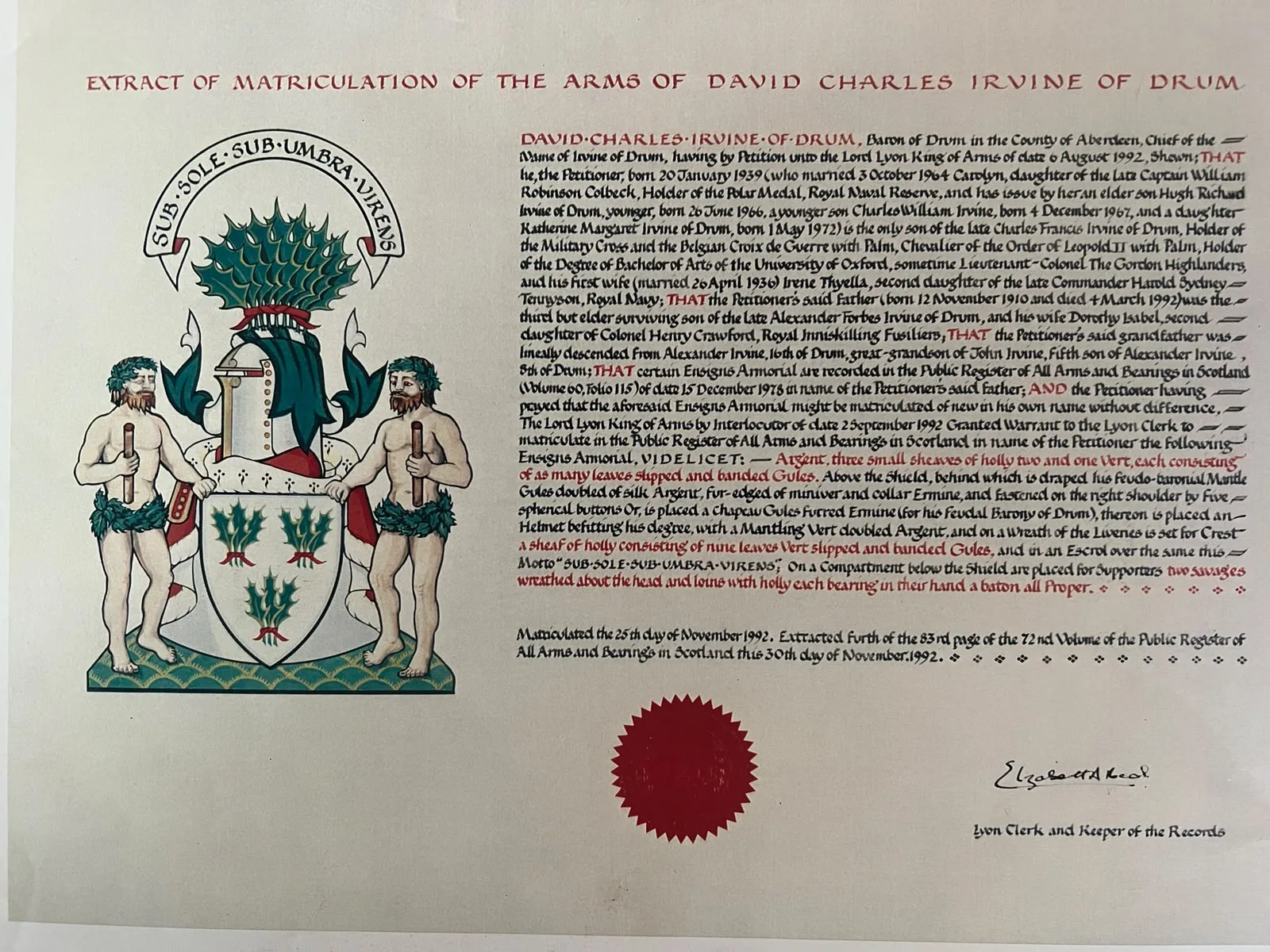
It was still the ordinary practice at the end of the feudal era. When the Court of Session needed an example of the Lyon Court’s practice before the appointed day, it took Letters Patent subscribed by Lord Lyon Blair on 27 July 2007 naming the grantee “Baron of Ballencrieff”, with a nobility clause at the end.8
After the appointed day
Lord Lyon Blair drew a line at the appointed day, and on the far side of it he gave the baronage everything. On 30 May 2007, conform to a warrant of 8 November 2004, he “OFFICIALLY RECOGNISE[D]” the daughter of Ronald Busch Reisinger, Baron of Inneryne, “in the name, style and dignity as Abigail Busch Reisinger of Crawfurd-Lindsay and of Auchterutherstruther, Feudal Countess of Crawfurd-Lindsay and Baroness of Auchterutherstruther”. Her patent grants a feudo-baronial mantle, a chapeau “in respect of her feudal earldom of Crawfurd-Lindsay and barony of Auchterutherstruther”, a badge and a standard, “limited to the Petitioner’s said pupil daughter and her successors in the said Ensigns Armorial who are in right of the feudal earldom of Crawfurd-Lindsay and barony of Auchterutherstruther”, and closes with a nobility clause: she and her successors “are, amongst all Nobles and in all Places of Honour, to be taken, numbered, accounted and received as Nobles in the Noblesse of Scotland”.9
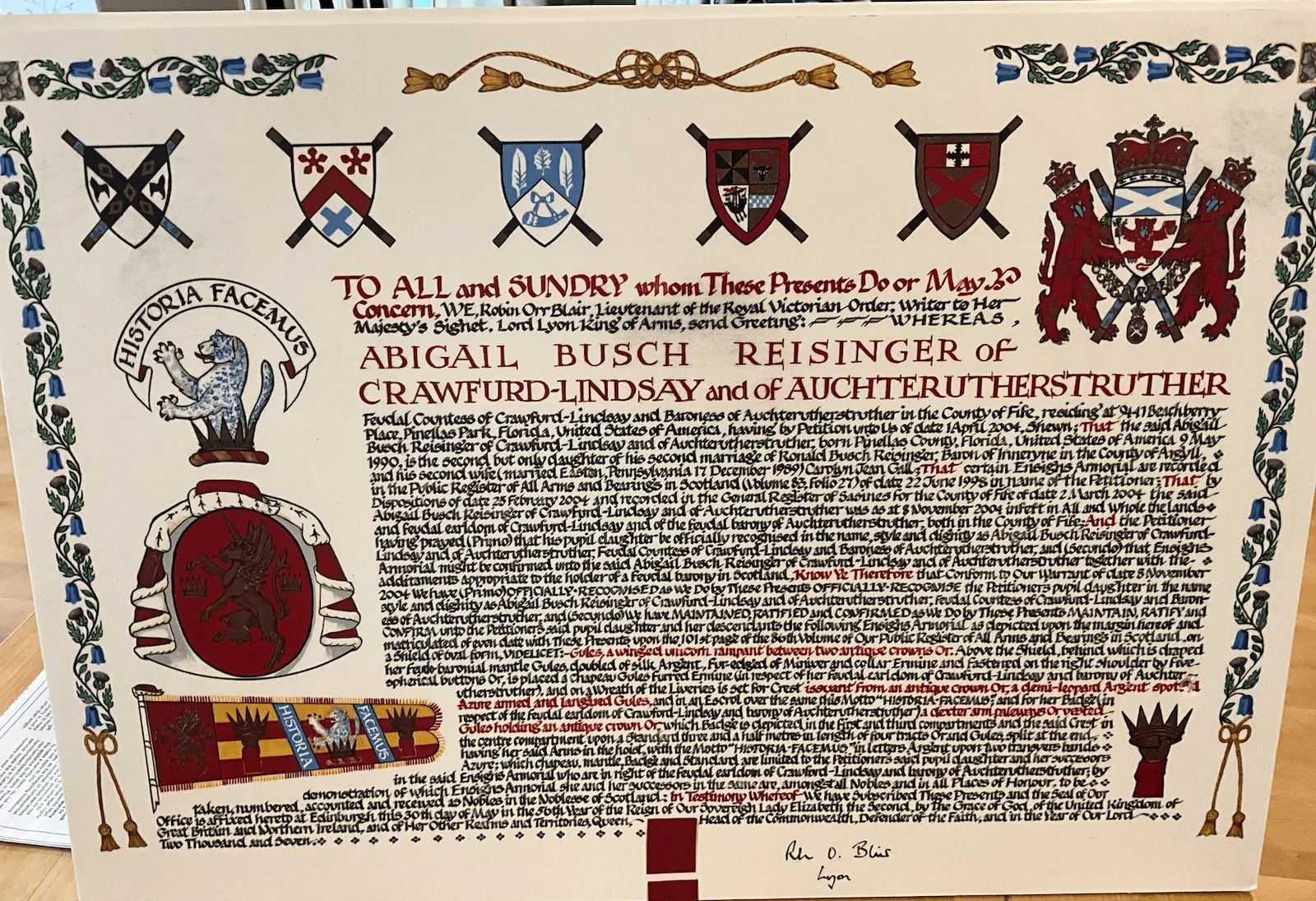
For barons who acquired after the appointed day, his first response was restrictive: in 2006 he recognised Margaret Hamilton of Rockhall only as “Holder of the Barony of Lag”, without baronial additaments. She and Dr Lindberg brought judicial reviews, and neither reached a hearing. Under Heads of Agreement in 2008 Blair’s decisions were to be “quashed”, the 2006 Warrant was reduced, and “in due course, Lyon Blair recognised the pursuer as ‘the Baroness of Lag’ with grant of arms with baronial additaments appropriate to the dignity of baron”.10 Of the changes of wording made in those years, the one the Court of Session singled out was the nobility clause. Found in Lyon Court grants to titled and untitled armigers alike from at least 1945, it was omitted from grants made after 2007. The nobility of an armiger is implied by the grant itself: Innes of Learney describes those granted arms as “persons deserving of being raised to the nobility” who become the root of a “noble stok”, words the Court of Session adopted in 2019.11
Lord Lyon Sellar (2008–2014) made the settlement the basis of a working practice. He undertook to “officially recognise the petitioner as ‘Baron of [the barony]’”, accepted the Custodian of the Scottish Barony Register as “a man of skill”, and in January 2010 set out a rule on additaments. Barons who acquired after the appointed day receive “a helm appropriate to their degree, that is, to the dignity of baron”, and are recognised “in the style of ‘baron of X’”; barons granted a red chapeau or a mantle before that day keep them; and “those who succeed to such baronies after the appointed day as heirs should continue to enjoy a red chapeau as an appropriate additament, and also a mantle if that has been granted before”.12 The chapeau and the feudo-baronial mantle were withdrawn from new grants, not from the baronage. Sellar’s Letters Patent of 31 October 2012 “Officially Recognise the Petitioner in the name Pier Felice Alberto Renato degli Uberti, baron of Cartsburn for aught yet seen”.13 The word “feudal” has gone. Fulwood’s warrant of 2005 still speaks of the “feudal Barony” and a “feudal baron”, the barony being held on a Land Certificate of 2000, before the appointed day; Sellar’s patent of 2012 says “baron of Cartsburn”, in keeping with his term of 2009, “quondam feudal” — formerly feudal.14 His own patents show it. On 15 December 2010 Sellar “Officially Recognise[d] the Petitioner in the name Brian Lawrence Williamson, Baron of Craigmillar for aught yet seen”, on an assignation recorded in the Scottish Barony Register on 10 March 2009, and granted “an Helm befitting the holder of the dignity of baron”; the word “feudal” appears nowhere in it.15
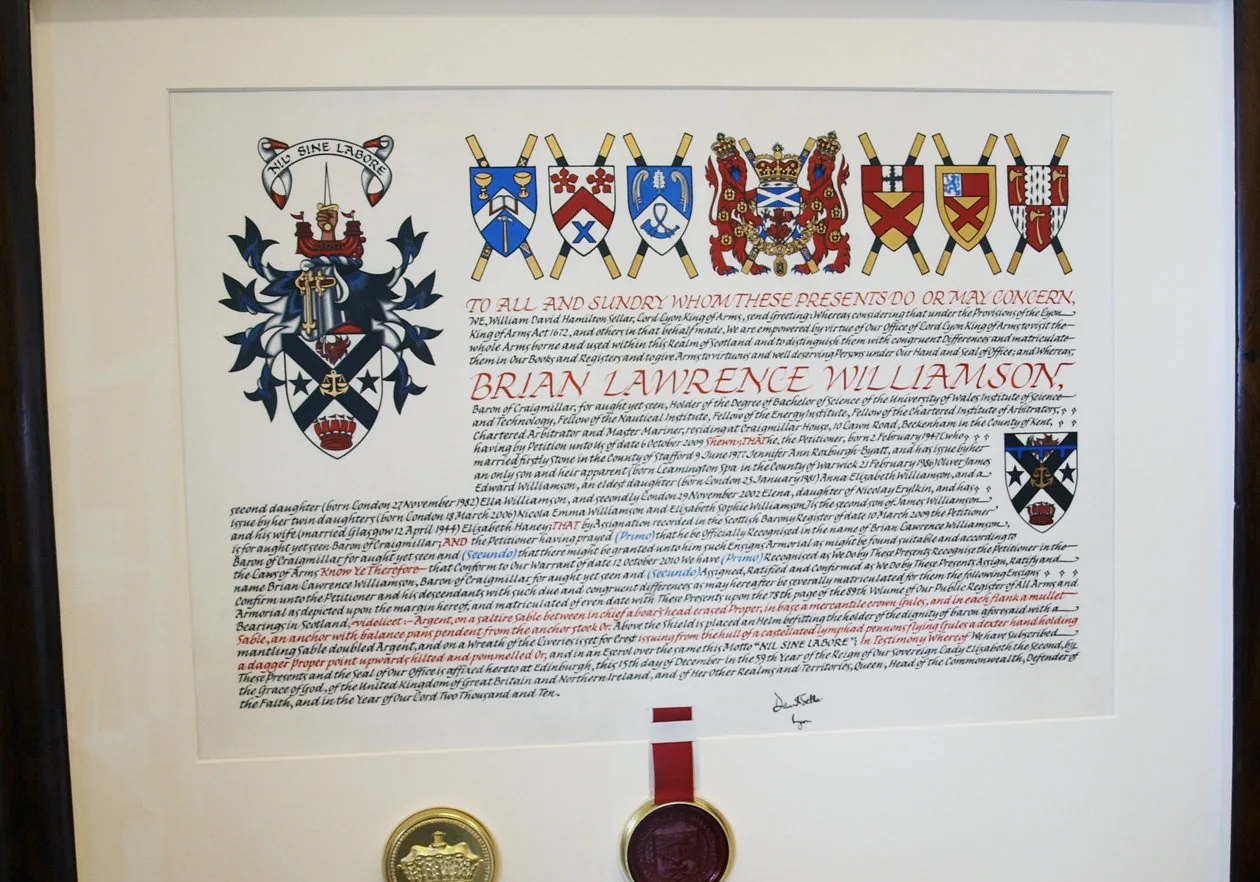
The dates are set out in The Lord Lyon and the baronage since 2004.
Three patents, side by side
Lord Lyon Morrow was appointed by Letters Patent of 7 January 2014.16 The three Letters Patent below were issued under his hand in 2014, 2015 and 2018.
Fulwood, 10 October 2014
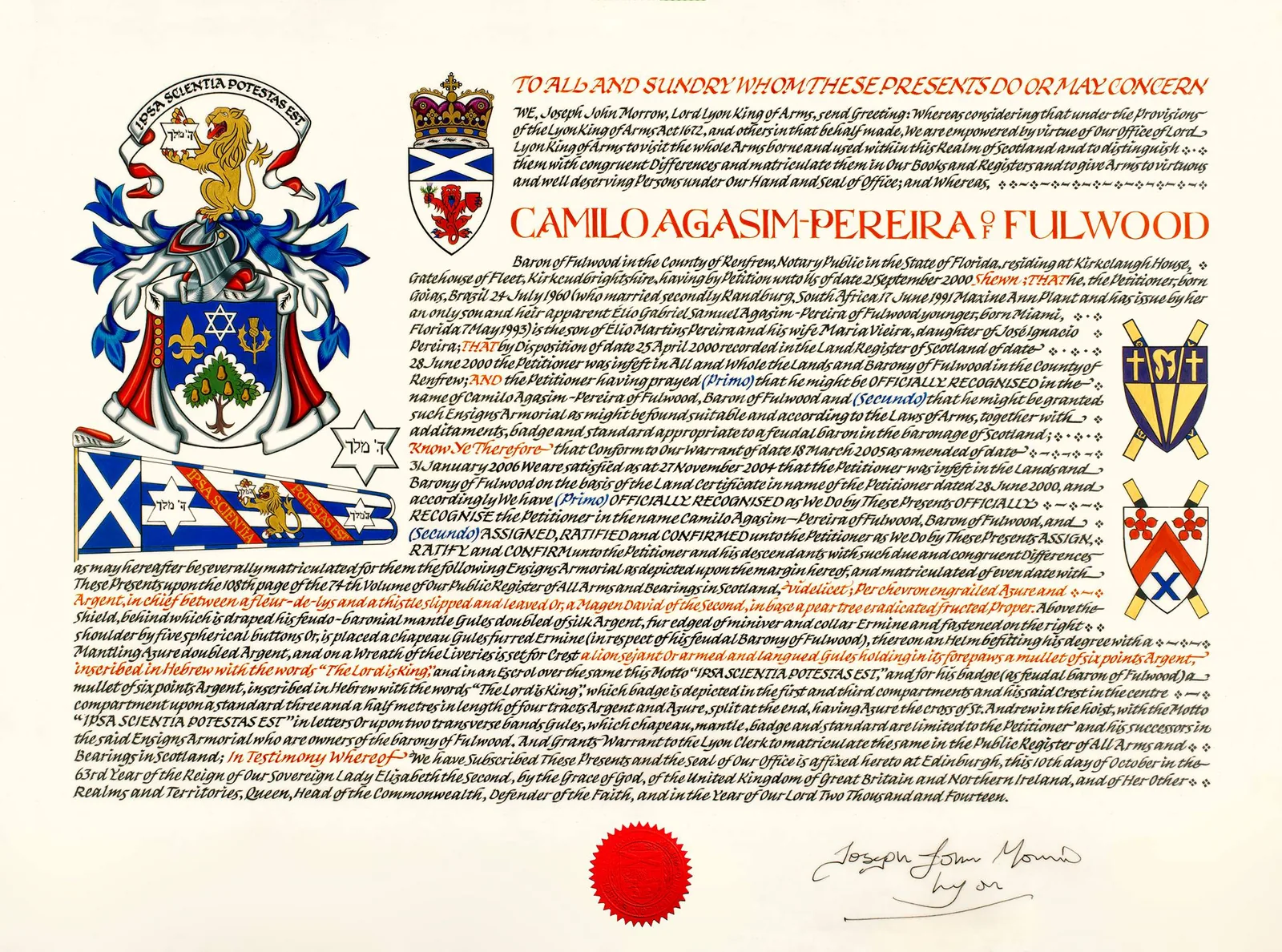
The petition is dated 21 September 2000, and the patent is granted “Conform to Our Warrant of date 18 March 2005 as amended of date 31 January 2006”, a warrant of Lord Lyon Blair’s time. Title rests on the Land Register: the Lyon is “satisfied as at 27 November 2004”, the day before the appointed day, “that the Petitioner was infeft in the Lands and Barony of Fulwood on the basis of the Land Certificate in name of the Petitioner dated 28 June 2000”. The patent “OFFICIALLY RECOGNISE[S] the Petitioner in the name Camilo Agasim-Pereira of Fulwood, Baron of Fulwood”, names his heir apparent “of Fulwood younger”, and grants the full baronial achievement: a “feudo-baronial mantle Gules doubled of silk Argent … fastened on the right shoulder by five spherical buttons Or”, “a chapeau Gules furred Ermine (in respect of his feudal Barony of Fulwood)”, a helm befitting his degree, a badge “as feudal baron of Fulwood”, and a standard three and a half metres long.17
The additaments do not end with the grantee. They are “limited to the Petitioner and his successors in the said Ensigns Armorial who are owners of the barony of Fulwood”, and the heir apparent is already named “of Fulwood younger”. Under the patent’s own terms, the successor who owns the barony bears the chapeau, feudo-baronial mantle, badge and standard of a baron of Fulwood.
Inchdrewer, 28 October 2015
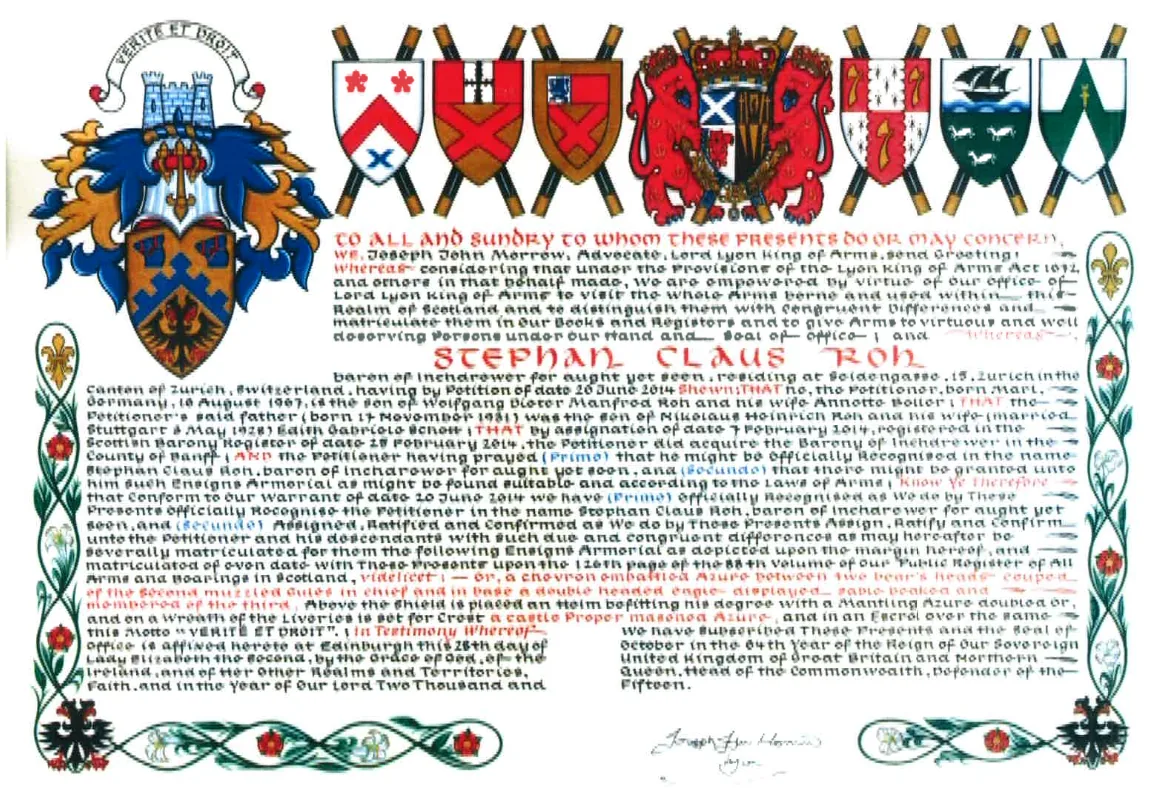
The barony was acquired after the appointed day, “by assignation of date 7 February 2014, registered in the Scottish Barony Register”, and the petition is dated 20 June 2014, two months before the petition in Menking. The patent “Officially Recognise[s] the Petitioner in the name Stephan Claus Roh, baron of Inchdrewer for aught yet seen”, in Sellar’s formula, and grants a helm befitting his degree without chapeau or mantle, as the 2010 guidance provides for a baron who acquired after 2004.18 The difference from Fulwood is not a new policy. It is the date on which the barony was acquired.
Stobo, 29 October 2018
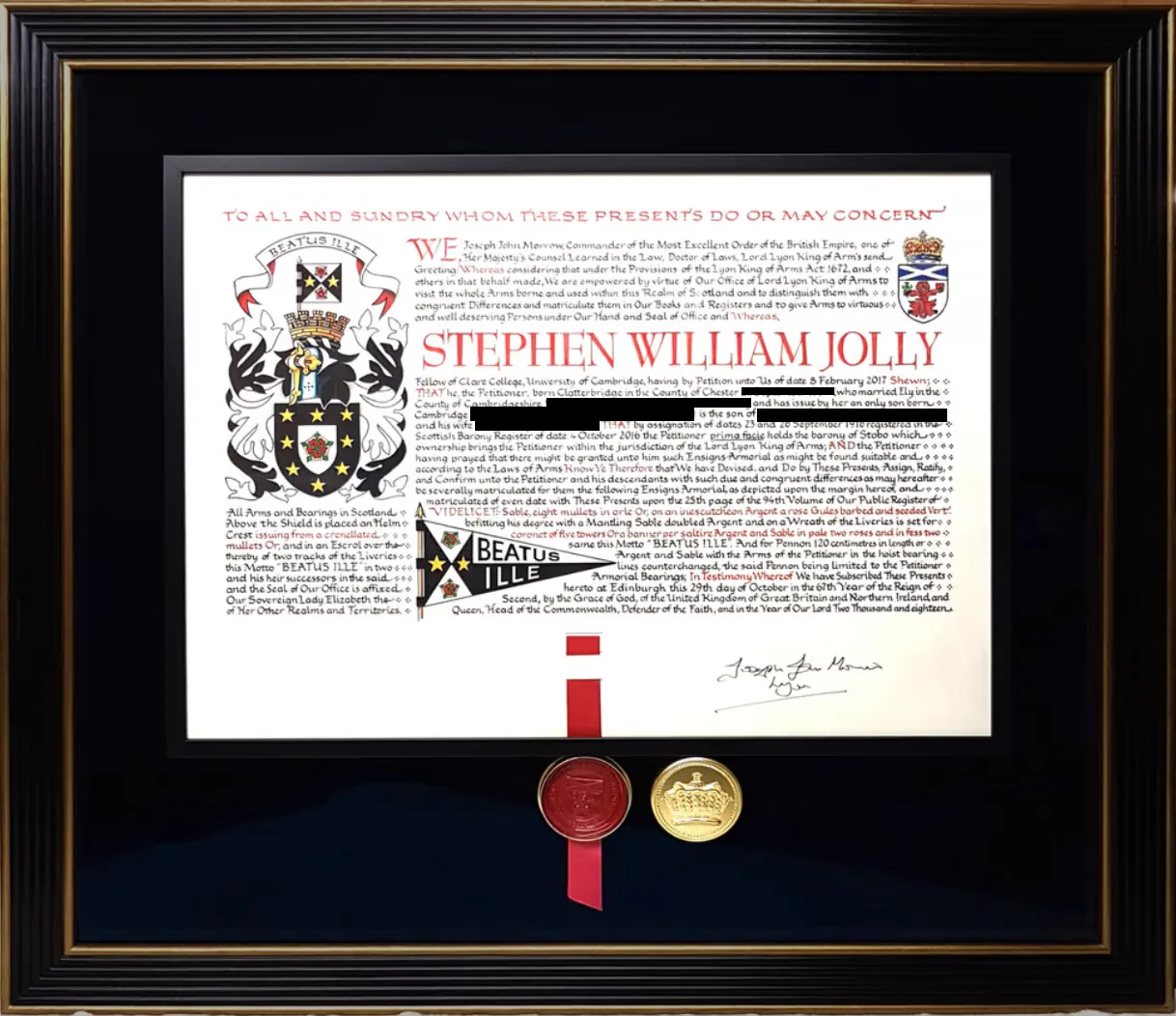
The petition is dated 8 February 2017, after Menking. There is no recognition clause and no title after the petitioner’s name. The patent records only that by assignation “registered in the Scottish Barony Register of date 4 October 2016 the Petitioner prima facie holds the barony of Stobo which ownership brings the Petitioner within the jurisdiction of the Lord Lyon King of Arms”, and grants a helm befitting his degree.19 This is the wording Lord Lyon Morrow set out in Menking on 30 April 2015 for “all future petitions involving feudal and other dignities”.16 The patent was issued on 29 October 2018, seven months after the wording of 1 March 2018 took effect; that change applied to petitions received from that date, and this one had been lodged before it.20
| Fulwood | Inchdrewer | Stobo | |
|---|---|---|---|
| Letters Patent | 10 Oct 2014 | 28 Oct 2015 | 29 Oct 2018 |
| Petition | 21 Sep 2000 | 20 Jun 2014 | 8 Feb 2017 |
| Title held from | Before the appointed day | After the appointed day | After the appointed day |
| Evidence of title | Land Certificate, 28 Jun 2000 | Scottish Barony Register | Scottish Barony Register |
| Name in the patent | “Camilo Agasim-Pereira of Fulwood, Baron of Fulwood” | “Stephan Claus Roh, baron of Inchdrewer for aught yet seen” | “Stephen William Jolly” |
| Officially recognised | Yes | Yes | No recognition clause |
| Additaments | Chapeau, feudo-baronial mantle, badge, standard; helm | Helm | Helm |
What changed, and what did not
Read in order, the patents show two separate steps. Fulwood to Inchdrewer is Sellar’s rule of 2010: the same recognition, with chapeau and mantle for a pre-2004 baron and a helm for a later one. Inchdrewer to Stobo is Menking: the recognition clause and the title in the name go, and the patent records only that the petitioner holds a dignity of the genus of barony. The last step came on 1 March 2018, when Letters Patent were to say only that the petitioner, “being within the jurisdiction of the Lord Lyon, King of Arms”, is assigned arms. By the hearing in 2019 the Lyon Court had received “only three petitions to which the new policy was applicable, one of which was thereafter withdrawn”.21
What did not change is as clear. Each of the three is granted a helm befitting his degree. Each is brought within the Lord Lyon’s jurisdiction by ownership of the barony. And the dignity itself is held under s. 63 of the 2000 Act whatever words a patent uses.22 The Association’s answer to the practical question is at Scottish Baronies, Explained.
Notes
- Innes of Learney, “The Robes of the Feudal Baronage of Scotland”, PSAS 79 (1944–45), p. 116, adopting Craig, Jus Feudale, I.8.2. ↩
- Innes of Learney, PSAS 79, p. 160 (the Innes of that Ilk birthbrief; Lord Lyon Brodie; Leslie of Balquhain, 18 January 1861) and p. 126 (the Register of Genealogies begins with Lord Lyon Brodie’s appointment, 1727). ↩
- Certificate of Lord Lyon Innes of Learney, 10 March 1946, recorded against the matriculation of the arms of Wilfrid James Plowden-Wardlaw, Public Register of All Arms and Bearings in Scotland, vol. 85, fol. 6 — scan. ↩
- Lord Lyon Sir Francis Grant, interlocutor of 26 February 1943, Public Register of All Genealogies and Birthbrieves, vol. iv, p. 26 (printed in PSAS 79, p. 143 n. 3); Wauchope of Niddrie, 19 April 1945, Lyon Register vol. xxxv, p. 31 (printed at p. 160). ↩
- Edinburgh Gazette, 15 March 1968, p. 213, Rolls of the Chiefs and Heads of Territorial Houses: “Innes of Edingight, Malcolm Rognvald”, matriculated 13 August 1965, Public Register of All Arms and Bearings vol. XLVIII, p. 103, marked † “matriculated with chapeau in respect of being a Minor Baron”; notice signed by him as Lyon Clerk — Gazette page; copy on the Roll. ↩
- “Lord Lyon King of Arms”, Wikipedia, list of holders. ↩
- Extract of Matriculation of the Arms of David Charles Irvine of Drum, Baron of Drum, interlocutor of 2 September 1992, matriculated 25 November 1992, Public Register of All Arms and Bearings in Scotland, vol. 72, p. 83; Innes of Learney, PSAS 79, p. 161 (the certificate of 2 June 1757 granted by “Alexander Irvine, baro de Drum”). ↩
- Hamilton of Rockhall [2019] CSOH 85, para [21]. ↩
- Letters Patent in favour of Abigail Busch Reisinger of Crawfurd-Lindsay and of Auchterutherstruther, 30 May 2007, matriculated in the Public Register of All Arms and Bearings in Scotland, vol. 86, p. 101. ↩
- Hamilton of Rockhall [2019] CSOH 85, paras [6]–[9]. ↩
- Hamilton of Rockhall [2019] CSOH 85, para [22]; Wauchope of Niddrie, 19 April 1945, Lyon Register vol. xxxv, p. 31 (printed in Innes of Learney, PSAS 79, p. 160); an untitled grant of 20 February 1984 carrying the clause is reproduced in Campbell, Scottish Armory and Heraldry (2019), pp. 76–77; Innes of Learney, Scots Heraldry (2nd ed., 1956), p. 85, quoted in Hamilton of Rockhall [2019] CSOH 85, paras [14] and [101]. ↩
- Lyon Court statement of 3 December 2008; Lord Lyon Sellar, Note in the Petition of Lindley-Highfield of Ballumbie Castle, Baron of Cartsburn (issued 4 December 2009); general guidance on baronial additaments (January 2010) — all reproduced in Campbell (2019), pp. 82–84. ↩
- Hamilton of Rockhall [2019] CSOH 85, para [25]. ↩
- Letters Patent of 10 October 2014 (Fulwood), below; Hamilton of Rockhall [2019] CSOH 85, para [25]; Lord Lyon Sellar, Note in the Petition of Lindley-Highfield of Ballumbie Castle, Baron of Cartsburn (December 2009), reproduced in Campbell (2019), p. 82. ↩
- Letters Patent in favour of Brian Lawrence Williamson, Baron of Craigmillar for aught yet seen, 15 December 2010, conform to warrant of 12 October 2010 on a petition of 6 October 2009, matriculated in the Public Register of All Arms and Bearings in Scotland, vol. 89, p. 78. ↩
- Hamilton of Rockhall [2019] CSOH 85, paras [26]–[27]; Lord Lyon Morrow, Note in the Petition of Menking, 30 April 2015. ↩
- Letters Patent in favour of Camilo Agasim-Pereira of Fulwood, Baron of Fulwood, 10 October 2014, matriculated in the Public Register of All Arms and Bearings in Scotland, vol. 74, p. 108. ↩
- Letters Patent in favour of Stephan Claus Roh, 28 October 2015; general guidance on baronial additaments (January 2010), in Campbell (2019), p. 83. ↩
- Letters Patent in favour of Stephen William Jolly, 29 October 2018, matriculated in the Public Register of All Arms and Bearings in Scotland, vol. 94, p. 25. ↩
- Hamilton of Rockhall [2019] CSOH 85, paras [28]–[29]: the new wording applied to applications from 1 March 2018; Letters Patent of February and August 2018 produced to the court still stated that the petitioner “prima facie, holds the [Barony of X]”. ↩
- Hamilton of Rockhall [2019] CSOH 85, paras [28]–[29]. ↩
- Abolition of Feudal Tenure etc. (Scotland) Act 2000, s. 63. ↩