
The Lyon Court
Untitled or titled nobility?
The Lyon Court’s own words on the minor barons, from the Innes of Learney birthbrief to the finding of 1943
4 min read · Reviewed September 2026 · The Reading Room

In March 1930 Lord Lyon Sir Francis Grant certified that the House of Innes of Learney was “of the rank of minor barons or untitled nobility of Scotland”. In February 1943 the same Lord Lyon found that the minor barons “are, and have been … recognised as a ‘titled nobility’”. Between the two came the Esslemont petition of 1934. This paper sets the documents side by side.
The birthbrief of 1930
On 27 March 1930 Sir Francis Grant, Lord Lyon King of Arms, certified the birth and descent of Thomas Innes of Learney, younger, born two months earlier, “son and apparent heir of Thomas Innes of Learney, Carrick Pursuivant of Arms, Baron of the Baronies of Learney and Kinnairdy, Advocate, Member of the Royal Company of Archers”. The certificate is a birthbrief in the old Scottish form, recorded in the Public Register of Genealogies and Birthbrieves, and its colour facsimile was printed in 1933 in The Deeside Field, with the Carrick Pursuivant’s own article on the barony of Learney.1
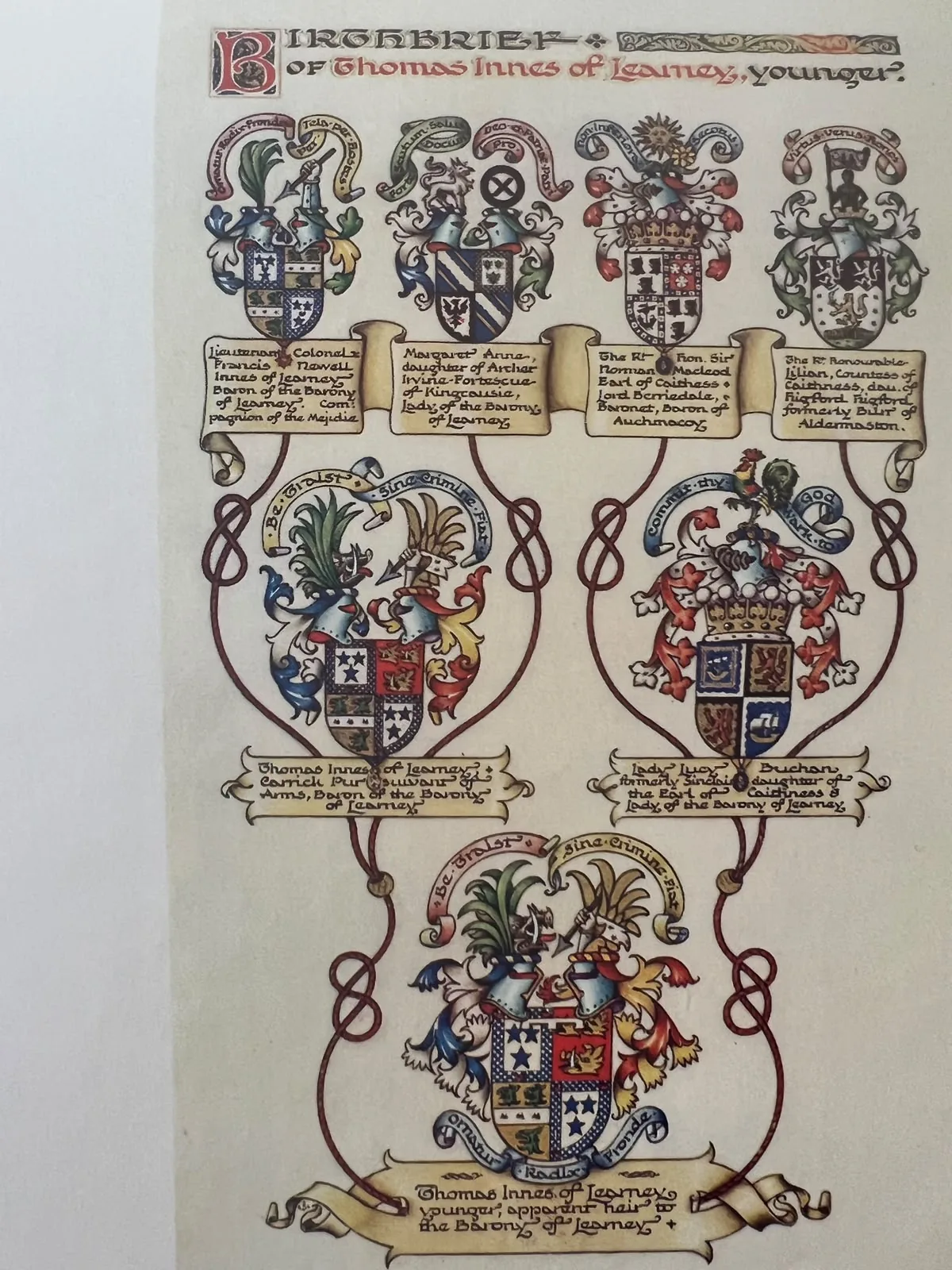
The birthbrief traces the family through Innes of Edingight and Innes of Innermarkie, “Baron of the Barony of Monycabok”, to “Berowald, Baron of Innes tempore Malcolm IV, King of Scots”, a descent “certified 14th December 1698, in a Birthbrief granted by Sir Alexander Erskine of Cambo, Baronet, Lord Lyon King of Arms”, the document in which Erskine styled himself Baron of Cambo.2 It records that the title “of Learney” is used by the petitioner “as representative of the said House and Family, irrespective of ownership of the lands”, adjected to his surname “in terms of Statute 1672, cap. 47”. And it closes with a nobility clause:1
“further, that the said Thomas Innes of Learney is noble in all his four branches, & that the House & Family of Innes of Learney is of the rank of minor barons or untitled nobility of Scotland, is of gentle blood, knightly descent, ancient lineage, & equal in rank to the ‘uradel’ of the Continent”.
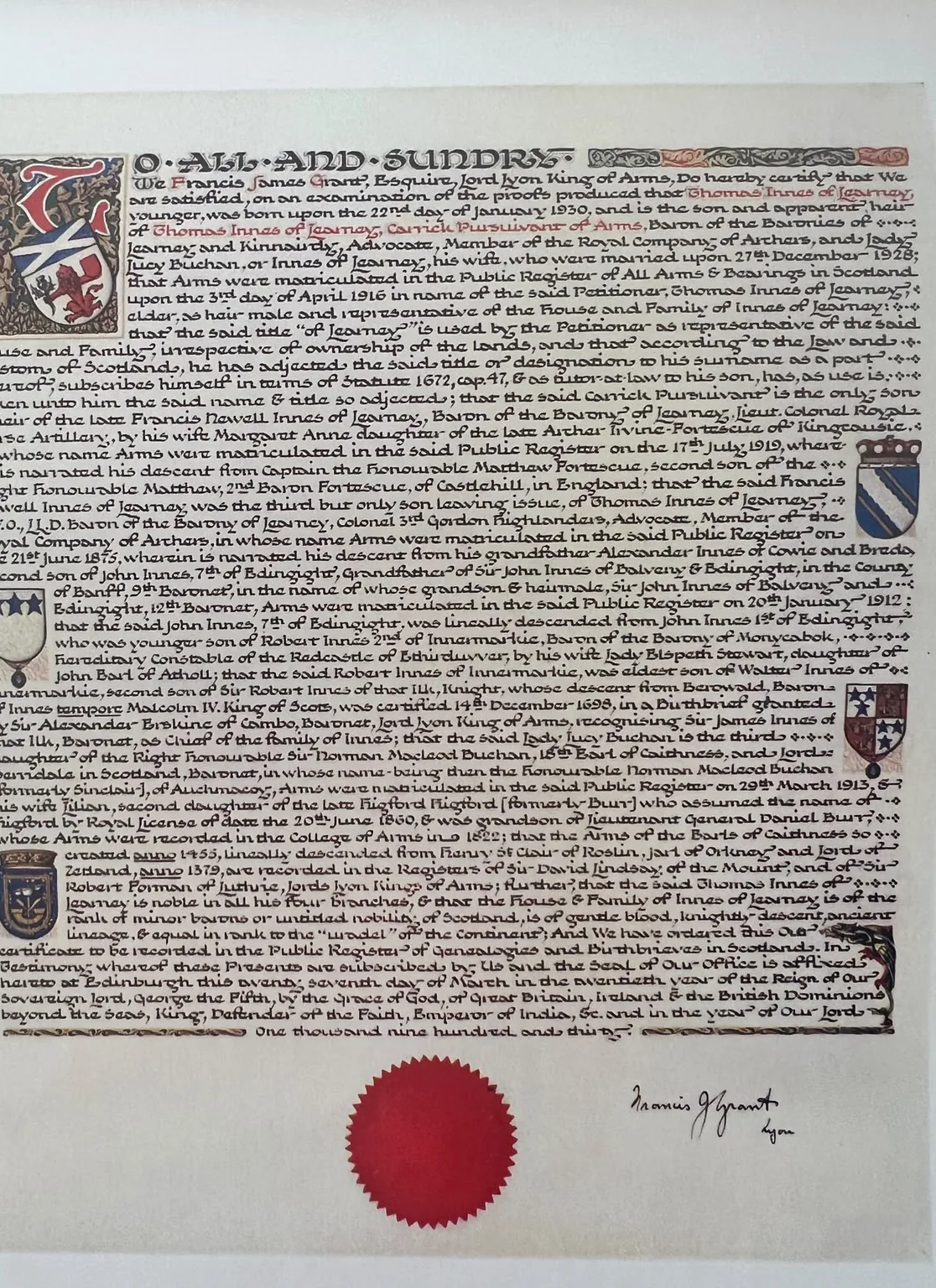
Two things in this document are worth holding on to. The minor barons are described as untitled nobility. And the baron is styled in the conveyancer’s form, “Baron of the Baronies of Learney and Kinnairdy”, his father “Baron of the Barony of Learney”.
1934: the form is challenged
Four years later Gordon of Hallhead, Baron of Esslemont, petitioned the same Lord Lyon for the baronial chapeau, and led a proof on the use of the baronial title. His Memorial objected to precisely the form used in 1930: that the baron’s title, “Baron of Bradwardine”, was being allowed “to fall into desuetude or — as it now transpires — ‘peerage-conveyancing description’ Baron of the Barony of B—— substituted, thereby conveying to the public and to foreigners that the feudal Baronage of Scotland are not truly constitutional barons, whereas they are”. On 4 September 1934 Grant found the claim established, awarded the chapeau, and recorded the petitioner as “Baron of Esslemont”.3 The proof and the Memorial are set out in The Esslemont petition of 1934.
1943: titled
On 26 February 1943, in a petition for a birthbrief, the Lyon Court under Grant “Finds and Declares that the Minor Barons of Scotland are, and have been both in this nobiliary Court and in the Court of Session recognised as a ‘titled nobility’ and that the estait of the Baronage (i.e. Barones Minores) are of the ancient Feudal Nobility of Scotland”.4 The words are the Court’s own, in the same register as the 1930 birthbrief, and they are retrospective: “are, and have been”. Innes of Learney, by then Albany Herald, drew the conclusion in his paper of 1945: whatever the date of a barony’s erection, “all are equally, and in the European sense, ‘Barons’ in a ‘Feudal Baronage’, and constitute a ‘titled nobility’ in the feudal sense”.5
The Continental comparison moved with it. In 1930 the family was “equal in rank to the ‘uradel’ of the Continent”, the ancient nobility. On 19 April 1945 the Court declared Wauchope of Niddrie, “as feudal Baron of Niddrie-Merschell and Lochtoure”, to be “of Baronial Race, and of rank equivalent to that denominated Hoch Adel”, the high nobility, “and equivalent to the Chiefs of Baronial Houses, upon the Continent of Europe”.6 And when Innes became Lord Lyon, his own certificates opened “We, Thomas Innes of Learney, Baron of Learney, Kinnairdy and Yeochrie”, the form the 1934 Memorial had asked for, not the form of 1930.7
What the two documents show
Read together, 1930 and 1943 are not the Lyon Court changing its mind about the barons. They are the Court settling a description that had been loosely used. Innes himself records the ambiguity: an impression had formed that the title of baron “was not used at all and contrariwise that it was applied to any large landowner”, and “both these views are wrong”; his own tentative suggestion of 1934, that chapeaux might be graded by the date of erection, gave way on “subsequent consideration” to the position that all barons are equally “a ‘titled nobility’ in the feudal sense”.5 The 1930 birthbrief, with its “untitled nobility” and its “Baron of the Barony of”, belongs to that loose usage. The proof of 1934 put the evidence on the record, and the finding of 1943 is declaratory, not a new rule: the minor barons “are, and have been” recognised as a titled nobility. From 1943 the position stands settled in the Court’s own register. The minor barons of Scotland are a titled nobility, and always were. Since the appointed day the Lyon Court’s wording has moved again, back towards “holder of the barony” and then to no barony at all.8 The documents of 1930 and 1943 are the record of the last time the Court examined the question with evidence, and of the answer it gave.
Notes
- Birthbrief of Thomas Innes of Learney, younger, 27 March 1930, subscribed by Francis James Grant, Lord Lyon King of Arms, and ordered to be recorded in the Public Register of Genealogies and Birthbrieves in Scotland; colour facsimile in Thomas Innes of Learney, “The Barony of Learney”, The Deeside Field, Sixth Number (1933). The quotations are from the facsimile. ↩
- Birthbrief of 1930, as above; Innes of Learney, PSAS 79, pp. 126–127 and 160 (the Innes of that Ilk birthbrief and Erskine of Cambo’s style). ↩
- Innes of Learney, PSAS 79, pp. 154, 160 and 162–163; Lyon Register vol. xxxi, p. 20. ↩
- Court of the Lord Lyon (Lord Lyon Sir Francis Grant), interlocutor of 26 February 1943, Public Register of All Genealogies and Birthbrieves, vol. iv, p. 26; printed in Innes of Learney, PSAS 79, p. 143 n. 3. ↩
- Innes of Learney, PSAS 79, pp. 154 and 157. ↩
- Wauchope of Niddrie, 19 April 1945, Lyon Register vol. xxxv, p. 31; printed in Innes of Learney, PSAS 79, p. 160. ↩
- Certificate of Lord Lyon Innes of Learney, 10 March 1946 — scan of the original. ↩
- Hamilton of Rockhall v Lord Lyon King of Arms [2019] CSOH 85, paras [7], [27] and [29] — PDF of the opinion; see The Lord Lyon and the baronage since 2004. ↩