
The Lyon Court
Non-peerage Earldoms
Lands the Crown erected into an earldom, the peerage dignity of the same name, and forty years of Lyon Court answers on how the holder is styled
11 min read · Reviewed September 2026 · The Reading Room

Two things share the name “earldom”: the peerage dignity of earl, and land the Crown erected into an earldom. Holders of the second are commonly called feudal earls, though the word has been defunct since feudal tenure ended on 28 November 2004, when the dignity ceased to be feudal. The Association styles such a holder an earl in the Baronage of Scotland, one of the minor barons of Scotland. The Lyon Court has answered the question of style in several ways. No court has ruled on it. This paper sets out the record and both readings.
Two things called an earldom
A peerage earldom is a personal dignity, created in words of honour. Charles I’s grants of 1633 creating a Marquess of Douglas and Earls of Queensberry and Wemyss gave “titulum et honorem”, the title and honour, and named no lands.1
The Crown could also erect lands into an earldom. The Earl of Annandale was created by patent in 1624. In 1625 a charter erected his lands “in liberum comitatum, dominium et baroniam de Annandaill”, a free earldom, lordship and barony, ratifying the patent.2
Stair and Erskine, the classic writers on Scots law, treated the erected earldom as a kind of barony. For Stair, lordships and earldoms “are but more noble Titles of a Barony, having the like Feudal Effects”.3 For Erskine, earldoms and lordships “are only titles of greater dignity conferred upon a barony; but all have precisely the same feudal effects”.4 Both were writing about land law. Neither says whether the owner of such lands is an earl.
The House of Lords addressed that question. In 1771 it resolved that the Sutherland charters did not “affect the title, honour, and dignity of Earl of Sutherland, but operate as conveyances of the estate only”.5 Lord Camden called it “an established point” that no charter of an earldom or lordship carries the title of honour “without specially mentioning the dignity”.6
One line in Lord Hardwicke’s speech in the Cassillis claim of 1762 points the other way. “In Scotland,” he said, “the lands are erected into a Lordship or Earldom, and the dignity is at the same time granted.” He still found that nothing passed, since “there is no appearance of words to convey the dignity”.7
The oldest earldoms have been called territorial peerages. In the Sutherland claim Lord Mansfield said that “when peerages were territorial, it cannot be doubted that the dignity followed the estate”. He added that “how long this continued no person has presumed to say”.8 Lord Clyde wrote in 1992 that Scotland distinguished “the greater barons and the lesser barons, the former acquiring such titles as Duke or Earl”.9 Craig and Bankton counted dukes, marquesses and earls among the barons.10 The lesser barons have been called the untitled nobility. In Scots, “peer” was used of a great noble by about 1475. By the 1560s it was used to deny a laird the rank of peer, and by 1576 it was tied to lords of parliament.11
According to Lord Lyon Sellar, the label “territorial earldom” “does not seem to be found before the 19th century”.12 None of these earldoms is held as feudal land now, so this paper uses a neutral name: non-peerage earldoms.
How the lands came apart from the peerages
Once the dignity was personal, land and title could part. “The Earl of Cassillis might have sold the one and kept the other,” said Lord Mansfield.13 John Riddell, who held that early grants of an earldom carried the honour, still found seventeenth-century “erections of lands merely … without conveying honours”.14
Wigtown is the oldest case. In February 1372 Thomas Fleming, 2nd Earl of Wigtown, sold all his earldom of Wigtown to Sir Archibald Douglas. The deed uses no word for a dignity.15 Robert II confirmed the sale in full council at Stirling on 7 October 1372, calling the seller “alias”, or sometime, earl.16
Hailes recorded in 1770 that “there is no evidence” Archibald ever used the style.17 His grandson used it from about 1419, and Great Seal confirmations of 1425–30 give him the style in the Crown’s own words.18 In 1451 Parliament regranted the earldom to William, 8th Earl of Douglas, reciting that his grandfather and uncle had held it.19
On one reading, the dignity went with the earldom and the Crown later acknowledged it. On the other, the sale ended Fleming’s dignity without passing it on, and the Douglas style was a new title. Sellar thought Wigtown, which predates a personal peerage, “irrelevant to the present Petition”.20 Lord Lyon Morrow’s patent of 2021, in the table below, recites that its petitioner “prima facie holds the dignity of the Earldom of Wigtown”, in the genus of barony.
Lennox is a later example. The Duke of Lennox and Richmond sold the Lennox lands, which reached the Marquess of Montrose in 1703.21 A Crown charter of 1706 granted the Marquess and his son “the honour, title and dignity of marquis of Montrose” and, among the lands, the “dukedom, earldom and regality of Lennox”.22 The words of honour attach to Montrose’s own peerage.
Orkney shows the Crown allowing for the split. A charter of 1707 gave the Earl of Morton the earldom of Orkney and lordship of Shetland, “united in one earldom, lordship and barony”, to his male heirs “succeeding to his honour and dignity, which failing, to his heirs and assignees whatsoever”.23 The unit could leave the line of the peerage.
In 1662 the Crown granted the Marquis of Huntly, and his heirs and assignees, “the lands, marquisate and earldom of Huntly”, erected into “a whole and free marquisate, earldom, lordship and barony”.24 In 1836 the marquessate passed to the Earl of Aboyne and most of the Gordon estates to the Duke of Richmond.25 An 1850 court decree, on the Duke of Richmond’s petition, freed “The Marquisate Earldom and Lordship of Huntly” from an entail (a bar on selling it).26
The Conveyancing (Scotland) Act 1874 eased later transfers. It does not mention dignities, and did not create the separation of land and title.27
What the Crown charters say
The usual words are “in liberum comitatum, dominium et baroniam”, as in the Annandale charter. The earliest found is Ross in 1565, and the formula recurs for Argyll in 1610 and Angus in 1631.28 It was not fixed. A Cassillis charter of 1642 has “liberum Comitatum et Dominium”, with no barony.29
Some charters put the dignity in the same clause. A Crawford-Lindsay charter of 1648 granted “the lands, earldom, lordship and barony of Crawford and Lindsay”, including the barony of Auchterutherstruther. It added “the name, style, title, honour and dignity of earl of Crawford Lindsay”.30 Huntly’s charter of 1662, as ratified, has no such words.24 The two readings differ on what that difference means.
The Lyon Court’s answers
| Date | Lord Lyon | Subject | Wording |
|---|---|---|---|
| 1983 | Innes of Edingight | Annandale and Hartfell | Percy Hope Johnstone of Annandale is designed “Baron of the Barony of the lands of the Earldom of Annandale and Hartfell”. He dies that year.31 |
| 1985 | Innes of Edingight | Annandale and Hartfell | The House of Lords upholds his son Patrick’s claim to the peerage earldom (23 July).32 Lyon then designs him “EARL OF ANNANDALE AND HARTFELL in the Peerage of Scotland”. “Earl of the Territorial Earldom”, which the petition asked for, is not in the interlocutor; it appears to have been added to the patent by counsel as a “minor addition”.33 |
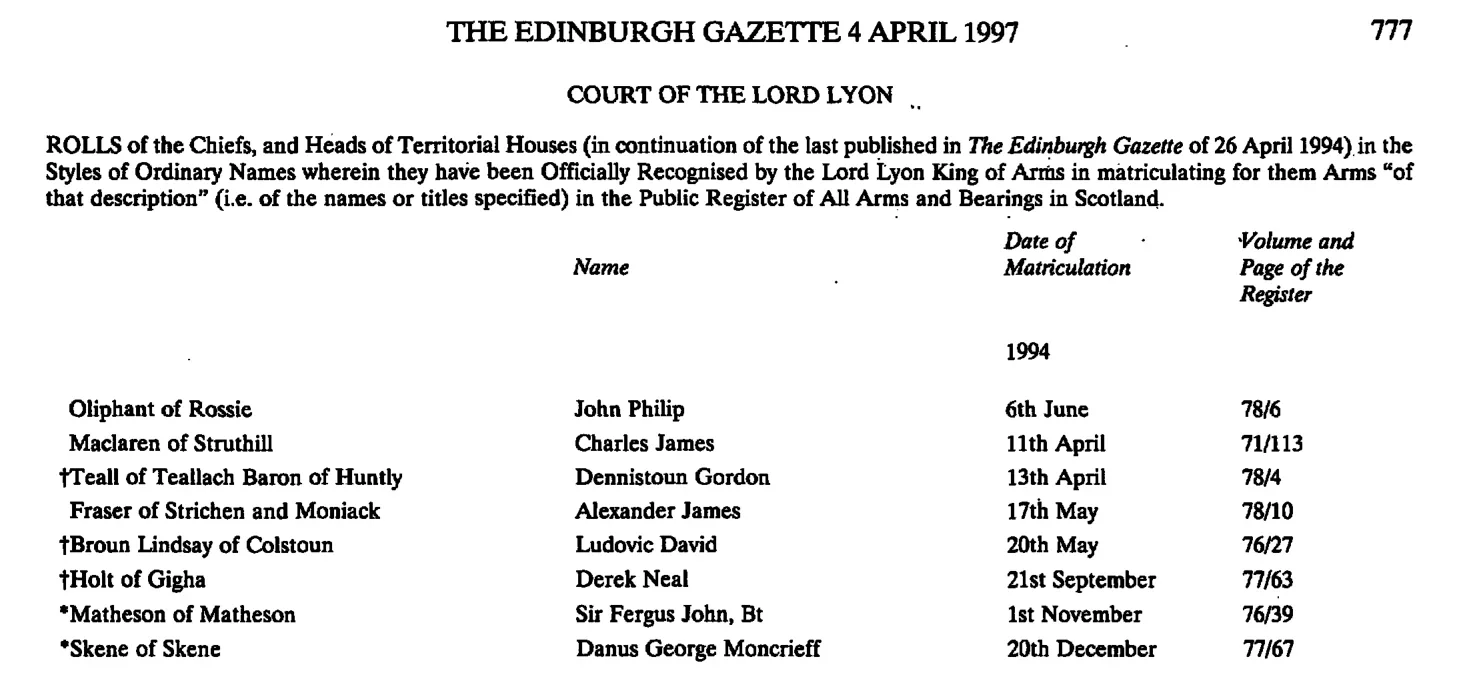
| 1993 | Innes of Edingight | Huntly | A petitioner narrating that he had “acquired right and title to the feudal Marquisate, Earldom and Lordship of Huntly” is designed “Baron of Huntly”.34 Gazette roll: “†Teall of Teallach Baron of Huntly”.35 |
| 2001 | Innes of Edingight | Arran | “Holder of the territorial Earldom of Arran”, after the Crown withdraws its objections.36 |
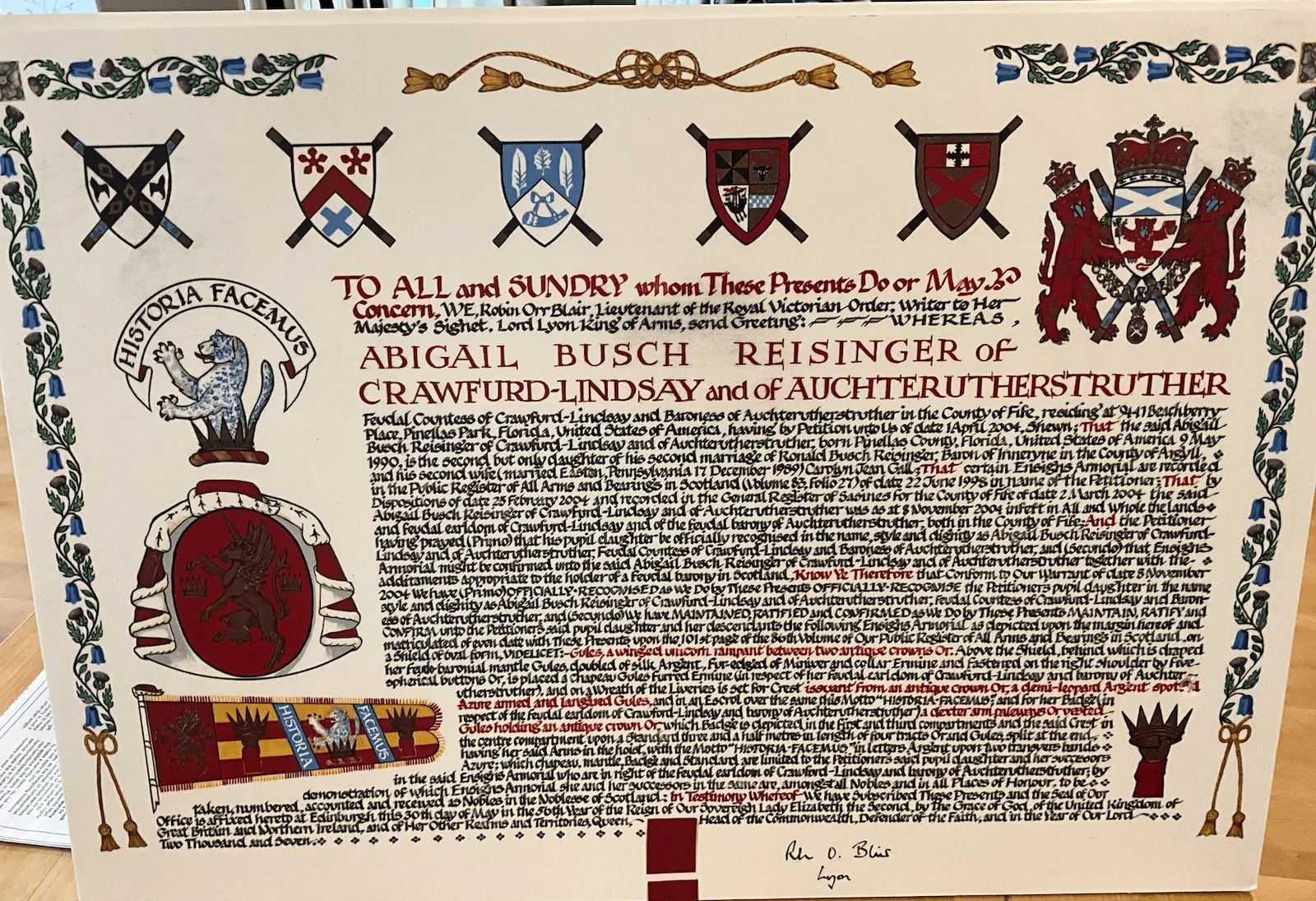
| 2006–07 | Blair | Crawfurd-Lindsay | “Feudal Countess of Crawfurd-Lindsay and Baroness of Auchterutherstruther”.37 |
| 2006 | Blair | Breadalbane | “Feudal Earl of Breadalbane, Feudal Lord of Kildrummie and Feudal Lord of Braemar”.38 |
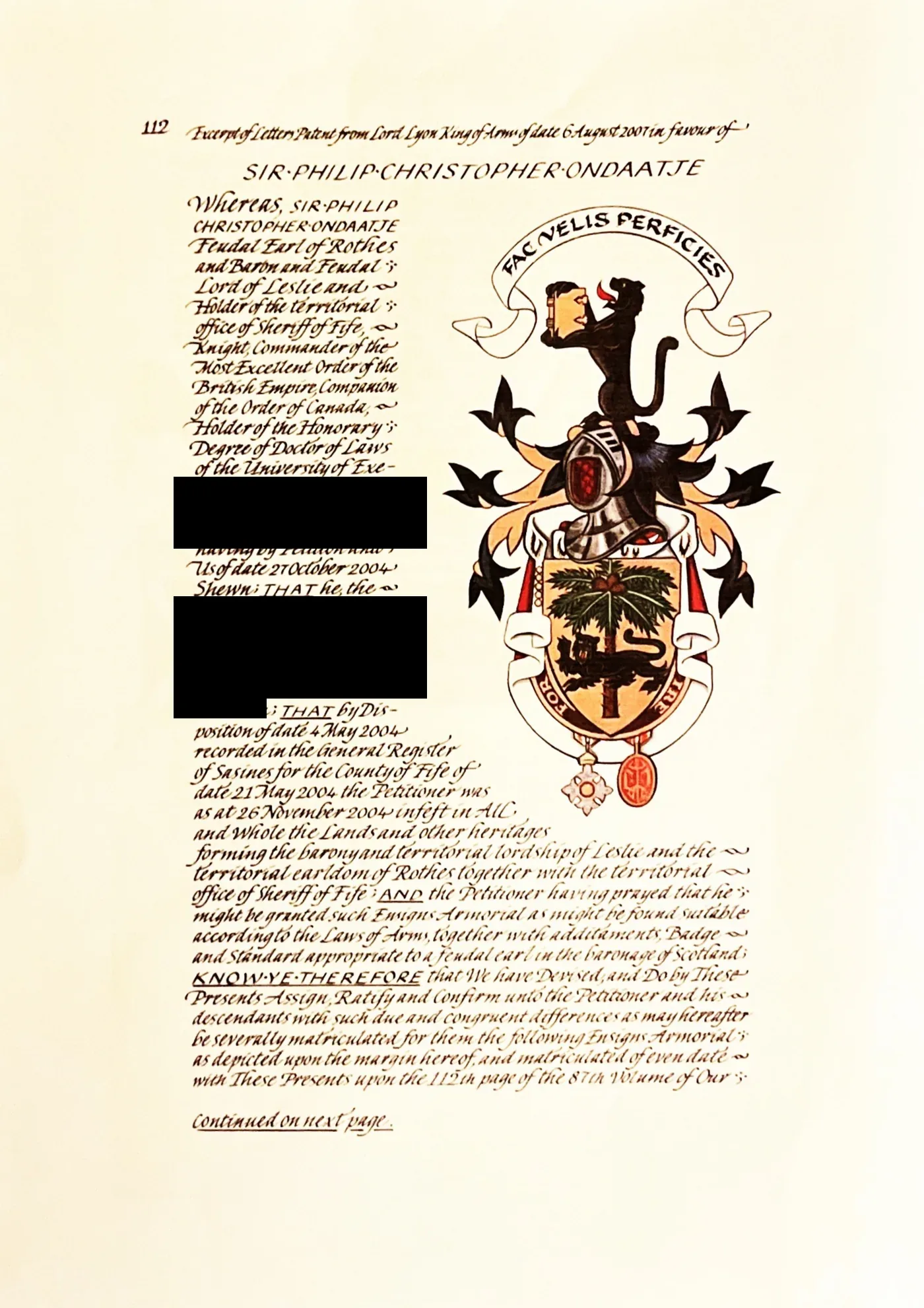
| 2006 | Blair | Rothes | “Feudal Earl of Rothes and Baron and Feudal Lord of Leslie and holder of the territorial office of Sheriff of Fife”.38 |
| c. 2010 | Sellar | Arran | Refuses “Feudal Earl of Arran”. The Duke of Hamilton, who holds the peerage title Earl of Arran, is served and does not appear. Sellar does not give the clash as a reason.39 |
| 2015 | Morrow | Garioch (Menking) | “of the genus of barony”.40 |
| 2018 | Morrow | Slains and Erroll | “prima facie, holds the lordship and barony of Slains and the earldom of Erroll being of the genus of barony”.41 |
| 2021 | Morrow | Wigtown | “prima facie holds the dignity of the Earldom of Wigtown, and the Lordship and Barony of Cumbernauld … being of the genus barony”.42 |
Lord Lyon Blair’s three decisions rest on title completed before feudal tenure ended on 28 November 2004. Each holder is described as infeft, or entered as owner, “as at” 8, 23 or 26 November 2004. That may explain why the decisions still say “feudal”.43
The Rothes excerpt has no recognition clause. The style appears in its opening address, and the chapeau, a baron’s cap of rank, is granted “in respect of his feudal earldom of Rothes and the barony and feudal lordship of Leslie”.44
Lord Lyon Sellar did not follow Blair. The arguments, he found, “do not appear to have been fully tested”, and in none of the cases “was the Warrant accompanied by a Note setting out Lyon’s reasoning”.45
In about 2010 Sellar refused the second Arran petition, calling it “a surprising proposition”: the peerage title Earl of Arran is held by the Duke of Hamilton, and feudal tenure had ended. The Duke was served and did not appear, and Sellar’s conclusion does not mention him.39 Whether one title could go to two people had been argued in the first petition.36
Of the passages in Stair and Erskine Sellar wrote: “it suggests to me that in terms of the feudal grant the owner has no claim to a style greater than that of baron.” He saw “a clear break” between earldoms from “before the evolution of a personal peerage” and later erections.39
Lord Lyon Morrow took a third course. In Menking the petitioner asked for insignia “appropriate to the dignity of Lord in the Baronage of Scotland”. Of earlier grants Morrow said, “I do not regard these decisions as setting any precedent”. He held that “such higher feudal dignities are of the genus of barony”, so “the additaments would be as a baron”. He recognised that Menking “holds the Lordship and Regality of the Garioch being of the genus of barony”, and proposed the same approach for “all future petitioners involving feudal and other dignities”.40 The later patents name the earldom and style no one earl.4142
The phrase “genus of barony” has not been found before 2015.46 Morrow wrote that “Craig states clearly” that such dignities “are all of the genus of barony”. Craig’s Latin says that dukes, marquises and earls are included under the name “Baro”.4010 Whether that makes them a genus of barony is a question of reading. “Baronage of Scotland” is much older, and names an order of people, not a kind of dignity. Douglas’s Baronage of Scotland (1798) was an account of “the Gentry of that Kingdom”. In 1943 the Lyon Court wrote of “the estait of the Baronage (i.e. Barones Minores)”. The Rothes and Menking petitioners both used the phrase.47
The two readings
Reading one: Baron of X. The holder of lands erected into an earldom holds a barony under a grander name. The Lords resolved that the Sutherland charters “operate as conveyances of the estate only”, and Lord Camden said no charter carries the title “without specially mentioning the dignity”.56 Stair and Erskine, writing on land law, gave earldoms the same effects as baronies.34 The Scottish Law Commission wrote that “peerages and higher dignities appear to have ceased to be tied to lands from about the 16th century”.48 Section 63(2) of the 2000 Act names only one dignity: “the dignity of baron, though retained, shall not attach to the land”, and from 28 November 2004 “any such dignity” is “incorporeal heritable property”.49 The Explanatory Notes read it the same way.50 The Huntly warrant of 1993 and Sellar’s Arran decision fit this reading.3439
Reading two: the whole unit by name. The dignity is whatever the Crown erected, and the charters name it in full: “comitatum, dominium et baroniam”.28 Section 63 is headed “Baronies and other dignities and offices”, and section 63(1) saves more than baronies: “nothing in this Act affects the dignity of baron or any other dignity or office (whether or not of feudal origin)”.49 Hardwicke spoke of the dignity granted “at the same time” as the erection.7 Riddell thought it “futile and preposterous to fancy” that the Ross erection of 1565 conveyed “the lands only”.51 Craig wrote of fiefs such as earldoms and baronies that “cum ipso feudo nobilitas concessa videtur”: nobility seems to be granted with the fief itself.52 Blair recognised three holders by their earldoms.3738 Morrow wrote that the “other feudal titles” saved by section 63 “include the dignities of feudal lord, feudal earl and feudal marquis where such titles are established on the basis of a Crown Charter”.40 Yet he placed them in the genus of barony.
What remains undecided
No court has ruled on how the holder of a non-peerage earldom is styled. Hamilton of Rockhall v Lord Lyon King of Arms (2019) concerned a barony and does not mention earls or earldoms. It records the Lord Lyon’s counsel as explaining that “the Lyon Court may issue a policy and have it publicised in the law reports. Menking was one such example.”53
Sellar noted that neither the 2000 Act nor the Scottish Law Commission’s report makes any mention “of feudal or territorial earls, or indeed of territorial earldoms”.54 The report says it is “not concerned with any right, title, honour or dignity (even if of feudal origin historically) held by any person”.55
Section 63(1) leaves “any other dignity” unaffected but does not say what becomes of it. Section 63(2) names only the dignity of baron. Whether an earldom erected in barony is “an estate held in barony”, and so within s. 63(2), is not addressed. No decision on the point has been found.49
For how the Association styles lords and earls in the Baronage of Scotland, see its forms of address. It records usage and does not decide the legal question.
Notes
- Registrum Magni Sigilli (RMS), vol. VIII (1894), nos. 2171 (Queensberry, 13 June 1633), 2172 (Douglas, 14 June 1633) and 2182 (Wemyss, 25 June 1633), pp. 734–737. ↩
- RMS vol. VIII, no. 599 (Whitehall, 13 March 1624), p. 208 (“creavit … COMITEM DE ANNANDAILL”), and no. 826 (Oatlands, 13 July 1625), pp. 298–301, erection clause p. 300 (“ratificando literas patentes Jac. VI. regis de titulo dicti comitatus”) — archive.org. ↩
- James Dalrymple, Viscount Stair, The Institutions of the Law of Scotland (2nd ed., Edinburgh, 1693), II.iii.45, p. 222 — archive.org. ↩
- John Erskine of Carnock, An Institute of the Law of Scotland (Edinburgh, 1793), vol. 1, II.iii.46, p. 216 — archive.org; Stair, II.iii.45 (note 3). ↩
- Resolution of the House of Lords on the Sutherland Peerage claim, March 1771, in Maidment (ed.), Reports of Claims (1840), Sutherland report, p. 30 (NLS PDF p. 120) — archive.org; NLS PDF. The words are the Sutherland resolution’s; the Cassillis resolution of 1762 (Cassillis report, p. 61) decides heir-male descent. Speeches in Maidment are manuscript notes “in substance”. ↩
- Lord Camden, speech of 21 March 1771, as reported in Maidment (1840), Sutherland report, pp. 22–23 (NLS PDF pp. 112–113), on the same principle as the Cassillis claim of 1762. The words about specially mentioning the dignity are Camden’s, not the resolution’s. ↩
- Lord Hardwicke, speech of 22 January 1762, as reported in Maidment (1840), Cassillis report, pp. 56 and 59 (NLS PDF pp. 70, 73). ↩
- Lord Mansfield, speech of 21 March 1771, as reported in Maidment (1840), Sutherland report, p. 10; at p. 15 he speaks of “a territorial peerage”. He added: “How long this continued no person has presumed to say”. In the Cassillis claim of 1762 (Cassillis report, p. 45) he thought the territorial dignities “ceased long before the 1424”. Checked in the archive.org text, not the page images — archive.org. ↩
- Spencer-Thomas of Buquhollie v Newell 1992 SLT 973, per Lord Clyde, in his observations on barony titles (pp. 976–977 per the headnote): “It was at the earliest a territorial dignity as distinct from the later personal peerage. Thus when one was divested of an estate the title of honour ceased (Bankton, II.iii.84).” He adds that the case “is properly not about a matter of peerage” — archive.org. ↩
- Sir Thomas Craig, Jus Feudale (3rd ed., Edinburgh, 1732), I.xii.15, p. 105: under the name “Baro” “Duces, Marchiones & Comites sub illo nomine comprehenduntur”; Craig adds that the name is used in two ways, one including them and the other “ut sit Comite inferius”, a rank below earl — archive.org. Lord Bankton, An Institute of the Laws of Scotland, vol. 1 (1751), II.iii.83, p. 565: “the title of Baron included that of Duke, Marquis and Earl, as well as that of Lord” — archive.org. ↩
- Dictionary of the Older Scottish Tongue, “Pere n.1”, sense 5: “in Scotland, a member of the titled nobility”; c1475, Hary’s Wallace (Earl Patrick “a peyr off the land”); 1558–66, Knox (Bothwell refused the Laird of Tullibardine, “saying that he was not a peer of the kingdom”); 1576 (peers claimed “in respect that he is ane lord of parliament”). “Lord n.”, sense 8: the greater barons whose attendance was reserved in the Act of 1428, “as distinguished from the lesser barons and freeholders”; lords of parliament, titled “from c 1450”, formed a rank “below the earls but above the lesser barons or ‘lairds’”. See also RPS, Historical Introduction (“the parliamentary peerage in the mid-fifteenth century”), and Scot Law Com No 168, para 2.24 (note 48). ↩
- Lord Lyon Sellar, Note in the Petition of Sturzenegger of Arran, pp. 12–13 (the erection of lands into a free earldom “was in fashion in the 1660s”) and p. 18 (the phrase “seems to have come into use in the 19th century”). For the appointed day, 28 November 2004, see note 43. ↩
- Lord Mansfield, Cassillis claim, as reported in Maidment (1840), Cassillis report, p. 54 (NLS PDF p. 68). ↩
- John Riddell, Inquiry into the Law and Practice in Scottish Peerages (Edinburgh, 1842), vol. II, p. 596 (“erections of lands merely, into a ‘Comitatum,’ and even ‘Marquisatum’ and ‘Ducatum,’ without conveying honours”); for early grants, pp. 688–689 (note 51). ↩
- RMS vol. I (1814), Registrum Roberti Secundi, Rot. III, no. 5, p. 114 (deed dated at Edinburgh, 8 February 1371/2) — MDZ; Sir William Fraser, The Douglas Book, vol. III (1885), no. 327, pp. 396–397 (abridgment of the original, dated 16 February 1371/2). The seller styles himself “Comes de Wygton” and sells “totum Comitatum meum de Wygton”. ↩
- RMS vol. I (1814), p. 114, no. 5 (confirmation “in pleno nostro consilio tento apud Striuelyn”, 7 October 1372, reciting “cartam Thome fflemyng alias Comitis de Wygton”) — MDZ. In such records “alias” means sometime or formerly; a later confirmation, “Confirmacio Willelmi Boyd”, p. 109 (Perth, 24 February, fourth regnal year), has “Thome fflemyng dudum Comit[is] de Wygton” — MDZ. The Scots Peerage, vol. VIII, p. 523, calls the confirmation an Act of Parliament; that has not been checked. ↩
- [Lord Hailes], The Additional Case of Elisabeth, claiming the Title and Dignity of Countess of Sutherland (1770), ch. IV, pp. 52–53 (“there is no evidence that he ever did”). ↩
- The Scots Peerage, vol. III (1906), p. 168 (“invariably styled EARL OF WIGTOWN”); Fraser, Douglas Book, vol. III, no. 374, p. 413 (“Archibald of Douglas, Earl of Wygtoun, son and heir of … Sir Archibald Earl of Douglas”, 20 September 1419); RMS vol. II (1882), nos. 13, 59 and 143 (“nepotis sui Archibaldi comitis de Wygtoun”), reciting documents of 1423–24 — archive.org. ↩
- Acts of the Parliaments of Scotland, vol. II (1814), pp. 71–72 (Stirling, 26 October 1451: “totum et integrum Comitatum de wigtone”) — archive.org; RMS vol. II, no. 503, the Great Seal abstract, reciting that his grandfather and uncle had held it (“sicut quondam Arch. com. de D. avus dicti Wil., aut Arch. patruus ejusdem Wil.”). ↩
- Sellar, Arran Note, p. 19: “Such examples refer to a time which predates the introduction of a personal peerage and are, in my view, irrelevant to the present Petition.” ↩
- Scots Peerage, vol. VI (1909), p. 262 (in 1703 the Marquess succeeded “in purchasing from the disponees of Charles, Duke of Lennox and Richmond, the estates of Lennox and Darnley, which the Duke had inherited … and had immediately sold”); vol. V (1908), p. 364 gives 1702 (“which lands he sold to the Duke of Montrose in 1702”; Montrose was then a marquess). The sale deed itself has not been seen. ↩
- RPS A1706/10/50, list of ratifications, charter “of the date at Windsor Castle, 5 August 1706”, granted “to James [Graham], marquis of Montrose in liferent and David [Graham], lord Graham, his son, in fee”. The entry is a calendar, not the full charter. ↩
- RPS A1706/10/50, charter “of the date at Kensington, 18 February last” [1707]. ↩
- RPS 1681/7/140, ratification of 6 September 1681 of the Great Seal charter of 14 April 1662 (NAS PA2/31, ff. 89v–90v), which grants “all and whole the lands, marquisate and earldom of Huntly, of old called the lordship and barony of Strathbogie”; Sellar, Arran Note, p. 13, citing RMS vol. XI, no. 232, p. 115 (“the Marquisate, Earldom, lordship and barony of Huntlie”). ↩
- F. H. Groome (ed.), Ordnance Gazetteer of Scotland (1882–85), “Gordon Castle” (“the greater part of the Gordon estates”) — Gazetteer for Scotland; Scots Peerage, vol. IV (1907), p. 253 (the dukedom “expired with George, fifth Duke and eighth Marquess, 20 May 1836”). ↩
- National Records of Scotland, CS46/1850/8/22 (catalogue title; decree dated 17 July 1850). The body follows the catalogue description; the process itself has not been seen. ↩
- Conveyancing (Scotland) Act 1874, s. 3 (“Superior” includes the Crown), s. 4(1)–(2) (no charter “by progress” is needed; an owner infeft is deemed “duly entered with the nearest superior”) and s. 59. ↩
- RMS vol. IV (1886), no. 1618 (Stirling, 15 May 1565), p. 381 (“in liberum comitatum, dominium et baroniam de Ros”) — archive.org. “Earliest” means the earliest clean example found in a search of the printed text of vols II–IV; Riddell (vol. II, p. 688) describes the same erection as “Comitatum et dominium &c.”. Argyll: RMS vol. VII, no. 265, p. 97; Angus: vol. VIII, no. 1750, p. 597. Annandale: note 2. Huntly: note 24. ↩
- Great Seal charter of 29 September 1642 (“In unum integrum et liberum Comitatum et Dominium”), as printed in “The Case of Sir Thomas Kennedy”, Maidment (1840), Cassillis report, pp. 16–17 (NLS PDF pp. 30–31). ↩
- RPS 1648/3/234, ratification to the Earl of Crawford-Lindsay and Lord Parbroath of a charter of 1 March 1648 (NAS PA2/24, ff. 68r–69r). ↩
- Letters Patent of 4 February 1983, following a warrant of Lord Lyon Innes of Edingight, as recorded in Sellar, Arran Note, pp. 19–20 (“design him inter alia as ‘Baron of the Barony of the lands of the Earldom of Annandale and Hartfell’”, and recognise him as Chief of Clan Johnstone; “He died that same year”); The Edinburgh Gazette, 17 January 1984, p. 51 (matriculation of 4 February 1983, Register 66/71). ↩
- Earldom of Annandale and Hartfell: Report from the Committee for Privileges (HMSO; ordered by the House of Lords to be printed 23 July 1985), Minutes of Proceedings, 23 July 1985 (Lord Keith of Kinkel in the chair), p. xliii, and Report, p. xliv, resolution (5): “the Petitioner Patrick Andrew Wentworth Hope Johnstone is now entitled of right to the title and dignity of Earl of Annandale and Hartfell in the peerage of Scotland created by the said Signature and Charter” (dated 23 April 1662). The House Journal extract for 23 July 1985 records that the report “was made and ordered to be printed (No. 228)” (p. xliii). Lord Keith held (p. 149) that the King “by the Charter of 1662 intended to and did create, not only the territorial earldom of Annandale and Hartfell, but also the new title, style and dignity of Earl of Annandale and Hartfell”. Sellar reads the decision as attaching the title of Earl not to the erection of the lands but to the words “cum titulo, stylo et dignitate comitis” (Arran Note, p. 21), and cites the case as 1986 SLT (HL) 18. Checked in the archive.org text, not the page images — archive.org. ↩
- Sellar, Arran Note, pp. 21–22. The interlocutor of 23 September 1985 designs the petitioner “EARL OF ANNANDALE AND HARTFELL in the Peerage of Scotland”. His counsel, Sir Crispin Agnew of Lochnaw, approved the draft letters patent “subject to two minor additions marked in red”, and the Lyon Clerk accepted them, “the first of which, it would appear, was the addition of the words ‘Earl of the Territorial Earldom of Annandale and Hartfell and Lordship of Johnstone’”. Sellar: “These words, it may be thought, were hardly a ‘minor addition’.” The petition had sought that style, but the words “do not appear in Lyon’s Interlocutor and do not appear to have been discussed or to have been the subject of a judicial determination by the Lord Lyon”. At p. 23 he calls it “the questionable example of the earldom of Annandale and Hartfell”. ↩
- Sellar, Arran Note, p. 4 (petition of 27 May 1992, seeking additaments “in respect of his foresaid feudal barony”; Warrant of 30 June 1993). The acquisition is the petitioner’s own narrative. ↩
- The Edinburgh Gazette, 4 April 1997, issue 24169, p. 777, Court of the Lord Lyon (matriculated 13 April 1994, Register 78/4; † explained in the notice’s second note), signed by the Lyon Clerk and Keeper of the Records. ↩
- Sellar, Arran Note, pp. 2–4. In the first petition (1997) the Lord Advocate asked for service on the Duke of Hamilton “as Earl of Arran in the peerage of Scotland” and on the Earl of Arran in the peerage of Ireland. The petitioner argued that “the Crown could grant the same title of nobility to different individuals”, citing Annandale. Lyon Innes of Edingight ordered service on the Duke only and “observed that the Petition did not relate to a peerage dignity but to an interest in land” (citing Sturzenegger, Petitioner 2000 SLT (Lyon Ct) 1, not checked). The Duke did not in the end appear. The Answers lodged by the Lord Advocate on 2 February 1998 were withdrawn on the motion of the Advocate General, 15 November 2000, “in respect that the Petitioner has indicated to the Respondent’s agents that he will now seek recognition in a style to which the Respondent has no objection”; Warrant of 15 March 2001. The Note does not state the grounds of the Crown’s objection. “No Note accompanied Lyon Innes’s Warrant.” ↩
- Letters Patent of Lord Lyon Blair, 30 May 2007, Public Register vol. 86, p. 101 (petition 1 April 2004; disposition of 23 February 2004 recorded in the General Register of Sasines for Fife, 2 March 2004; infeft “as at 8 November 2004”; recognition clause “OFFICIALLY RECOGNISE”, in favour of the petitioner’s daughter; “Conform to Our Warrant of date 8 November 2004”), as reproduced on the Roll of Scottish Barons; Sellar, Arran Note, pp. 4–5 (Warrant of 9 February 2006, “amended from 8th November 2004”). ↩
- Sellar, Arran Note, p. 5 (Breadalbane: infeft “as at 23rd November 2004”, Warrant of 12 April 2006, “amended from 2nd August 2005”; Rothes: infeft “as at 26th November 2004”, Warrant of 5 September 2006, “amended from 6th December 2005”, designing the petitioner in the words quoted). Sellar does not say what the amendments changed. No Letters Patent or register entry for Breadalbane has been seen; for the Rothes matriculation of 6 August 2007, see note 44. ↩
- Sellar, Arran Note (undated; it cites Kerr of Ardgowan v Lord Lyon 2009 SLT 759, so it cannot be earlier than 2009), p. 1 (“On the face of it this is a surprising proposition. The style has the appearance of a peerage title, yet the style being sought is not the recognised peerage title of Earl of Arran which is currently held, as a subsidiary title, by the Duke of Hamilton.”), p. 6 (served on the Advocate General and “the Duke of Hamilton as Earl of Arran in the Scottish peerage. Neither chose to enter appearance.”), pp. 18–19 (the passages of Stair and Erskine; “it suggests to me …”), p. 22 (“a clear break”) and p. 24 (“Taking everything into account, I have not been satisfied that I should grant the Prayer of this Petition”). His reasons also include the unreasoned 2006 warrants (p. 6) and the absence of any example before 2006 “save for the questionable example of the earldom of Annandale and Hartfell” (p. 23). The peerage title is mentioned only on p. 1 and in the records of service (pp. 2, 6). ↩
- Lord Lyon Morrow, Note in the Petition of Menking, 30 April 2015, paras 1, 7, 22, 25, 28, 30–31 and 34. ↩
- Letters Patent of Lord Lyon Morrow, 9 February 2018, as reproduced on the Roll of Scottish Barons (petition 15 May 2016). A grant of arms with “an Helm befitting his degree”; no style of Lord or Earl is recognised. ↩
- Letters Patent of Lord Lyon Morrow, 28 June 2021 (petition 29 July 2016), Public Register vol. 93, p. 104, as reproduced on the Roll of Scottish Barons (“prima facie” is written in blue). A grant of arms with “an Helm befitting his degree”; no style of Earl is recognised. ↩
- Letters Patent, 30 May 2007 (note 37: disposition recorded 2 March 2004); Rothes excerpt (note 44: disposition recorded 21 May 2004); Sellar, Arran Note, p. 5 (Breadalbane, “as at 23rd November 2004”; Rothes, “as at 26th November 2004”); Abolition of Feudal Tenure etc. (Scotland) Act 2000 (Commencement No. 2) (Appointed Day) Order 2003 (SSI 2003/456), art. 2 (appointed day 28 November 2004). For Crawfurd-Lindsay the “as at” date is that of the warrant the patent cites, eight months after the disposition was recorded; no recording date for Breadalbane has been seen. At the time, “feudal” was the word used for a barony held as land. ↩
- Excerpt of Letters Patent of Lord Lyon Blair, matriculated 6 August 2007, Public Register vol. 87, pp. 112–113 (petition 27 October 2004; disposition of 4 May 2004 recorded in the General Register of Sasines for Fife, 21 May 2004; prayer for additaments “appropriate to a feudal earl in the baronage of Scotland”), from a copy seen by the Association. Whether the full patent contains a recognition clause is not known. ↩
- Sellar, Arran Note, pp. 5–6 (also noting that none of the decisions had been served on interested parties or reported). ↩
- The search for “genus of barony” before 2015 covered the Scottish Law Commission’s report, Sellar’s Note, Riddell, the Latin text of Craig (note 10) and the institutional passages quoted in Menking; it is not exhaustive. ↩
- Sir Robert Douglas, The Baronage of Scotland; containing an Historical and Genealogical Account of the Gentry of that Kingdom (1798), title page — Google Books; interlocutor of the Court of the Lord Lyon, 26 February 1943, Register of Genealogies vol. iv, p. 26, printed in Innes of Learney, PSAS 79 (1944–45), p. 143 n. 3; Rothes excerpt (note 44); Menking, para 1 (note 40). ↩
- Scottish Law Commission, Report on Abolition of the Feudal System (Scot Law Com No 168, 1999), para 2.24, p. 17. ↩
- Abolition of Feudal Tenure etc. (Scotland) Act 2000, s. 63 (“Baronies and other dignities and offices”), as enacted. Section 63(1): “nothing in this Act affects the dignity of baron or any other dignity or office (whether or not of feudal origin)”. Section 63(2): “When, by this Act, an estate held in barony ceases to exist as a feudal estate, the dignity of baron, though retained, shall not attach to the land; and on and after the appointed day any such dignity shall be, and shall be transferable only as, incorporeal heritable property”, followed by words on land registration. The appointed day is 28 November 2004 (note 43). The land-registration words were substituted from 8 December 2014 by the Land Registration etc. (Scotland) Act 2012, Sch. 5 para 39(5) (current version); the dignity wording was not changed. Section 63(4) defines “dignity”, for the whole section, to include “any quality or precedence associated with, and any heraldic privilege incidental to, a dignity”. No court decision on how s. 63(2) applies to an earldom has been found; case law was not searched in full. ↩
- Explanatory Notes to the Abolition of Feudal Tenure etc. (Scotland) Act 2000, paras 197–198. Para 197: “Subsection (1) expressly preserves the dignity of baron … and any other dignity or office whether or not of feudal origin.” Para 198: “Subsection (2) provides that the retained dignity of baron will no longer attach to the land.” The Notes are an aid to reading the Act, not part of it. ↩
- Riddell, Inquiry (1842), vol. II, pp. 688–689. ↩
- Craig, Jus Feudale (1732), I.x.16, p. 75 (“Ducatus, Marchionatus, Comitatus, Baroniæ”) — archive.org. The passage concerns nobility, not the title of earl. ↩
- Hamilton of Rockhall v Lord Lyon King of Arms [2019] CSOH 85, paras [2] and [26] — PDF of the opinion. ↩
- Sellar, Arran Note, p. 10. ↩
- Scottish Law Commission, Report No 168, para 2.30. Beyond a passage on the Principality (para 2.28, p. 18: it “comprises the hereditary lands of the Stewarts and the Earldom of Carrick and the Isles”), the report does not discuss earldoms. ↩