
Law & Statutes
The baron’s court and its officers
Bailie, clerk, officer and dempster: what each did in a Scottish baron’s court, how Parliament cut the court down, and what is left of it today
18 min read · Reviewed October 2026
Baronage of Scotland Association · The Reading Room · www.baronage.com/reading-room/the-barons-court-and-its-officers/

On 21 July 1620 the baron court of Urie in Kincardineshire met in a barn at Woodhead. The clerk wrote down who was there: the bailie, the clerk, the officer and the dempster. This paper sets out, from the court books that survive in print, what a baron’s court was, who its officers were and what each of them did, how Parliament cut the court down in 1746 and ended its last powers in 2004, and what remains: a court and officers kept for ceremony, with no power to judge.
The short answer
- A barony came with a court. The Crown’s grant of a barony gave its holder a share of the King’s justice over the people on his lands.
- Whoever presided, the baron or his bailie, did not judge. The tenants who owed attendance, the suitors, were the judges, and the dempster spoke their judgment aloud.
- The clerk kept the book. The officer summoned people and carried out the court’s orders. The officer’s badge of office was a horn and a white wand.
- Most of the work was small: rents, debts, mill dues, straying cattle, blows that drew blood. Power of life and death needed the words “pit and gallows” in the charter, and in most baronies it had fallen out of use by the 1600s.
- The Act of 1746 cut the court down. From 1748 it could try nothing capital, fine no more than twenty shillings, keep a man in the stocks no more than three hours, and hear no ordinary claim above forty shillings.
- All jurisdiction ended on 28 November 2004. The dignity of baron did not.
- Today the court and its officers are ceremonial. A baron may still name a bailie and hold a court. It can decide nothing.
What a baron’s court was
A barony was more than an estate. When the Crown erected lands into a free barony, in liberam baroniam, it gave the holder a share of the King’s justice over the people who lived there. W. Croft Dickinson, who edited the Carnwath court book, put it in a sentence: “The essence of the barony was its possession of an ‘ordinary’ jurisdiction; it enjoyed a slice of the King’s rights of public justice.”1 A legal argument of 1382 says the same in Latin, Baronia est nomen dignitatis et importat iudicaturam et potestatem iurisdictionalem ordinariam, which Dickinson renders: “A barony is a dignity which carries an ‘ordinary’ jurisdiction.”2
The court was where that justice was done, but judging was only part of its business. In Dickinson’s words, “much of its work also lay in administering the day-to-day affairs of the community, in deciding petty disputes with or between neighbours and tenants, and in enforcing the economic dictates of the baron.” Sir Thomas Innes of Learney made the same point: “the Barony was a peaceful self-governing social unit, and … the economic functions of the Baronial-Council, or court, were far more important than its judicial functions”.3
Four court books of landed baronies are in print, and they are the evidence used here: Carnwath in Lanarkshire (1523–1542), Urie in Kincardineshire (1604–1747), Stitchill in Roxburghshire (1655–1807) and Forbes in Aberdeenshire (1659–1678).4
What the charter gave
How much a baron’s court could do depended on the words of his charter. Viscount Stair set out the rule in 1681: “Jurisdiction and Courts are comprehended in Barrony, in so far as concerns Civil Jurisdiction and Blood-wits, or lesser Crimes, but will not reach to Capital Punishment, unless the same be exprest, as it uses to be when the Priviledge of Pit and Gallows are exprest”.5
So a barony carried a court for civil disputes and for bloodwites, the fines for blows that drew blood. Power of life and death needed the words “pit and gallows”, furca et fossa, in the grant. Even then four crimes, the “four points of the Crown”, were kept for the King’s own judges: murder, rape, robbery and fire-raising. Only a regality, a barony with fuller powers, could try them.6
The capital power was narrow, and in most baronies it fell out of use. A baron with pit and gallows could try a thief taken “red-hand”, with the stolen goods on him; otherwise the thief went before the King’s justiciar. Dickinson found “no case of slaughter coming before the court of Carnwath” between 1523 and 1542. The greater jurisdictions kept their courts of life and limb longer, but by the seventeenth century, he wrote, “the records of baron courts are generally devoid of actions involving life and limb.”7
Who sat in the court
“The judges of the court were the suitors.”
W. Croft Dickinson, 1937
A baron’s court was not one man sitting in judgment. It was a meeting of the barony. The baron’s tenants owed him suit of court: they had to attend, usually at three head courts in the year, and were fined if they stayed away.8 These suitors were the judges. Dickinson is emphatic: “the presiding officer was not a judge. His sole task was to ensure that the court observed the correct procedure and the proper rules of law.” He quotes the old maxim, Curia domini debet facere judicium et non dominus, the lord’s court gives the judgment and not the lord, and concludes: “The judges of the court were the suitors.”9
At Carnwath the suitors acted through a jury chosen from among them. “In the early part of our record thirteen was the usual number; later, fifteen becomes more common.”10 The baron often took the chair himself. Of the courts recorded there, 49 were presided over by the baron, 21 by one bailie and 5 by two bailies sitting together.11
That changed after the time of the Carnwath book. Dickinson writes of a later period “when the jury had disappeared from the local courts and when the baron (or his bailie) had become the sole judge”, except in criminal cases and those of bloodwite and deforcement. When Douglas Barron edited the Urie book in 1892 he described the dempster of those later days as “retained merely to pronounce the sentence which the bailie, in his capacity as judge, had first awarded”.12
The officers, one by one
Sir John Skene, in his law dictionary of 1597, called a court’s officers “the keyes of the court”: an officer “quha suld summond, attache and arreist the parties”; a clerk who “hes the cure and keiping of the proces”; a suitor; and “Ane dempster or doomester quha gives the doome or sentence definitive”.13 In a baron’s court they were these.
The bailie
The baron’s deputy, who held the court in his place. The Scottish National Dictionary defines him: “A Baron Baillie was the deputy appointed by a Baron to exercise the jurisdiction of the Baron both civil and criminal in the Barony Courts.”14 He was appointed by the baron, took an oath de fideli administratione, of faithful administration, and had to have “sufficient power, be letter and seale of the Baron” to hold the court.15 The bailie at Urie in 1620, John Hay of Crimonmogate, was a cousin of the laird.16
The clerk
He kept the court book. At Carnwath on 15 May 1527 “vilȝem somerwell vas sworn to vrit trewly in the office of clerkschip”, sworn to write truly. The clerk at Urie in 1620 was a notary, “James Thomsoune, notter”, though Dickinson found “no clear evidence as to whether the clerk of the baron court was bound to be a notary”.17
The book mattered for money as well as law. It recorded the rents, fines and forfeitures due to the baron. Dickinson quotes the maxim Justitia magnum emolumentum, justice is a great source of profit: “the court was a definite source of income to the baron since all its issues went into his privy purse.”18
The officer
He is also called the baron-officer, the sergeand or the sergeant, and he was the court’s messenger and its enforcer. He summoned the suitors, the parties and the witnesses. When the court met “it was fenced by him”. Afterwards he saw that its decisions were carried out: “he executed all poindings and arrestments”. Poinding was the seizing of goods.19
He is the one officer whose insignia are recorded. Dickinson: “His insignia of office included a horn and a white wand ‘ane eln lang.’ If opposed in the execution of his duty he broke his wand as an indication that he had been ‘deforced.’” An ell was a little over three feet.20
The Carnwath book shows it happening. When the officer William Eldar went to seize goods for the baron’s fines, the tenants of Quothquhan came at him “with bow & speir”, took the goods back and struck his witnesses, “of the quhilk reif & deforsment he brak his wand & tuk witnes”: for which robbery and deforcement he broke his wand and took witnesses.21
An officer was sworn on taking office: “my lord creat & maid thome chesly barrone offisar and gart hyme swere to be leill & trew”, loyal and true.22
The dempster
The dempster, or doomster, spoke the court’s judgment aloud. Of him, Dickinson says, “there is little to be said, save that he was one of the suitors of the court and that it was his duty to pronounce its ‘doom.’” A Carnwath entry gives the form: the bailies “gart giff doum be the mouth of Jhone watsone dompstar”, had the doom given by the mouth of John Watson, dempster.23
By the 1660s the office could be an empty form. In the Forbes court book the dempster “is always mentioned in the minutes, but his name is always left blank”, because “the Bailie exercised his functions”.24
The procurator fiscal
The prosecutor, who pursued offences in the baron’s interest. Not every court had one. Dickinson’s account of Carnwath names none; there most of the actions were “brought by my lord” himself. At Forbes the fiscal “is never mentioned in this record”.25 At Urie there was one. At a sitting earlier in 1620 John Tailzeour was pursued by his neighbour and by “James Wyshart, procuratour fiscall, for the erle of Erroll and the laird of Wrie”, “for hurting, wounding, and bluid-drawing”, and was ordered to pay “the sowme of tene pundis money”.26
The birlaw men
Neighbours chosen to settle neighbours’ quarrels over pasture, boundaries and shared holdings. Skene again: “lawes of Burlaw are maid, and determined be consent of nichtbors”.27 At the Urie sitting of 21 July 1620 four tenants were “electit, nominat, and chossin barlaw men” and sworn.28 Dickinson: “Like the officers of the baron court, the burlaw men took the oath de fideli administratione. Their decrees, or the decrees of their court, were upheld by the baron court”.29
What they wore
Dickinson’s Introduction runs to a hundred pages and describes no robe, cap or badge for the bailie, the clerk or the dempster. The officer’s horn and white wand are the only insignia it names. Innes of Learney’s paper on the robes of the baronage adds nothing on the officers’ dress beyond the same white wand.30
A court in session
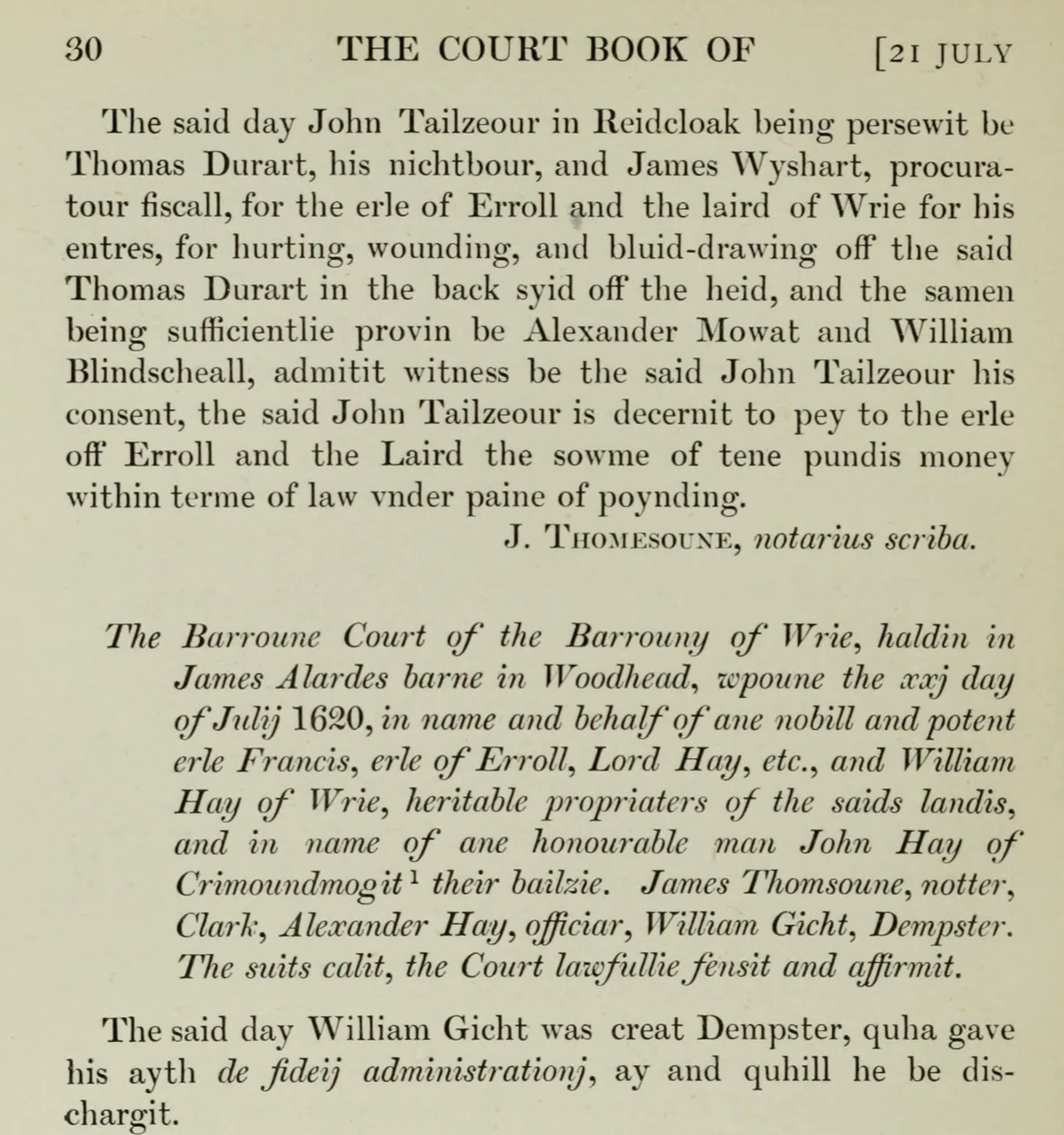
The heading of the Urie sitting, put into modern English, reads: the Baron Court of the Barony of Urie, held in James Alardes’s barn at Woodhead on 21 July 1620, in the name of Francis, Earl of Erroll, and William Hay of Urie, heritable proprietors of the lands, and of John Hay of Crimonmogate their bailie; James Thomson, notary, clerk; Alexander Hay, officer; William Gicht, dempster. It ends: “The suits calit, the Court lawfullie fensit and affirmit.” The roll of suitors had been called and the court lawfully fenced. The first business follows: “The said day William Gicht was creat Dempster, quha gave his ayth”, the oath of faithful administration.26
Fencing was the opening proclamation. Once it was made the court was in session and under its own peace. An old style-book, The Forme and Maner of Baron Courts, gives the words: “I defend, and biddis, in our liege Lord the king’s behalfe of Scotland, and in the behalfe of the Lord that this Court aucht, and his Baillie, that here is, that na man distrouble this Court unlawfullie, under the paine that may follow; or make him to speik for any, but leave asked and obteined.”31 In plain terms: in the King’s name, and in the name of the lord who owns this court and of his bailie here present, I forbid any man to disturb this court, or to speak for another without leave.
The rule was enforced. At Carnwath James Ramsay was fined “for his spekin vithout leif askit or gyffin”, for speaking without leave asked or given.32
As to place, “The baron usually held his court at the caput baronie which, in early times, was the castle”, but he could hold it wherever he wished on his lands.33 Urie met in a barn in 1620. Forbes met on 14 May 1663 “vithin the great hall off Castle Forbes”.34 Nor was there a timetable: at Carnwath “the baron held his courts at his own pleasure and as the need arose.”35
What the court did
Mostly small things. On its civil side, Dickinson says, the court at Carnwath “was concerned principally with actions for petty debt, possessory actions, lawburrows, and the quasi-criminal actions of breach of arrestment, bloodwite, and deforcement”. One entry will stand for many: “Jhon copland folloit katerin of denome for the vrangus haldin fra him vj s the inqueist ordanis to pay iij s & vj d”. John Copland pursued Katherine of Denome for six shillings wrongly kept from him, and the jury ordered three shillings and sixpence to be paid.36
The Whitsun courts dealt with what the record calls good neighbourhood. The land was let for the coming year, rights of grazing on the common were settled, and complaints about dykes in poor repair and the damage done by cattle were looked into.37
The court also enforced the baron’s mill. Tenants were bound to bring their corn to it and pay for the grinding, and “the lord relied upon the authority of his court.”38 At Forbes the bailie “was first and foremost concerned to enforce payment of his lord’s rents in money and victual”.39 It fixed prices as well. At Carnwath in 1524 the baron pursued the innkeepers for charging too much for ale, and the jury “ordanis thaim to sell for xvj d the gallon”, sixteen pence the gallon.40
A fight that drew blood ended in a fine, the bloodwite, which in a baron’s court “could not exceed £50”: £50 Scots, as the editor of the Forbes book has it.41
Cut down: 1654 and 1746
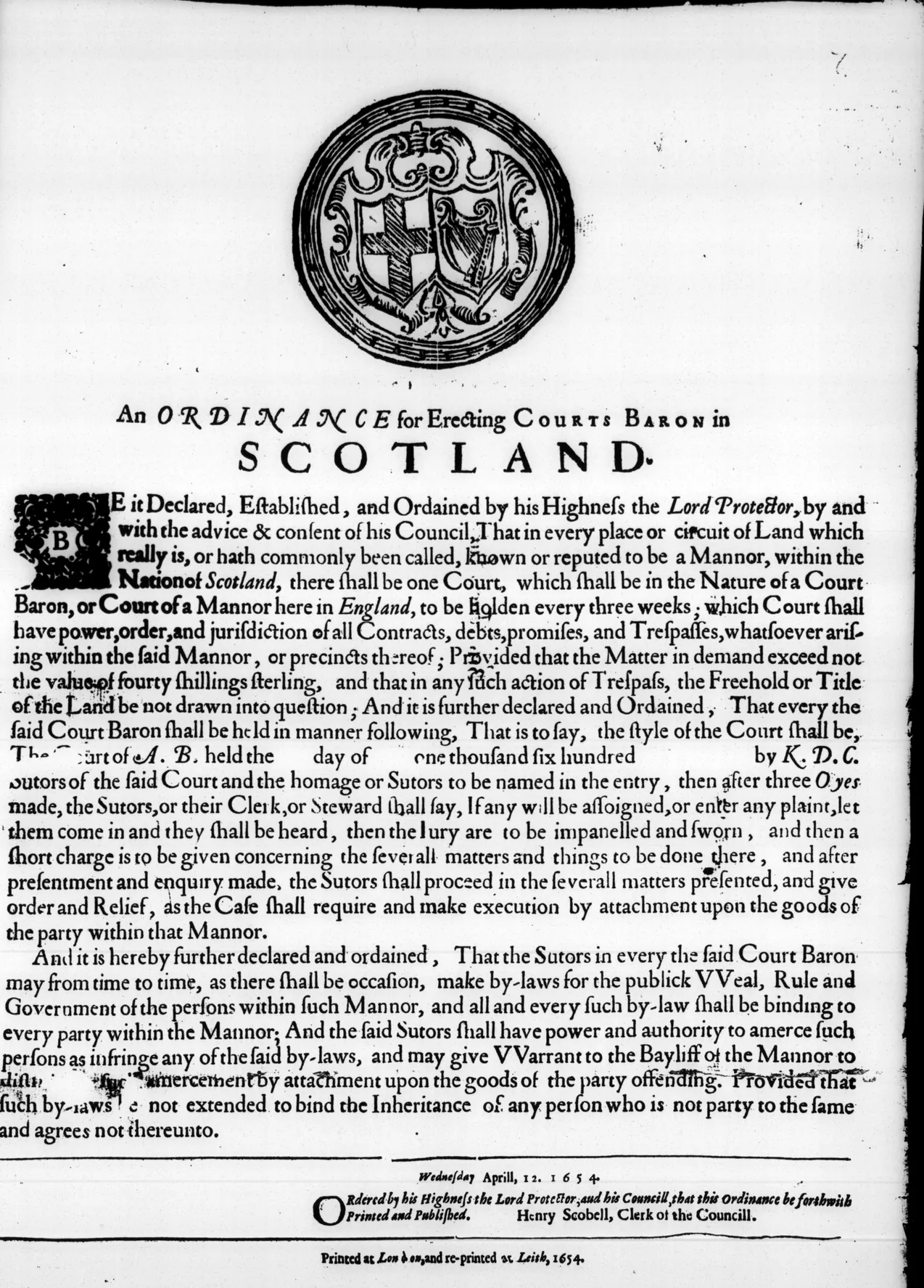
Two measures reduced the court. The first was Cromwell’s. An Ordinance of 12 April 1654 set up in every Scottish manor a court “in the Nature of a Court Baron, or Court of a Mannor here in England, to be holden every three weeks”, limited to cases where “the Matter in demand exceed not the value of fourty shillings sterling”.42 Dickinson thought it possible that the Ordinance “gave the coup de grace to a dying jurisdiction.”43
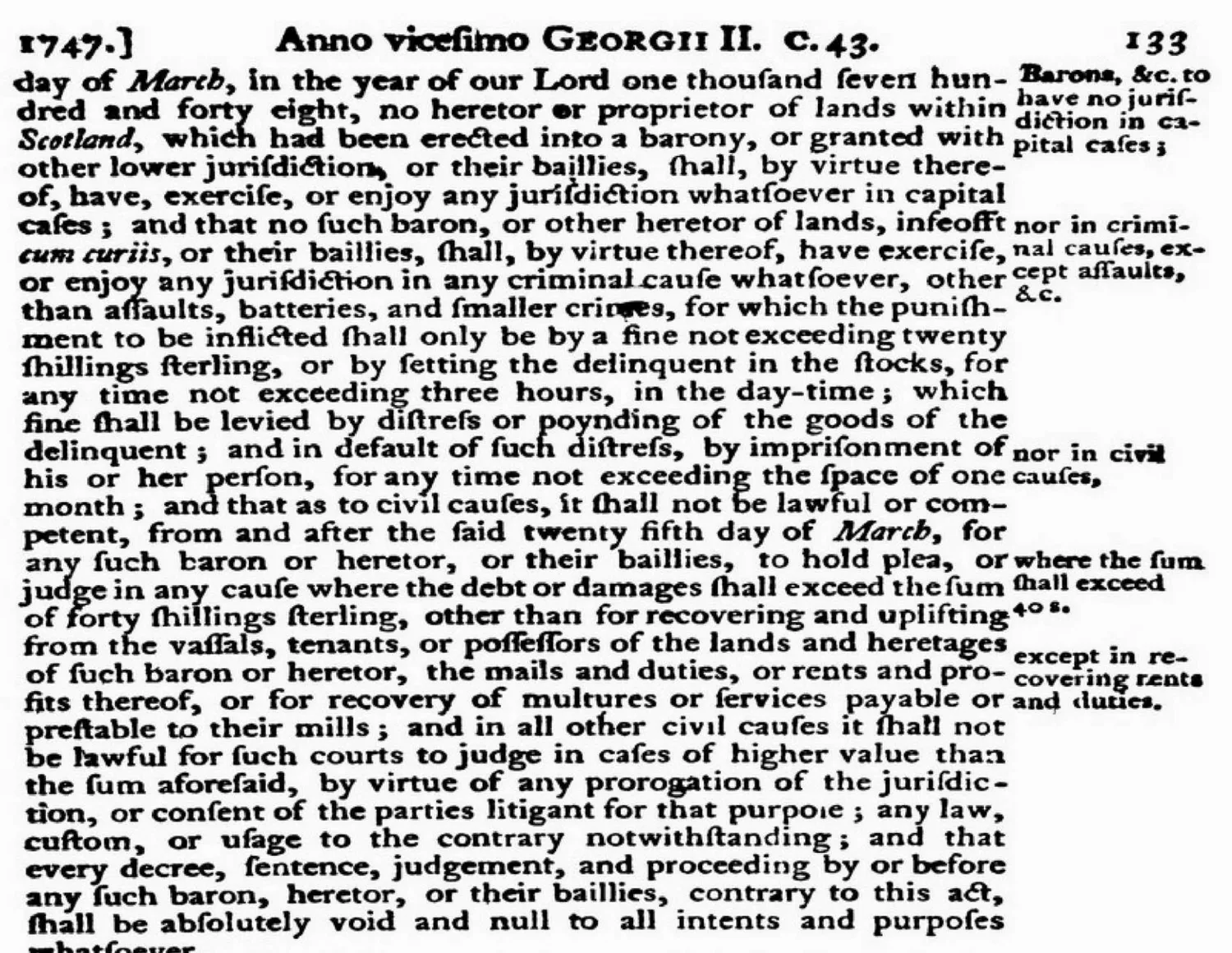
The second was permanent. After the rising of 1745 Parliament passed the Heritable Jurisdictions (Scotland) Act 1746, which took effect on 25 March 1748. It abolished the greater private jurisdictions and compensated their owners. It did not abolish the baron’s court. It cut it down.
Section 17 begins by admitting that the barons’ power of life and death “hath been long discontinued or fallen into disuse”. It then provides that no baron or his bailie shall have “any jurisdiction whatsoever in capital cases”; that in criminal matters the court may deal only with “assaults, batteries, and smaller crimes”, punished by “a fine not exceeding twenty shillings sterling, or by setting the delinquent in the stocks, for any time not exceeding three hours, in the day-time”; and that in civil cases it may not judge “where the debt or damages shall exceed the sum of forty shillings sterling”, the baron’s own rents and mill dues excepted.44
Two more provisions finished the old court. A bailie could no longer sit until he had taken the oaths required of holders of public office and had a certificate of it registered, on pain of a ten pound penalty, or six months in prison if he did not pay.45 And a companion Act of the same session released the suitors: no proprietor of lands “shall be obliged to attend, appear and give suit and presence” at any head court.46
John Erskine’s Institute sums up what was left of the criminal side: the restrictions “lie so heavy on the baron, that they amount nearly to a prohibition of this branch of his jurisdiction”.47 Dickinson’s verdict is that the Act changed less than it seemed: “The barons had ceased to exercise their franchises even before they were taken away”.48 For the Treaty of Union’s protection of these jurisdictions as property, see The Treaty of Union and the baronage.
Fading out, 1748 to 2004
“… and there being no other business before the Court it was adjourned till next Court day.”
The last entry in the Stitchill court book, 21 November 1807
Some courts carried on with what remained. The Stitchill book runs to 21 November 1807. On that day “a Head Court was held when the tenants and householders appeared and paid their fines”, and the court was adjourned. No later court is recorded.49
In the burghs of barony the baron-bailie lasted longer, as a local magistrate. Dalkeith in 1868 was “governed by a baron-bailie under the Duke of Buccleuch”, and Fraserburgh in the 1880s still counted “a baron bailie” among those who governed it.50 But the landed baron’s own court was going out of use. In 1892 the editor of the Urie book wrote: “A Baron still retains the right of holding Courts,—a privilege, however, of which he has altogether ceased to take advantage.”51 Sir Crispin Agnew of Lochnaw reports that commissioners inquiring into the Scottish courts in 1870 found “only two or three baron courts were handling more than a few cases each year”. They recommended that the bailies’ jurisdiction be withdrawn, and nothing was done.52
One baron-bailie lived on as pure ceremony, though he is a burgh’s officer and not a baron’s. The Scottish National Dictionary recorded the custom in 1933: “Every year at the Riding of the Marches at Linlithgow a baron-bailie is elected to take charge of the affairs of the village of Blackness”, and it added, “His duties are now merely nominal.” He was still being installed at Blackness in 2025.53
By the 1990s lawyers disagreed whether a baron’s court had any legal power left at all, since the Statute Law Revision Act 1948 had repealed section 17.54 The Scottish Law Commission described the position in 1999: “The baron can, in theory, hold a baron’s court, appoint a baron baillie to be judge, and exercise a minor civil and criminal jurisdiction.” Its footnote adds: “In practice barons’ courts are held now only for ceremonial purposes.”55
Sir Crispin Agnew, then Rothesay Herald, had come to the same point in 1994: “There is and was no reason why a baron should not operate a quasi court for ceremonial purposes or have used the officers of his court for purposes other than those of operating his court of law.”56
2004 and today
“… nothing in this Act affects the dignity of baron”
Abolition of Feudal Tenure etc. (Scotland) Act 2000, section 63(1)
The Commission recommended that “Any surviving criminal or civil jurisdiction of barony courts should be abolished”, and the Scottish Parliament did so.57 Section 63(1) of the Abolition of Feudal Tenure etc. (Scotland) Act 2000 reads: “Any jurisdiction of, and any conveyancing privilege incidental to, barony shall on the appointed day cease to exist; but nothing in this Act affects the dignity of baron or any other dignity or office (whether or not of feudal origin).”58 The appointed day was 28 November 2004. The official notes to the Act call the old jurisdiction “obsolete for all practical purposes”.59
One court sat before the door closed. The Baron Court of Prestoungrange in East Lothian, by its own account “established in its present form in 1998”, worked from 1999 with the Baron Court of Dolphinstoun, and the two were registered as a Scottish charity in 2002. By a declarator of 8 May 2004 the two barons appointed a common Baron Bailie, a Clerk of Courts who was also their Baron Sergeand, a Doomster and a body of ByrLawmen, with a Procurator Fiscal besides. The courts sat on 13 and 27 July 2004 and proclaimed their own closure “at midnight on the 27th day of November 2004”.60 At the second sitting the court granted a pardon to 81 people convicted of witchcraft in the district, which the BBC reported as “81 pardons, secured in the Prestoungrange Baronial Court on 27 July this year”.61 A historian of the Scottish witch-hunt, Julian Goodare, later objected that none of the 81 had been convicted by a baron court and that the pardon was “issued by a body with no jurisdiction to do so”.62 Whatever its standing in law, the sitting showed a baron’s court in being, with its officers in place, four months before the jurisdiction ended.
Since 28 November 2004 the position is plain. A baron’s court can decide nothing. It cannot summon, fine or bind anyone. What remains is ceremony. A baron may still name a bailie, a clerk, an officer and a dempster, and may still hold a court, as an honour of the barony and for its occasions. The charity that carries the name of the Prestoungrange and Dolphinstoun courts is still active, and the courts’ own news records a “Session of the Courts held on January 16th 2008” at which a new Bailie of Dolphinstoun was announced.63
The Lord Lyon’s guidance of 5 January 2010 deals with the officers’ heraldry, and with that only. Lord Lyon Sellar wrote: “In view of the separation of quondam feudal baronies from both land and jurisdiction after the appointed day, it no longer seems appropriate to grant additaments to baronial officers, for example, baron bailies or baron sergeants, or to regard such appointments as being sufficient to bring the person so appointed within Lyon’s jurisdiction.”64 The guidance takes for granted that barons make “such appointments”. What it ends is the Lyon Court’s practice of adding something to an officer’s own arms on the strength of his office, and of treating the office as enough to bring him before the Court for arms at all.65
The court that once tried thieves and settled the price of ale is now an honour of the barony. The bailie, the clerk, the officer and the dempster may still be named and the court may still be fenced, but it sits for ceremony and judges nothing. For the baron’s own dress see Robes, chapeau and insignia of the baronage; for the Acts, The baronage in the statutes, 1428–2004.
Five things often said
“Baron courts were abolished in 1747.” They were not. The Act of 1746 reduced them from 25 March 1748, and what was left lasted in law until 28 November 2004.44
“Every baron could hang a man.” Only if his charter said so. Stair: a barony’s jurisdiction “will not reach to Capital Punishment, unless the same be exprest”.5
“The pit was for drowning women and the gallows for hanging men.” Partly true. Skene printed that account in 1597 on the authority of the chronicler Hector Boece, and no statute lays it down. But Dickinson found that in the records of baron courts thieves “were not infrequently drowned”, and that drowning was “usually, but not always, employed in the case of women”. Of later times he adds that the “pit” within a castle “was certainly nothing more than the baron’s dungeon or prison.”66
“The court met on a moot hill.” Sometimes it met on a mound, and some charters reserve a hill-top for the purpose. But Dickinson found “nothing in our record to indicate” that the courts at Carnwath did, and adds that the head place of a barony “was not bound to be a castle or castle-mound.”67
“The bailie and the dempster wore robes of office.” No record read for this paper says so. The officer’s horn and white wand are the only insignia found. Agnew refers his readers to a booklet of 1989, Colin Forester’s The Insignia of the Baronage of Scotland and their Courts, for the officers’ “robes and insignia”; it has not been seen for this paper.30
Notes
- Dickinson, Carnwath, Introduction, p. xxxix. ↩
- Ibid., p. xx, quoting the Registrum Episcopatus Aberdonensis, i. 152. ↩
- Dickinson, p. lx; Innes of Learney, PSAS vol. 79, p. 114. ↩
- See “Authority & sources”. Dickinson’s Preface (p. v) calls Carnwath “the earliest baron court book preserved in H.M. Register House”. Extracts from other court books are in print, among them Skene, Leys and Whitehaugh in the Miscellany of the Spalding Club, vol. V (1852), and Corshill in the Archaeological and Historical Collections relating to the Counties of Ayr and Wigton, vol. IV (1884). ↩
- Stair, Institutions (1681), Title 13, § 62 (II.iii.62 in the later editions), p. 276. ↩
- Maitland Thomson, Introduction to the Forbes Baron Court Book, p. 207: jurisdiction over the “four points” reserved to the Crown “could only be conferred by a grant of regality”. The four are named by Barron, Urie, Introduction, p. vi: “murder, rape, robbery, and fire-raising”. ↩
- Dickinson, pp. cvii–cviii (theft “red-hand” and slaughter) and p. xlvii, where he notes hangings by sentence of a regality court as late as 1697 and of the Breadalbane court in 1701. ↩
- Dickinson, p. lxxxviii, where the usual service is “tres sectas in anno ad tria placita capitalia infra baroniam”, suit at the three head courts held in the year; for the fines, pp. xc–xci. ↩
- Ibid., p. lxxx. The italics are Dickinson’s. ↩
- Ibid., p. xciv. The numbers varied widely: he records juries of eleven and of twenty-nine. ↩
- Ibid., p. lxxviii, n. 5. One further court seems to have been held by the baron and his bailie together. ↩
- Dickinson, p. lxxx and n. 2; Barron, Urie, Introduction, p. viii. ↩
- Skene, De Verborum Significatione (1597), s.v. Curia. Skene is describing courts in general. ↩
- Scottish National Dictionary, s.v. “baron-bailie”. ↩
- Dickinson, pp. lxxviii–lxxix and p. lxxix n. 1, quoting The Forme and Maner of Baron Courts, c. 1. ↩
- Urie, p. 30, n. 1: “Cousin of the Laird of Urie.” ↩
- Dickinson, p. lxxxi and n. 6; Urie, p. 30. ↩
- Dickinson, pp. lxxxii–lxxxiii. ↩
- Ibid., pp. lxxxv–lxxxvi. ↩
- Ibid., p. lxxxvi. For the wand’s length Dickinson cites the Acts of the Parliaments of Scotland, ii. 22, c. 11. Innes of Learney, PSAS vol. 79, p. 118, cites the same page of Dickinson for “the ‘Wand’ of the Officers of a Barony”. The Scots ell: Scottish National Dictionary, s.v. “ell”, “in Sc. = 37.059 inches”. ↩
- Carnwath, court book, pp. 138–139. ↩
- Dickinson, pp. lxxxvi–lxxxvii. Thomas Cheisle was appointed or reappointed in 1524, 1530 and 1532. ↩
- Ibid., p. lxxxviii and n. 7, quoting the court book, p. 184 (where the word is printed “doume”). ↩
- Maitland Thomson, Introduction to the Forbes Baron Court Book, p. 214. ↩
- Dickinson, p. civ; Maitland Thomson, p. 214. ↩
- Urie, p. 30. ↩
- Skene, s.v. Burlaw; the same passage is quoted in the Dictionary of the Older Scottish Tongue, s.v. “birlaw”. For the business, Dickinson, Appendix A, pp. cxiii and cxv. ↩
- Urie, p. 33. ↩
- Dickinson, Appendix A, p. cxvi. ↩
- Dickinson, p. lxxxvi; Innes of Learney, PSAS vol. 79, p. 118. Neither describes any dress for the bailie, clerk or dempster of a baron’s court. Innes (p. 145, n. 6) mentions black gowns for the bailies of burghs, who held a different office. ↩
- Dickinson, p. xcviii, quoting The Forme and Maner of Baron Courts, c. 1. ↩
- Ibid., pp. xcviii–xcix, quoting the court book. ↩
- Ibid., p. lxxiv. ↩
- Forbes Baron Court Book, pp. 236–237. ↩
- Dickinson, pp. lxxvi–lxxvii. ↩
- Ibid., p. civ and n. 1, quoting the court book, p. 12. ↩
- Ibid., pp. cviii–cix. ↩
- Ibid., p. lxiii. ↩
- Maitland Thomson, Introduction to the Forbes Baron Court Book, p. 211. ↩
- Dickinson, p. lxvi, quoting the court book. ↩
- Ibid., p. cvi; Maitland Thomson, p. 207, has “not exceeding £50 Scots”. ↩
- An Ordinance for Erecting Courts Baron in Scotland, 12 April 1654. ↩
- Dickinson, p. xlvi, n. 3. ↩
- Heritable Jurisdictions (Scotland) Act 1746, s. 17, in Pickering, Statutes at Large, vol. XIX, p. 132 (recital) and p. 133. The excepted actions are those “for recovering and uplifting” the baron’s “mails and duties, or rents and profits”, and “multures or services payable or prestable to their mills”. For the Act’s title and its compensation of the owners, see The baronage in the statutes, 1428–2004. ↩
- Ibid., s. 23, pp. 134–135. ↩
- Tenures Abolition Act 1746 (20 Geo. II c. 50), s. 18, in Pickering, vol. XIX, p. 167. Erskine, Institute, I.iv.29, p. 69: the obligation “on barony-vassals to attend the baron’s head-courts, is now prohibited” by that Act. ↩
- Erskine, Institute (3rd ed., 1793), I.iv.28, vol. 1, p. 68 and p. 69. ↩
- Dickinson, p. xlviii. ↩
- Records of the Baron Court of Stitchill, p. 214, the last of the minutes. ↩
- The National Gazetteer of Great Britain and Ireland (1868), s.v. Dalkeith, transcribed by GENUKI; F. H. Groome, Ordnance Gazetteer of Scotland (1882–84), s.v. Fraserburgh, transcribed by A Vision of Britain through Time. ↩
- Barron, Urie, Introduction, p. xvii. ↩
- Agnew, The Baron’s Court (1994), citing the Fourth Report of the Commissioners appointed to inquire into the Courts of Law in Scotland (1870). The report itself has not been read for this paper. ↩
- Scottish National Dictionary, s.v. “baron-bailie”, under Linlithgow, 1933. Falkirk Herald, 16 June 2025 (archived copy), in the programme for the Linlithgow Marches: “After paying respects at Blackness War Memorial the Baron Bailie is installed”. ↩
- Scottish Law Commission, Report No 168, para 2.42, n. 55: “Section 17 (now repealed by the Statute Law Revision Act 1948)”, and n. 57: “There is a difference of opinion as to whether the jurisdiction of the barony courts still survives.” Agnew, The Baron’s Court (1994), discusses the same doubt. ↩
- Scottish Law Commission, Report No 168, para 2.31 and n. 40. ↩
- Agnew, The Baron’s Court (1994), under the heading “Jurisdiction after 1948”. ↩
- Scottish Law Commission, Report No 168, para 2.45, Recommendation 5(a). ↩
- Abolition of Feudal Tenure etc. (Scotland) Act 2000, s. 63(1). ↩
- Explanatory Notes to the Act, para 197. The day was fixed by SSI 2003/456, art. 2, and section 63 was brought into force on it by SSI 2003/620, art. 2. ↩
- The courts’ own published record, on prestoungrange.org: the Declarator “Curiis et earum exitibus”, published 8 May 2004 (the officers); the Order of Proceedings of the Trinity Session, with sittings “at 12 noon on July 13th” and “July 27th”; and the Declarator of 27 July 2004 on the cessation of the courts (the closure). Further Declarators and Judgements are dated 15 and 16 November 2004. The charity is “Baron Courts Of Prestoungrange & Dolphinstoun Limited”, SC033139, a “Registered charity from 02 May 2002”. ↩
- BBC News, “Town pardons executed ‘witches’”, 29 October 2004. ↩
- Julian Goodare, “Remembering Scottish Witches”, The Bottle Imp, issue 14 (November 2013). ↩
- Office of the Scottish Charity Regulator, SC033139, status “Active”; the courts’ own news item “Dolphinstoun Appoint Herbert Coutts MBE as Bailie”, 16 January 2008, on prestoungrange.org. ↩
- Lord Lyon Sellar, general guidance of 5 January 2010, under the heading “Guidance regarding Baronial Officers”, archived copy of the Lyon Court’s former website. ↩
- The Prestoungrange courts’ Declarators of 2004 cite three entries in the Lyon Register recording a “cap of justice” for a baron-bailie: vol. 51, p. 115 (1969); vol. 61, p. 37 (1976); and vol. 82, p. 90 (2001). The Register is not published and these entries have not been checked there. ↩
- Skene, s.v. Fossa, citing “Hector Boetius. l. 12.”; Dickinson, p. cviii, n. 5, and p. xxvii, n. 1. ↩
- Barron, Urie, Introduction, p. viii: “Its place of meeting was originally a hill or mound”. Dickinson, p. lxxiv, n. 6, and p. xxii and n. 2, where a charter of 1442 reserves a hill-top “pro curiis nostris tenendis”. ↩