Robes & Insignia
The arms and flags of a baron
What a Scottish baron may bear and fly: the helm, chapeau and supporters, the banner that comes with the arms, and the four flags that need the Lord Lyon’s grant
15 min read · Reviewed October 2026
Baronage of Scotland Association · The Reading Room · www.baronage.com/reading-room/heraldry-and-flags-of-a-baron/

A baron’s arms are his own. They are granted or matriculated by the Lord Lyon and written into a public register that has been the rule of the matter since 1672. A barony adds certain marks to them, and may open the way to certain flags. This paper sets out what those are, from Sir Thomas Innes of Learney’s book on Scots heraldry, the Lyon Court’s guidance, the old writers and patents the Court has issued to barons. It is as plain about what a barony does not bring with it.
The short answer
- Arms belong to one person, not to a family and not to a barony. A baron needs his own grant or matriculation from the Lord Lyon.
- A barony shows in the arms. For barons who had their grants before 28 November 2004 it shows by a red cap, the chapeau, and often a robe draped behind the shield. For those who have acquired a barony since, it shows by a helm of a baron’s degree.
- Supporters are not automatic. They belong to the heirs of the old barons who were liable to be called to Parliament before 1587, and to chiefs.
- The banner is the arms as a flag, and belongs to whoever owns the arms. A baron’s is square, three feet each way.
- The standard, guidon, pennon and pinsel are each granted or assigned by the Lord Lyon. Innes of Learney wrote that a baron “will, if he applies for them, receive” a standard. A baron’s is four yards long, or three and a half metres.
- The Saltire is every Scot’s flag. The Lion Rampant is the Sovereign’s, and a baron has no right to fly it.
- The guidance survives in more than one version. They agree on sizes and differ on who may have a guidon or a pennon. Ask the Lyon Office before a flag is made.
Arms belong to a person
“There is no such thing in Scotland as a ‘family coat of arms’”, the Lyon Court tells enquirers. A personal coat of arms “can only be borne by one person at a time”.1 A baron is in the same position as anyone else. His barony adds marks to his arms, as shown below, but it does not supply the arms. He must have his own.
The law is old. An Act of 1592 gave the Lyon King of Arms and his heralds power “To visite the haill armes of noblemen baronis and gentlemen borne and vsit within this realme”, and to enter them in their books.2 The Act of 1672 set up the register the Lyon Court still keeps, the Public Register of All Arms and Bearings in Scotland, and declared that it “shall be respected as the true and unrepeallable rule of all Armes and Bearings in Scotland”. Barons are named in both Acts, and the Act of 1672 gave them a fee of their own: “20 merks by every prelate and nobleman, and 10 merks by every knight and baron”.3
So a baron who wants arms petitions the Lord Lyon as anyone must. In the Court’s words, “Any person who wishes to use Arms must petition for a Grant of Arms”, or, for those who can trace their descent from an ancestor of the same name who had a grant of arms in Scotland, for a matriculation. The Court says the process “generally takes between 30 - 36 months”.4
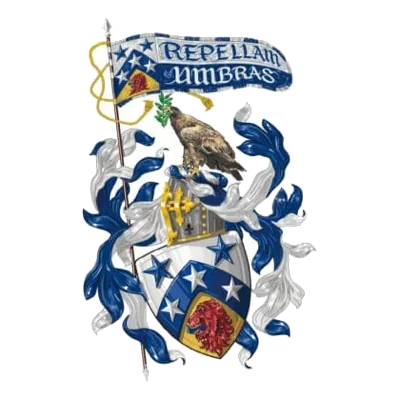
The parts of a baron’s arms
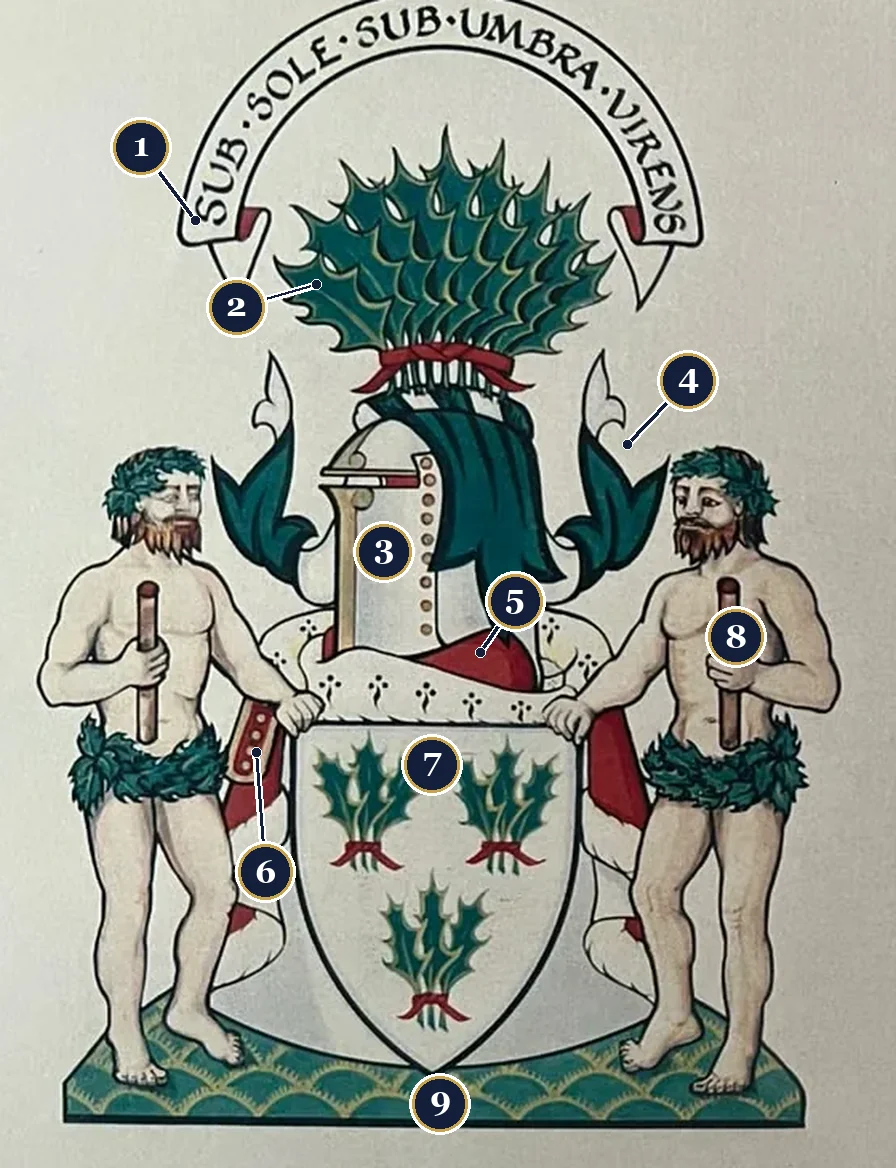
- Motto, on a scroll.
- Crest, here a sheaf of holly.
- Helmet. The matriculation calls it “an Helmet befitting his degree”.
- Mantling, the cloth that flows from the helmet.
- Chapeau, the red cap turned up with ermine: “a Chapeau Gules furred Ermine (for his Feudal Barony of Drum)”.
- Mantle, the baron’s robe draped behind the shield, “fastened on the right shoulder by five spherical buttons Or”.
- Shield, which is the arms proper.
- Supporters, here “two savages wreathed about the head and loins with holly”.
- Compartment, the ground the supporters stand on.5
Any armiger may have the shield, helmet, mantling, crest and motto. What a barony added to them was set down by Lord Lyon Sir Thomas Innes of Learney in his Scots Heraldry.6
“And a feudal Baron will, if he applies for them, receive: (r) Cap of Estate; (s) Standard; (t) Feudo-baronial mantle.”
Sir Thomas Innes of Learney, Lord Lyon, Scots Heraldry
The chapeau and the mantle
The chapeau, or cap of estate, is a velvet cap turned up with ermine. Innes of Learney calls it “the privilege of the feudal Baronage”, a cap that “seems technically to have indicated ownership of jurisdiction”, and says that in Scotland it “has been definitely assigned to the ‘minor barons’, for whom it is constitutionally appropriate”. Its colour told two kinds of baron apart: red for “Barons heretofore in possession of their fief or jurisdiction”, and blue for “Chiefs of Baronial Houses who no longer possess the baronial fief or jurisdiction”.7
The Lyon Court upheld a baron’s claim to it in the case of Gordon of Hallhead, Baron of Esslemont: on 4 September 1934 the Lord Lyon, in Innes’s words, “found the claim established, and awarded the chapeau”.8 The mantle is the baron’s robe, shown in the painting as it was once worn. Both are treated at length in Robes, chapeau and insignia of the baronage.
Both belong to grants made on petitions lodged before the appointed day, 28 November 2004. The Lord Lyon’s guidance of 5 January 2010 says that barons “who were granted a chapeau Gules or, it may be, a mantle before the appointed day may, of course, continue to display these additaments”, and proposes that heirs who succeed to such baronies “should continue to enjoy a red chapeau as an appropriate additament, and also a mantle if that has been granted before”. Those who acquire a barony after 28 November 2004 “will be granted a helm appropriate to their degree, that is, to the dignity of baron”.9
The helm
The old writers gave a Scottish baron no helmet of his own. Sir George Mackenzie in 1680 set out the English rule and the French, and the helm he gives “To a Barron”, carried “half side-wise, half in Front”, is the French one. Alexander Nisbet gave the barred helmet in profile to the peers: “by our practice, a knight has a fore-standing helmet open, and our dignified nobility a side-standing helmet with bars”.10
The modern rule is Innes of Learney’s. In his list of helmets by rank, after peers and knights and before esquires, come the barons: “The great tilting-helm garnished with gold (they being of ‘tournament rank’), or a steel helmet with grille of one or three grilles, garnished with gold, but the tilting-helm is most used.”11
The Lyon Court’s patents use a short formula for it. The Drum matriculation of 1992 has “an Helmet befitting his degree”, set on the chapeau. The Hartsyde document described below, for a barony acquired in 2010, has “an Helm befitting the holder of the dignity of baron”, with no chapeau or mantle. That is the guidance of 2010 at work.
Supporters
“all our Chiefs of Families, and old Barons in Scotland, may use Supporters”
Sir George Mackenzie, 1680
Supporters are the figures that stand on either side of the shield. Mackenzie claimed them for the old barons in 1680: “I crave liberty to assert, that all our Chiefs of Families, and old Barons in Scotland, may use Supporters”. His reason was that barons “were Members of Parliament with us, as such, and never lost that Priviledge, though for their convenience, they were allowed to be represented by two of their number”. Among his examples is “Irwin of Drum, two Savages, wreathed about head and loyns with Hollin, and bearing Battons in their hands”: the supporters in the Drum matriculation of 1992, shown above.12
The Lyon Court came to apply that as a rule with a date. Innes of Learney states it: “the heirs of the many minor barons, or ‘Lairds’, who were liable to be called to Parliament prior to 1587 and Chiefs of Clans and ‘old families’ and certain knights, are entitled as of right to obtain grants of supporters from the Lord Lyon.”13 In 1838 Sir Thomas Burnet of Leys received supporters as “the male representative of one of the minor Barons of Scotland prior to the year 1587”.14
A narrower statement is sometimes quoted against the barons. In a note of 27 June 1821 the Lyon-Depute, George Tait, confined the barons’ right to the “Lawful heirs-male of the bodies of the smaller Barons”, and added that “the want of usage is a strong presumption against the right.” Innes of Learney gave the note no weight. It is, he wrote, “of no evidential value, and is amongst the things for which Tait was dismissed in 1823.”15
So supporters go with an old baronial house, not with the holding of a barony as such. The guidance of 2010 keeps the rule: “Armigers formerly entitled to a chapeau Azure, or to supporters as representatives of baronial houses who had a seat in Parliament until 1587, continue to be so entitled.”9
The five flags
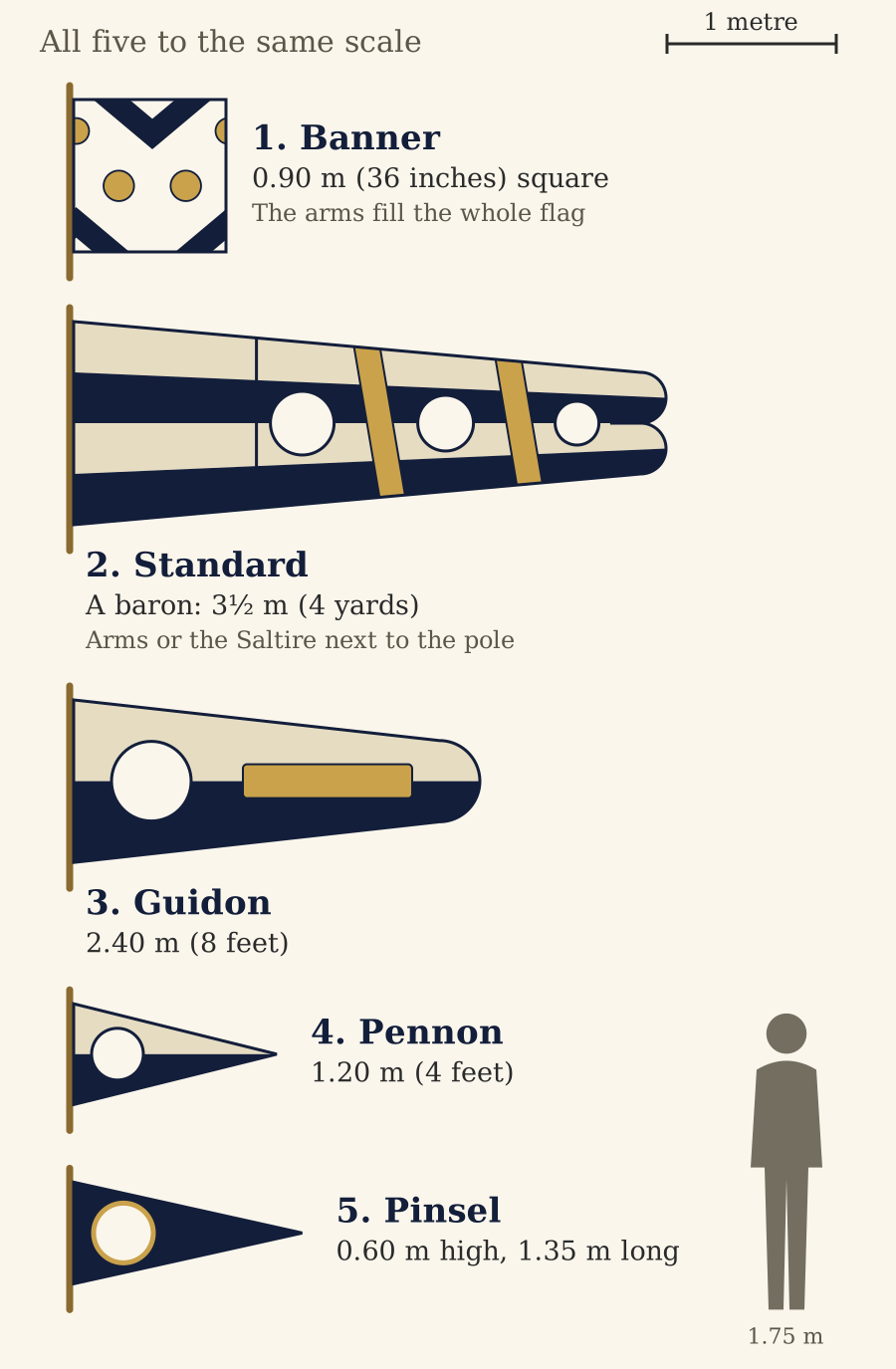
“The other principal sign of honour”, Nisbet wrote in 1722, “is the ensign; under which general name, are comprehended standards, banners, pennons, gideons, and gonfanouns.”16 The Lyon Court’s guidance describes five: the banner, the standard, the guidon, the pennon and the pinsel.
The guidance has come down in three forms, and they are one text at three dates. The oldest is Innes of Learney’s Scots Heraldry, which gives the sizes in feet and yards. A printed leaflet of the Lyon Court, “Information Leaflet No. 3 … Scottish Heraldic Flags”, repeats them. A page of the Court’s former website, “Further Guidance on Flags”, turns them into metric measures.17 They agree on sizes and differ on who may have two of the flags, as shown below. All three speak of feudal barons, as was usual before 2004. The Court’s present website has no page on flags.
The banner
“The coat of arms fills the banner right to its edges, as though it were a rectangular shield.”
The Court of the Lord Lyon, guidance on flags
The banner is the arms themselves made into a flag. The Lyon Court calls it “the personal flag of the owner of a coat of arms”, showing the arms “granted by the Lord Lyon or inherited in right of an ancestor”. It is “often wrongly called a ‘Standard’”. The guidance sets it apart from the other four, which it lists as “Special Heraldic Flags”, each granted, assigned or allotted by the Lord Lyon.18
The rule for drawing it is strict. “It is quite wrong to use a banner of a plain colour with the owner’s arms on a shield in the middle.” Helmet, crest, motto and supporters are left off.18

The banner stands for its owner. “No one else may use it. Flown over the house it denotes that the armiger is there”. For a house flag the proportions are five to four.18
A square banner is itself a mark of rank. “In actual mediaeval warfare”, Innes of Learney wrote, “none below knights-banneret and (feudal) barons displayed the square banner. Other nobles used, and can still only use, the ‘upright’ banners.”19
For personal use the size goes by rank. Innes gives “Baronets and feudal barons, 3 feet square”, and the leaflet “Barons and Feudal Barons : 36 Inches square”. The web page has “Baronets and Feudal Barons : 0.90 square metres”, which a later copy corrects to “0.90 metres square”. A banner made to be carried in procession is taller: for “Feudal Barons, 3 ft. by 3 ft. 9 in.”, or 90 centimetres by 115.20
The standard
The standard is the long tapering flag, and it is not for every armiger. The Lyon Court’s guidance says it is “granted by the Lord Lyon only to those who have a ‘following’, such as Clan Chiefs, because it is a ‘Headquarters’ flag. It is used to mark the assembly point or Headquarters of the Clan or following, and does not necessarily denote the presence of the Standard’s owner as the personal banner does.”21
A baron was counted among those who have a following. Innes of Learney: “Standards, guidons, and pennons are assigned by Lyon in grants or matriculations to those who are peers, baronets, knights, barons, or chieftains, i.e. those who from their position or feudal tenure may be presumed to have a ‘following’.” He adds that standards and guidons “are legally regarded as an ‘addition to’ the armorial achievement.”22
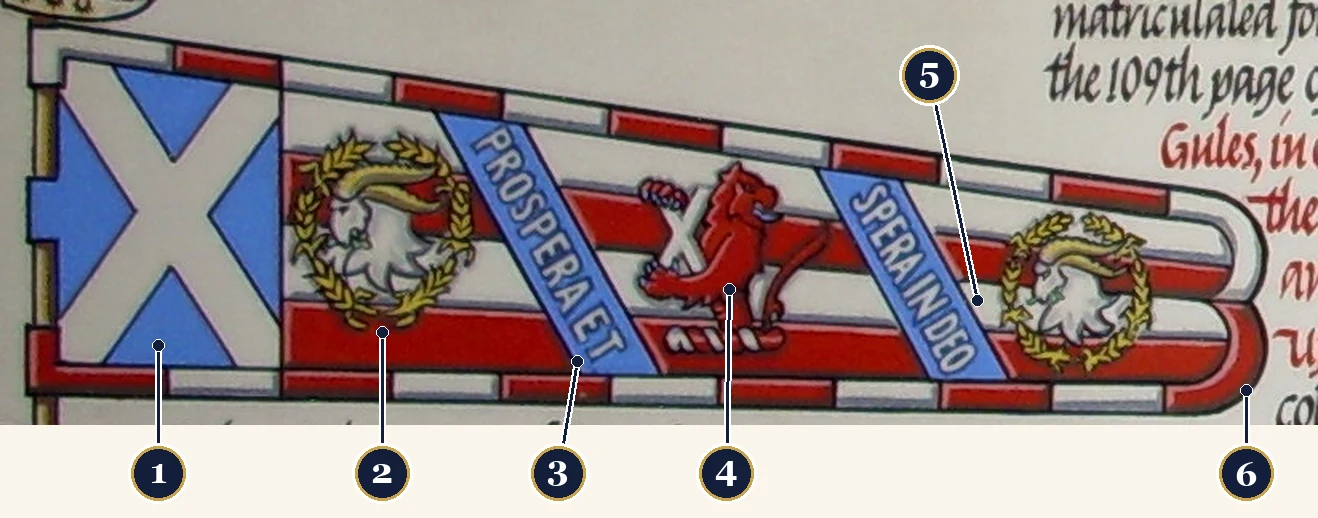
The guidance describes the parts. Next to the pole, in the hoist, old standards showed the Saltire and newer ones often show the owner’s arms. The rest is divided lengthways into tracts of the owner’s livery colours, on which are set the crest and badges, “separated by transverse bands bearing the owner’s motto or slogan”. And there is a mark of rank in the shape of the end: “Those of peers and barons have the ends split into two and rounded.”21
The Association’s Armorial has an example. The Letters Patent of Charles Russell Clayton Ross, Baron of Biggar, granted on a petition of 5 November 2004 and dated 23 October 2007, blazon his badge and crest “upon a Standard three and a half metres in length of four tracts Argent and Gules, split at the end”, with the Saltire in the hoist and the motto “in letters Argent upon two transverse bands Azure”. The patent limits the standard, with the chapeau, mantle and badge, to the petitioner and his successors in the arms “who are in the right of the barony of Biggar”.23
On length the three texts agree. Innes gives “Knight and Baron, 4 yds.”, and the leaflet “Knights and Barons : 4 yards”, which is 3.66 metres. The web page gives “Knights and Feudal Barons : 3½ metres”: its metric table is the old table of yards rounded to the half metre. The Biggar standard is exactly that length. A later copy of the web page adds a caution. It reads “Knights and, where a Standard has been granted, Feudal Barons”.24
The guidon
The guidon is a shorter flag of the same shape, a third shorter than the standard, at 8 feet or 2.40 metres, and it ends in “a round, unsplit end”. It carries the crest or badge in the hoist and the motto in the fly. The texts disagree on who may have one. Innes and the leaflet give it to lairds who have a following but “are of non-baronial tenure”; in Innes’s words, “Lairds of non-baronial tenure are only allowed guidons.” The web page assigns it “to those individuals who qualify for a grant of supporters to their Arms and to other individuals who have a following”.25
The pennon
The pennon is half the length of the guidon, 4 feet or 120 centimetres. The leaflet says it is assigned “in very rare cases and circumstances nowadays”; the web page says it “is assigned by the Lord Lyon to any armiger who wishes to apply for it”.26
The Armorial has one of these too. The Lyon Court document shown on the Roll for the Baron of Hartsyde, in the name of Lord Lyon Sellar, adds to his arms a “Pennon 120 centimetres long”, with “the Arms of the Petitioner in the hoist” and his motto.27
The pinsel
The pinsel is a small triangular flag, 4 feet 6 inches long by 2 feet high, and it is a chief’s. The Lyon Court calls it “the flag denoting a person to whom a Clan Chief has delegated authority for a particular occasion”. It bears the chief’s crest within a strap and buckle and a circlet with his title, and “On top of this circlet is set the owner’s coronet of rank or his baronial cap.” It is not a flag for barons generally. In Innes’s words it is “Given only to Chiefs or very special Chieftain-barons for practical use”, and the Lyon Court adds, “only upon the specific authority of the Lord Lyon King of Arms.”28
The three texts side by side
| Point | Innes, Scots Heraldry | Leaflet No. 3 | The former website |
|---|---|---|---|
| Baron’s banner | “Baronets and feudal barons, 3 feet square” | “Barons and Feudal Barons : 36 Inches square” | “Baronets and Feudal Barons : 0.90 square metres” |
| Baron’s standard | “Knight and Baron, 4 yds.” | “Knights and Barons : 4 yards” | “Knights and Feudal Barons : 3½ metres” |
| Who may have a guidon | “Lairds of non-baronial tenure” | Lairds with a following who “are of non-baronial tenure” | Those who qualify for supporters, and others with a following |
| Who may have a pennon | Those presumed to have a following | “very rare cases” | “any armiger who wishes to apply for it” |
On sizes the three agree, the metric figures being the old ones rounded. On who may have a guidon or a pennon they do not, and the Lyon Office is the only authority on which rule now applies. A baron who wants a flag should put the question to the Lyon Clerk first.
The Saltire and the Lion Rampant
A baron has no special right to either national flag, and needs none for the first. The Saltire is “the correct flag for all Scots or Scottish corporate bodies to fly”, and the leaflet adds that it “may be freely flown by any Scot”.29
The Lion Rampant is another matter. In the Lyon Court’s words, “This is NOT a national flag and its use by citizens and corporate bodies is entirely wrong.” It “is the Scottish Royal banner”, kept for the Sovereign and a few great officers who represent the Sovereign.30 J. H. Stevenson called its common use, in 1914, “by far the most outrageous infringement of the law in Scotland”.31
Getting arms and flags today
The Lyon Court still paints these flags. Its note of fees for April 2026 lists “Additional painting fees” for a “Standard or Guidon” from £295, a “Pinsel” at £380, a “Pennon or Pennoncel” at £273 and a “Banner” from £147, with a “Badge” at £189.32 In the Biggar patent the standard is both blazoned in the text and painted in the margin.
A baron who wants a flag has three steps to take. He should hold arms of his own. He should ask the Lyon Office which flags he may have and in what size. And he should have the flag made to the blazon in his patent, with the arms filling a banner to its edges.
Five things often said
“A barony comes with a coat of arms.” It does not. Arms are one person’s, by grant or matriculation, and each baron needs his own.1
“Every baron may have supporters.” No. They belong to the heirs of the barons who were liable to be called to Parliament before 1587. For those houses Innes of Learney calls it a right.13
“A baron has a right to a standard.” Nearly. Innes of Learney wrote that a baron “will, if he applies for them, receive” a cap of estate, a standard and a mantle. It still had to be applied for and granted, and the Lyon Court’s later wording is “where a Standard has been granted”.6
“A shield on a coloured flag is a banner.” The Lyon Court calls that “quite wrong”. The arms must fill the flag.18
“Any Scot may fly the Lion Rampant.” No. The Saltire is the flag for all Scots. The Lion Rampant is the Sovereign’s.30
Notes
- The Court of the Lord Lyon, Frequently Asked Questions. ↩
- Lyon King of Arms Act 1592, legislation.gov.uk; in modern English at RPS 1592/4/47. ↩
- Lyon King of Arms Act 1672, legislation.gov.uk. The fee clause was repealed in 1906 and is quoted from the modern-English text at RPS 1672/6/57. ↩
- The Court of the Lord Lyon, Petitioning for a Coat of Arms. ↩
- Extract of Matriculation of the Arms of David Charles Irvine of Drum, Baron of Drum, matriculated 25 November 1992, Public Register of All Arms and Bearings in Scotland, vol. 72, p. 83. The whole document is reproduced in Barons in the Lyon Court’s own words. ↩
- Innes of Learney, Scots Heraldry (1978 ed.), p. 17. The letters (r), (s) and (t) continue his list of the parts of an achievement. He was writing of barons as they then were, holding their baronies with the land. The later wording is that of the Lyon Court’s web page as archived in 2015 (note 24). ↩
- Ibid., p. 18. ↩
- Innes of Learney, PSAS vol. 79, p. 154, citing Lyon Register, vol. xxxi, p. 20. See The Esslemont petition of 1934. ↩
- Lord Lyon Sellar, general guidance of 5 January 2010, under the heading “Guidance regarding Baronial Additaments”, archived copy of the Lyon Court’s former website. ↩
- Mackenzie, The Science of Herauldry (1680), ch. XXVI, pp. 86–87; Nisbet, A System of Heraldry (ed. 1816), vol. II (first printed 1742), part IV, ch. II, p. 5. By “dignified nobility” Nisbet means the peers. ↩
- Innes of Learney, Scots Heraldry (1978 ed.), p. 17, under “The Helmet”, item (4), “Feudal Barons”. The italic is his. ↩
- Mackenzie, The Science of Herauldry (1680), ch. XXXI, p. 94. ↩
- Innes of Learney, Scots Heraldry (1978 ed.), p. 71. ↩
- Lyon Register, vol. iv, p. 33, as quoted by Seton, p. 317, and by Stevenson, Heraldry in Scotland, vol. II, p. 322. ↩
- Note of George Tait, Lyon-Depute, 27 June 1821, printed in Seton, The Law and Practice of Heraldry in Scotland (1863), pp. 286–287; Innes of Learney, Scots Heraldry (1978 ed.), p. 74, n. 18. ↩
- Nisbet, A System of Heraldry (ed. 1816), vol. I, p. 10. ↩
- See “Authority & sources”. Scots Heraldry was first published in 1934 and is quoted here from the edition of 1978. The web page is quoted from the archived copy of 14 January 2008, except where a later copy is named; it is later than the leaflet, which names the Secretary of State for Scotland where the web page names the First Minister. The leaflet has been read in the copy hosted by the Clan Strachan Society. ↩
- “Further Guidance on Flags”, under “The Personal Banner”; the leaflet, para. 13, has the same rule. ↩
- Innes of Learney, Scots Heraldry (1978 ed.), p. 21. The italic is his. ↩
- Innes of Learney, Scots Heraldry (1978 ed.), p. 21 and p. 35, n. 26; leaflet, paras. 13 and 14; “Further Guidance on Flags”, under “The Personal Banner” and “Carrying Flags”, where the carrying flag is “90 centimetres wide x 115 centimetres high”. The corrected wording is in the archived copy of 27 February 2015. ↩
- “Further Guidance on Flags”, under “The Standard”; leaflet, para. 17. ↩
- Innes of Learney, Scots Heraldry (1978 ed.), p. 21. ↩
- Letters Patent of Charles Russell Clayton Ross, Baron of Biggar, by Lord Lyon Blair, 23 October 2007, matriculated in the Public Register of All Arms and Bearings in Scotland, vol. 86, p. 109, and shown on the Roll. ↩
- Innes of Learney, Scots Heraldry (1978 ed.), p. 35, n. 30; leaflet, para. 17; “Further Guidance on Flags”, under “The Standard”. Four yards is 3.6576 metres. The later wording is in the archived copy of 27 February 2015. In some archived copies of the page, among them those of 2009, the fraction signs are missing or damaged, so that the figure appears to read “3 metres”. ↩
- Innes of Learney, Scots Heraldry (1978 ed.), p. 21; leaflet, para. 18; “Further Guidance on Flags”, under “The Guidon”. ↩
- Leaflet, para. 19; “Further Guidance on Flags”, under “The Pennon”. Innes (p. 21) says only that pennons “are half the size of guidons” and are assigned with standards and guidons. ↩
- Shown on the Roll, which describes it as a warrant for Letters Patent. The copy published there is small, and only the words quoted here have been read with confidence; its date cannot be read. ↩
- “Further Guidance on Flags”, under “The Pinsel”; Innes of Learney, Scots Heraldry (1978 ed.), p. 23; leaflet, para. 20, which has the circlet inscribed with “the Chief’s or Baron’s title”. The web page gives the size as 60 centimetres by 135. ↩
- The Court of the Lord Lyon, “The Saltire”, former website, archived copy of 14 January 2008; leaflet, para. 21. ↩
- Leaflet, para. 12; the former website’s page “The ‘Lion Rampant’ Flag”, archived copy of 14 January 2008, is to the same effect. ↩
- Stevenson, Heraldry in Scotland (1914), vol. I, p. 100. ↩
- The Court of the Lord Lyon, Note of Dues, Fees and Charges, April 2026, Appendix A, “Additional painting fees”. ↩