
Guide · In Eight Chapters
Court and Officers
The baron’s court and who served in it, in the words of the record.

Chapter I · 1681
A barony came with a court
The Crown’s grant of a barony gave its holder a share of the King’s justice over the people on his lands. Power of life and death needed the words “pit and gallows” in the charter.
“Jurisdiction and Courts are comprehended in Barrony”

Chapter II · The baron’s deputy
The bailie
He held the court in the baron’s place, and was sworn to faithful administration. At Urie in 1620 the bailie was a cousin of the laird.
“sufficient power, be letter and seale of the Baron”

Chapter III · Keeper of the book
The clerk
He kept the court book: its judgments, and the rents and fines due to the baron. At Carnwath in 1527 the clerk was sworn “to write truly”.
“vilȝem somerwell vas sworn to vrit trewly in the office of clerkschip”

Chapter IV · Horn and white wand
The officer
The court’s messenger and enforcer: he summoned the parties and seized goods for its fines. His insignia were a horn and a white wand an ell long, which he broke if he was resisted.
“of the quhilk reif & deforsment he brak his wand & tuk witnes”

Chapter V · The voice of the court
The dempster
One of the tenants, he spoke the court’s judgment, its “doom”, aloud. The tenants who owed attendance were the judges, not the baron.
“gart giff doum be the mouth of Jhone watsone dompstar”

Chapter VI · 21 July 1620
A court in session
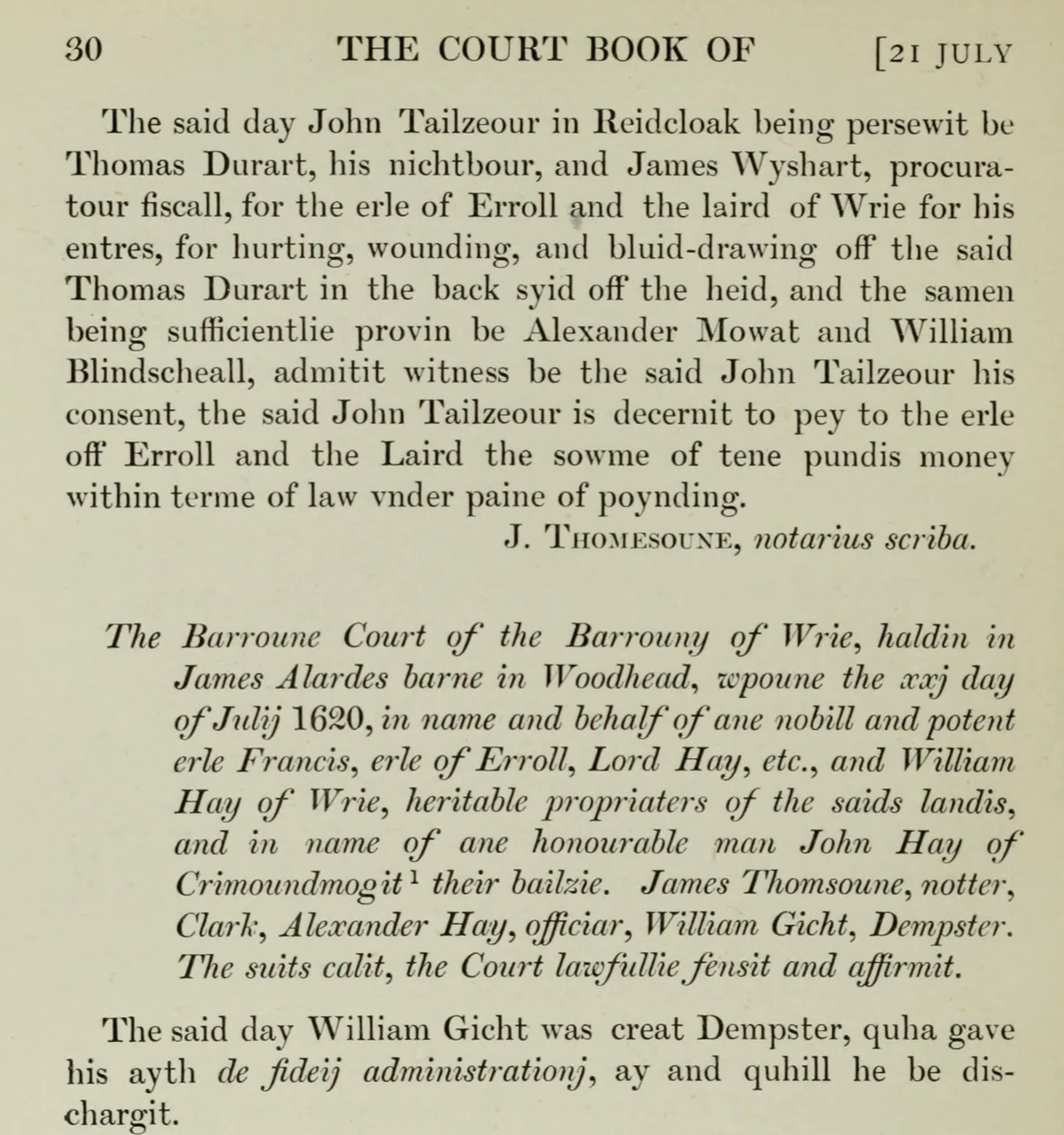
The court of Urie met in a barn at Woodhead. One heading names the bailie, the clerk, the officer and the dempster. Most of the work was small: rents, debts, mill dues, straying cattle, blows that drew blood.
“The suits calit, the Court lawfullie fensit and affirmit.”

Chapter VII · 1746
Cut down
After the rising of 1745 Parliament cut the court down but did not abolish it. From 1748 it could try nothing capital, and hear no ordinary claim above forty shillings.
“a fine not exceeding twenty shillings sterling, or by setting the delinquent in the stocks, for any time not exceeding three hours, in the day-time”

Chapter VIII · Since 2004
Today
All jurisdiction ended on 28 November 2004. A baron may still name a bailie, a clerk, an officer and a dempster, and hold a court, for ceremony. It can decide nothing.
“Any jurisdiction of … barony shall on the appointed day cease to exist; but nothing in this Act affects the dignity of baron”
The court has gone. The dignity it belonged to has not, and who holds that dignity is what the Roll records.
Read further
Sources
- W. Croft Dickinson (ed.), The Court Book of the Barony of Carnwath, 1523–1542 (Scottish History Society, 1937)
- The Court Book of the Barony of Urie in Kincardineshire, 1604–1747 (Scottish History Society, 1892)
- Viscount Stair, The Institutions of the Law of Scotland, 1681, Title 13, §§ 62–63
- Heritable Jurisdictions (Scotland) Act 1746, s. 17, in Pickering’s Statutes at Large, vol. XIX, p. 133
- Abolition of Feudal Tenure etc. (Scotland) Act 2000, s. 63
- Scottish Law Commission, Report on Abolition of the Feudal System (No 168, 1999)
What the baron wore and bore
The red robe and the chapeau; the helm, the banner and the flags.