Guide · In Seven Chapters
Arms and Flags
What a Scottish baron may bear and fly, in the words of the record.

Chapter I · 1672
One person’s arms
There is no family coat of arms in Scotland, and a barony does not supply one. Each baron needs his own grant or matriculation from the Lord Lyon, entered in the register Parliament set up in 1672.
“the true and unrepeallable rule of all Armes and Bearings in Scotland”

Chapter II · The Baron of Drum, 1992
What a barony adds
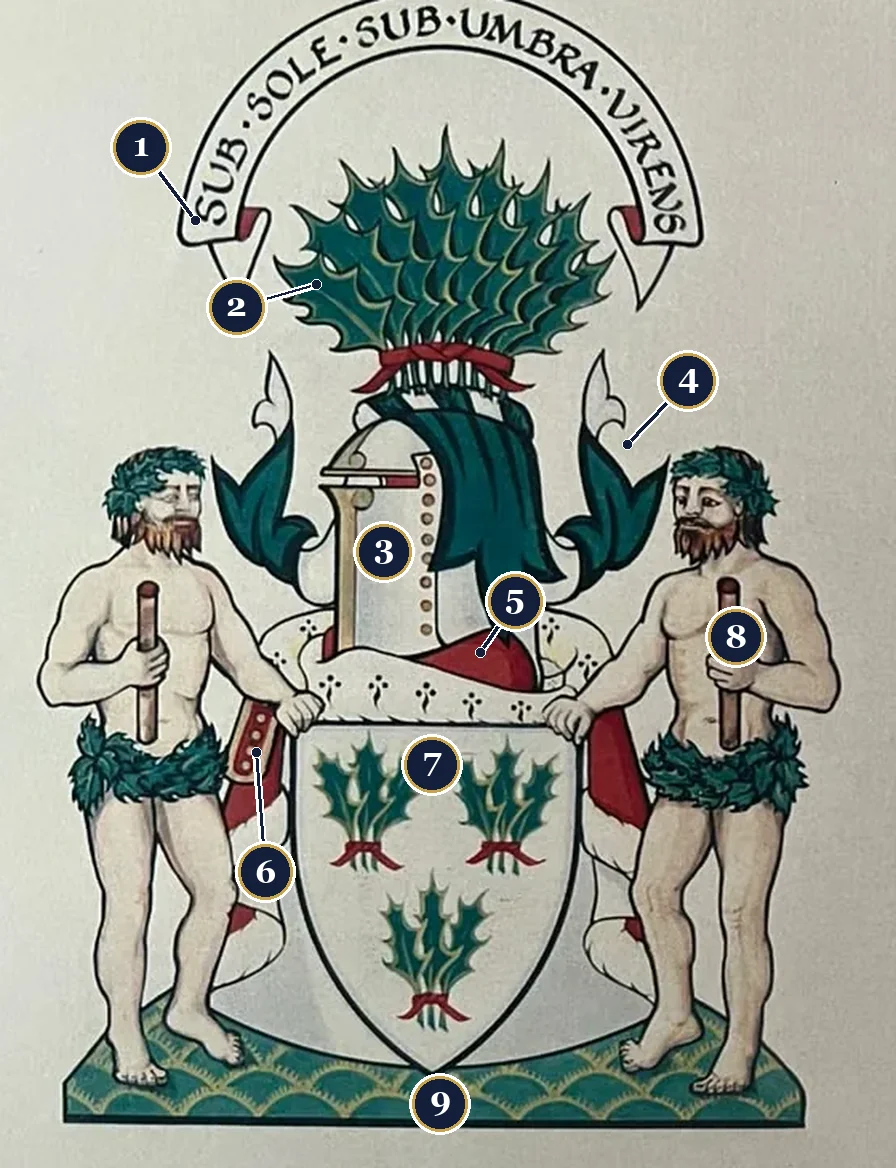
The shield is the arms. In arms granted before 2004 a barony shows in the red chapeau and the robe behind the shield; the old houses also have supporters.
“fastened on the right shoulder by five spherical buttons Or”

Chapter III · Since 2004
The helm
For a barony acquired since 28 November 2004 the arms show it by the helm alone: the great tilting-helm garnished with gold, or a steel helm with a gold grille.
“a helm appropriate to their degree, that is, to the dignity of baron”

Chapter IV · Banner, standard, guidon, pennon, pinsel
Five flags
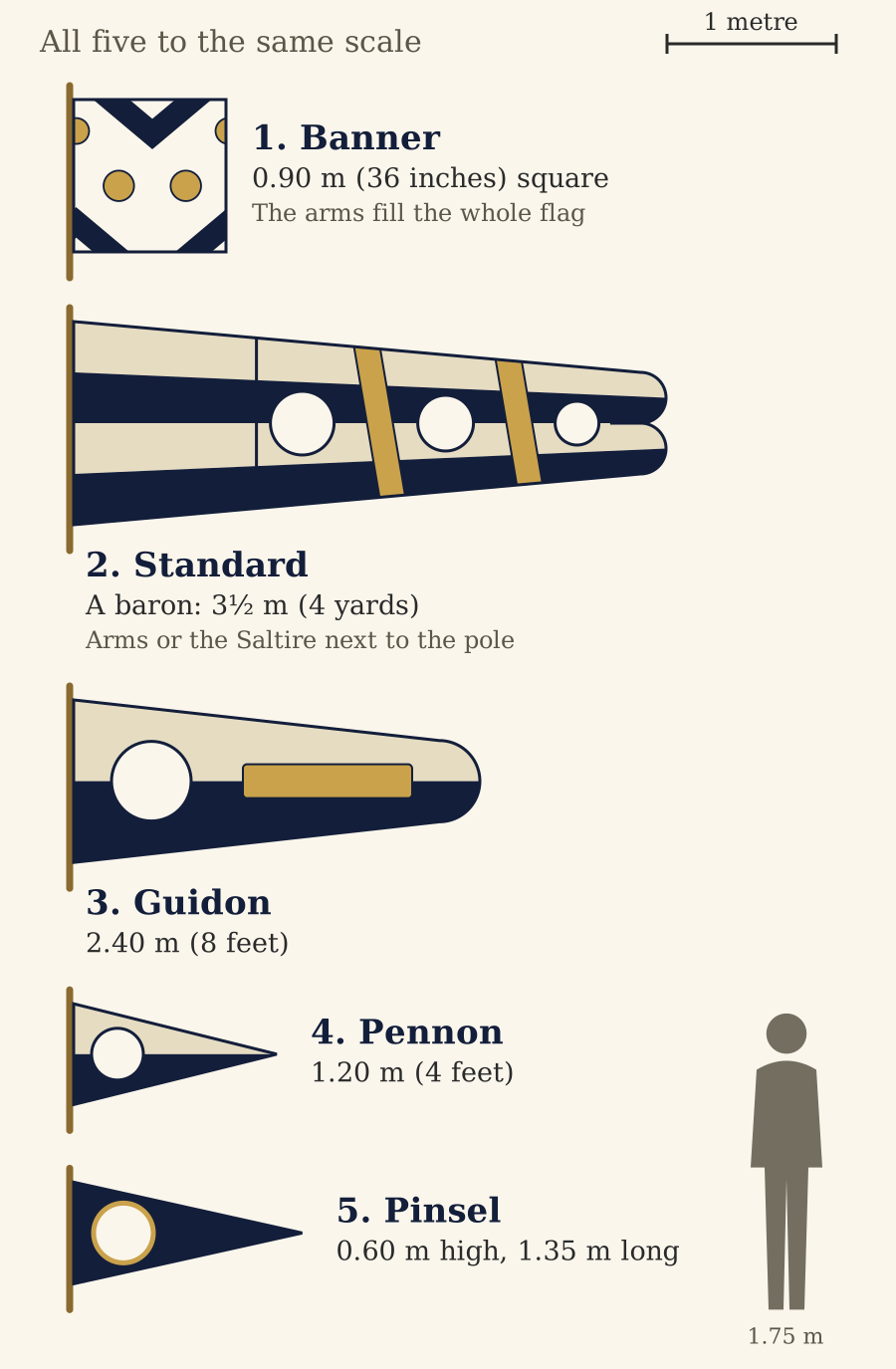
Only the banner comes with the arms. The other four are each granted or assigned by the Lord Lyon. Ask the Lyon Office before a flag is made.
“under which general name, are comprehended standards, banners, pennons, gideons, and gonfanouns”

Chapter V · Three feet square
The banner
The arms themselves as a flag: for a baron, square, three feet each way. It flies where its owner is, and no one else may use it.
“The coat of arms fills the banner right to its edges, as though it were a rectangular shield.”


Chapter VI · The Baron of Biggar, 2007
The standard
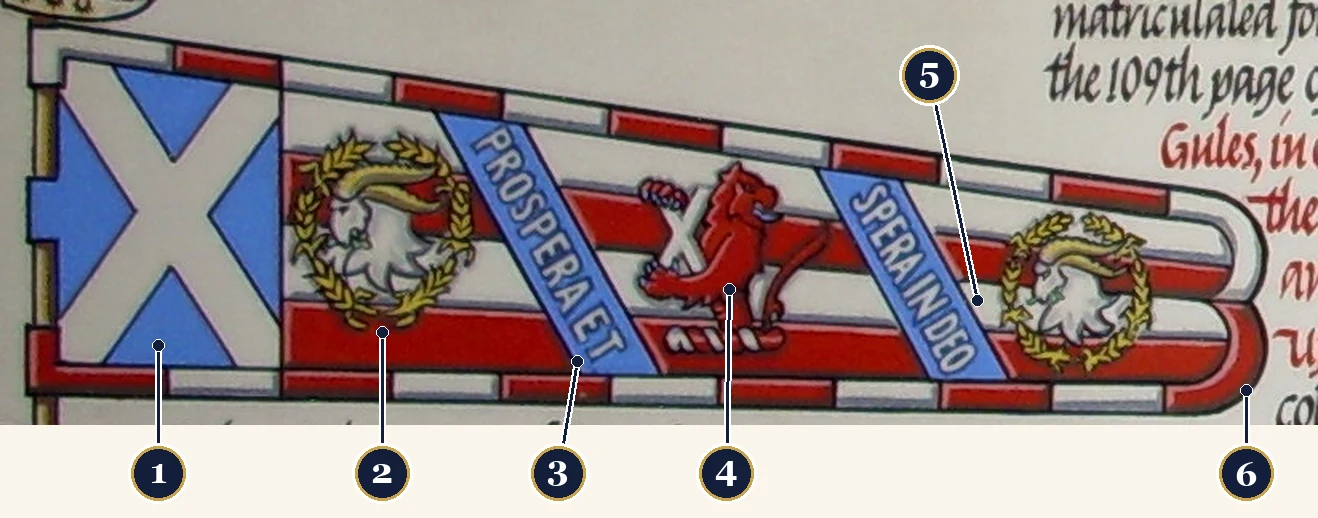
The long flag of those with a following, granted by the Lord Lyon. A baron’s is four yards long, and its end is split in two and rounded.
“Those of peers and barons have the ends split into two and rounded.”

Chapter VII · Two national flags
The Saltire and the Lion
The Saltire is every Scot’s flag. The Lion Rampant is the Sovereign’s, and a baron has no right to fly it.
“This is NOT a national flag and its use by citizens and corporate bodies is entirely wrong.”
Arms and flags follow the person who holds the dignity. Who holds it is what the Roll records.
Read further
Sources
- Lyon King of Arms Act 1672
- The Court of the Lord Lyon, “Further Guidance on Flags” (former website, archived 14 January 2008)
- Lord Lyon Sellar, guidance of 5 January 2010 (archived copy)
- Sir Thomas Innes of Learney, Scots Heraldry (1978 ed.)
- Alexander Nisbet, A System of Heraldry (1722; ed. 1816), vol. I
- Letters Patent of the Baron of Biggar, 23 October 2007, shown on the Roll
The robe and the court
What a baron wore, and who served in his court.