
Law & Statutes
Tried by his fellow barons: the baron’s privilege that lasted until 1949
A peer was tried by peers, and a baron by barons. The peers’ privilege was abolished in 1948; the barons’, by then shared with other landed men, in 1949
6 min read · Reviewed October 2026
Baronage of Scotland Association · The Reading Room · www.baronage.com/reading-room/the-barons-privilege-of-trial-by-barons/

A peer accused of a crime was tried by his fellow peers. Scots law gave a baron a privilege of the same kind: to be tried by barons. This paper sets out what the privilege was, who had it, and when it ended.
The short answer
- A baron had the privilege of trial by barons. The old law says it in terms: “ane Earle, be Earles; ane Baron, be Barons”.
- It was the same kind of privilege as a peer’s. Mackenzie records that of old only noblemen sat on a nobleman’s jury, and only barons on a baron’s.
- The court upheld it. In 1667 it ordered a jury with a majority of “Barrons holding of the king”.
- It was the baron’s own. It did not pass to his heir, or to a landowner whose lands were not a barony. Later it was opened to landed men generally.
- It was used into the 1800s. In 1838 a landed proprietor was tried in the High Court by a jury with a majority of landed men.
- The two ended a year apart. Parliament abolished the peers’ privilege in 1948 and the landed man’s in 1949.
The privilege
“It is statute, that na man sould thoill judgement, or be judged, be ane man of inferiour estate then his awin peir; that is, ane Earle, be Earles; ane Baron, be Barons; ane Vavassour, be Vavassours; ane Burges, be Burgesses.”
Quoniam Attachiamenta, chapter 67, as Sir John Skene printed it in 1609
Quoniam Attachiamenta is one of the old books of Scots law. Sir John Skene printed it in Scots in 1609, and headed this chapter “Ilk man sould be judged be his peirs”.1 Sir George Mackenzie put it into the English of his day: “no Man shall be judged by a lower Person than his Peer, an Earl by an Earl, a Baron by a Baron, a Subvassal by a Subvassal, and a Burgess by a Burgess, but a lower Person may be judged by an higher”.2
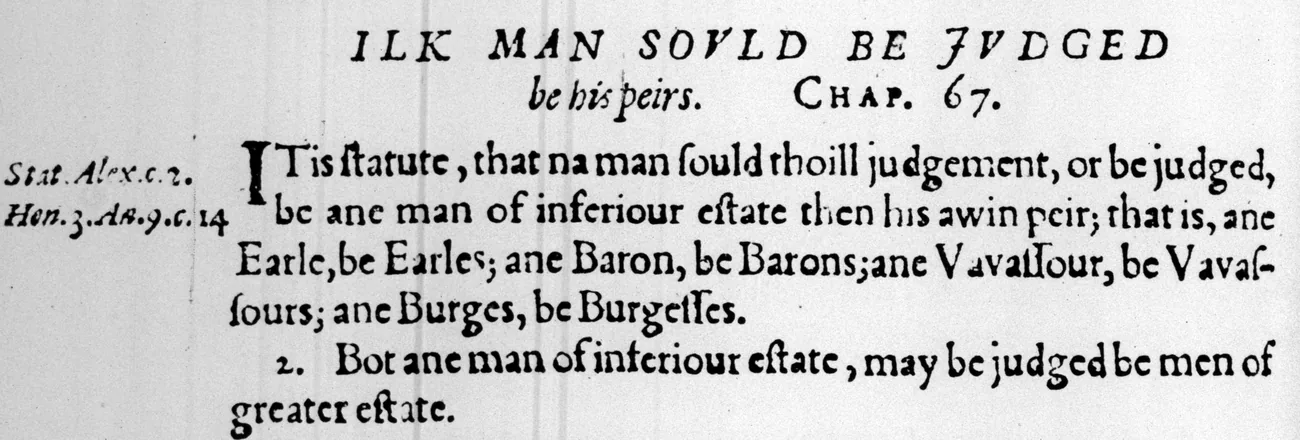
The list is a ladder of rank, and the barons are on it by name, next below the earls. Mackenzie states the practice for the two ranks in one breath: “of old it was uncontrovertedly received, that none should pass upon the Assize of Noblemen except Noblemen, nor upon the Assize of Barons except Barons”.2 An assize is a jury.
Like a peer’s
The peers’ privilege is the better known. After the Union a Scottish peer charged with treason or felony was tried as a peer of Great Britain, by “the entire order of peers who have right to sit and vote in Parliament”.3
The baron’s privilege rested on the same idea, and was argued from the peer’s. In 1667 Sir George Mackenzie told the Court of Justiciary that “by our Law a Barron is interpret to be of parity with a Lord”. Lords were judged only by their peers, he said, and it was against reason “that the same should be denyed to Barrons”.4
David Hume, professor of Scots law at Edinburgh, gave the history in 1800: “for long, and until the full establishment of parliamentary representation, the order of noblemen and other barons, or immediate vassals of the Crown, were truly one and the same, and therefore peers to each other in the strict sense of law”.5
Upheld by the court
Mackenzie was speaking for Archibald Douglas of Spott, accused in 1667 of the “Slaughter of Sir James Hoom of Eccles” in a duel.6 Spott objected to the jurors who were not barons. The court agreed.
“The Justices finds the objection against the present Assizers relevant and ordains the pursuers to summond a new Assize … the most part of which Assize they ordain to be of the Laird of Spot his own quality, viz. Barrons holding of the king and the rest landed Gentlemen holding either of the king or of another Superior by Charter.”
Court of Justiciary, 9 May 1667
The order gave him barons in the majority, not a jury of barons only.7 The Crown had opposed the plea: the old books were not law, it said, and “it cannot be instanced that the said objection was ever proponed and sustained”.8 Spott himself escaped from Edinburgh Castle and was never tried.9
The plea was older than Spott. In 1613 Hew Somervell of Drum, “within the degrie of ane Barroune”, asked to be “tryit be his peiris, viz. be Barrones”. That time the Justice found the jurors “honest, substantious men” and let them sit.10
Whose it was
It was the baron’s own. Mackenzie records two limits. In 1675 the court “found the Privilege extended not to the apparent Heirs of Barons”. And it did not extend “to landed Men, tho’ infeft, if their Lands be not erected in a Barony”.11 A landowner without a barony did not have it, and neither did a baron’s son.
When it ended
The baron’s privilege was later shared. Hume wrote in 1800 that the older practice had required, “if he were a baron, or immediate vassal of the Crown, that at least half of the assize should be barons also”. In later times the judges had settled for “a majority only of the assize” being landed men, “and these indifferently, vassals holding of the Crown, or of a subject”. “To this extent the privilege still maintains itself”, he added.12 An Act of 1825 provided for the case “where a Person shall by Law be entitled to the Privilege of having a Majority of Landed Men for Jurors on his Trial”.13
It was still used. In 1838 Donald Kennedy of Bogbain, a landed proprietor, stood trial in the High Court: “The pannel being a landed man, the Assize consisted of twenty-four landed men, and twenty-one common Jurors. Eight of the Jury were chosen from the former class, and seven from the latter.”14 The pannel is the accused. A textbook of 1894 still gives the rule, “If the accused be a landed man, he is entitled to have a majority of landed men on the jury”, and cites a case of 1853 for it.15 No later case has been found, and none after 1700 in which the accused is called a baron.
The two privileges ended a year apart.
The peers’ went first. The Criminal Justice Act 1948 says: “Privilege of peerage in relation to criminal proceedings is hereby abolished.”16
The landed man’s followed. The Juries Act 1949 says: “The privilege to which a landed person is entitled of being tried by a jury comprising a majority of landed persons is hereby abolished.” The Lord Advocate called it an “archaic provision”. It ceased on 1 October 1949.17
What it shows
A baron had fellow barons, as a peer had peers, and the law gave him the same kind of protection: judgment by men of his own rank. It was a privilege of rank, and it went with the barony.
It is history now, as the peers’ privilege is. Both were gone half a century before the Act of 2000, which ended a barony’s jurisdiction and left the dignity alone: “nothing in this Act affects the dignity of baron”.18
The Roll and the Pledge
Part of the Crown’s answer in 1667 was about proof: “it cannot be found that the Defender is an barren, there being nothing produced for instructing thereof”.19 Who holds a barony was a matter of evidence then, and it is now.
The Baronage of Scotland Association keeps the Roll of Scottish Barons, which enters a holder only on evidence, and offers the Pledge: an undertaking, in honour and not in law, to preserve a barony within the family for future generations and to uphold the Baronial Code of Honour. The precedent is the baronets’ Roll of 1910.
Notes
- Quoniam Attachiamenta, cap. 67, in Sir John Skene, Regiam Majestatem: The Auld Lawes and Constitutions of Scotland (Edinburgh, 1609), the Scots text. “Thoill” is to undergo. ↩
- Sir George Mackenzie, Works, vol. II (Edinburgh, 1716), “Of Assizes”, p. 244. ↩
- David Hume, Commentaries on the Law of Scotland, respecting Trial for Crimes, vol. II (Edinburgh, 1800), p. 100, quoting the Treaty of Union, article 23: Scottish peers “shall be tried as peers of Great Britain”. Before the Union, Hume says, Scotland had no fixed rule that a nobleman’s jury be all noblemen (p. 99). ↩
- Records of the Proceedings of the Justiciary Court, Edinburgh, 1661–1678, ed. W. G. Scott-Moncrieff, vol. I (Scottish History Society, 1905), pp. 206–207. Mackenzie was counsel for the accused; this is his argument, not the court’s finding. He added in Latin that a baron who holds of the King “primum gradum nobilitatis potest sibi ascribere”, may claim the first degree of nobility. ↩
- Hume, Commentaries, vol. II, p. 99. ↩
- Justiciary Records, vol. I, pp. 200–201. The volume prints a manuscript account of the court’s proceedings, with its writer’s own comments. ↩
- Justiciary Records, vol. I, p. 211. ↩
- Justiciary Records, vol. I, p. 202 and p. 210; Mackenzie, Works, vol. II, p. 244. ↩
- Justiciary Records, vol. I, p. 214. ↩
- Robert Pitcairn, Criminal Trials in Scotland, vol. III (Edinburgh, 1833), p. 260. ↩
- Mackenzie, Works, vol. II, p. 245. He names the case of 19 July 1675 as Mackintosh contra Frazer of Culbockie. ↩
- Hume, Commentaries, vol. II, pp. 97–98. ↩
- Jurors (Scotland) Act 1825 (6 Geo. IV c. 22), s. 12. ↩
- Archibald Swinton, Reports of Cases before the High Court and Circuit Courts of Justiciary in Scotland, vol. II (Edinburgh, 1842), p. 216, Donald Kennedy, 3 December 1838. The headnote, p. 214: “A majority of landed men chosen on the Jury, in respect the pannel was a landed man.” ↩
- J. H. A. Macdonald, A Practical Treatise on the Criminal Law of Scotland (Edinburgh, 1894), p. 469, citing David R. Williamson, High Court, 13 June 1853. ↩
- Criminal Justice Act 1948 (11 & 12 Geo. VI c. 58), s. 30(1). Section 81 extends section 30 to Scotland, and the Tenth Schedule repeals the words of the Treaty of Union “and shall be tried as peers of Great Britain”. ↩
- Juries Act 1949 (12, 13 & 14 Geo. VI c. 27), ss. 28(2) and 30; the Lord Advocate, Mr Wheatley, House of Commons, 1 February 1949, col. 1578. ↩
- Abolition of Feudal Tenure etc. (Scotland) Act 2000, s. 63(1): “Any jurisdiction of, and any conveyancing privilege incidental to, barony shall on the appointed day cease to exist; but nothing in this Act affects the dignity of baron or any other dignity or office (whether or not of feudal origin).” ↩
- Justiciary Records, vol. I, p. 202. ↩