
Words & Usage
Baron of X, or X of Y?
A name and a title: the evidence that Scotland’s barons were called by both, often by the same writer and sometimes in the same deed
13 min read · Reviewed September 2026 · The Reading Room

“To our traist freynd the barroun of Kylrawak,” wrote Mary Queen of Scots from Aberdeen on 3 November 1562. Five years later a writ in her name called the same laird “Hucheoun Ros of Kilrawak”. The first gives him his title, the barony, a dignity and title of nobility; the second gives his name, with its territorial designation. A Scottish baron had both, and the records move freely between them. This paper sets out the evidence as it stands: the Kilravock papers, the Forbes, Leys and Irvine charters, and a count across four volumes of Aberdeen and Banff records.
Two parties, both with evidence
The argument is old. Sir George Mackenzie recorded in 1680 that the old barons, “especially where they are Chiefs of Clans”, refused to yield precedence to baronets, although “the other pretend that a Baron is no Name of Dignity”.1 J. H. Stevenson took the second side for modern scholarship: “the mere territorial baron has no title of dignity appropriated to him”.2 Sir Thomas Innes of Learney took the first, marshalling letters, suit-rolls and Lyon Court records in which men are called “Baron of X” outright; in 1943 the Court of the Lord Lyon found the minor barons recognised as a “titled nobility”.3
Both parties could point to genuine documents. The reason is not that one side misread its sources. It is that the sources themselves give the same man two styles.
A name and a title
The two forms are not two versions of one style. “X of Y” is a name: the surname with its territorial designation, the “of” that Scots law treats as part of the name itself.4 “Baron of X” is a title: the barony is a dignity, an honour and a title of nobility. A document of 1382 says so in terms, Baronia est nomen dignitatis et importat judicaturam, a barony is a name of dignity and imports jurisdiction;5 the Crown charter of 1590 erecting Spynie into a free barony conferred the “Titulum, Honorem, Ordinem, et Statum liberi Baronis”, the title, honour, rank and status of a free baron;6 and in 1943 the Court of the Lord Lyon found the minor barons a “titled nobility”.3 The dignity outlived feudal tenure: under the Act of 2000 an estate held in barony ceased to exist as a feudal estate, but “the dignity of baron, though retained, shall not attach to the land”.7
The name and the title need not go together. A territorial designation comes from land, and the Lord Lyon’s guidance of 5 January 2010 looks for property of some substance: “an ‘estate’, or farm or, at the very least, a house with policies extending to five acres or thereby, outwith a burgh”.8 A baron might take his designation from one estate and his title from a barony elsewhere. Innes cites “Gordon of Hallhead, Baron of Esslemont”, where Hallhead “is only a feu-holding in the Barony of Cushnie, whilst at Esslemont he holds a barony in his own right”;9 the Great Seal register of 1548, below, gives John Forbes of Pitsligo as baron of Kinnaldie. Or a baron might have no designation at all. Since 2004 the dignity no longer attaches to land, and many barons today hold none: the Lord Lyon recognises a baron who acquired his barony after that date “in the style of ‘baron of X’”, and the Letters Patent of 2010 name “Brian Lawrence Williamson, Baron of Craigmillar”, with no designation in his name.10 For the difference, see What is a territorial designation, and is it the same as a barony?
Where the designation and the barony share a place-name, as at Kilravock, a baron could be named “Hugh Rose of Kilravock” and titled “Baron of Kilravock”. The place-name is the same in both; what it does is not.
Peers were different. A peer was known, and signed, by his title, not by a surname with a territorial designation. The Lyon King of Arms Act of 1672 declared “that it is only allowed for noblemen and bishops to subscribe by their titles”, and that all others should sign with their surnames and “may, if they please, adject the designations of their lands prefixing the word ‘of’”.11 The papers below bear it out: the Earl of Huntly signs “Huntlye”, the Regent Moray “James Regent”, and Lord Sinclair “Williame Lord Synclare”.12 The change can be watched in one man. Sir Alexander Forbes is styled “of that Ilk” in October 1444, and in a writ of 1 July 1445 he is “Lord Forbes”.13 The territorial designation was the mark of everyone below the peerage, barons included; the peer had his title in its place. In modern times a handful of peers have also carried a territorial designation in their surname. The Lyon Court’s Rolls printed in the Edinburgh Gazette include Lord Strathspey as “Grant of Grant”, the Earl of Annandale and Hartfell as “Johnstone of Annandale and of that Ilk”, and Lord Borthwick as “Borthwick of that Ilk”.14
What follows is the evidence of how the records used the baron’s name and his title.
The Kilravock papers
The Roses of Kilravock kept their papers, and the Spalding Club printed them in 1848 as A Genealogical Deduction of the Family of Rose of Kilravock.15 Across the book a laird of Kilravock is styled some 150 times. About sixty give him his title, “baron of Kilravock”; about ninety give his name, “Rose of Kilravock”, or call him “the laird of Kilravock” or simply “Kilravock”.16
The same writers use both. Mary Queen of Scots wrote in 1562 “To our traist freynd the barroun of Kylrawak”; the writ of 1567 in her name runs “oure louit Hucheoun Ros of Kilrawak”.17 Her mother, Mary of Guise, writing as Queen Regent, addressed the laird as baron in 1555, 1557 and 1559: “To our traist freind the barron of Kylrawok”.18 The Earl of Huntly addressed one letter “To my trast cussyng the barroun off Kylrawak” and another “To our traist cousing Huchon Ros of Kilrawok”; on 15 July 1567 he wrote “To my trest cuseing Barroun of Kilravak”, and on 27 July 1570 “To our treist cusing Hutchon Ros of Kylrawok”.19 The Regent Moray’s letter of 24 April 1569 is addressed “To our traist freind the Baron of Kilrawak”; a writ of his printed on the same page opens “Huchone Ros of Kilrawok, we undirstand …”.20
The lairds used both of themselves, sometimes in one deed. On 1 May 1545 Hugh Rose subscribed a bond “HUCHON Ros baroun off Kilrawok”.21 Taken prisoner at Pinkie, he bound himself for his ransom in a bond that opens “Me Huchon Ros baroun of Kilrawoch, to be bynd and oblist”, and closes, “at the Torwodlie” on 24 October 1547, “HUCHON Ros of Kylrawok, with my hand.”22 An agreement on the marches of 25 June 1577 gives certain ground “wnto the barron of Kilrawok” and, a few lines later, leave “to the laird of Kilrawok”.23 A later Hugh wrote a memorandum at Kilravock on 22 June 1621 and signed it “HUCHONE ROSE of Kilraok”; the Earl of Moray’s letter printed on the same page, of 1618, is addressed “To the honorabill my luffing freind the Barrone off Kilraok”.24
When the laird Hugh Rose died in 1732, the accounts for his funeral give every possibility within a few weeks: a merchant’s bill “for the Laird of Kilraick’s funeral”, a baker’s “for dressing and ordering the honored Hugh Rose baron and laird of Kilraock’s funeralls”, and Lord Lovat’s letter of condolence, which opens “My dear Baron,”.25
Where each style falls
The name and the title are not scattered at random. The name, “Rose of Kilravock”, is the working form: it carries the great majority of bonds, contracts and discharges, most of the lairds’ own subscriptions, and the Crown’s writs. The title, “Baron of Kilravock”, is the marked form. It gathers in letters from sovereigns, regents and peers, and in documents where the barony itself was in issue. The earliest in the book is a licence of 18 February 1460 from John of Isla, Earl of Ross and Lord of the Isles, to “Huchone de Roos, baron of Kylravok, to fund, big, ande vpmak a toure of fens … within the barony of Kylrawok”.26 In the correspondence of the 1550s to the 1640s the baron form is the usual address of a superior to the laird; after about 1650 it thins out, surviving as a peer’s salutation.
A third pattern puts the two together. A charter of the 1460s by Alexander Sutherland of Duffus grants lands “dilecto nostro Hugoni Ros de Kyl-rawok baroni”, name and title side by side.27 The funeral bill of 1732 does the same in Scots: “Hugh Rose baron and laird of Kilraock”.
The same pattern elsewhere
Kilravock is not unusual. Alexander Forbes appears in an English safe-conduct of 1421 as “Alexandro Forbas milite domino de Forbas”.28 In a royal charter to his brother William, given at Inverness on 27 July 1429, the remainder runs to “Alexandro de Forbas militi et heredibus suis baronibus de Forbas”: Alexander and his heirs, barons of Forbes. He was not yet a peer; he became the first Lord Forbes between October 1444 and July 1445.29 A bond of manrent of 1467 names “Duncane Makyntoschy cheife and captane of Clanchattane” beside “Hutschone Ross barrone of Kilrawake”.30
The Crown’s own instruments give lairds with no peerage the title. On 24 July 1548 the Great Seal confirmed a charter of “Johannis Forbes de Petslego, baronis de Kynawde”: his name, Forbes of Pitsligo, with its territorial designation, and his title, baron of Kinnaldie, taken from a different place altogether.31 A birthbrief under Charles I, given at Edinburgh on 15 November 1642, names among the forebears of Dr Alexander Donaldson “Davidis Lambe baronis de Dunkeny”, “Patricij Mortimer barronis de Cragievar” and “Donaldi Donaldsoun baronis de Essilmond”.32 None of these men was a peer.
The Burnetts show the same division between record and speech. Their Latin records call the laird “Alexander Burnet de Leyis”; their historian of 1901 calls Alexander Burnard, laird from 1454 to 1505, “the first ‘Baron of Leys’”, and the diary of the laird of Brodie speaks of “the lord of Leyis Burnet”.33 Their neighbour Alexander Irvine opens his own charter of 1458–9 as “Alexander Irwyne dominus de Drwm”.34
“Lord of the barony” and “baron of the barony”
Two longer forms need to be kept apart from the personal style.
The first is the superior’s formula, dominus baronie de X, the “lord of the barony of X”. On 17 March 1390–1 Robert, Earl of Fife and Menteith, confirmed a grant of Lumphanan as “Robertus Comes de Fyf et de Menteth dominus baronie de Coule et Onele”; James Douglas, son and heir of the Earl of Douglas and Mar, confirmed the same grant as “dominus baronie de Onele in Marr”.35 William Sinclair used it of Newburgh in 1474: “Willelmus de Sanctoclaro dominus baronie de Newburgh”.36 The phrase states who held the barony, and so who could confirm a vassal’s holding within it. It describes superiority, not a separate dignity.
The second is the peer’s style for a barony held beside his peerage. A writ of 1483 runs to “Thome domino Erskin ac baroni baronie de Kelle”, Lord Erskine and baron of the barony of Kelly; John of Isla wrote in 1470 as “Johannes de Ylle comes Rossie et baro de Kynedward”; and William Sinclair, who subscribed as “Williame Lord Synclare”, appears in a charter confirmed in 1487 as “Willelmi de Sancto Claro et baronis de Newburghe”.37 Peers used the shorter form as well as the longer. Innes took the longer “Baron of the Barony of X” to be the peer’s form, the way a barony held beside a peerage was added to a peer’s style;38 the records show it was not the only one. When the Lyon Court recorded a non-peer on proof of usage in 1934, it recorded him as “Baron of Esslemont”.39
Counting the record
Style can be counted. Across the four printed volumes of the Spalding Club’s Aberdeen and Banff records, the word is used far more often of land than of men: “barony” as a unit of tenure outnumbers “baron” as a person’s style by at least five to one in the second volume and by more than twelve to one in the third and fourth. The personal style occurs some seventy times, for peers and for lairds and knights with no other title. Most of its dated uses gather between 1467 and 1548; the earliest is the Forbes charter of 1429.40
The figures bear out both parties. Baronia was above all a tenure, and most documents name a man by his lands. But the personal style was a real and repeated usage: among lairds as well as peers, in the Crown’s own letters, and in the lairds’ own deeds.
In the Lyon Register
The Lyon Court’s own records show the same two forms, and explain why the title can seem to be missing from them. When Sir Charles Erskine drew up the Public Register of All Arms and Bearings in 1672, the lesser barons were given a section of their own. Innes explains the consequence: “it was therefore unnecessary to qualify each as baron”, and “every laird recorded in that section of Erskine’s Register was ipso facto a ‘baron’”.41 Sir James Balfour Paul, himself Lord Lyon, describes the same arrangement: the first part of the volume held “the arms of the King and the Duke of Albany and York, the prelates, peers, and lesser barons of Scotland”.42
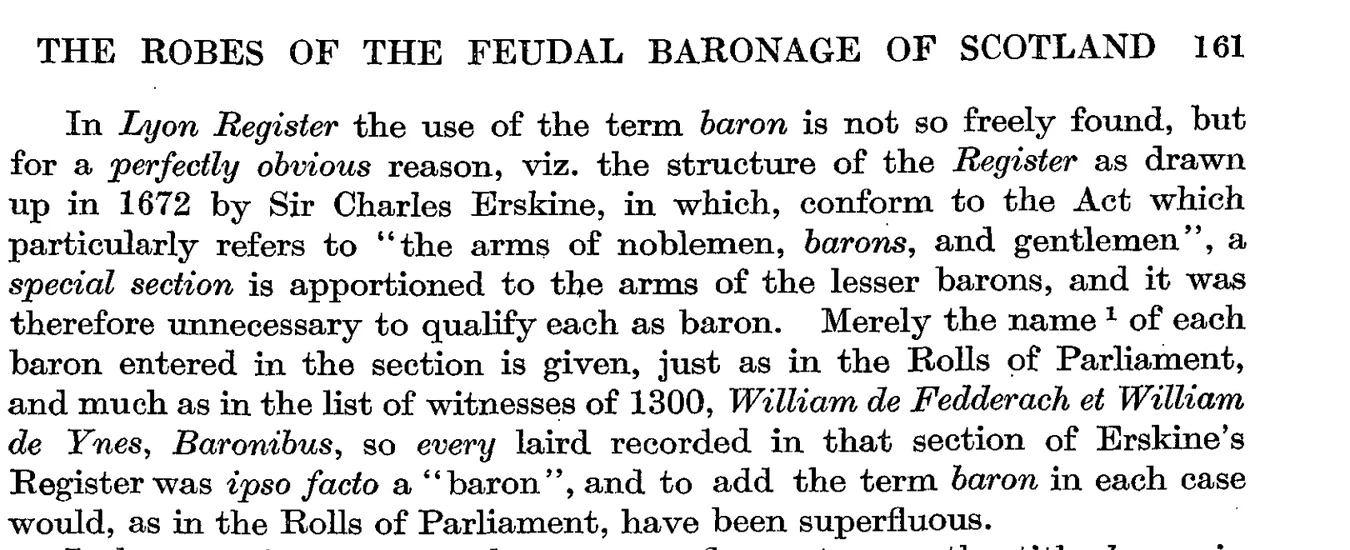
Once entries were made in date order, a change Innes dates to a recommendation of Lord Coulston in 1764, a baron’s status had to be written into the entry itself. Innes cites examples from the Register: “Sir Alexander Colquhoun, Baron of Colquhoun”, Sir George Brisbane, Baron of Brisbane, and “Aylmer Hunter, Baron of Hunterston”.43 The Lyon Court’s second register, of genealogies and birthbriefs, used the title freely. The Innes birthbrief, recorded in an earlier volume that no longer survives, is subscribed by the Lord Lyon, Sir Alexander Erskine, “Ego Alexander Areskinus Baro de Cambo”, and names ancestors’ wives as daughters of the “Baronis de Fyvie” and the “Baronis de Gight”.44 In the surviving volumes of that register Innes found Lord Lyon Brodie styling himself Baron of Brodie, and in almost every birthbrief with baronial ancestors found them described as “A.B. Baro de C.”, a usage he follows into the nineteenth century.45 By his account the Lyon Court’s documents used “simply ‘Baron of X’ down to late in the nineteenth century”; the longer “Baron of the Barony of X” appeared in a matriculation of 1932, and the plain form was “since resumed”, as in the Esslemont matriculation of 1934.46
The same records show how much more often the Lyon Court dealt in names than in titles. In Gordon of Hallhead’s case it was calculated that baronial registrations made up “about 7½ per cent” of the Register.47 The Rolls of the Chiefs and Heads of Territorial Houses that the Court printed in the Edinburgh Gazette from 1951 to 2005 recognised names with their territorial designations, and until 1967 had no mark for a baron at all. Even after a mark for a minor baron was added, roughly one entry in five carries it in the notices to 1979.48
What the record shows
A Scottish baron had a name and a title. “Rose of Kilravock” was his name, the surname with its territorial designation, and the everyday form: the Lyon King of Arms Act of 1672 afterwards set it for subscription, allowing all but peers and bishops to sign with their surnames and to “adject the designations of their lands prefixing the word ‘of’”.49 “Baron of Kilravock” was his title, the dignity, used by sovereigns, regents and peers in address and by the lairds themselves when the barony was in point. To be named by the one was not to lose the other: Hugh Rose used both in the same bond. The two need not share a place-name, as Hallhead and Esslemont show, and since 2004 many barons have the title with no territorial designation at all.
That is why the question could be argued for centuries from genuine records on both sides. A charter or a bond will usually show the name; a royal letter will often show the title. The Lyon Court’s own registers recorded barons as barons: in a section of their own from 1672, by title in the entries from the later eighteenth century, and as Baro de in the birthbriefs. The style the Court confirmed in 1934 and 1943 was not new; it is the style the sovereigns themselves used. For the words themselves, see Lairds, lords and barons; for the Lyon Court’s change of view, Untitled or titled nobility?; for the form recorded in 1934, The Esslemont petition of 1934.
Notes
- Sir George Mackenzie, The Science of Herauldry (1680), in Works, vol. ii (1722), pp. 549–550. ↩
- J. H. Stevenson, quoted in Lord Lyon Sellar’s Note in Sturzenegger of Arran, p. 8. ↩
- Innes of Learney, PSAS vol. 79, pp. 157–161; the interlocutor of 26 February 1943 (Lord Lyon Sir Francis Grant) is printed at p. 143 n. 3. ↩
- Innes of Learney, PSAS vol. 79, p. 161 n. 1: “The ‘Name’ including territorial designation in accordance with Scots Law.” On the territorial designation, see Lairds, lords and barons. ↩
- Innes of Learney, PSAS vol. 79, p. 144. ↩
- Registrum Magni Sigilli, vol. V, no. 1727, Holyrood, 6 May 1590, pp. 591–592; clause at p. 592, where the abstract gives only “titulum et statum liberi baronis de S.”. The fuller clause is from the charter as quoted in James Maidment, Reports of Claims Preferred to the House of Lords in the Cases of the Cassillis, Sutherland, Spynie, and Glencairn Peerages (Edinburgh, 1840), Spynie report, p. 4. ↩
- Abolition of Feudal Tenure etc. (Scotland) Act 2000, s. 63(2), in force 28 November 2004. ↩
- Lord Lyon Sellar, Guidance regarding Territorial Designations, 5 January 2010, reproduced in D. D. Campbell, Scottish Armory and Heraldry: A General Overview (rev. 12 January 2019), pp. 50 and 84. ↩
- Innes of Learney, PSAS vol. 79, p. 159. On the petition that recorded him as Baron of Esslemont, see The Esslemont petition of 1934. ↩
- Lord Lyon’s general guidance on baronial additaments, 5 January 2010, reproduced in Campbell (2019), p. 83; Letters Patent of 15 December 2010, Public Register of All Arms and Bearings, vol. 89, p. 78, on an assignation recorded in the Scottish Barony Register on 10 March 2009. The patent is reproduced in Barons in the Lyon Court’s own words. ↩
- Lyon King of Arms Act 1672, RPS 1672/6/57. ↩
- A Genealogical Deduction of the Family of Rose of Kilravock (1848): Huntly, 27 July 1570, p. 253; the Regent Moray, 24 April 1569, p. 250; Antiquities of the Shires of Aberdeen and Banff, vol. III, p. 102 (1487). ↩
- The Scots Peerage, ed. Sir James Balfour Paul, vol. iv (1907), “Forbes, Lord Forbes”, p. 49: “Between October 1444 and July 1445 Sir Alexander Forbes, knight, was raised to the Peerage, as he is at the first date styled ‘of that Ilk,’ and in a writ of 1 July 1445 he is styled LORD FORBES.” ↩
- Rolls of the Chiefs and Heads of Territorial Houses, Court of the Lord Lyon, as printed in the Edinburgh Gazette: “Grant of Grant”, Lord Strathspey, dated 6 March 1950 (16 January 1951, p. 28); “Johnstone of Annandale and of that Ilk”, the Earl of Annandale and Hartfell, dated 29 January 1986, and “Borthwick of that Ilk”, Lord Borthwick, dated 20 June 1986 (5 September 1986, p. 1338). The Gazette did not print every recognition, and its tables are not free of error, so these are examples, not a complete list, and the dates are as printed. ↩
- A Genealogical Deduction of the Family of Rose of Kilravock (Spalding Club, 1848), archive.org. In the scan, the leaf is the printed page plus 27. ↩
- Counted by hand from the text of the 1848 edition, excluding uses of “barony” for the estate. The figures are close approximations; a handful of cases could be classed either way. ↩
- Mary Queen of Scots, Aberdeen, 3 November 1562, p. 239; writ of 24 April 1567, p. 248. Innes of Learney (PSAS vol. 79, p. 158) prints Mary’s address as “Our traist friend the barroun of Kylrawak”, citing p. 220 of the 1848 edition; the letter on that page, of 27 June 1555, is signed “Marie R.” at Edinburgh while Mary was in France, and is her mother’s, as Queen Regent. Mary’s own letter of 1562 bears the same address. ↩
- Mary of Guise, Queen Regent: 27 June 1555, p. 220, “To our traist ffrend the Barroun of Kylrawach”; 12 May 1557, p. 223, the words quoted; 10 August 1559, p. 228, “To our traist freind the Barroun of Kilrawak”. ↩
- Huntly’s undated letters, p. 217 and p. 234; 15 July 1567, p. 249; 27 July 1570, p. 253. ↩
- p. 250. The letter is dated at Edinburgh, 24 April 1569, and subscribed “Youre gude freind James Regent”; the writ that follows it is undated. ↩
- Bond with James Ogilvy of Cardell and others, at Spynie, 1 May 1545, p. 213. ↩
- The ransom bond, p. 214 (opening) and p. 215 (subscription, “at the Torwodlie”, 24 October 1547). ↩
- Agreement of 25 June 1577, p. 269. ↩
- p. 308: memorandum of 22 June 1621 and the Earl of Moray’s letter of 22 June 1618. ↩
- Funeral accounts and Lord Lovat’s letter, January–February 1732, p. 407. ↩
- Licence by John of Isla, Earl of Ross and Lord of the Isles, 18 February 1460, p. 135. ↩
- Charter by Alexander Sutherland of Duffus, p. 136; undated on the page, and printed after the licence of 1460. By contrast the Great Seal confirmation of 11 March 1475, p. 138, names “Hugoni le Ross de Kylrawak” and confirms to him “terras baronie de Kilrawak”, the barony there being the land. ↩
- Antiquities of the Shires of Aberdeen and Banff, vol. IV, p. 386, A.D. 1421. ↩
- Ibid., vol. IV, p. 390, “Carta Willelmi de Forbes militis super terris de Kynnaldy”, abridged by the editor from the Register of the Great Seal (lib. iii, no. 39); date clause at p. 391, “apud Inuernys xxvijo die mensis Julij … millesimo quadringentesimo xxix”. On Alexander’s peerage and his brother William of Kynnaldy, The Scots Peerage, ed. Sir James Balfour Paul, vol. iv (1907), pp. 49 and 69. ↩
- Ibid., vol. IV, p. 402, bond of manrent, 1467. ↩
- Registrum Magni Sigilli, vol. iv, no. 234, p. 57: confirmation “Apud Monast. de Hadingtoun, 24 Jul.” 1548 of a charter given at Clune on 15 June 1548. The Antiquities of the Shires of Aberdeen and Banff, vol. IV, p. 657, summarises it as by “John Forbes of Petslego, baron of the barony of Kynawde” and dates the confirmation 4 July; the Register reads “baronis de Kynawde” and 24 July. ↩
- Antiquities of the Shires of Aberdeen and Banff, vol. IV, p. 370, “Litera prosapiae Alexandri Donaldsoun medicine doctoris”, dated at Edinburgh, 15 November 1642. A diploma of Charles II of 17 June 1669 similarly names “Domini Joannis Vrrie comarchi seu baronis de Pitfichie”: vol. III, p. 501. ↩
- The Family of Burnett of Leys: “Alexander Burnet de Leyis”, p. 183; p. 11; p. 72. ↩
- Ibid., charter X, 2 March 1458–9, p. 163. ↩
- Ibid., charters VI and VII, p. 158 and p. 159; the editor’s abstract renders the first as “Lord of the Barony of Coule and Onele”. Innes of Learney cites this charter, PSAS vol. 79, p. 158 n. 2. ↩
- Antiquities of the Shires of Aberdeen and Banff, vol. III, p. 99, A.D. 1474. ↩
- Ibid., vol. III, pp. 145–146 (1483); vol. II, p. 360 (1470); vol. III, p. 102 (confirmation of 13 July 1487). ↩
- Innes of Learney, PSAS vol. 79, p. 158 and n. 2. ↩
- See The Esslemont petition of 1934. ↩
- Counted in the archive.org text of all four volumes, vol. I included, excluding uses of “barony” for land. The text is nineteenth-century OCR; two independent scans of the same volumes differ by up to about a tenth, and two counting methods gave different ratios for the second and fourth volumes, so the lower figures are given and all are indicative. ↩
- Innes of Learney, PSAS vol. 79, p. 161. ↩
- Sir James Balfour Paul, An Ordinary of Arms contained in the Public Register of All Arms and Bearings in Scotland (2nd ed., 1903), Introduction, p. xv. ↩
- Innes of Learney, PSAS vol. 79, p. 161 and nn. 2–5: Lyon Register, vol. i, pp. 528, 529 and 507, in the part of the volume filled after the change to chronological entries. The manuscript Register is not published, and Balfour Paul’s Ordinary, an index of blazons, does not print the style, so these entries rest on Innes’s reading. ↩
- Ane Account of the Familie of Innes (Spalding Club, 1864), p. 45 and p. 47; Innes of Learney, PSAS vol. 79, p. 160 and n. 2. ↩
- Innes of Learney, PSAS vol. 79, p. 160 and nn. 3–5, citing the Register of Genealogies, vol. i, p. 1 (Brodie) and vol. iii, pp. 20, 24 and 44 (Leslie of Balquhain, 18 January 1861; “Joannes MacDonell, Baro de Lochgarry”). ↩
- Innes of Learney, PSAS vol. 79, p. 158 n. 2 (Fraser of Reelig, 10 February 1932, “Baron of the Barony of Moniack”); see The Esslemont petition of 1934. ↩
- Innes of Learney, PSAS vol. 79, p. 155 n. 4. ↩
- Counted from the thirteen notices of 24 January 1967 to 16 November 1979: about 38 of some 180 entries carry the mark (two notices are poorly scanned and counted approximately); the notice of 15 March 1968, the first to use it, marks four of sixteen. The share grew later: 18 of 34 entries in 2002 and 38 of 57 in 2005. The mark shows arms matriculated with a chapeau as a minor baron, so an unmarked entry is not proof that the holder was not a baron, and the notices printed only part of the Court’s work. See Officially Recognised: the Lyon Court’s Rolls in the Gazette. ↩
- Lyon King of Arms Act 1672, RPS 1672/6/57; see Lairds, lords and barons. ↩