
The Lyon Court
Barons in the Gazette
Thirty-six Court of the Lord Lyon notices in The Edinburgh Gazette, 1951 to 2005, and the one word none of them ever used
5 min read · Reviewed September 2026 · The Reading Room

Between 1951 and 2005 the Court of the Lord Lyon published thirty-six notices in The Edinburgh Gazette, each a list of names it had officially recognised. Most of those named were not barons. A dagger against a name marked a Minor Baron. Not one notice uses the word “feudal”.
The Gazette notices
The Edinburgh Gazette is Scotland’s edition of The Gazette, the United Kingdom’s official public record.1 From 1951 to 2005 the Court of the Lord Lyon published its recognitions there, in thirty-six notices.2 Each named the people “Officially Recognised by the Lord Lyon King of Arms in matriculating for them Arms ‘of that description’”: recognised, that is, in the name printed beside their entry.3
The first notice, of 16 January 1951, continued an unpublished roll “for the years 1866-1948 compiled for the Lord Chamberlain’s Department in 1948”.4 The notices kept no fixed schedule; once almost six years passed without one.5 The Lyon Clerk signed each.6 The last appeared on 19 August 2005, and no explanation of why the series stopped has been found.7
These were official acts, and the Gazette treats them as such. Its own record files the notices under “State”, as “Change of Name and/or Arms”.8 On the printed page they are headed “Court of the Lord Lyon” from 1968.9
A designation is not a barony
A territorial designation is the “of X” added to a surname, taken from land its owner holds. It does not make anyone a baron. Most of the people named in the Gazette notices were not barons: in the notice of 15 March 1968 only four of the sixteen entries carry the baron’s mark.10 The right goes back to the Lyon King of Arms Act 1672, which let anyone who was not a nobleman or bishop “adject the designations of their lands prefixing the word ‘of’”.11 How that practice developed is set out more fully in Lairds, lords and barons. The Gazette notices record the next step: the Lord Lyon’s official recognition of the name with its designation, once arms have been matriculated in it.3
The Minor Baron and the chapeau
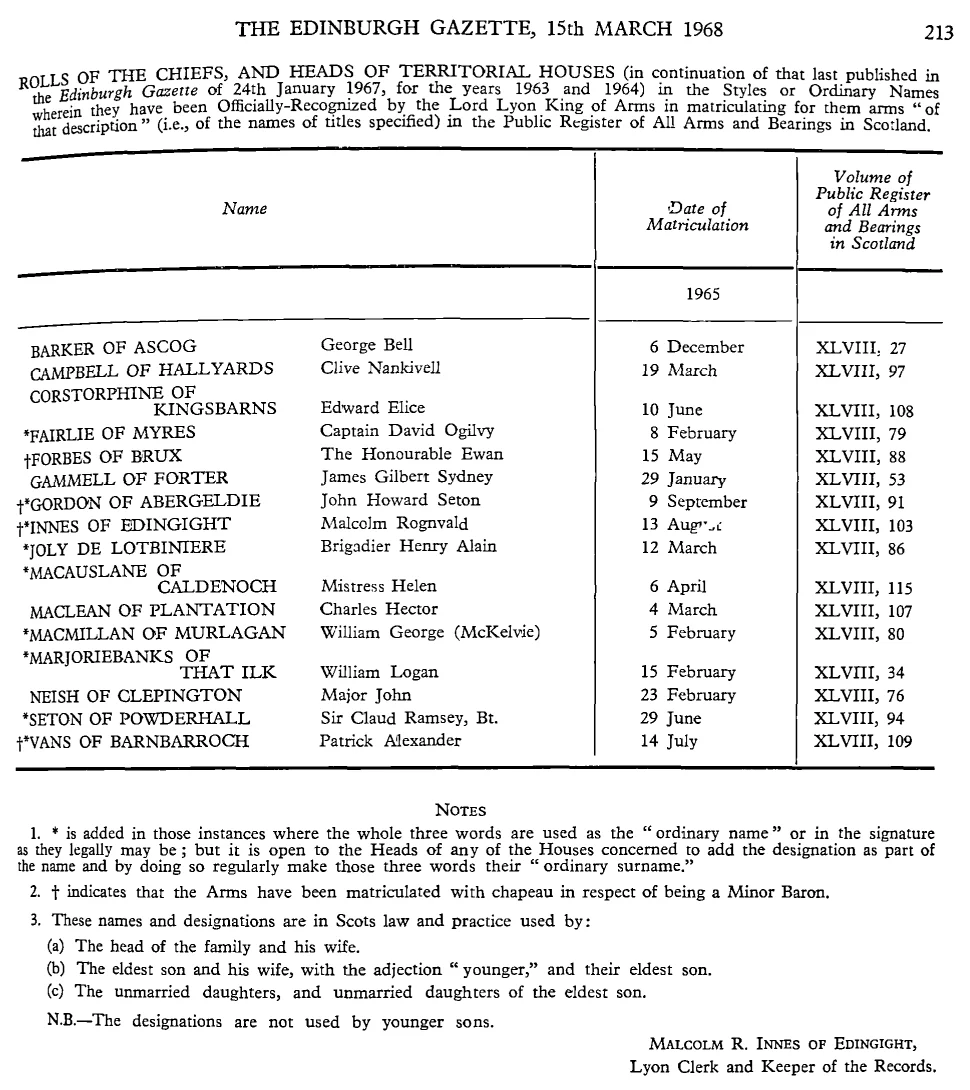
From 24 January 1967 the notices carried a new note: “† indicates that the Arms have been matriculated with chapeau in respect of being a Minor Baron.”12 No entry in that issue actually carried the mark yet. The first to do so was the notice of 15 March 1968, where four names were daggered: Forbes of Brux, Gordon of Abergeldie, Innes of Edingight and Vans of Barnbarroch.10
The chapeau itself, the baron’s cap of maintenance, had been settled as the baronial mark by the Lord Lyon’s decision of 4 September 1934, in the petition of Gordon of Hallhead, Baron of Esslemont, told in full in The Esslemont petition of 1934.13 “Minor” in Minor Baron does not mean small. It means the barons below the peerage, the barones minores. In 1943 the Lyon Court declared that the minor barons “are, and have been both in this nobiliary Court and in the Court of Session recognised as a ‘titled nobility’”. That was not a new finding but an old position made plain, as Untitled or titled nobility? sets out.14 The mark itself did not stay fixed. It was a dagger in 1968, a different, curled glyph in 1984, and a slashed “ø” in several notices between 1986 and 2000, among them the one of 17 May 1988.15 Through all of that the note explaining it barely changed.15
Three ways a baron appears
| Pattern | Example | Date |
|---|---|---|
| Designation the same as the barony: the name and the mark alone, shorthand for “Forbes of Brux, Baron of Brux” | †Forbes of Brux | 15 March 1968 |
| Designation different from the barony, both printed | †Teall of Teallach Baron of Huntly | 4 April 1997 |
| No designation, the barony printed on its own | øHolman, Baron of Rickarton | 17 May 1988 |
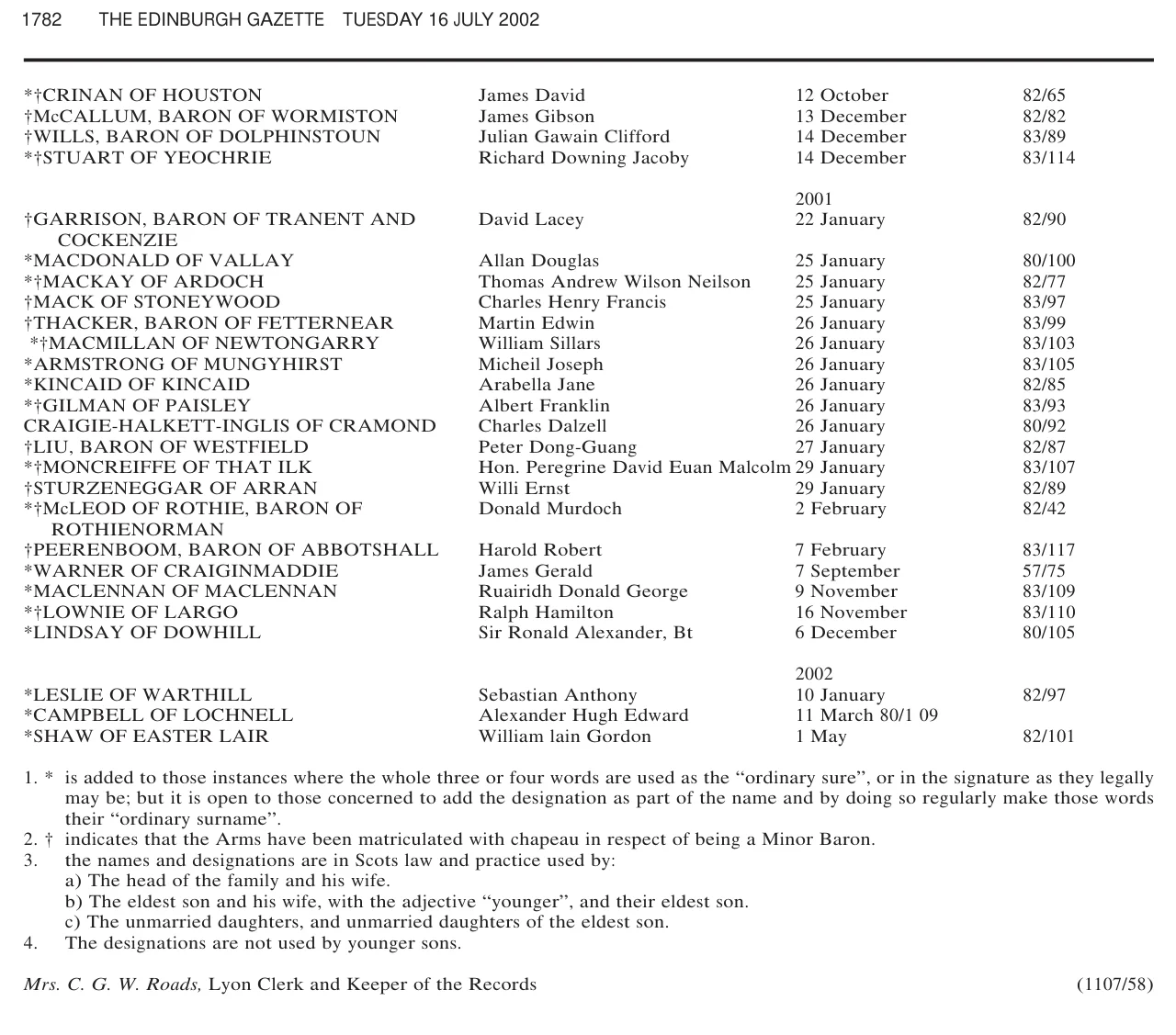
Most entries take the first form, which is shorthand. When a baron’s designation was already his barony’s name, the Gazette printed the name once with the mark: “†Forbes of Brux” in 1968, or “†Sturzeneggar of Arran” in 2002.16 In full these would read “Forbes of Brux, Baron of Brux” and “Sturzeneggar of Arran, Baron of Arran”. Irvine of Drum shows it. His matriculation of 25 November 1992 names him “Baron of Drum in the County of Aberdeen”. The Gazette of 26 April 1994 prints only “ø*Irvine of Drum”, with the same date and register page.17 The mark saved printing the word twice.
Sometimes the two differed, and then the Gazette printed both. Dennistoun Gordon Teall’s designation was Teallach, not Huntly, so the 1997 notice reads “†Teall of Teallach Baron of Huntly”.18 The 2002 notice does the same: “*†McLeod of Rothie, Baron of Rothienorman”.19 Huntly and Arran are themselves non-peerage earldoms, a separate subject covered in Non-peerage earldoms.
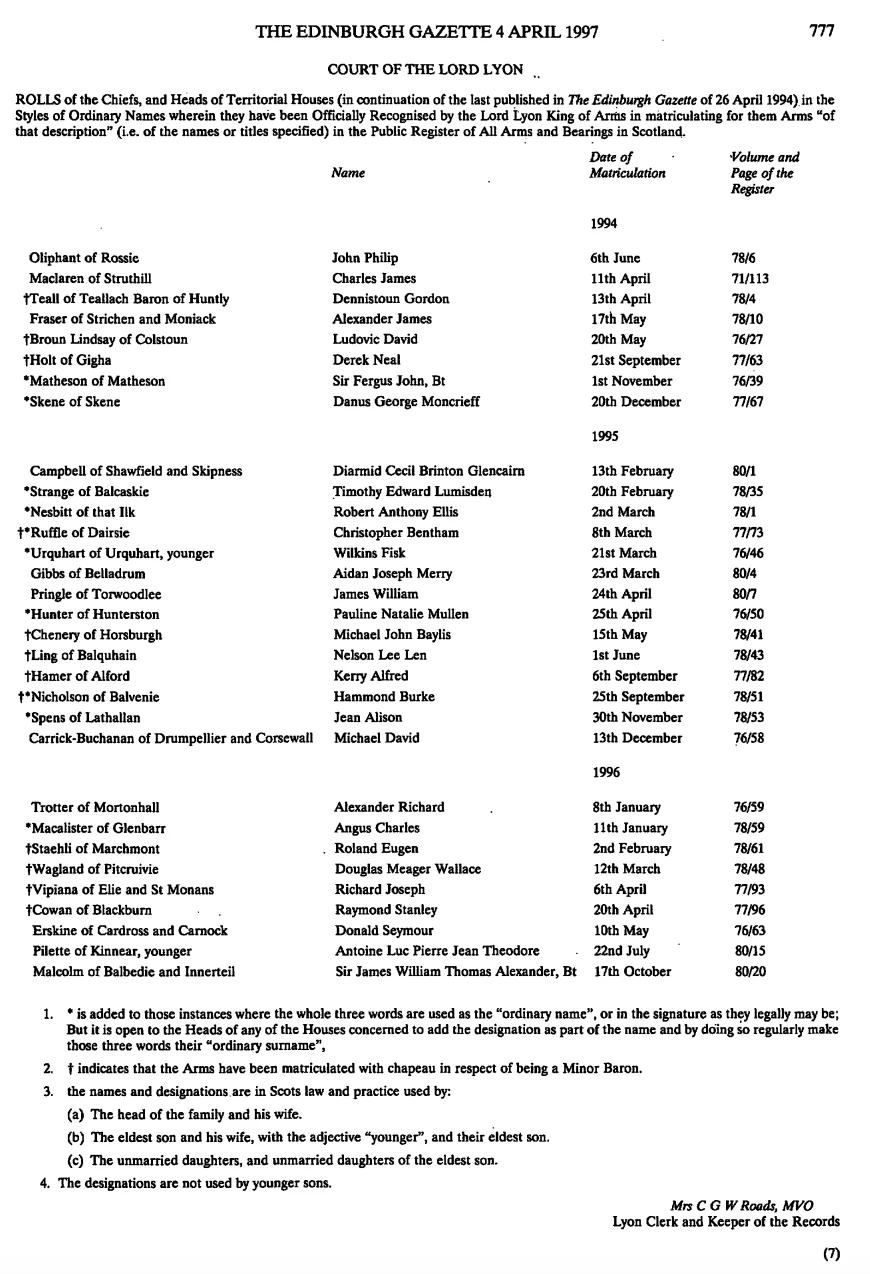
Some barons carried no separate territorial designation at all, and for them the Gazette printed the barony on its own next to the mark. The earliest found is “øHolman, Baron of Rickarton” in the notice of 17 May 1988.20 The 2002 notice gives “†Thacker, Baron of Fetternear”, on the same page as the Sturzeneggar and McLeod of Rothie entries above.21
Not every baron was gazetted
The Gazette is a partial record. A name appears only where arms were matriculated in it, and only while the series ran. Some barons were gazetted and others were not. That was so in earlier times too. The first notice continued a roll for 1866 to 1948 compiled for the Lord Chamberlain’s Department, and no Gazette notice of that roll has been found. Barons recognised in those years, such as Gordon of Hallhead, Baron of Esslemont, in 1934 and Wauchope of Niddrie in 1945, appear in no notice.22 Nothing was gazetted after 2005, so barons recognised in Letters Patent of 2007, 2010 or 2018 appear in no notice.23
So a Gazette entry is good evidence, but its absence proves nothing. The Roll of Scottish Barons accepts other Lyon Court and government records as well.
Not once “feudal”
The word “feudal” does not appear in any of the thirty-six notices. Every notice page, from 1951 to 2005, was searched for it. It was not found once, not even in the note that explains the Minor Baron’s mark.24
The Lyon Court’s own word, in the Gazette, was always “Minor Baron”. When the series began in January 1951, Sir Thomas Innes of Learney had been Lord Lyon for some years. The notices are signed by his Lyon Clerk, not by him.425 About five years earlier, in 1945, Innes of Learney had given his own paper to the Society of Antiquaries of Scotland, and titled it “The Robes of the Feudal Baronage of Scotland”.26 The Gazette never used his word. Why “feudal” is the wrong word for a barony today is set out in Scottish Baronies, Explained.
Notes
- The Gazette’s own “About” page describes it as “the UK’s official public record” and “the UK’s official journals of record”, comprising The London Gazette, The Belfast Gazette and The Edinburgh Gazette, published under the superintendence of HM Stationery Office: thegazette.co.uk/about. ↩
- Count of notices located by a search of the Gazette’s own archive for the Court of the Lord Lyon’s notices, Edinburgh edition, 1951–2010: twenty-one from 16 January 1951 (issue 16821, p. 28) to 16 November 1979 (issue 20598, p. 1276), then fifteen from 6 March 1981 (issue 20866, p. 291) to 19 August 2005 (issue 25893). A further search of 2006–2010 found no additional notice in the series. ↩
- The Edinburgh Gazette, 15 March 1968, issue 18650, p. 213: “ROLLS OF THE CHIEFS, AND HEADS OF TERRITORIAL HOUSES … in the Styles or Ordinary Names wherein they have been Officially-Recognized by the Lord Lyon King of Arms in matriculating for them arms ‘of that description’ (i.e., of the names of titles specified) in the Public Register of All Arms and Bearings in Scotland.” Data.pdf. The wording varies slightly from notice to notice (for example “Roll”, singular, in 2002 and 2005), but this clause is constant in substance throughout the run. ↩
- The Edinburgh Gazette, 16 January 1951, issue 16821, p. 28: “ROLL OF THE CHIEFS, AND HEADS OF TERRITORIAL HOUSES (in continuation of that for the years 1866-1948 compiled for the Lord Chamberlain’s Department in 1948) …”, signed “H. A. B. LAWSON, Lyon Clerk and Keeper of the Records”. Data.pdf. Lawson’s last signed notice in this run is 27 May 1966, issue 18460, p. 430: data.pdf. ↩
- The Edinburgh Gazette, 1 July 1958, issue 17623, pp. 386–387 (data.pdf), states it continues the notice of 9 March 1956; the next notice is 16 June 1964, issue 18254, p. 394 (data.pdf), a gap of just under six years. No notice was found for 1978: the chain runs from 8 November 1977, issue 20182, pp. 1225–1226 (data.pdf), straight to 16 November 1979, issue 20598, p. 1276 (data.pdf). None was found for 1980 either: the next notice after 16 November 1979 is 6 March 1981, issue 20866, pp. 291–292 (data.pdf). ↩
- Malcolm R. Innes of Edingight first signs the notice of 24 January 1967, issue 18530, p. 59 (data.pdf). John I. D. Pottinger signs the notice of 17 January 1984, issue 21460, p. 51 (data.pdf), and that of 4 January 1985. Mrs C. G. W. Roads first signs the notice of 5 September 1986, issue 22004, pp. 1337–1338 (data.pdf), and signs every notice located thereafter to 19 August 2005. One intervening notice, 19 October 1982, issue 21205, p. 1512, is signed too, but the signature is not legible on the scan; only the title, “Lyon Clerk and Keeper of the Records”, is clear, and no name beyond these four was found anywhere in the run. ↩
- The Edinburgh Gazette, 19 August 2005, issue 25893, “Roll of the Chief, and Head of Territorial Houses (in continuation of that last published in The Edinburgh Gazsette [sic] of 16 July 2002)”: notice record. Every notice in the run states that it continues the one before by date, without a break in the chain. No source, in the Gazette or found by general search, states why or exactly when the Court decided to stop; this is an absence in the sources checked, not a documented statement of cessation. ↩
- 16 July 2002 notice, E-25256-1107-58: Notice category “State”, Notice type “Change of Name and/or Arms”, Notice code 1107. 19 August 2005 notice, E-25893-1107-293: Notice category “State” per the Gazette’s own metadata. Neither the 2002 nor the 2005 printed page carries a “State” rubric. ↩
- The Edinburgh Gazette, 19 April 1968, issue 18660, p. 326 (data.pdf), is the first notice with the super-heading “COURT OF THE LORD LYON” printed above the notice heading. No such heading appears on any notice from 16 January 1951 to 15 March 1968; each simply follows whatever unrelated notice precedes it on the page, for example 16 January 1951, issue 16821, p. 28. ↩
- The Edinburgh Gazette, 15 March 1968, issue 18650, p. 213: Forbes of Brux (The Honourable Ewan, matriculated 1965, Vol. XLVIII p. 88), Gordon of Abergeldie (John Howard Seton, 9 September 1965, Vol. XLVIII p. 91), Innes of Edingight (Malcolm Rognvald, matriculated 1965, Vol. XLVIII p. 103) and Vans of Barnbarroch (Patrick Alexander, 14 July 1965, Vol. XLVIII p. 109). Data.pdf. The notice has sixteen entries. ↩
- Records of the Parliaments of Scotland, 1672/6/57, “Act concerning the privileges of the office of lyon king at arms”: “And his majesty, with consent foresaid, declares that it is only allowed for noblemen and bishops to subscribe by their titles, and that all others shall subscribe their christened names, or the initial letter thereof, with their surnames, and may, if they please, adject the designations of their lands prefixing the word ‘of’ to the said designations.” rps.ac.uk. ↩
- The note is worded identically from its introduction in the notice of 24 January 1967, issue 18530, p. 59 (data.pdf), through the notice of 16 November 1979: “† indicates that the Arms have been matriculated with chapeau in respect of being a Minor Baron.” Quoted here from the notice of 15 March 1968, issue 18650, p. 213. ↩
- Sir Thomas Innes of Learney, “The Robes of the Feudal Baronage of Scotland”, PSAS 79 (1944–45), p. 154: “the Lord Lyon, on 4th September 1934, found the claim established, and awarded the chapeau”, recording the petitioner as “Baron of Esslemont” (Lyon Register vol. xxxi, p. 20). Open access PDF. ↩
- Court of the Lord Lyon, interlocutor of 26 February 1943, Public Register of All Genealogies and Birthbrieves, vol. iv, p. 26: the Minor Barons of Scotland “are, and have been … recognised as a ‘titled nobility’”. Printed in Innes of Learney, PSAS 79, p. 143 n. 3. ↩
- Dagger, visually confirmed: 15 March 1968, issue 18650, p. 213. A third, distinct curled glyph, not a dagger and not “ø”, visually confirmed in the notice of 17 January 1984, issue 21460, p. 51. “Ø” (o with stroke), visually confirmed in the notice of 17 May 1988, issue 22351, pp. 732–733 (data.pdf), and in several other notices between 1986 and 2000. The explanatory sentence itself is verbatim-identical from 24 January 1967 to 16 November 1979, and close to it (with a shorter phrasing used for a few notices in the 1980s) throughout 1981–2005. ↩
- Forbes of Brux, as at note 10 above. Sturzeneggar of Arran (Willi Ernst, matriculated 29 January 2001, register 82/89): The Edinburgh Gazette, 16 July 2002, issue 25256, p. 1782. Data.pdf. ↩
- Extract of Matriculation of the Arms of David Charles Irvine of Drum, matriculated 25 November 1992, Public Register of All Arms and Bearings in Scotland, vol. 72, p. 83, reproduced in Barons in the Lyon Court’s own words; The Edinburgh Gazette, 26 April 1994, issue 23567, p. 970: “Irvine of Drum”, David Charles, 25th November [1992], 72/83, marked ø and * — Gazette page. ↩
- Teall of Teallach Baron of Huntly (Dennistoun Gordon, matriculated 13 April 1994, register 78/4): The Edinburgh Gazette, 4 April 1997, issue 24169, p. 777. Data.pdf. ↩
- McLeod of Rothie, Baron of Rothienorman (Donald Murdoch, matriculated 2 February 2001, register 82/42): The Edinburgh Gazette, 16 July 2002, issue 25256, p. 1782, printed exactly as “*†McLEOD OF ROTHIE, BARON OF ROTHIENORMAN”. Data.pdf. ↩
- Holman, Baron of Rickarton (John Francis, matriculated 29 January 1987, register 68/96): The Edinburgh Gazette, 17 May 1988, issue 22351, p. 733. Data.pdf. This is the earliest instance of this pattern found. ↩
- Thacker, Baron of Fetternear (Martin Edwin, matriculated 26 January 2001, register 83/99): The Edinburgh Gazette, 16 July 2002, issue 25256, p. 1782. Data.pdf. ↩
- The Edinburgh Gazette, 16 January 1951, issue 16821, p. 28 (“in continuation of that for the years 1866-1948 compiled for the Lord Chamberlain’s Department in 1948”); the search of the Gazette for this paper found no notice earlier than 1951. For Esslemont (4 September 1934) and Niddrie (19 April 1945) see The Esslemont petition of 1934. ↩
- The last notice is that of 19 August 2005. Letters Patent of 30 May 2007, 15 December 2010 and 29 October 2018 are reproduced in Barons in the Lyon Court’s own words. ↩
- Method: a text search, case-insensitive, for “feudal” across every located page of all thirty-six notices, 16 January 1951 to 19 August 2005. No instance was found. The scan of 1 July 1958, issue 17623, pp. 386–387, and the scan of 8 November 1977, issue 20182, pp. 1225–1226, are too degraded to read with full confidence, so this is reported as a search of the readable text rather than a certainty for those two pages specifically. ↩
- Sir Thomas Innes of Learney signs his 1945 paper “LORD LYON KING OF ARMS”, dated “Read October 27, 1945”, about five years before the Gazette series is documented from 1951. PSAS 79 (1944–45), p. 111. Open access PDF. ↩
- Sir Thomas Innes of Learney, “THE ROBES OF THE FEUDAL BARONAGE OF SCOTLAND. BY THOMAS INNES OF LEARNEY AND KINNAIRDY, F.S.A.Scot., LORD LYON KING OF ARMS. Read October 27, 1945”, Proceedings of the Society of Antiquaries of Scotland, vol. 79 (1944–45), p. 111ff. Open access PDF. ↩