Law & Statutes
“Never ceded”: the precedence of a Scottish baron
The King set his baronets before the barons in 1625, and the barons fought it. They shared a name and a red robe with the lords of parliament, and in 1665 Charles II gave a coronet to “the barons and lords of Parliament”
11 min read · Reviewed October 2026
Baronage of Scotland Association · The Reading Room · www.baronage.com/reading-room/the-precedence-of-a-scottish-baron/

Where does a Scottish baron rank? The Crown gave an answer in 1625, when it set its new baronets before the barons. The barons took the matter to the Estates. This paper sets out what the record fixes, what it leaves open, and what the law keeps today.
The short answer
- A baron ranks before esquires. The Stair Memorial Encyclopaedia, the standard work on Scots law, says so in a paragraph headed “The baronage”.
- The place rests on an Act of Parliament. In 1633 Parliament gave the baronets’ patents the force of statute. Those patents name the barons.
- The Crown named the rank in 1625. Each baronet’s patent sets him before all knights, and before all barons, esquires and gentlemen.
- The barons fought it, and “never ceded” it. The Estates voted to back their petition, and the King overruled them. Sir George Mackenzie records the claim still alive in 1680.
- “Lords and Barons were the same”, and were robed alike. “Of old”, Mackenzie says. “Baron” was then the common name of the whole nobility, as “peer” is now. The Act of 1455 gave the lords of parliament one red mantle, which Lord Lyon Innes of Learney read as the barons’, great and small.
- Charles II gave a coronet to “the barons and lords of Parliament”. His warrant of 1665 names both. The Baronage of Scotland Association does not claim the coronet today: a baron’s own mark is the chapeau.
- The Scale of 1905 left the baronage out. Its “Barons of Scotland” are the lords of parliament, under the name that rank has had since the Union. The Stair Encyclopaedia says barons have “an undoubted precedence by the law of Scotland”, and that the Lord Lyon has a duty to give them their place.
- The law keeps the precedence. The Act of 2000 saves “any quality or precedence associated with” the dignity of baron.
Named by the King, 1625
Charles I created the first baronets of Scotland in 1625. The patent of the first, Sir Robert Gordon, gives him place
“before all knights … and before all barons, called lairds, esquires, and gentlemen whatsoever”
Patent of Sir Robert Gordon, baronet, 28 May 1625, translated from the Latin
The patent is in Latin, with the Scots word set beside it: “baronibus, lie Lairdis”.1 Sir George Mackenzie, the King’s Advocate, put the clause into English in 1680: “before all Knights, called equites aurati, all lesser Barons, commonly called Lairds, and before all other Gentlemen”.2
So the Crown’s own instrument names the barons as a rank, and sets the baronet above them. It does not rank the barons against the knights or the esquires. A charter of the same year lists the esquires first.3
The barons object
The barons did not accept it.
- 1625: the barons petitioned. The “small Barronis”, the barons who were not lords of parliament, told the Convention of Estates that the baronets’ precedence over every small baron and freeholder prejudiced their “priviledgeis and dignityis”, held in all ages past.4
- 1625: the Estates took their side. Having heard both parties, they voted by a majority to join the barons in asking the King to suspend it.4
- 1626: the King overruled them. He called the petition derogatory to his royal prerogative, and told the Laird of Traquair to take a baronetcy himself or “compleane no more”.5
- 1630: the Estates ratified the baronets’ “dignity, place and precedence”.6
- 1633: Parliament ratified it again, this time by Act.7
So the baronets kept their place, and keep it. The record also shows how the barons saw their own: as privileges and dignities, held time out of mind.
“Never ceded”
“The old Barons (or Lairds) amongst us, especially where they are Chiefs of Clans, or the Representatives of old Families that were Earldoms … have never ceded the Precedency to Knights Baronets, much less to ordinary Knights”
Sir George Mackenzie, 1680
Mackenzie gives both sides in the one sentence. The other side said “that a Baron is no Name of Dignity”, and “generally it is believed, that next to Knights Baronets succeed Knights Batchellors, and next to them our Lairds or landed Gentlemen”.8 Elsewhere he says the old barons yield to the baronets “with some Reluctancy”, and gives their reason: they were “originally heritable Counsellers to the King, as Members of Parliament”.9
So in 1680 the old claim was still alive, and the common view put the barons next after the knights.
The Lyon Register, begun in 1672, groups them the same way. After the prelates and the nobility come “the bearings of the Knights Baronet, Knights Bachelor, and Barons”, in one alphabet, and after them the “Gentlemen”.10 Lord Lyon Innes of Learney drew the conclusion in 1945: “Their precedence was thus after Knights and before Esquires.”11
The place in the law books
The Act of 1633 is the root of it. These are not our words but Parliament’s:
“… the said dignitie, title, and order of Baronets, and all letters patents and infeftments of Lands, and dignities granted therewith, to any person whatsoever, shall stand and continue in full force; with all liberties, priviledges and precedencies thereof, according to the tenour of the same.”
Act of Parliament, 1633
The patents are to stand as fully as if their words were written into the Act itself.7 Their words are part of the statute, and their words name the barons.
Two legal encyclopaedias read the baron’s place from it.
The Encyclopaedia of the Laws of Scotland of 1931 says the old Scots order of precedence below the baronet was given the effect of an Act of Parliament in 1633, and that the warrant of 1905 does not override it. It then takes the barons by name. They once ranked next to the knights. Under the Scale of 1905, with its newer degrees, “they can only rank before esquires”. The writer was Thomas Innes, Carrick Pursuivant, the later Lord Lyon.12
The Stair Memorial Encyclopaedia is the standard modern work. Its volume of 1995 has a paragraph headed “The baronage”. The baronage, it says, has a precedency established by Act of Parliament. Barons rank before esquires, and before doctors of divinity, law and physic. Among themselves they rank by the date on which their lands were erected into a barony. The writer was Sir Crispin Agnew of Lochnaw, Rothesay Herald of Arms.13
Stair adds that a right of precedence which comes from an Act of Parliament may well be one a court of law would enforce.14
“Lords and Barons were the same”
“Baron” was once the common name of the whole nobility, as “peer” is now. Mackenzie says so in terms: “Under the Word Baron all our Nobility are comprehended”.15 A Lord Lyon said the same two centuries later: “The Earls belonged to the order of Barons.”16 Dukes, earls and lords were the great barons, and held baronies of their own. The small barons had no greater title.
“With us here in Scotland there was no distinction of greater or lesser barons”, Nisbet wrote, “but all were admitted to come to Parliament who had a free barony”. An Act of James I then excused the small barons from coming: “Here we have the first distinction of small barons, and barons lords of Parliament”.17 Mackenzie: “of old I conceive that Lords and Barons were the same”. The old Acts put them “in one Column undistinguished, and under the common Name Barons”. “Now the Lords are called the great Barons, and the rest are called small Barons”.18 David Hume, professor of Scots law, wrote in 1800 of “the order of noblemen and other barons”, who were for long “truly one and the same”.19
Lord Forbes shows it. In 1429 the King erected Sir Alexander Forbes’s lands “in unam liberam baroniam de Forbes”, into one free barony of Forbes. He was a lord of parliament only from 1444 or 1445: a baron first, and a great baron after. Mackenzie’s roll of the lords begins with “Forbes Lord Forbes”.20 The Roll enters the present Lord Forbes as Baron of Forbes.
The King’s Scale of 1905 uses the word more narrowly. It lists “Barons of Scotland” among the peers, and the words “Lords of Parliament” are not in it.21
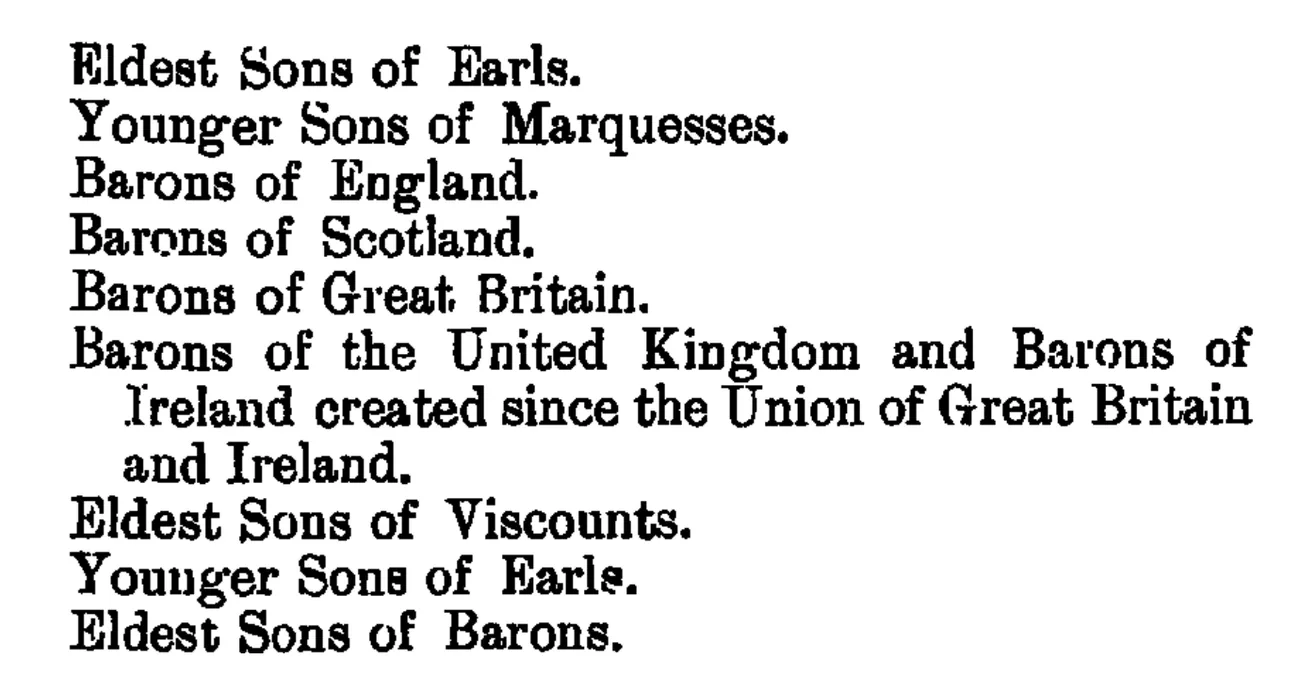
The Stair Encyclopaedia explains the name. The lowest rank of the Scottish peerage was “lord” before the Union, and has been “baron” since.22 So the Scale’s “Barons of Scotland” are the lords of parliament, under the name the Union gave their rank. The baronage itself is not in it.
Robed alike
Their dress shows the same. The Act of 1455, the first on robes, gave the earls “mantles of ‘grained’ brown”. “The other lords of parliament” were to have “a mantle likewise of red, open at the front”. The burgh commissioners had blue cloaks, “open on the right shoulder”.23
Lord Lyon Innes of Learney read “the other lords of parliament” as the barons, great and small: under the Act they “were robed alike”. The freeholders had no robe in the Act. Their cloak, he says, fastened with three buttons; the baron’s mantle had five.24 In 1606 a proclamation ordered “Dukes, Marquesses, Earls, Lordis, and Barronis” to have “robes to be made in red, lined white”.25 The pictures are in Robes & Chapeau.
The robe says what the name says. Great barons and small wore one mantle. The earls’ differed, and the freeholders had none.
The coronet of 1665
The lords of parliament had no coronet until 1665. In that year Charles II gave one, and his warrant has been read as giving it to every baron. The case is worth stating.
The warrant’s words are “the barons and lords of Parliament of this ancient kingdom”. It describes them as those “who had place and vote in Parliament, and all other public conventions, by heritable right”. That is how Mackenzie describes the barons: “of old they were all heritable Members of Parliament”.26 On that reading the cap “with a golden circle decorated with six pearls” was given to barons and lords alike. Nor did “peers” then mean the lords only. Mackenzie wrote in 1680 that the lesser nobility “be not Peers of Parliament, yet they are all Peers to one another”.15
The other reading is that the words name one body twice. The warrant goes on to speak of “those of the degree of peers”, who are to bear the cap as “the viscounts of this kingdom, and other peers of higher degree” bear their coronets. Mackenzie, fifteen years later, writes “the Barons or Lords of Parliament”.27
The Association does not press the point, and claims no coronet today. A baron’s own mark is the chapeau, the red cap turned up with ermine, and the record of it is older than the warrant. When the vault at Roslin was opened in 1650, the Baron of Roslin lay “in his armour with a red velvet cap on his head”. In 1835 the Lyon Court allowed Ainslie of Pilton a cap of maintenance “as being indicative of his descent from the ancient barons of Dolphington”.28
What the Scale of 1905 leaves out
The Scale of 1905 was the first laid down by authority. Until then, the warrant says, “a Scale of Precedence in Scotland has not been defined with due authority”. It runs from the peers through “Baronets” and the knights to “Esquires” and “Gentlemen”. It has no line for the baronage.21
Nothing in it says why. When the scale was questioned in the Commons two days later, question and answer were about the peers: the Lord Advocate pointed to article 23 of the Union.29
The dates are worth setting side by side. In 1843 the baronets’ own book called the baron’s “an hereditary dignity which has long been considered obsolete, although, in fact, it is only merged in the higher degrees”.30 Seven years before the King’s Scale, a legal encyclopaedia printed the order of precedence then in use in Scotland, the one “recognised by the Lyon King of Arms”. It ran from baronets and knights to esquires and gentlemen, and did not mention barons.31 The King’s Scale followed in 1905.
The lawyers have since said what the Scale missed. The encyclopaedia of 1931 has a section on cases the warrant does not cover, and puts the barons in it. The Stair Encyclopaedia goes further. The scales of 1905, it says, do not cover every right of precedence, and seem to have been made without proper thought for the Scots law on the subject. It names barons among those left out who have “an undoubted precedence by the law of Scotland”. In such a case the Lord Lyon, who is charged to see the warrant kept, is bound to find that person a fitting place.32
The Lyon Court had by then returned to the barons itself. It awarded the chapeau to a baron, as a baron, in 1934, and found in 1943 that the minor barons are recognised as a “titled nobility”: see The Esslemont petition and Untitled or titled nobility?.
What the law keeps
The Abolition of Feudal Tenure etc. (Scotland) Act 2000 ended a barony’s jurisdiction and kept the dignity: “nothing in this Act affects the dignity of baron”. It also says what the word covers: “‘dignity’ includes any quality or precedence associated with, and any heraldic privilege incidental to, a dignity”.33
Two things follow. The old answer to the barons, “that a Baron is no Name of Dignity”, is not the law: the statute’s words are “the dignity of baron”. And whatever precedence went with that dignity before the Act goes with it still. Both encyclopaedias were written when a barony went with land. The Act cut that tie in 2004, and kept the dignity with its precedence.
What is not shown
- No line in the King’s Scale. The warrant of 1905 does not name the baronage. Their place comes from the patents and the Act of 1633, as the two encyclopaedias read them.
- Not from the patents’ words alone. The patents set the baronet above the barons. They do not rank barons against knights or esquires. That barons come before esquires is the reading of the encyclopaedias and of Innes of Learney.
- The robe of 1455. The Act says “lords of parliament”, not barons. That the words then covered the barons is Innes’s reading.
- No Act of 1592. The Convention of the Baronage of Scotland gives the same order, baronets, knights, barons, esquires, gentlemen, and cites “Statutes of 1592” for it, along with the baronets’ patents. The order is right, and so are the patents. The statute is not: the Act of 1592 on the Lyon King of Arms speaks of the arms of “noblemen, barons and gentlemen” and ranks no one, and Scotland had no baronets until 1625. The order comes from the patents and the Act of 1633.34
- No place among the peers. The Scale of 1905 gives the baronage none, and this paper does not say it does. Stair says the baron’s title is not to be confused with a dignity in the peerage of Scotland.22
The Roll and the Pledge
Precedence goes with the dignity, so the first question is always who holds the barony. That is a matter of evidence.
The Baronage of Scotland Association keeps the Roll of Scottish Barons, which enters a holder only on evidence, and offers the Pledge: an undertaking, in honour and not in law, to preserve a barony within the family for future generations and to uphold the Baronial Code of Honour. The precedent is the baronets’ Roll of 1910.
Notes
- F. W. Pixley, A History of the Baronetage (London, 1900), p. 83, where the patent of Sir Robert Gordon of Gordonstoun, the first baronet created, is printed in full from p. 59. The Latin: “ante omnes milites auratos hactenus factos et creatos, aut quocunque tempore a futuro faciendos et creandos, et prae omnibus baronibus, lie Lairdis, armigeris lie Esquyris, et generosis quibuscunque, lie Gentilmen”. “Lie” introduces the Scots word. The English is ours. ↩
- Sir George Mackenzie, “Of Precedency” (1680), in his Works, vol. II (Edinburgh, 1716), p. 547. ↩
- Charter to Sir William Alexander, 1625, in David Laing (ed.), Royal Letters, Charters, and Tracts relating to the Colonization of New Scotland (Bannatyne Club, 1867), Charters, p. 44: he is to have place “tam ante omnes armigeros barones minores et generosos vulgo squyris lairdis and gentilmen dicti regni nostri Scotiae quam ante omnes praedictos equites auratos baronettos”. ↩
- The Records of the Parliaments of Scotland, A1625/10/48, “Regarding baronets”, 2 November 1625, in modern English. The Scots is in Laing, Royal Letters, Preface, pp. 29–30: “It was fund be pluralitie of voittis that the Estaittis sould joyne with thame in thair petitioun”. ↩
- The King to the Privy Council, Whitehall, 12 February 1626 (“so much derogatorie to our Royall prerogative”), and to the Laird of Traquair, 24 March 1626 (“that yow compleane no more heirefter of others to be preferred vnto yow”): Laing, Royal Letters, Preface, pp. 31–32. ↩
- The Records of the Parliaments of Scotland, A1630/7/28, “Ratification of the order of knight baronets”. ↩
- Act of 1633, c. 28, “Ratification in favour of the Viscount of Sterling … and of the dignity and order of Knight Baronets”, as first printed in 1633: Laing, Royal Letters, Preface, pp. 81–82; Acts of the Parliaments of Scotland, vol. V, p. 43. Modern text: RPS 1633/6/43. ↩
- Mackenzie, Works, vol. II, p. 550. The sentence in full: the old barons “have never ceded the Precedency to Knights Baronets, much less to ordinary Knights, tho’ the other pretend that a Baron is no Name of Dignity, and that Knights Baronets have a special Privilege, that there shall be no Degree betwixt them and Lords, except the Bannerets: And tho’ militia non est per se dignitas … yet generally it is believed, that next to Knights Baronets succeed Knights Batchellors, and next to them our Lairds or landed Gentlemen”. ↩
- Mackenzie, Works, vol. II, p. 545. ↩
- George Seton, The Law and Practice of Heraldry in Scotland (Edinburgh, 1863), p. 76, describing the first volume of the Register: “all sett downe as their sur-names agree with the order of the alphabet”. The Register does not rank the three among themselves. ↩
- Sir Thomas Innes of Learney, “The Robes of the Feudal Baronage of Scotland”, Proceedings of the Society of Antiquaries of Scotland, vol. 79 (1944–45), p. 113: open access PDF. See Innes of Learney, 1945. ↩
- Encyclopaedia of the Laws of Scotland, vol. XII (Edinburgh, 1931), “Precedence”, by Thomas Innes, Advocate, Carrick Pursuivant: section 13, “Exceptions to and Cases not covered by the Warrant”, ss. 25 (p. 15) and 28, “Landowners” (p. 16). For the barons’ place before doctors of divinity, law and physic he cites a decision of the Lyon Depute of 1811, whose terms, he notes, read “gentlemen of landed property”. In copyright; summarised. ↩
- The Laws of Scotland: Stair Memorial Encyclopaedia, vol. 16 (Edinburgh, 1995), “Precedence”, by Sir Crispin Agnew of Lochnaw, Bt, para. 2021, “The baronage”, pp. 433–434. Para. 2019 (p. 432) says the place of the baronets of Nova Scotia “was fixed by their charters of creation and by Act of Parliament”. In copyright; summarised. ↩
- Stair Memorial Encyclopaedia, vol. 16, “Precedence”, para. 2005, pp. 422–423, citing the Act of 1633, c. 28. ↩
- Mackenzie, Works, vol. II, p. 534: “Under the greater are comprehended all such as are Lords of Parliament, under the lesser are comprehended Knights and Gentlemen; and though all these be not Peers of Parliament, yet they are all Peers to one another”. He adds: “Under the Word Baron all our Nobility are comprehended”. ↩
- George Burnett, Lord Lyon, in a letter of 1889 printed in G. E. C., The Complete Peerage, vol. I (London, 1910), Preface to the First Edition, p. xxvii. He goes on: “All Barons in the old sense, i.e., landholders holding their land as a Barony, had the right, or, more properly speaking, were under the obligation, to attend the meeting of the Estates”. ↩
- Alexander Nisbet, A System of Heraldry, vol. II (Edinburgh, 1804), part IV, p. 51. For the Act see The baronage in the statutes. ↩
- Mackenzie, Works, vol. II, pp. 549–550. ↩
- David Hume, Commentaries on the Law of Scotland, respecting Trial for Crimes, vol. II (Edinburgh, 1800), p. 99. See Trial by barons. ↩
- Registrum Magni Sigilli Regum Scotorum, vol. II, no. 134, p. 27: the Register’s page is headed 1429; The Scots Peerage gives 1430. The Scots Peerage, vol. IV (Edinburgh, 1907), p. 49: “Between October 1444 and July 1445 Sir Alexander Forbes, knight, was raised to the Peerage”. Mackenzie, Works, vol. II, p. 547. ↩
- Royal Warrant of 9 March 1905, London Gazette, 14 March 1905, pp. 2012–2013. ↩
- Stair Memorial Encyclopaedia, vol. 16, “Peerages”, para. 1311, p. 136. The title “Precedence”, para. 2018 (p. 432), uses “baron” in the same way, for the lowest rank of the peerage. In copyright; summarised. ↩
- Act of 4 August 1455, RPS 1455/8/12, quoted from the modern-English text of the Records. ↩
- Innes of Learney, PSAS 79, p. 130, note 2 (the earls and the barons were the lords of parliament of the Act, the burgh commissioners having a different robe); p. 139; p. 146 (the freeholders’ cloak); p. 127 (five buttons). ↩
- Birrell’s Diary, 22 June 1606, as printed by Innes of Learney, PSAS 79, p. 139. The proclamation itself is not in the official record. ↩
- Warrant of Charles II, Whitehall, 2 June 1665, recorded by the Privy Council at Edinburgh on 29 June: Nisbet, System of Heraldry, vol. II, part IV, pp. 51–52. Mackenzie, Works, vol. II, p. 545: “the Lords, who had no Coronet till the Year 1665”. ↩
- The warrant: “because it is just and reasonable that those of the degree of peers carry a mark of honour suitable to that of the peers of a higher degree”. Mackenzie, Works, vol. II, p. 545; Nisbet too has “barons or lords of Parliament” (p. 51). ↩
- Father Hay’s account of the Roslin vault, and the Lyon Court’s interlocutor of 28 November 1835, as given by Innes of Learney, PSAS 79, pp. 152 and 153–154. See Robes & Chapeau and The Esslemont petition. ↩
- House of Commons, 16 March 1905, cols 200–201. Article 23 gives the peers of Scotland rank “next and immediately after the Peers of the like orders and degrees in England”: see The Treaty of Union. ↩
- Sir Richard Broun, The Baronetage for 1843, dedication, pp. v–vi: see How the baronets pleaded the barons’ nobility. ↩
- J. H. Stevenson, “Precedence”, in Green’s Encyclopaedia of the Law of Scotland, vol. IX (Edinburgh, 1898), pp. 386–387: baronets, knights, “Heralds and other Esquires”, gentlemen. ↩
- Stair Memorial Encyclopaedia, vol. 16, “Precedence”, para. 2013, pp. 426–427; Encyclopaedia of the Laws of Scotland, vol. XII, “Precedence”, s. 25, p. 15: “The Warrant of 1905 is not exhaustive of the rights of precedence in Scotland”. ↩
- Abolition of Feudal Tenure etc. (Scotland) Act 2000, s. 63(1) and (4). ↩
- The Convention of the Baronage of Scotland, “Table of Precedence”, on its website, read 14 October 2026: “Statutes of 1592 and the Baronetcy Warrants of Charles I show the non-peerage Table of Precedence as: 1. Baronets, 2. Knights, 3. Barons/Lairds, 4. Esquires, 5. Gentlemen.” The Act: RPS 1592/4/47. ↩