Heritage & Sources
“A class of nobles”: how the baronets pleaded the barons’ nobility
In 1843 a committee of baronets, claiming to be noble, built its case on the barons of Scotland, “called ‘Noblemen’ in Acts of Parliament”
9 min read · Reviewed October 2026
Baronage of Scotland Association · The Reading Room · www.baronage.com/reading-room/how-the-baronets-pleaded-the-barons-nobility/

In 1843 a committee of baronets wanted the world to accept that baronets were noble. To prove it they pointed to the barons of Scotland, whose nobility they took as settled, and said that a baronet ranked above them. Their book survives and anyone can read it. This paper sets out what it says about the barons, and what that shows.
The short answer
- The baronets’ own book called the barons of Scotland “a class of nobles”. Before James VI, the nobility of Scotland, it said, had three grades: “Earls, Lords, and Barons”.
- It rested the baronets’ claim on them. A Scottish baronet was noble, it argued, because he ranked above the barons and was nearly always a baron himself.
- It listed what a baron had: a seat in Parliament, the name “Noblemen” in Acts of Parliament, the style “Right Honourable”, pit and gallows, robes by statute and supporters to his arms. On the seat in Parliament it quoted Mackenzie: the barons “never lost that privilege”.
- It said the dignity of baron was alive. The book calls it “an hereditary dignity”, thought obsolete by many but “in fact” still held: by the heir to the throne, as Baron of Renfrew, and by a score of the baronets in its own pages.
- Most of it checks out. Of his seven points about the barons, six hold against the records and the seventh holds in part.
- The law keeps the dignity. The Act of 2000 says that nothing in it “affects the dignity of baron”, and that a dignity includes “any quality or precedence associated with” it.
Who was arguing, and why
By its own account the Committee of the Baronetage for Privileges was founded on 15 July 1840. Richard Broun was its honorary secretary. It claimed for baronets a coronet, robes, a collar of SS, a badge, supporters and the style “the Honourable”. Ministers refused, and the Committee took them on its own authority. That story is told in A dignity in disarray. The Committee’s case is set out in Broun’s Baronetage for 1843.1
Every claim depended on baronets being noble, and Broun knew the point was contested: “It appears to be doubted whether a Baronet may be considered a nobleman”.2
The answer they gave
“the hereditary nobility of Scotland consisted only of three grades—EARLS, LORDS, and BARONS”
Sir Richard Broun, The Baronetage for 1843
The answer was the barons. “Nearly all the Baronets of Scotland and Nova Scotia are Barons, and as such formed a constituent portion of the second estate of the realm of Scotland”. Before the reign of James VI, “the hereditary nobility of Scotland consisted only of three grades—EARLS, LORDS, and BARONS.” Broun cites the records of the Scots Parliament for it, and Sir George Mackenzie: “under the word Baron all our nobility are comprehended.”3
With that laid down, the doubt about baronets, he says, “is clearly resolved”. Scottish baronets “have hereditary state and place above a class of nobles who ever ranked INTER MAGNATES, and formed a portion of the PROCERES REGNI”.2
The Latin is the Latin of the old records. Inter magnates means “among the great men”; proceres regni means “the nobles of the realm”. In plain words: the barons were a class of nobles who had always ranked among the great men of the kingdom, and a baronet’s place was above theirs.
The argument runs from the barons to the baronets, not the other way. The barons’ nobility is the fixed point. The baronets’ is what had to be proved.
What they said a baron had
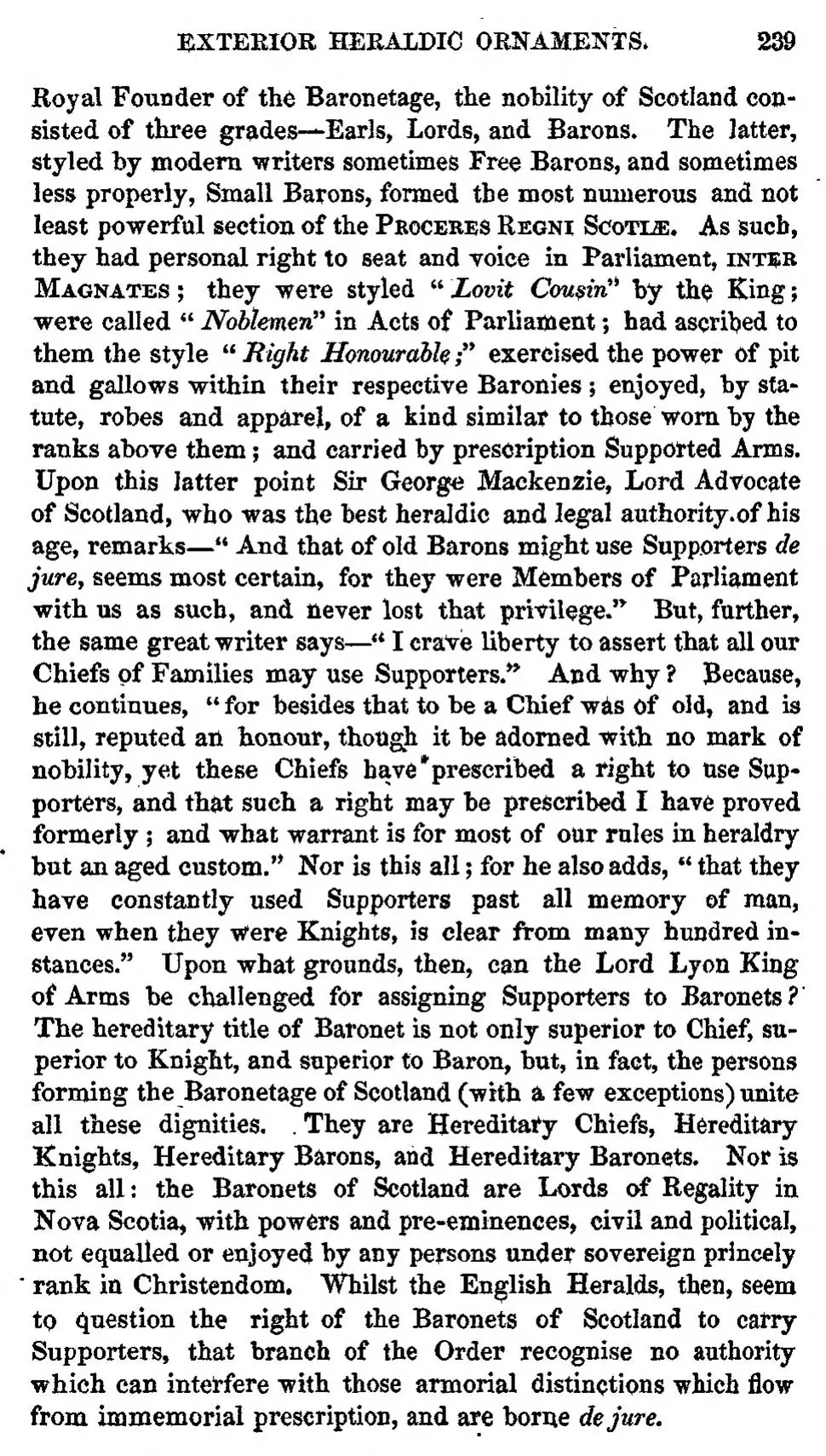
The English heralds had questioned the Lord Lyon’s practice of assigning supporters to Scottish baronets. Broun answered them before the Committee on 18 September 1841, with a description of the barons, whom he called “the most numerous and not least powerful section of the PROCERES REGNI SCOTIÆ”, the nobles of the kingdom of Scotland:
“As such, they had personal right to seat and voice in Parliament, INTER MAGNATES [among the great men]; they were styled ‘Lovit Cousin’ [beloved cousin] by the King; were called ‘Noblemen’ in Acts of Parliament; had ascribed to them the style ‘Right Honourable;’ exercised the power of pit and gallows within their respective Baronies; enjoyed, by statute, robes and apparel, of a kind similar to those worn by the ranks above them; and carried by prescription Supported Arms.”4
For the last point he calls Sir George Mackenzie, “the best heraldic and legal authority of his age”:
“they were Members of Parliament with us as such, and never lost that privilege”
Sir George Mackenzie on the barons, as Broun quoted him in 1843
The sentence in full reads: “And that of old Barons might use Supporters de jure, seems most certain, for they were Members of Parliament with us as such, and never lost that privilege.”4 Mackenzie’s own text, of 1680, is quoted in The arms and flags of a baron.
The other points are tested against the records in papers here: the seat in Parliament and the Acts in The baronage in the statutes, the court and its power of pit and gallows, the power of life and death, in The baron’s court and its officers, the robes in Robes, chapeau and insignia, and “Right Honourable” in Where “The Much Honoured” comes from.
Barons in the baronets’ own book
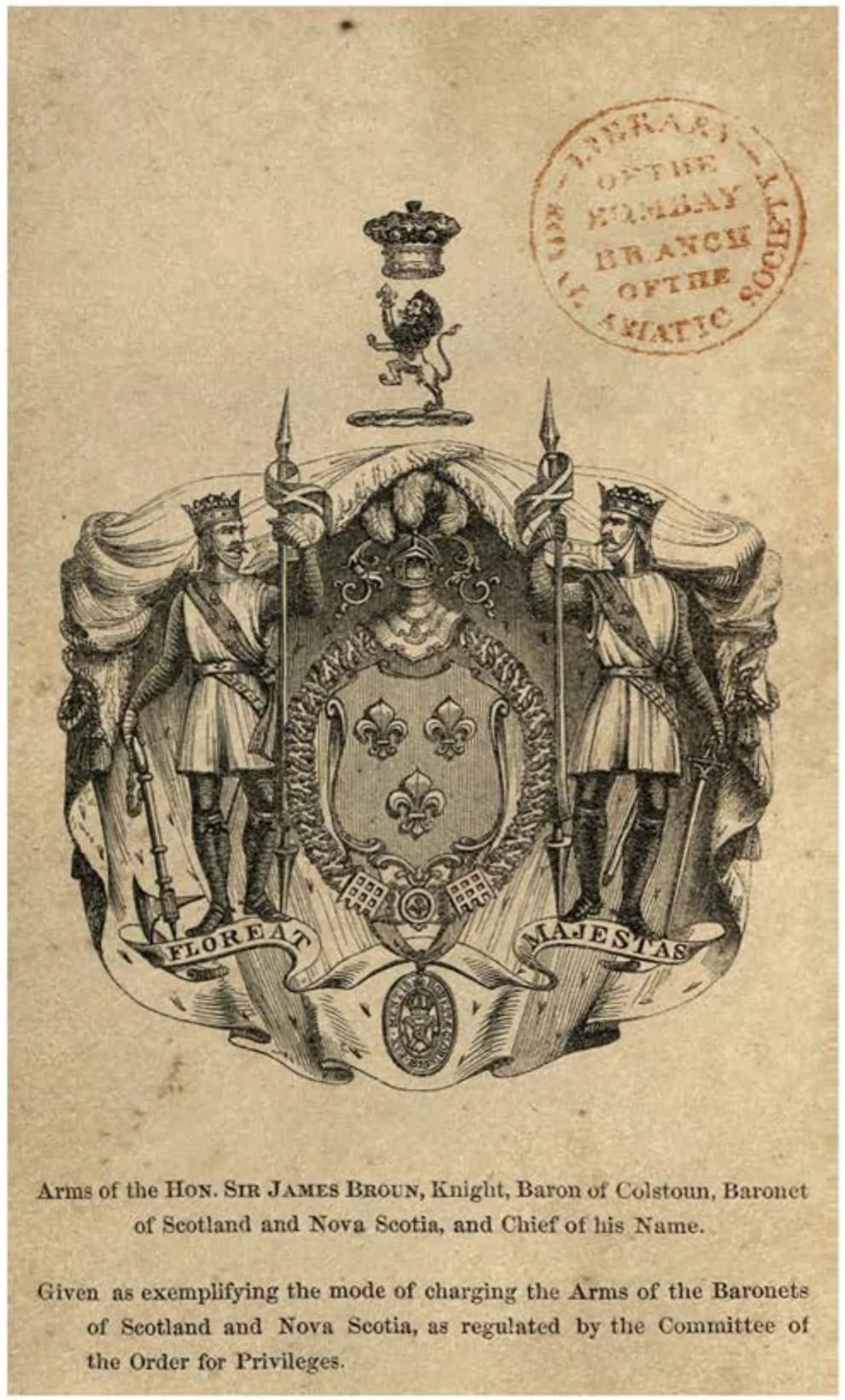
The book practises what it argues. Its specimen engraving for Scotland is captioned “Arms of the HON. SIR JAMES BROUN, Knight, Baron of Colstoun, Baronet of Scotland and Nova Scotia, and Chief of his Name.” In the entries some twenty-two living Scottish baronets are given a baron’s style beside the baronetcy: “feudal baron of Innerquharity”, “free baron of Colquhoun”, “Baron of Lochnaw”.5 Of the Scottish baronets as a body Broun told the Committee: “They are Hereditary Chiefs, Hereditary Knights, Hereditary Barons, and Hereditary Baronets.”4
Broun also says where a baron’s title came from: “The title of Baron in Scotland was anciently conferred by erecting lands into a free barony”. He prints the Crown charter of 20 June 1589 that gave James Colville of Culross the “Titulum, Honorem et Statum LIBERI BARONIS”: in English, the title, honour and status of a free baron. It is the charter cited from the Register of the Great Seal in Lairds, lords and barons.6
Not obsolete: the Baron of Renfrew
The book is dedicated to the infant Prince of Wales as “Knight and Baron of Renfrew”, and the first reason given is this:
“Because, his birth has, in the person of the most exalted subject in the British nation, revived the title, honour, and state in Scotland of BARON,—an hereditary dignity which has long been considered obsolete, although, in fact, it is only merged in the higher degrees of Baronet, Lord, Viscount, Earl, Marquess, and Duke.”7
Two things stand out. Broun knew the dignity was alive: on his own showing it was held by the heir to the throne and by a score of the baronets in his book. And by 1843 many people had already come to think of it as a thing of the past. The law had not changed. The public had forgotten.
Was Broun right about the barons?
Broun was a partisan, and his campaign failed. The Spectator judged the Committee’s proceedings “for ignorant folly and self-sufficient audacity” to be “almost unequalled in the annals of impudence and humbug”.8 His book is no authority for what a baronet may wear.
What it says of the barons is another matter, because it can be checked. Here are his seven points from p. 239, each set against the records.
| Broun said the barons… | What the records show | Was he right? |
|---|---|---|
| had a seat and voice in Parliament | 1428: the small barons “need not come” in person; each shire sends commissioners. 1567: “the barons of this realm ought to have vote in parliament as a part of the nobility”. Mackenzie, 1680: they “never lost that Priviledge”.9 | Yes |
| were called “Noblemen” in Acts of Parliament | Act of 1540: “every nobill man, sic as erle, lord, knycht and baroune”. Article of 1567: “a part of the nobility”. Act of 1592: “the nobility, earls, lords and barons”.10 | Yes |
| were styled “Lovit Cousin” by the King | The King’s word for a baron was “our lovit” (our beloved) or “traist freind”; “cousin” was for earls and lords. A few lairds were called cousin: James VI in 1571 wrote of “oure weilbelovit cousing, Mathew Campbell of Lowdoun, knycht”.11 | In part |
| had the style “Right Honourable” | Peers used it to barons from the 1570s to 1715: “the rycht honorabill the Barrone of Kylraok” (the Earl of Crawford, 1579).12 | Yes, as a courtesy |
| had the power of pit and gallows | Only where the charter gave it (Stair, 1681). The Act of 1746 ended it.13 | Yes, where the charter said so |
| had robes by statute | The Act of 1455 gave “the other lords of parliament”, who then included the barons, a red mantle.14 | Yes, on Innes’s reading |
| carried supporters by prescription | Mackenzie, 1680: “old Barons in Scotland, may use Supporters”. The Lyon Court allows them “as of right” to the heirs of barons liable to be called to Parliament before 1587.15 | Yes, for the old baronial houses |
Six of the seven hold, and the seventh in part. Broun had every reason to set baronets high, and he ranked them “superior to Baron”. Yet for a nobility to build on he reached for the barons, and the Committee, having heard him, passed its resolutions unanimously.4
Never taken away
Two things in the table have gone: the old Scots Parliament, in 1707, and the baron’s jurisdiction, in 2004. The Act that ended the jurisdiction saved everything else:
“… nothing in this Act affects the dignity of baron or any other dignity or office (whether or not of feudal origin).”
A dignity, the Act says, includes “any quality or precedence associated with, and any heraldic privilege incidental to, a dignity”.16 What belonged to the dignity of baron before the Act belongs to it still.
The Crown still uses it. In 1469 Parliament annexed “the barony of Renfrew, with the lands and tenandries of the same” to the King’s eldest son “in perpetuity”. The notice of the letters patent of 2023 that made Prince William Prince of Wales names him “Baron of Renfrew”.17
Revived, not invented
By 1843 the public had forgotten the dignity. The law had not. It was recovered in the twentieth century, in the Lyon Court, and the man who did most to make the case was Sir Thomas Innes of Learney, Lord Lyon from 1945 to 1969.
In 1934 the Court recorded Gordon of Hallhead as “Baron of Esslemont” and awarded him the baron’s chapeau. In 1943 it found that the minor barons are “recognised as a ‘titled nobility’”. In 1945 Innes set out the evidence in print.18
He created nothing. His evidence is in the table above: the Acts of 1455 and 1567, the charters of the Great Seal, Mackenzie. He went back to the precedents and applied them.
The Roll and the Pledge
The Association works in the same way. It claims nothing new for barons. It asks two things of those who hold the dignity.
Proof. No public authority keeps a register of who holds a barony. The Roll of Scottish Barons is that record: public, free, and entered only on evidence. Its precedent is the baronets’ own official Roll of 1910, which ended their disarray by the same means.
Honour. A barony can now be bought and sold, and a dignity for sale is not believed: that was the baronets’ trouble. Those who sign the Pledge undertake, in honour and not in law, to preserve their barony within the family for future generations and to uphold the Baronial Code of Honour. The Roll treats pledged baronies as hereditary and not in commercio.
The baronets of 1843 knew what a baron was, and built their case on him. Parliament, in 2000, left the dignity as it found it. The Roll and the Pledge are there so that the public can know it again.
Notes
- Broun, The Baronetage for 1843, p. 222 (“Founded 15th July, 1840”) and p. 16 for the insignia. The title page names Broun as “Hon. Secretary of the Committee of the Baronetage for Privileges”. For the claims and their refusal by “every Minister”, The Spectator, 15 April 1843, p. 352. ↩
- Broun, The Baronetage for 1843, pp. 14–15. ↩
- Ibid., pp. 13–14. For the Acts themselves see The baronage in the statutes. ↩
- Ibid., p. 239, in the “exposition” Broun made to the Committee on 18 September 1841 (pp. 225–226), which the contents page calls the “Address on Exterior Heraldic Ornaments”; the heralds’ remark is at p. 238. The Committee, “having heard the Exposition made by the Hon. Secretary”, then “unanimously passed a series of Resolutions” (p. 273). The italics are in the original. ↩
- Ibid., plate facing p. 61; the entries are at pp. 64 (Ogilvie), 62 (Colquhoun) and 67 (Agnew). The count is from a search of the book’s text and is approximate. “Baron of Colstoun” is the book’s own style for Sir James: its entry for the family gives his residence as Lochmaben, Dumfriesshire, and lists “Colstoun, near Haddington” among its “Ancient Seats” (p. 82). ↩
- Ibid., p. 14. ↩
- Ibid., dedication, pp. v–vi. ↩
- The Spectator, 15 April 1843, “Broun’s Baronetage”, p. 352. ↩
- Act of 5 March 1428, RPS 1428/3/3; Parliament of December 1567, RPS 1567/12/45; Sir George Mackenzie, The Science of Herauldry (1680), ch. XXXI, p. 94. Mackenzie in full: they “were Members of Parliament with us, as such, and never lost that Priviledge, though for their convenience, they were allowed to be represented by two of their number”. The Acts are set out in The baronage in the statutes. ↩
- Act of 10 December 1540, “The manere of harness, wapnis and armoure”, RPS 1540/12/30; RPS 1567/12/45; Act of 5 June 1592 on the lords of session, RPS 1592/4/72, which Broun cites at p. 14 as “the 134 Act” (the old printed editions number it 132). Where later Acts say “noblemen barons and gentlemen”, as the Lyon King of Arms Act 1672 does, “noblemen” is the narrow word for the peers; the barons stayed “a part of the nobility”, and the Lyon Court found them a “titled nobility” in 1943. See The baronage in the statutes. ↩
- A Genealogical Deduction of the Family of Rose of Kilravock (Spalding Club, 1848): the Queen Regent’s letter of 27 June 1555, which speaks of “oure rycht traist cousing the erle of Athole” and is addressed “To our traist ffrend the Barroun of Kylrawach”, p. 220, and a summons of James IV, executed in July 1511, “at the instance of oure louit Huchoun Ross of Kilrawok”, p. 181. James VI’s letter of 22 January 1571 is printed in The Exchequer Rolls of Scotland, vol. XX, p. 61, note; Campbell of Loudoun was hereditary sheriff of Ayr. Mackenzie says that the style “familiar Counseller” is given to “all Officers of State who are not Earls, because they cannot be called Cousins”: Works, vol. ii (1722), p. 540. Broun gives no source for the phrase. ↩
- Family of Rose of Kilravock, 25 September 1579, p. 270; Lord Lovat “To the Right Honorable the Laird of Grant”, 1714–15, in Sir William Fraser, The Chiefs of Grant, vol. 2, p. 287. More examples, and the limits of the usage, are in Where “The Much Honoured” comes from. ↩
- Stair, The Institutions of the Law of Scotland (1681), Title 13, § 62, p. 276: a barony’s jurisdiction “will not reach to Capital Punishment, unless the same be exprest, as it uses to be when the Priviledge of Pit and Gallows are exprest”. Heritable Jurisdictions (Scotland) Act 1746, s. 17. See The baron’s court and its officers. ↩
- RPS 1455/8/12; Sir Thomas Innes of Learney, “The Robes of the Feudal Baronage of Scotland”, Proceedings of the Society of Antiquaries of Scotland, vol. 79 (1944–45), p. 130 — open access PDF. See Robes, chapeau and insignia. ↩
- Mackenzie, The Science of Herauldry (1680), ch. XXXI, p. 94; Innes of Learney, Scots Heraldry (1978 ed.), p. 71: they “are entitled as of right to obtain grants of supporters from the Lord Lyon”. See The arms and flags of a baron. ↩
- Abolition of Feudal Tenure etc. (Scotland) Act 2000, s. 63(1) and (4). The appointed day was 28 November 2004. ↩
- Act of 27 November 1469, RPS A1469/2; The London Gazette, issue 63979, 24 February 2023, p. 3638 — notice. ↩
- Lyon Register, vol. xxxi, p. 20 (4 September 1934, under Lord Lyon Sir Francis Grant), as cited by Innes; interlocutor of 26 February 1943 (Lord Lyon Sir Francis Grant), Public Register of All Genealogies and Birthbrieves, vol. iv, p. 26, printed by Innes at p. 143 n. 3; Innes of Learney, PSAS 79 (1944–45), pp. 111–163, read 27 October 1945. See The Esslemont petition of 1934, Untitled or titled nobility? and The Lord Lyon’s Case for the Baronage. ↩