Words & Usage
“Younger of” and “Master of”: the record set straight
For five centuries the records of Crown and Parliament have styled a baron’s heir “younger of”, beside “Master of” for the heir of a peer
8 min read · Reviewed October 2026
Baronage of Scotland Association · The Reading Room · www.baronage.com/reading-room/younger-of-and-master-of/

The heir to a Scottish title is “Younger”, unless the title is a peerage, when the heir is “Master of”. The two styles have stood side by side in the records since the 1500s. Where a baron, baronet, chief or laird has a territorial designation, the heir adds “younger” to it, after it or before it. The heir of a baron with none is “Younger of” the barony. Some say he may not be. This paper sets out the record.
The short answer
- The style is old and official. From 1584 to 2005, Parliament, the Great Seal, the Gazette and the Lyon Court’s own rolls write the heir “younger of”.
- It is the counterpart of “Master”. A survey of Scots law of 1936 puts the two in one sentence: the heir of a peer is “Master”, the heir of a baron is “younger of”.
- Barons share it with baronets, chiefs and lairds. Each adds “younger” to the family’s territorial designation. Only the heir to a peerage is “Master”.
- It follows the father’s rank. One man was “younger” of Stair in 1689 and “master of Stair” in 1690, when his father had become a peer.
- No rule requires a territorial designation. It is part of a surname and needs the Lord Lyon’s recognition, and many barons have none. No statute, court ruling or Lyon Court text has been found that says a baron’s heir needs one.
- A baron with no territorial designation uses the barony. His heir is “Younger of [Barony]”, as a peer’s heir is “Master of [Peerage]”. The “of” is the barony’s own, as in “Baron of X”. “The” may go before either.
In the record
“Robert Dowglas, younger of Lochlevin, Laurence, maister of Oliephant, Johne, maister of Forbes”
Summons of treason, Parliament of Scotland, 1584
In 1584 Parliament summoned a list of men for treason. The clerk put the heirs of lairds and the heirs of peers in one line. “Robert Dowglas, younger of Lochlevin” is followed at once by “Laurence, maister of Oliephant” and “Johne, maister of Forbes”, and, one name later, by “Johne Levingsstoun, younger of Dynnypace, Johne Carmichaell, younger of that Ilk”. “Maister” is Master. Lord Oliphant and Lord Forbes were lords of Parliament, so their heirs are Masters. The other fathers were not, so their heirs are “younger”.1
The Crown’s Latin says the same. In a Great Seal charter of 1600 the heir is “juniori de Bathgait”, younger of Bathgate, “filio et heredi apparenti”, son and heir apparent, of his father the elder.2 And the heir acted under the style: in 1693 “The laird of Calder, younger” was admitted to Parliament for Nairnshire “in place of Sir Hugh Campbell of Calder, his father”.3
The form lasted. In 1986 the London Gazette printed a commission to “Donald Cameron, Younger of Lochiel”.4 The Lyon Court’s rolls in the Edinburgh Gazette, down to 2005, carried a note signed by the Lyon Clerk: a family’s name and territorial designation are used by “The eldest son and his wife, with the adjective “younger””.5
Beside the Master
“Whilst the heir-apparent of a feudal baron is invariably styled ‘younger of,’ the heir, whether apparent or presumptive, of an earl or peerage-lord is ‘Master’.”
The Stair Society’s survey of Scots law, 1936, as quoted in the Scottish National Dictionary
The national dictionary quotes that sentence twice, once to explain “Master” and once to explain “younger”. Of “Master of” it says: “The designation is that of the title to be inherited.”6
The Lord Lyon’s own certificate does the same for a baron’s heir. In 1930 he certified the birth of “Thomas Innes of Learney, younger”, son of the “Baron of the Baronies of Learney and Kinnairdy”. The pedigree on the certificate names the child “younger, apparent heir to the Barony of Learney”.7
Sir John Dalrymple shows both on one man. In June 1689 Parliament recorded “Sir John Dalrymple, younger, of Stairs”. By 1690 his father was “the viscount of Stair”, and the next name on the roll is “the master of Stair”.8 The father’s rank changed, and the son’s style changed with it.
A Master is named from his father’s dignity, not from the surname or an estate. Debrett’s of 1921 lists the heir of Lord Saltoun, whose surname is Fraser, as “Master of Saltoun”.9
Who is “Younger”
The style is not the barons’ alone. The national dictionary gives it to “the eldest son and heir of a landed proprietor below peerage rank”.6 A guide to forms of address of 1955 gives the heirs of chiefs and lairds as “John Mackvicular, younger of Mackvicular”, and says of a baronet’s eldest son: “In Scotland he is styled “younger” of the family description.”10
So the heir of a chief, a laird, a baronet or a baron with a territorial designation is “younger” of it. Only the heir to a peerage is Master.
The word goes after the territorial designation or before it. The Lyon Court’s rolls print “FORBES OF ROTHIEMAY, younger”;5 the Gazette prints “Donald Cameron, Younger of Lochiel”.4
A baron with no territorial designation has no “of X” in his surname to add the word to. His heir takes the style from the barony itself: “Younger of [Barony]”. Whether he may is the question that follows.
Does it need a territorial designation?
A territorial designation is the “of X” in a surname. It is not the barony. It comes from land, and it needs the Lord Lyon’s recognition: his guidance of 2010 says it “proclaims a relationship with a particular area of land”.11
A baron may have none, and that is not new. The Lyon Court’s own rolls print “HOLMAN, BARON OF RICKARTON” in 1988 and “THACKER, BARON OF FETTERNEAR” in 2002, each with no territorial designation.12 Since 2004 “the dignity of baron, though retained, shall not attach to the land”, and many barons have no territorial designation at all.13
One baronial society says on its website that the son of such a baron may not use the style: a baron must first have a territorial designation recognised by the Lord Lyon. It cites no authority.14 Another, in a paper of 2024, accepts “Younger” for him but not yet “Younger of”. It says “the use of ‘Younger’ without territorial reference is acceptable”, while “Younger of Exton” for the heir of a baron with no estate “has not yet gained wide acceptance”.15
That view treats the “of” as belonging to a surname territorial designation (TD). But a barony has an “of” of its own. “HOLMAN, BARON OF RICKARTON” has no TD, and the “of” is in his barony title.12 And the heir’s “of” does not depend on an “of” in the father’s style at all. Lord Oliphant, Lord Forbes and Lord Saltoun have none, yet their heirs are “Master of Oliphant”, “Master of Forbes” and “Master of Saltoun”.19 That is the precedent for “Younger of [Barony]”: an heir named from the title itself, not from a territorial designation.
The Lyon Court has published no rule on the style of a baron’s heir. Its Gazette note speaks only of a family’s “names and designations”.5
What do the records show?
Named from the barony. In 1649 Parliament put two heirs on a commission “in place of their said fathers”. One is the “laird of Duncrub, younger”. The other is the “baron of Auchyle, younger”.16 In the Lyon Court’s own rolls, “McCUNE OF COLL-EARN, BARON OF ELPHINSTONE” in 1989 is followed by “McCUNE OF ELPHINSTONE, younger” in 1992: on its face, a younger named from the barony.17
Named from the territorial designation. A territorial designation and a barony can have different names. Where they did, the old registers name the heir from the surname’s “of X”, not from the barony. In a Great Seal charter of 1631 a father and son are “seniori de Bischoptoun” and “juniori de Bischoptoun”, elder and younger of Bishopton, though their barony is Gogoside. In 1681 “James Gordon, younger of Lesmore” was “infeft in the lands and barony of Newtongarry”.18
Each of those fathers had a territorial designation in his surname: he was “Surname of X”. None of these records shows the heir of a baron who had none.
The peerage does show an heir named from the title alone: a Master is named from the dignity, whatever the surname.
No court has ruled on the point for barons. But no statute, court ruling or Lyon Court text has been found that says a baron’s heir needs a territorial designation, and the society that says so cites none.
With or without “the”
The style is “Younger of X”, after the name or alone, as a peer’s heir is “Master of X”. For both, “the” is optional.
The Master shows it. The passport rules have both in a single entry. The surname field reads “MASTER OF [title]”. The observation reads “THE HOLDER IS [forenames and surname] THE MASTER OF [title]”.19 An account of a reception for chiefs’ heirs in 2014 has “John, Master of Lauderdale” and “Alexander, the Master of Cranstoun” in one list.20
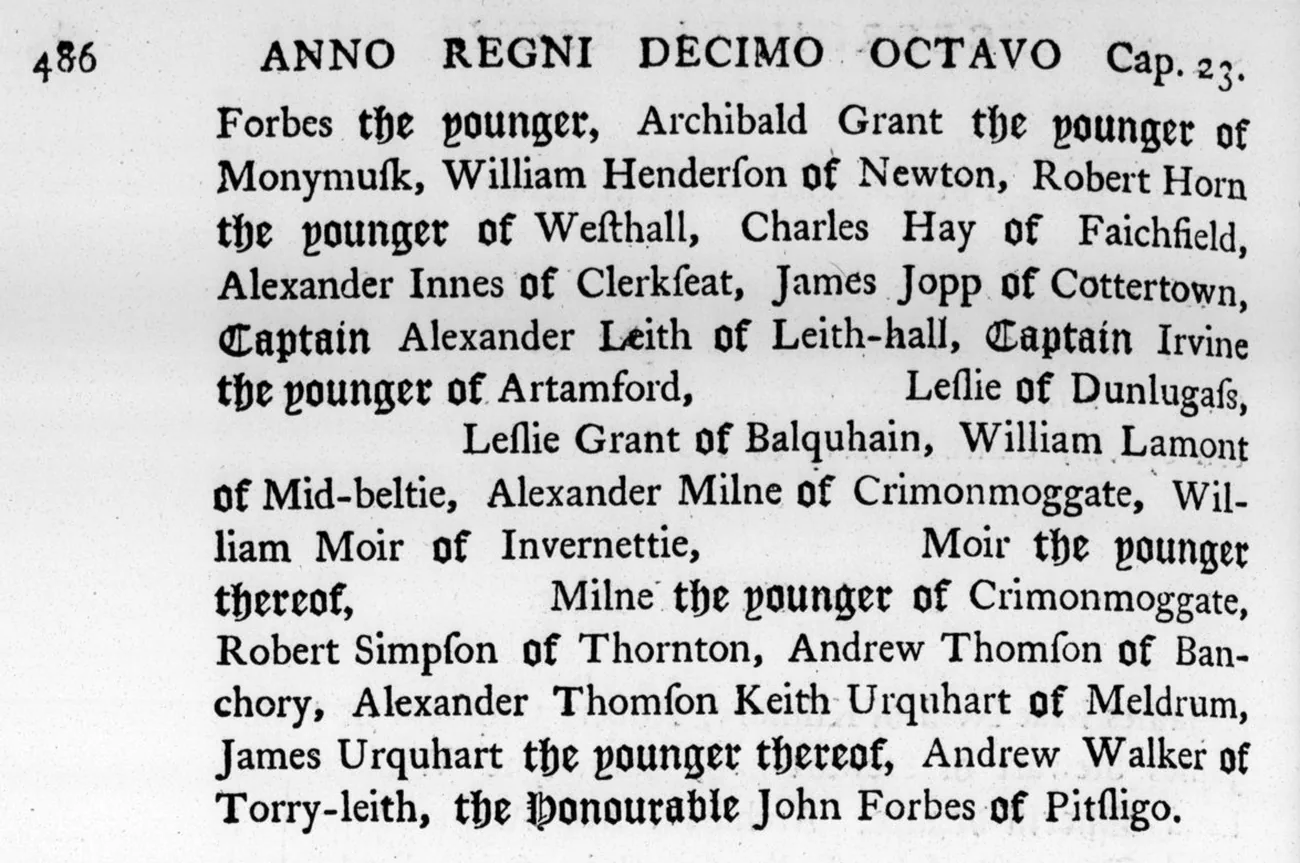
“The Younger” has long been written: “Donald Cameron the Younger, of Lochiel” in the London Gazette of 1746, and “Pirie Gordon the Younger of Buthlaw” in a book on titles of 1991. An Act of 1778 names “Alexander Thomson Keith Urquhart of Meldrum” and, next, “James Urquhart the younger thereof”. The forenames differ, so “the younger” is not there to tell two men of one name apart.21
It is written without “the” as well: the Crown’s “Donald Cameron, Younger of Lochiel” of 1986.4
There is a practical reason to add “the”. A standard work on the clans, revised by Innes of Learney as Lord Lyon, warns that officials “might otherwise suppose “younger” to be a surname”.22 “The” before the word removes the doubt, as it marks the Master.
A woman as heir
In some families a daughter who is heir is “the Maid of”. Sir Iain Moncreiffe of that Ilk, a herald of the Lyon Court, wrote in 1967: “It is the old Scots custom to call an heiress the Maid of her inheritance.”23 No statute, court or Lyon Court rule sets the form.
A woman may also be “Younger”. In 2014 the Standing Council of Scottish Chiefs gave a reception for heirs at the Palace of Holyroodhouse, with the Lord Lyon and the Lyon Clerk among the guests. Among the heirs its account names are “Catriona, the Maid of Bachuil” and “Claire Henderson younger of Fordell”, daughter of the chief of the Hendersons.20 It is the earliest record found of a woman so styled: a recent precedent, from the chiefs’ own council. One baronial society’s paper of 2024 says the use “is not a style that is generally accepted”.15
The Roll and the Pledge
A Younger takes his style from a barony. The Roll shows, on evidence, who holds it.
The Baronage of Scotland Association keeps the Roll of Scottish Barons, which enters a holder only on evidence, and offers the Pledge: an undertaking, in honour and not in law, to preserve a barony within the family for future generations and to uphold the Baronial Code of Honour. The precedent is the baronets’ Roll of 1910.
Notes
- Summons of treason, RPS 1584/5/60, in the original Scots. The name between is “Patrik Drumond, apperand of Carnok”, the heir apparent of Carnock. “Of that Ilk” means of the place that bears the family’s own name. ↩
- Registrum Magni Sigilli, vol. vi, no. 1020 (18 February 1600), p. 338: “ROBERTO HAMMILTOUN juniori de Bathgait, filio et heredi apparenti Roberti H. senioris de B.” The printed Register gives the editor’s Latin abstract of each charter. ↩
- RPS M1693/4/21. ↩
- The London Gazette, 21 March 1986, p. 4069, Deputy Lieutenant commissions for Lochaber, Inverness, Badenoch and Strathspey. ↩
- The Edinburgh Gazette, 16 July 2002, “Court of the Lord Lyon”, note 3 — notice: “the names and designations are in Scots law and practice used by: a) The head of the family and his wife. b) The eldest son and his wife, with the adjective “younger”, and their eldest son.” Signed “Mrs. C. G. W. Roads, Lyon Clerk and Keeper of the Records”. The same note stands in the roll of 19 August 2005. ↩
- An Introductory Survey of the Sources and Literature of Scots Law (Stair Society, vol. 1, 1936), p. 433, as quoted in the Scottish National Dictionary under “Young”, sense 2, and “Maister”, sense 3. The Society’s list of the volume’s contents gives the chapters “Peerage Law” and “Heraldic Law” to Thomas Innes, afterwards Sir Thomas Innes of Learney, Lord Lyon. ↩
- Birthbrief by Sir Francis Grant, Lord Lyon, 27 March 1930, Public Register of Genealogies, vol. iv, p. 9, reproduced as Plate XLIII in Sir Thomas Innes of Learney, Scots Heraldry, 2nd edn (Edinburgh, 1956). It certifies that the child “is the son and apparent heir of Thomas Innes of Learney, Carrick Pursuivant of Arms, Baron of the Baronies of Learney and Kinnairdy”. The father was the book’s author. ↩
- RPS M1689/6/4 (June 1689); RPS 1690/4/44, commissioners for the sheriffdom of Wigtown: “the viscount of Stair, president of the sessione, the master of Stair”. ↩
- Debrett’s Peerage and Titles of Courtesy (London, 1921), p. 803: “SALTOUN, BARON. (Fraser.)”, with “Hon. ALEXANDER ARTHUR (Master of Saltoun)”. ↩
- Titles and Forms of Address, 9th edn (London: A. & C. Black, 1955), p. 94, of chiefs and lairds: “Their heirs are addressed in writing as: John Mackvicular, younger of Mackvicular”; and p. 84, “Children of Baronets”. ↩
- Lord Lyon Sellar, guidance on baronial additaments and territorial designations, 5 January 2010, from the Lyon Court’s website as archived on 5 June 2011. On territorial designation and title, see The two styles of a Scottish baron. ↩
- The Edinburgh Gazette, 17 May 1988, p. 733, and 16 July 2002, p. 1782, in the Lyon Court’s rolls. On barons with and without a territorial designation, see Baron of X, or X of Y? ↩
- Abolition of Feudal Tenure etc. (Scotland) Act 2000, s. 63(2), in force 28 November 2004. ↩
- The Convention of the Baronage of Scotland, web page “Male Heir”, read 13 October 2026. The archived copy of 26 December 2004 limits these usages to a baron who has taken the territorial name, but does not have the sentence that the style is otherwise wrong. The copy of 9 May 2006 does. ↩
- Forum for the Scottish Baronage, Forms of Address & Related Matters (August 2024), endnote 18. The society’s web page on forms of address, read 13 October 2026, says the eldest son of a baron “may be known by his father’s territorial designation with the addition of “younger””, and gives “James McDonald, Younger of X”. On a woman as heir, the same endnote: “Some have suggested the use of ‘Younger’ for a female heir presumptive, as well as for an eldest son, but this is not a style that is generally accepted.” ↩
- Act of addition to the revaluers of Perthshire, RPS 1649/5/132, in the modern-English text of the Records, leaving out the names its editors supply in brackets. The original reads “the laird of Duncrub, youngar, and baroun of Auchyll, youngar, may be put in place of thair saidis fathers”. ↩
- The Edinburgh Gazette, 5 December 1989, p. 2064, and 7 April 1992, p. 1040, in the Lyon Court’s rolls of names officially recognised. Each entry carries the mark that, by the rolls’ own note, “indicates that the Arms have been matriculated with chapeau in respect of being a Minor Baron”. ↩
- Registrum Magni Sigilli, vol. viii, no. 1846 (9 August 1631), p. 630, a grant of lands “omnes in baroniam de Gogoside erectas”, all erected into the barony of Gogoside; RPS 1681/7/191, in the modern-English text of the Records. So too Sir Patrick Home, “juniori de Aytoun”, in the charter of 1605 that erects his own lands into the barony of Duns (vol. vi, no. 1628, p. 591), and “John Livingstone, younger, of Dunipace”, whose infeftment “of the lands and barony of Craigs” is named in an Act of 1593 (RPS 1593/4/38). ↩
- HM Passport Office, Titles (guidance for passport staff), version 25.0, “Titles for the heir apparent to a Scottish peerage” — GOV.UK, read 13 October 2026. ↩
- “Heirs reception given by the Standing Council of Scottish Chiefs”, posted 15 December 2014 on the Standing Council’s website, read 13 October 2026. The reception was on 28 November 2014; those attending included “Lord Lyon King of Arms, Dr. Joseph Morrow, and, Lyon Clerk, Elizabeth Roads”. Burke’s Peerage, 107th edn (2003), vol. 2, p. 1864, as reported at thepeerage.com, gives her as the daughter of Alistair Donald Henderson of Fordell, then “younger”; the Clan Henderson Society’s website says he “was recognized as Chief of the Name and Arms of the Baronial House of Henderson by the Lord Lyon in 2005”. ↩
- 18 Geo. III c. 23 (1778), p. 486. The London Gazette, 3–7 June 1746, no. 8542, front page. L. G. Pine, Titles: How the King Became His Majesty (New York, 1991), p. 163. ↩
- Adam, Clans, Septs and Regiments, 6th edn (1960), p. 408. ↩
- Sir Iain Moncreiffe of that Ilk and David Hicks, The Highland Clans (New York, 1967), p. 119, of the chief of the MacDougalls, “known, not as the Maid of Dunollie, but as the Maid of Lorn”. The Scottish National Dictionary, “Maid”, sense 2, has “the Maid of Lorn(e), the eldest daughter of MacDougall of Lorne”. ↩