
Law & Statutes
Is a Scottish baron a commoner? Not in Scots law
Why “anyone who is not a peer is a commoner” is English law, and what Scots law says about the baron before and after the Union
13 min read · Reviewed October 2026
Baronage of Scotland Association · The Reading Room · www.baronage.com/reading-room/is-a-scottish-baron-a-commoner/

In English law everyone below a peer is a commoner, however grand. Scots law drew the line lower: its nobility took in the barons, the knights and the gentlemen. The Union of 1707 sent the barons’ members to the House of Commons, but it did not change the law of rank. This paper sets out both meanings of “commoner” and the record for each.
The short answer
- “Commoner”, in the sense of anyone who is not a peer, is English law. Blackstone wrote in 1765 that all below the peers are “in law peers, in respect of their want of nobility”.
- Scots law drew the line lower. Sir George Mackenzie, Lord Advocate, wrote in 1680 that the nobility is “greater” and “lesser”, and that “Under the Word Baron all our Nobility are comprehended”. An Act of 1540 names “every noble man, such as an earl, lord, knight and baron”.
- Noble, though not peers of Parliament. Mackenzie: “though all these be not Peers of Parliament, yet they are all Peers to one another”. A nobleman had to accept a gentleman’s challenge to a duel as his peer.
- A barony ennobles. Mackenzie: “a Barony, as we call it, do ennoble; for Baronies are establisht only by the Prince’s Erection or Confirmation.”
- Before the Union, Scots did not use the word for rank. A “commoner” was an arbitrator. The common people were, in Mackenzie’s word, “Plebeians”.
- “Commoner” measures the peerage, not nobility. A foreign baron in London is not called a commoner. A British one was: Lionel de Rothschild, a baron of the Austrian empire, sat in the House of Commons from 1858.
- The Union changed Parliament, not Scots law. Scotland’s forty-five members went to the House of Commons, and the printed Act of 1707 that settled their election calls them “commoners”. The Treaty kept Scots law.
- The Lyon Court said so in 1943. It found that the minor barons are “recognised as a ‘titled nobility’”.
Two meanings of “commoner”
England divides its people in two. Blackstone, the great writer on English law, put it like this in 1765:
“The commonalty, like the nobility, are divided into several degrees; and, as the lords, though different in rank, yet all of them are peers in respect of their nobility, so the commoners, though some are greatly superior to others, yet all are in law peers, in respect of their want of nobility.”
William Blackstone, Commentaries on the Laws of England, 1765
In English law, then, the nobility is the peerage. “The first dignity after the nobility”, Blackstone goes on, is a knight of the Garter. Baronets, knights, esquires and gentlemen are all commoners, and that is how the word is used today: a commoner is anyone who is not a peer. Even so, a page later Blackstone still calls the baronets and knights an “inferior nobility”.1
Older Scots had no such word. The Dictionary of the Older Scottish Tongue, which covers Scots up to 1700, gives “commoner” only as an arbitrator. In 1591 Edinburgh named two of its assessors as arbitrators (“commoneris”) for the town in a dispute with the Kirk of Leith.2 The common people were “the commoun”, and one of them was “a commoun”.3
“The greater and the lesser Nobility”
Scotland’s rule was set down by Sir George Mackenzie of Rosehaugh, Lord Advocate, in his treatise on precedence of 1680.
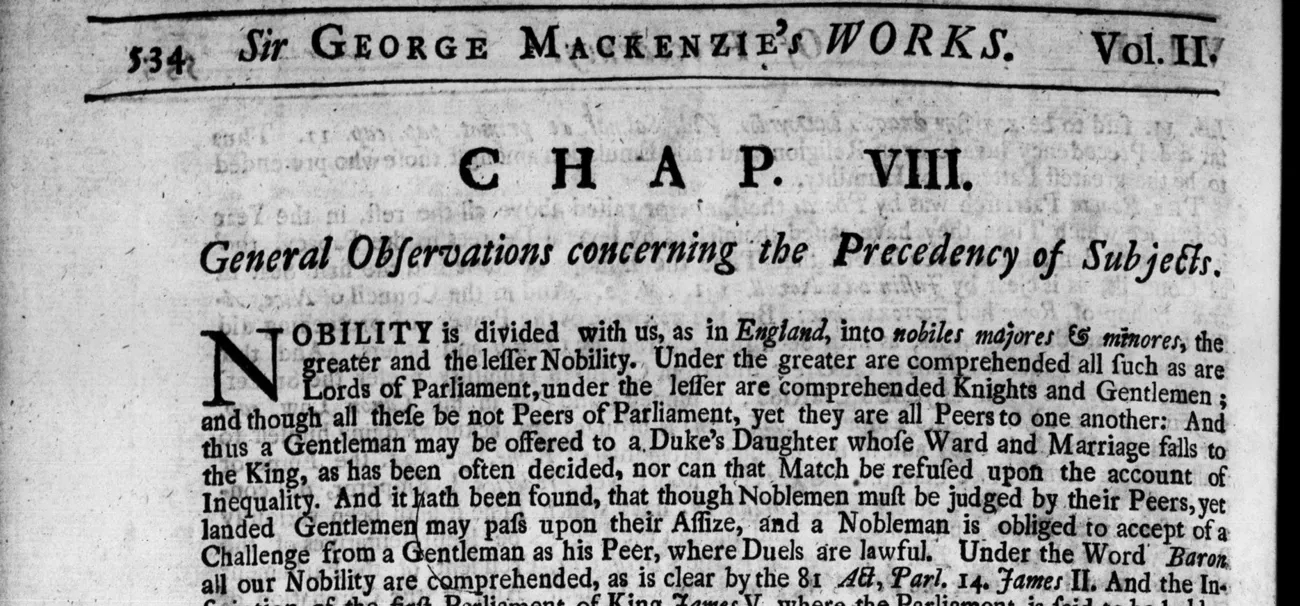
The lords of parliament are the greater nobility. Knights and gentlemen are the lesser. All of them are “Peers to one another”, though not all are “Peers of Parliament”.4 Mackenzie says England divided its nobility the same way, and an English writer had said so a century earlier: Sir Thomas Smith, in 1583, called England’s knights, esquires and gentlemen “the second sort of gentlemen which may be called Nobilitas minor”.5 English law later drew the line at the peerage. Scots law did not.
Then Mackenzie gives the word that covers them all: “Under the Word Baron all our Nobility are comprehended”. “Baron” was once the common name of the whole nobility, as “peer” is now, because the greater nobles held baronies too. In Lord Clyde’s words, Scotland distinguished “the greater barons and the lesser barons, the former acquiring such titles as Duke or Earl”.6 The dukes, earls and lords were the great barons, and the small barons had no greater title: “Now the Lords are called the great Barons, and the rest are called small Barons”.7
His proof is the wording of the old Parliaments: James V’s first Parliament sat with “the prelates, the barons and the commissioners of the burghs”, and Robert I’s with earls, barons “and other great men”, so that there were great men below the barons.4
The statute book agrees. An Act of 1540 on arms and armour begins with “every noble man, such as an earl, lord, knight and baron”.8
What made a baron noble was the Crown’s grant, not his acres. Owning land, Mackenzie writes in his Science of Heraldry, “doth not nobilitate in all Cases … for else a rich Man might ennoble himself”. But “such Feus as had a Jurisdiction annext to them, a Barony, as we call it, do ennoble; for Baronies are establisht only by the Prince’s Erection or Confirmation.” Those who held their lands of the Crown “were called Lairds”; those who held of a subject, “though they were large, and their Superior very noble, were only called Good-men”.9 See Lairds, lords and barons.
Below the gentlemen came everyone else. Mackenzie’s word for them is “Plebeian”. He asks, for instance, whether “a Knight Baronet’s Lady marrying a Plebeian, could thereafter recover her Dignity if she marry a Gentleman”.10
A baron by barons
Nobles were judged by their equals. Quoniam Attachiamenta, one of the old books of Scots law, says that no man should be judged by a man of lower rank than his own peer: an earl by earls, a baron by barons.11 “Peer” here means an equal in rank, and a baron’s peers were barons.
David Hume, professor of Scots law at Edinburgh, put it plainly in 1800: “the order of noblemen and other barons, or immediate vassals of the Crown, were truly one and the same, and therefore peers to each other in the strict sense of law”.12 The baron’s right to be tried by men of his own rank outlived the Union: see Trial by barons.
A duel at Carberry Hill
Rank decided who could fight whom, as well as who could judge whom.
On 15 June 1567 the Queen’s army faced the lords who had taken up arms against Bothwell, at Carberry Hill near Musselburgh. Bothwell, the Queen’s husband, rode out “with a defie to any that would fight with him”. James Murray took it up, and Bothwell refused him, “alleadging he was not his equall”. Murray’s elder brother then offered himself.13
“William Murray, Laird of Tullibardin, answered, That he would fight with him, as being his better in estate, and in antiquitie of house many degrees above him; yet Bothwell refused him, saying, That he was not a Peer of the Kingdom, as he was”
The History of the Reformation in Scotland, Book V, printed in 1644
Lord Lindsay offered next. Bothwell, “seeing that there was no more subterfuge nor excuse”, had the Queen forbid the fight, and she surrendered to the lords the same day.13
Bothwell drew the line at the peerage, and it kept him out of the fight. A century later Mackenzie set down the rule the other way: “a Nobleman is obliged to accept of a Challenge from a Gentleman as his Peer, where Duels are lawful”.4 That did not make a baron a peer of the realm; it meant a nobleman could not refuse a gentleman’s challenge (a gentleman being untitled nobility, if armigerous) as beneath him.
A Parliament without commons
Scotland’s Parliament sat as one house. Its estates were the clergy, the barons and the burgesses. There was no estate of commons.
The small barons owed attendance in person, and in 1428 each absent baron or freeholder was “adjudged in an amercement of £10 for their contumacy”.14 For a small baron with a small estate, far from Edinburgh or Perth, the seat was a burden: the journey was long, and the fine for missing it, the “old unlaw”, could be levied at will. An Act of 1428 let each shire send two or more commissioners instead, but it “remained practically inoperative”;15 an Act of 1504 spared the smaller men, those within 100 merks of land, from being “compelled to appear in person”.16 The historian R. S. Rait read these Acts less as taking the barons’ seats away than as “a protection from the occasional arbitrary employment of a partially obsolete penalty”.17 In 1587 James VI revived the shire commissioners, whose attendance would “relieve the whole remaining small barons and freeholders of the shires of their suits and presence owing”.18
Whether that ended the barons’ own right to sit was argued for the rest of the century. In 1673 the barons pleaded that the Act did not bar them, but only excused their absence.19 Mackenzie called them “originally heritable Counsellers to the King, as Members of Parliament, and not debarred”.20 In his Science of Heraldry he put it more plainly: the barons “were Members of Parliament with us, as such, and never lost that Priviledge, though for their convenience, they were allowed to be represented by two of their number”.21 The claim was made to the end. On 7 January 1707, as the Union was voted, George Lockhart of Carnwath protested that nothing in the treaty “shall prejudice the barons of this kingdom from their full representation in parliament as now by law established, nor in any of their privileges”.22
What the Union changed
The Union of 1707 made one Parliament, with a House of Lords and a House of Commons. Article XXII fixed Scotland’s share: sixteen peers in the Lords, and “45 the number of the Representatives of Scotland in the House of Commons”.23 The printed Act of 5 February 1707 that settled how they were to be chosen calls the forty-five “commoners”. For the first Parliament of Great Britain, they were to be “chosen by the peers, barons and burghs respectively”.24
From then on a baron who sat in Parliament sat in the Commons, as baronets and knights did. The Scottish Parliament chose its thirty shire members on 13 February 1707 under the heading “Of the barons”, among them “Hugh Rose of Kilravock”;25 at home he was “baron and laird of Kilraock”, and Lord Lovat wrote to his son, “My dear Baron”.26 In Parliament’s sense the barons became commoners in 1707, in a House of landowners chosen by landowners: see Did Scottish barons sit in the House of Commons?. Nothing else in the Treaty made them so.
- Article XXIII protected the peers. They became peers of Great Britain, with “Rank and Precedency next and immediately after the Peers of the like orders and degrees in England”, and were to be tried as peers.27 No article spoke of the barons.
- Article XVIII kept Scots law. No alteration was to be made “in Laws which concern private Right except for evident utility of the subjects within Scotland”.28 The law of barony, and the Lyon Court’s law of rank, went on as before.
- Article XX kept the barons’ courts, with the other heritable jurisdictions, “as Rights of Property”.29 See The Treaty of Union and the baronage.
A foreign baron in London
A Spanish or German baron in London is not called a commoner: the English rule of two classes applies only to the Crown’s own subjects. A British subject with a Continental title was a commoner like anyone else.
Lionel de Rothschild inherited from his father the title of a baron of the Austrian empire, granted at Vienna on 29 September 1822. In 1838 Queen Victoria gave him licence to “assume and use the title thereof in this country”.30 He was elected for the City of London, and on 26 July 1858 “Baron Lionel Nathan de Rothschild” was sworn and took his seat in the House of Commons.31 The Crown Office called him “Lionel Nathan de Rothschild, commonly called Baron Lionel Nathan de Rothschild”. In the same notice it used the same form for a duke’s son, “Alfred Spencer Churchill, commonly called Lord Alfred Spencer Churchill”.32 Courtesy lords sat in the Commons, and so did the Austrian baron. The family left it for the Lords only when his son was made a peer in 1885, as Baron Rothschild of Tring.33
So in English usage “commoner” measures the peerage, not nobility. Debrett’s said as much in 1921. Foreign titles, it noted, “afford their holders no precedence whatever in this country”, and the English tables are silent on Scottish barons too. But it placed the Continent’s barons, the German freiherrs, “with the families in England who are also of the nobiles minores (knights, esquires, and gentlemen)”.34
Noble after 1707
Scots writers after the Union kept Mackenzie’s line.
- 1742. Alexander Nisbet’s System of Heraldry repeats Mackenzie’s division of the nobility into greater and lesser word for word, though not his sentence that “Under the Word Baron all our Nobility are comprehended”.35
- 1800. Hume writes of the barons as peers of the noblemen, and of the privilege at trial: “To this extent the privilege still maintains itself”.36
- 1835. The Lyon Court grants George Robert Ainslie of Pilton, “heir and representative of the Feudal Barons of Dolphinton”, a cap of maintenance in his crest, “the cap as being indicative of his descent from the ancient barons of Dolphington”.37
- 1930. A Lyon Court birthbrief describes the House of Innes of Learney as “of the rank of minor barons or untitled nobility of Scotland”.38
- 1943. The Lyon Court corrects the description. “With regard to the words ‘untitled nobility’ employed in certain recent birthbrieves in relation to the Minor Baronage of Scotland”, it “Finds and Declares that the Minor Barons of Scotland are, and have been both in this nobiliary Court and in the Court of Session recognised as a ‘titled nobility’”.39 Before 1943 the barons were sometimes incorrectly called untitled nobility; the Lyon Court found them a titled nobility. See Untitled or titled nobility?
- 1949. What was left of the privilege, a jury with a majority of landed men, is abolished, a year after the peers’ privilege.40
- 1945 to 2007. From Innes of Learney’s time, Lyon Court grants of arms close by receiving the grantee and his successors “amongst all Nobles and in all Places of Honour … as Nobles in the Noblesse of Scotland”. A grant of 1952 made a corporate body “an incorporation noble in the noblesse of Scotland”; the clause is in a grant of 1984, in Lord Lyon Blair’s patent of 27 July 2007 to the Baron of Ballencrieff, and in a corporate grant of October 2007. It was left out of grants made after 2007.41
- 2000. The Act of 2000 keeps the dignity: “nothing in this Act affects the dignity of baron”, and a dignity includes “any quality or precedence associated with” it.42
Why people get it wrong
- English usage. Parliament and the press use “commoner” for anyone who is not a peer. In that sense a baronet, a knight and a Scottish baron are all commoners, and for England the usage is right. The same press calls a baronet an aristocrat, and a Scottish barony an “ancient noble title” or an “ancient aristocratic title”.43
- The House of Commons. After 1707 the barons’ members sat in the Commons. By 1739 the Lords of Session themselves spoke of the old Scottish Parliament’s “peers and commons, who sat together in one house”.44
- The books. Burke’s Landed Gentry and its kind listed Scottish barons among the landed gentry, an English category, until Burke’s Peerage set them beside the peers, baronets and chiefs in its 107th edition (2003).45
Rank in Scotland
The Noblesse of Scotland, in order of precedence
| # | Rank | Scots law | English / UK usage |
|---|---|---|---|
| 1 | Peers (dukes, marquis, earls, viscounts, lords of parliament in the peerage of Scotland) | Titled nobility; noblemen; peers (“greater barons” also holding baronies) | Nobility; peers |
| 2 | Baronets (baronets of Nova Scotia, the baronetage of Scotland) | Baronetcy (hereditary knighthood); noblemen | Commoners in law; gentry, often counted among the aristocracy |
| 3 | Knights (knights of the Thistle and knights bachelor) | Knighthood (for life); noblemen | Commoners, gentry |
| 4 | Barons (barons and barons of higher dignities in the baronage of Scotland) | Titled nobility; noblemen; “minor barons”; before 1943 sometimes incorrectly untitled nobility, and before 2004 feudal barons (both terms are now defunct) | Commoners, gentry |
| 5 | Esquires/Chiefs/Lairds | Untitled nobility if armigerous | Commoners, gentry |
| 6 | Gentlemen | Untitled nobility if armigerous | Commoners, gentry |
| 7 | Everyone else (not of the Noblesse) | The commons (Mackenzie: “Plebeians”) | Commoners |
English usage counts everyone below a peer a commoner;1 but UK law includes Scots law.28
In 1945 the Lyon Court declared a Scottish baron “of rank equivalent to that denominated Hoch Adel”, the Continent’s high nobility.46
In Scotland, greater or lesser, all are noble: “though all these be not Peers of Parliament, yet they are all Peers to one another” (Mackenzie, 1680). Rank decided who could fight or marry whom, yet a baron, even a gentleman as untitled nobility, counted as a duke’s peer: he could challenge him to a duel and marry his daughter.4
The table is the one on Scottish Baronies, Explained, where each row carries its sources. The order is the one Lord Lyon Innes of Learney drew from the record in 1945: “Their precedence was thus after Knights and before Esquires.”47 See “Never ceded”: the precedence of a Scottish baron.
The Roll and the Pledge
Nobility in Scots law goes with the dignity, and the dignity has to be shown, not assumed.
The Baronage of Scotland Association keeps the Roll of Scottish Barons, which enters a holder only on evidence, and offers the Pledge: an undertaking, in honour and not in law, to preserve a barony within the family for future generations and to uphold the Baronial Code of Honour. The precedent is the baronets’ Roll of 1910.
Notes
- William Blackstone, Commentaries on the Laws of England, vol. I (Oxford, 1765), book I, ch. 12, “Of the Civil State”, p. 391; p. 392: “The last of these inferior nobility are knights bachelors”. ↩
- Dictionary of the Older Scottish Tongue, “Commoner n.”: “An arbitrator”, quoting the Edinburgh burgh records of 1591 (“Mr Jhonn Prestoun and Mr Henry Balfour, assessouris, be commoneris for the toun anent the difference betuix the town and the Kirk of Leyth”) and 1600. “Commonar n.” is “A sharer, partaker”. ↩
- Dictionary of the Older Scottish Tongue, “Commoun n.”, sense 2, “The common people”, and 2 b, “One of the common people”; compare “Commounis n. pl.” ↩
- Sir George Mackenzie, Observations upon the Laws and Customs of Nations as to Precedency (1680), in Works, vol. II (Edinburgh, 1716), ch. VIII, p. 534. Mackenzie writes that “Noblemen must be judged by their Peers, yet landed Gentlemen may pass upon their Assize” (same page), and the Lyon King of Arms Act 1672 (RPS 1672/6/57) names “noblemen barons and gentlemen”. In such places “noblemen” is the narrow word for the peers; the barons stayed a part of the nobility. Mackenzie records that in the old records “the Barons and Noblemen” were “represented promiscuously”, that is, together (p. 545). The Latin: James V’s Parliament held “per regis & regni tutorem una cum prælatis, baronibus & burgorum commissariis”; Robert I’s “cum episcopis, abbatibus, prioribus, comitibus, baronibus, & aliis magnatibus”. ↩
- Sir Thomas Smith, De Republica Anglorum (London, 1583), book I, ch. 16–18, in the edition of L. Alston (Cambridge, 1906), p. 31 (“Of gentlemen the first and chiefe are the king, the prince, dukes, marquises, earles, vicountes, barrons, and these are called κατ’ ἐξοχὴν the nobility … next to these be knightes, esquiers and simple gentlemen”; ch. 17, “Of the first part of gentlemen of englande called Nobilitas maior”) and p. 32 (ch. 18). ↩
- Spencer-Thomas of Buquhollie v Newell 1992 SLT 973, per Lord Clyde: archive.org. Mackenzie, Works, vol. II, p. 545: “With us all are called Barons who hold their Lands of the King in libera baronia [in free barony]”. ↩
- Mackenzie, Works, vol. II, p. 534 and p. 550: “Now the Lords are called the great Barons, and the rest are called small Barons in the 101 Act, 7 Parl. James I. and ever since.” On p. 549 he adds that “of old I conceive that Lords and Barons were the same”. ↩
- Act of 10 December 1540, “The manner of harness, weapons and armour”, RPS 1540/12/30, modern-English text of the Records; the original reads “every nobill man, sic as erle, lord, knycht and baroune”. ↩
- Mackenzie, The Science of Heraldry (1680), in Works, vol. II, p. 583. A feu is land held of a superior. ↩
- Mackenzie, Works, vol. II, p. 552. He quotes a French writer on the restoring of a noblewoman who has married a plebeian, “ut interveniat principis restitutio quæ plebeitatis maculam abstergat”: so that the prince’s restoring may wipe away the stain of plebeian status. ↩
- Quoniam Attachiamenta, cap. 67, in Sir John Skene, Regiam Majestatem: The Auld Lawes and Constitutions of Scotland (Edinburgh, 1609), the Scots text. The Scots reads: “na man sould thoill judgement, or be judged, be ane man of inferiour estate then his awin peir; that is, ane Earle, be Earles; ane Baron, be Barons”. The chapter is headed “Ilk man sould be judged be his peirs”. ↩
- David Hume, Commentaries on the Law of Scotland, respecting Trial for Crimes, vol. II (Edinburgh, 1800), p. 99. ↩
- The History of the Reformation in Scotland, Book V, in David Laing (ed.), The Works of John Knox, vol. II (Edinburgh, 1848), p. 560 and p. 561, where Laing’s note dates the Queen’s surrender at Carberry Hill to “Sunday the 15th June”. Book V was first printed in London in 1644. Laing thought it was compiled from Knox’s papers by an unknown hand. The Dictionary of the Older Scottish Tongue cites the passage under “Pere n.1”, sense 5: “in Scotland, a member of the titled nobility”. ↩
- RPS 1428/3/1, the general council at Perth, March 1428; the same formula in RPS 1428/7/1, July 1428. ↩
- RPS 1428/3/3: “the small barons and freeholders need not come to parliaments or general councils, so that two or more wise men, according to the size of the sheriffdom, be sent from each sheriffdom”. C. S. Terry, The Scottish Parliament: its Constitution and Procedure, 1603–1707 (Glasgow, 1905), p. 22. An Act of 1458 had spared freeholders below £20 “except if he be a baron”: RPS 1458/3/22. ↩
- RPS 1504/3/44, 15 March 1504; those above 100 merks were “to come to the parliament, under the pain of the old penalty”. Mackenzie cites it as “the 78 Act, Parl. 6. James IV.” (Works, vol. II, p. 545). ↩
- R. S. Rait, The Scottish Parliament before the Union of the Crowns (London, 1901), p. 23: the Acts “are generally regarded as freeing the lesser barons from the burden of attending Parliament … it seems much more likely that the real burden from which it freed them was that of ‘the old unlaw’”. C. S. Terry, The Scottish Parliament: its Constitution and Procedure, 1603–1707 (Glasgow, 1905), p. 23, agrees: the Acts were framed “less with the object of disfranchising the freeholders whose status they touched than of protecting them from the occasional and arbitrary exaction of penalties for absence”. ↩
- RPS 1587/7/143, Declaration concerning the votes of small barons in parliament, 1587, “providing always that the said small barons observe their promise and condition made to his majesty”. ↩
- Fountainhall, “Sundry Barons, &c. against The Lord Lyon”, June 1673, in Brown’s Supplement to the Dictionary of Decisions, vol. iii (1826), pp. 6–7: the Act “nowise debars them; but allenarly dispenses with their absence”. See Robes, chapeau and insignia of the baronage. ↩
- Mackenzie, Works, vol. II, p. 545. On the same page: “With us all are called Barons who hold their Lands of the King in libera baronia [in free barony], and who have Power of Pit and Gallows”. ↩
- Mackenzie, The Science of Herauldry (Edinburgh, 1680), ch. XXXI, p. 94, on why the old barons may use supporters. See The arms and flags of a baron. ↩
- RPS 1706/10/214, “Protest for the privileges of the barons by George Lockhart”, 7 January 1707; the protest goes on, “and particularly their judicative and legislative capacity, of which they are deprived by the terms of this treaty of union”. An earlier protest of his, of 27 December 1706, is RPS 1706/10/172. ↩
- Union with England Act 1707, Art. XXII. ↩
- Act settling the manner of electing the sixteen peers and forty-five members to represent Scotland in the parliament of Great Britain, 5 February 1707, RPS 1706/10/293. The Records follow the manuscript, which has “members”, and note “‘commoners’ in printed acts”. In general the shire members were to be elected by “the several freeholders in the respective shires and stewartries”. ↩
- Minutes of Parliament, 13 February 1707, “Election of the representatives for Scotland to the parliament of Great Britain”, RPS M1706/10/107; the same list in the record of warrants, RPS 1706/10/307. ↩
- A Genealogical Deduction of the Family of Rose of Kilravock (Spalding Club, Edinburgh, 1848), p. 407 (11 February 1732, and Lord Lovat’s letter, dated at Edinburgh, 11 February 1732, pp. 407–408). The same page records an account “for the Laird of Kilraick’s funeral”. ↩
- Union with England Act 1707, Art. XXIII; Hume, Commentaries, vol. II, p. 100: Scottish peers “shall be tried as peers of Great Britain”. ↩
- Union with England Act 1707, Art. XVIII. ↩
- Union with England Act 1707, Art. XX; the Heritable Jurisdictions (Scotland) Act 1746 later abolished the greater jurisdictions with compensation. ↩
- The London Gazette, no. 19628, 22 June 1838, “Whitehall, June 16, 1838”, p. 1413 and p. 1414: the licence runs to “the said Lionel Rothschild, and the heirs male of the body of his aforesaid late father (being respectively natural born subjects of this realm), upon whom the dignity of a Baron of the Austrian empire shall devolve, in virtue of the limitations of the letters patent or diploma granted by the said late Emperor unto the said late Nathan-Meyer Rothschild, and bearing date at Vienna the 29th day of September 1822”. ↩
- Journals of the House of Commons, vol. 113 (1857–58), 26 July 1858, p. 345: “Baron Lionel Nathan de Rothschild was sworn accordingly, and subscribed the Oath at the Table.” See also Hansard, House of Commons, 26 July 1858, vol. 151, cols 2105–2115. ↩
- The London Gazette, no. 22025, 28 July 1857, p. 2609, Members returned to serve in the present Parliament. ↩
- The London Gazette, no. 25486, 3 July 1885, p. 3060: “Sir Nathaniel Mayer Rothschild, Bart., by the name, style, and title of Baron Rothschild, of Tring, in the county of Hertford.” ↩
- Debrett’s Peerage, and Titles of Courtesy (London, 1921), “Foreign Titles”, p. lxxii: “the nobiles minores of Germany and France, varying between in France the rank of comte to that of baron or plain ecuyer gentilhomme, and in Germany the grafs of the new Empire down to, and including, the freiherrs (by courtesy) and herr vons, rank according to the antiquity of their families with the families in England who are also of the nobiles minores (knights, esquires, and gentlemen).” The same page counts the whole peerage as England’s “nobiles majores (or high nobility)”. ↩
- Alexander Nisbet, A System of Heraldry, vol. II (Edinburgh, 1742), part IV, ch. XVII, “Of Precedency”, p. 175; in the edition of 1804, p. 190. Nisbet does not repeat Mackenzie’s next sentences on the word “Baron” and the old Parliaments. ↩
- Hume, Commentaries, vol. II, pp. 97–98. ↩
- Petition of George Robert Ainslie of Pilton, and the matriculation pursuant to the Lyon Court’s interlocutor of 28 November 1835, Lyon Register vol. iv, p. 2, as printed in Innes of Learney, “The Robes of the Feudal Baronage of Scotland”, PSAS 79 (1944–45), p. 153. The cap of maintenance is the baron’s chapeau. ↩
- Birthbrief of Thomas Innes of Learney, younger, 27 March 1930, subscribed by Francis James Grant, Lord Lyon King of Arms; colour facsimile in Thomas Innes of Learney, “The Barony of Learney”, The Deeside Field, Sixth Number (1933). ↩
- Court of the Lord Lyon (Lord Lyon Sir Francis Grant), interlocutor of 26 February 1943, Public Register of All Genealogies and Birthbrieves, vol. iv, p. 26; printed in Innes of Learney, PSAS 79, p. 143 n. 3. ↩
- Criminal Justice Act 1948 (11 & 12 Geo. VI c. 58), s. 30(1); Juries Act 1949 (12, 13 & 14 Geo. VI c. 27), ss. 28(2) and 30: “The privilege to which a landed person is entitled of being tried by a jury comprising a majority of landed persons is hereby abolished.” ↩
- The Wauchope of Niddrie declaration of 19 April 1945 (Lyon Register vol. xxxv, p. 31) receives the baron “amongst all Nobles and in all places of Honour”: Innes of Learney, PSAS 79 (1944–45), p. 160. The 1952 grant to the Law Society of Scotland: Juridical Review, vol. 67 (1955), p. 105. The grant of 20 February 1984 is reproduced in D. D. Campbell, Scottish Armory and Heraldry: A General Overview (rev. 2019), p. 77: “amongst all Nobles and in all Places of Honour, to be taken, numbered, accounted and received as Nobles in the Noblesse of Scotland”. The Ballencrieff patent of 27 July 2007, “with a nobility clause at the end”, and the omission of the clause from grants made after 2007: Hamilton of Rockhall v Lord Lyon [2019] CSOH 85, paras [21]–[22]; see Barons in the Lyon Court’s own words. Letters Patent of 29 October 2007 to Scottish House, “as an Association Noble in the Noblesse of Scotland”: Matthew Glozier, Journal of the Sydney Society for Scottish History 21 (2023), fig. 7, p. 30. A grant of 21 April 2009 has no such clause: Strachan, Heraldry for Beginners (2024), fig. 1, p. 5. ↩
- Abolition of Feudal Tenure etc. (Scotland) Act 2000, s. 63(1) and (4), in force 28 November 2004. ↩
- The Guardian, 2 February 2023, “Landowner blocks plans for green walkway through Sussex estate”: “An aristocrat is at odds with his local council …”, the estate being “owned by a baronet”, Sir Richard Kleinwort. BBC News, 1 June 2007, “Rock star could be baronet’s heir”: “A Somerset aristocrat … Baronet Sir Benjamin Slade”. BBC News, 22 July 2004, “US buyer found for Scots castle”: “The new owner will assume an ancient noble title and become 35th Baron of Lee, following a proclamation by the Lord Lyon King of Arms in Edinburgh.” The Scotsman, 11 May 2023, “Prestige property: What £10m will buy you nowadays”, on the Logan estate: “Ownership also comes with an ancient aristocratic title. … The barony title that comes with the estate was granted in 1594”. The Times, 6 November 2019, “Baroness of Lag counts cost of legal battle over aristocratic titles”: “A trader in aristocratic titles has failed to overturn a ruling that bans people who purchase baronies from calling themselves barons.” ↩
- Return of the Lords of Session to the House of Lords, 1739, printed in Nisbet, A System of Heraldry, vol. II, p. 193. ↩
- Charles Mosley, editorial introduction to Burke’s Peerage, Baronetage & Knightage, 107th edition (2003), which “now contains knights, dames, Scottish and Irish chiefs and Scottish feudal barons”: archived copy. ↩
- Lyon Court declaration in the matriculation of Wauchope of Niddrie, 19 April 1945: “of rank equivalent to that denominated Hoch Adel, and equivalent to the Chiefs of Baronial Houses, upon the Continent of Europe”; printed in Innes of Learney, PSAS 79, p. 160. Innes, p. 146: in Scotland the baronage “is officially recognised as Hoch-adel”. ↩
- Innes of Learney, “The Robes of the Feudal Baronage of Scotland”, PSAS 79 (1944–45), p. 113: open access PDF. ↩
This research is paid for by members and friends of the Association. Support the Baronage →