Words & Usage
Why is the lowest Scottish peer a Lord of Parliament, not a baron?
England made “baron” a rank of its peerage. Scotland already had a baronage, and its peerage has no baron in it
Scottish Baronial StudiesPaper 2 of 17
8 min read · Reviewed November 2026
Baronage of Scotland Association · The Reading Room · www.baronage.com/reading-room/why-the-lowest-scottish-peer-is-not-a-baron/

In England a baron is the lowest rank of the peerage. The Peerage of Scotland has no such rank: its lowest is the Lord of Parliament, and “baron” stayed with the baronage. This paper shows how the line was drawn, from the Great Seal, and why it matters to the standing of a Scottish baron.
The short answer
- The Peerage of Scotland has no baron. Its ranks are duke, marquis, earl, viscount and Lord of Parliament. A woman holding the lowest rank sat in the Lords as “Lady Saltoun of Abernethy”, not “Baroness”.
- The baronage came first. “Baron” was the name of the whole order. Sir Alexander Forbes held a free barony by 1429 and became a lord of parliament only in 1444 or 1445.
- The honour was added. A Great Seal charter of 1583 makes Andrew Keith lord and baron of Dingwall, “who should have the honour of a lord of Parliament”.
- Sometimes the honour was in the land. At Torphichen the title of Lord of Parliament was annexed to part of a barony granted to “heirs and assignees”: “a territorial Peerage”, the peerage lawyer Riddell called it. Its holder was Baron of Torphichen by the barony and Lord Torphichen by the honour, and a notice of 1862 used both.
- So a Scottish baron is no lesser copy of an English peer. In England the word names a rank of the peerage. In Scotland it names a dignity of its own, which the Act of 2000 keeps by name.
“Baron” meant the whole order
Sir George Mackenzie, Lord Advocate, wrote in 1680: “Under the Word Baron all our Nobility are comprehended”.1 A Lord Lyon said the same two centuries later: “The Earls belonged to the order of Barons.”2 Parliament counted the barons in the nobility: “every noble man, such as an earl, lord, knight and baron” in 1540, “a part of the nobility” in 1567, and “the nobility, earls, lords and barons” in 1592.3 Tenure gave the name. William Borthwick wrote in 1775 that a man holding in free earldom was marked earl, in free lordship lord, and in free barony baron.4
An honour added to the lordship
The Act of 1428 excused the small barons from Parliament and kept the great men to it, the “lords of parliament” among them, summoned by the King’s “special precept”.5 The first named creations follow in the 1440s. Forbes is the clear case: a free barony in 1429, the honour of Parliament in 1444 or 1445.6
The Register of the Great Seal shows that lordship and the honour of Parliament were separate things. A charter could give the one without the other.
“in free lordship and barony … the said Andrew to be called lord and baron of Dingwall, who should have the honour of a lord of Parliament”
Charter of 18 March 1583, in modern English7
- 1583, Dingwall. A lord and baron by charter, with the honour named as something further.
- 1587, Paisley. A free temporal lordship and barony, with “the title and honour of a free baron and lord of parliaments”.8
- 1591, Balquhidder. Sir John Murray, a knight, in free lordship. No honour of Parliament.9
- 1631, Fenton. James Maxwell of Innerwick, in free lordship and barony. No honour of Parliament.10
It is often said that the only lords are peers. The Register answers it. Balquhidder and Fenton were erected into free lordships with no honour of Parliament, and their holders were lords of those lands and nothing more. Dingwall’s charter adds the honour as a further clause. Torphichen shows a third kind of lord. Before his lordship became a hereditary peerage in 1564, Sir James Sandilands was Lord of St John by his office as Preceptor of the Knights, and the Preceptors held it for their lives, by election and “investiture in the fief”. The three charter entries are below.
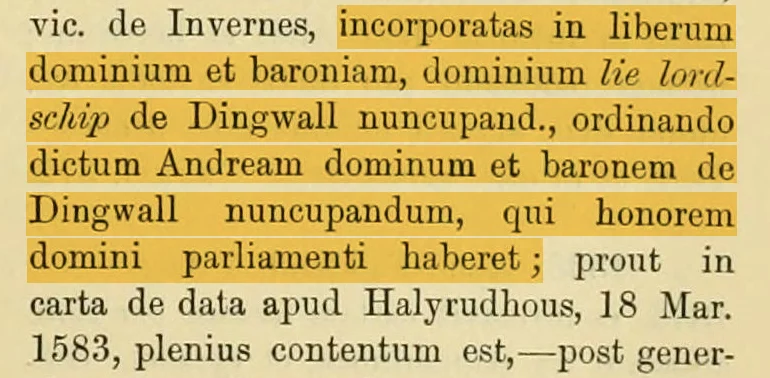
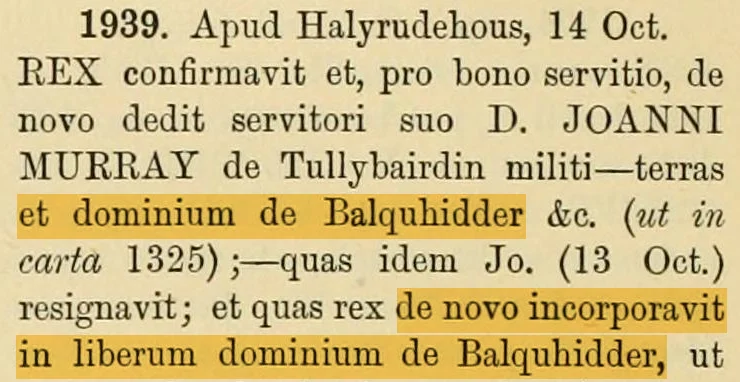
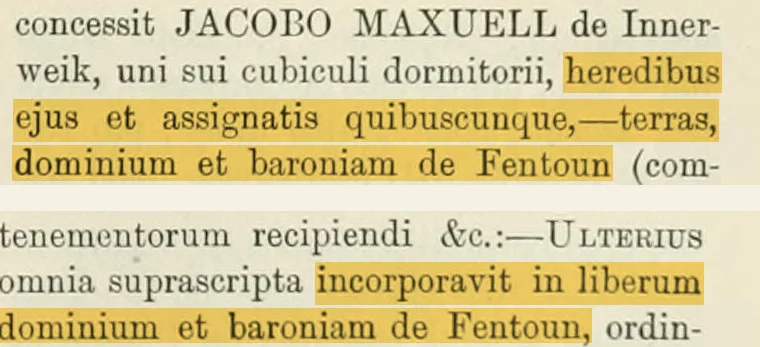
So “lord” alone did not make a peer. The peerage rank needed its fuller name, Lord of Parliament, because lords held territorially in the baronage. It was at first an honour added to such a lordship, and only later given by patent alone: in 1627 Sir Thomas Fairfax, an Englishman, was made Lord Fairfax of Cameron with no lands.11
Torphichen: the honour in the land
At Torphichen the barony and the lordship of Parliament were one estate. In January 1564 Sir James Sandilands, Preceptor of the Knights of St John in Scotland, resigned the Order’s lands into Queen Mary’s hands. She granted them back to him “and his heirs and assignees”, for 10,000 crowns of the sun, and incorporated them “into the free barony of Torphichen”. The charter names no title. It calls the erection a free barony, not a lordship, and its grantee “James, lord of St John’s”: the Preceptor’s style, for the Preceptors, Riddell notes, had held the peerage for their lives, “after their election, but more especially investiture in the fief”.12 In 1606 the charter was accepted “as the sole evidence creating the lordship and carrying with it the dignity of Lord Torphichen”.13 Riddell, writing on peerage law in 1833, read the record so: the grant “is merely that of a common barony, but with higher rights and privileges”; the heir of 1597 “assumes the dignity, on vesting himself in the fief, by retour”; and the barony “passed like a common property, under a limitation applicable to land, carrying the Peerage along with it”.14
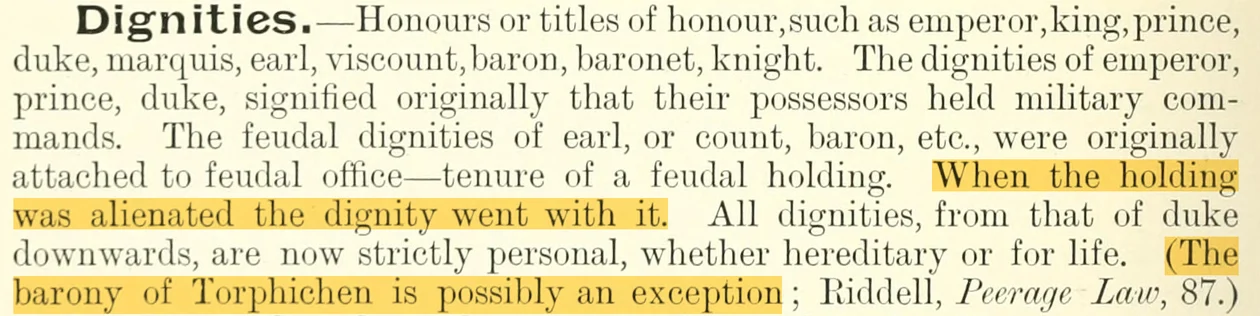
When Charles I resumed the church lands, the fourth Lord feared for the superiorities of his barony. An award of the King in 1636, with the force of an Act of Parliament, kept them “within that … portion of it in which the title and dignity of Lords of Parliament subsists, and to which the title of Lord of Parliament is annexed”.15 The peerage stood in the land: a lordship of Parliament annexed to part of a barony, held of the Crown by heirs and assignees. “Is not this a territorial Peerage?”, Riddell asked: a title that follows “the fate of the land, in which it subsists, and without which, like the head and members, it cannot subsist”. Sixty years later Stevenson’s legal encyclopaedia laid down that a dignity “is not now capable of transference”, and added: “The barony of Torphichen is possibly an exception.”16
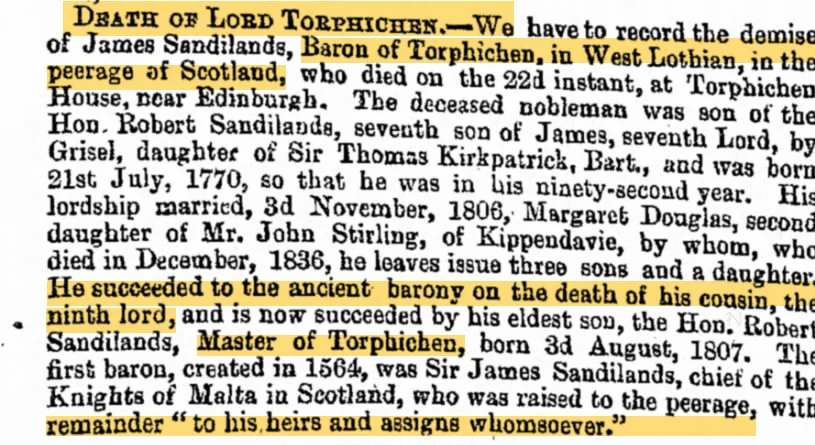
The holder carried two titles, as Forbes did: the barony made him Baron of Torphichen, the honour made him Lord Torphichen. Neither is a form of the other. When the tenth Lord died in March 1862, the London press used both. Its heading was “Death of Lord Torphichen”; its text recorded “James Sandilands, Baron of Torphichen, in West Lothian, in the peerage of Scotland”, who had “succeeded to the ancient barony on the death of his cousin, the ninth lord”, and whose heir was “Master of Torphichen”.17 The barony is named first and the peerage after it, in one sentence, for one man.
What the Union changed
England took another road. There “baron” became the lowest rank of the peerage, and at Westminster a baron was a peer. The Peerage of Scotland closed at the Union of 1707, and no Scottish peerage has been created since. The Stair Encyclopaedia puts it in a line: the lowest rank in the peerage was “lord” in Scotland before the Union, and has been “baron” since.18
That is why the King’s Scale of 1905 lists “Barons of Scotland” among the peers: it uses the British name for the lords of parliament.19 The holders themselves stayed Lords, and the women show it best. The Peerage Act 1963 gave a woman holding a peerage in her own right a seat in the Lords.20 Within months the House had “Baroness Strange of Knokin”, in an English barony, and “The Lady Kinloss”, in a Scottish lordship. Hansard’s “Lord Saltoun” of 1955 was followed by “Lady Saltoun of Abernethy”.21 The Scottish holders were Ladies, not Baronesses: the peerage of Scotland has no such rank.
Debrett’s table for England now gives them a line of their own, “Lords of Parliament, Scotland”.22
Why it matters
The common objection runs: a baron is a peer, so a Scottish baron who is not a peer is no real baron. That is English usage. In Scotland the word never passed to the peerage, because the baronage already held it.
Stair warns that the title “should not be confused with a dignity in the peerage of Scotland”.23 That is right, and it is the point. A Scottish baron does not claim a rank of the peerage. He holds a dignity older than the peerage: the Act of 2000 preserves “the dignity of baron”, and in 1943 the Lyon Court found the minor barons “a ‘titled nobility’”.24
What the record does not say
- No source gives the reason in terms. The charters show the separation. That the rank took its name from it is our reading.
- The word still crosses over. Debrett’s table for Scotland reads “Barons or Lords of Parliament (Scotland)”.
- How far the Torphichen peerage follows the land. Riddell: the barony “passed like a common property, under a limitation applicable to land, carrying the Peerage along with it”, and “a curious question might, possibly, arise, on the alienation” of the portion that carries the title. Stevenson: “When the holding was alienated the dignity went with it”, and Torphichen “is possibly an exception” to the rule that a dignity “is not now capable of transference”. Both leave the question open; the record shows the peerage passing with the barony by inheritance.
- The phrase is older than the first named creations. The Act of 1428 has “lords of parliament”; the first named creations are of the 1440s.
The Roll and the Pledge
The Baronage of Scotland Association keeps the Roll of Scottish Barons, which enters a holder only on evidence, and offers the Pledge: an undertaking, in honour and not in law, to preserve a barony within the family for future generations and to uphold the Baronial Code of Honour.
Notes
- Mackenzie, Works, vol. II, p. 534: “Under the greater are comprehended all such as are Lords of Parliament, under the lesser are comprehended Knights and Gentlemen; and though all these be not Peers of Parliament, yet they are all Peers to one another”. He adds: “Under the Word Baron all our Nobility are comprehended”. ↩
- George Burnett, Lord Lyon, in a letter of 1889 printed in G. E. C., The Complete Peerage, vol. I (London, 1910), Preface to the First Edition, p. xxvii. He goes on: “All Barons in the old sense, i.e., landholders holding their land as a Barony, had the right, or, more properly speaking, were under the obligation, to attend the meeting of the Estates”. ↩
- RPS 1540/12/30; Parliament of December 1567, RPS 1567/12/45; Act regarding the age and qualities of the lords of session, 5 June 1592, RPS 1592/4/72. See The baronage in the statutes, 1428–2004. ↩
- William Borthwick, An Inquiry into the Origin and Limitations of the Feudal Dignities of Scotland (1775), p. 13, in modern English: “if he held his lands in free earldom, he was marked down Earl; if he held his lands in free lordship, he was marked Lord; if he held them only in free barony, he was marked Baron”. ↩
- The Act of 5 March 1428, in modern English: “All bishops, abbots, priors, dukes, earls, lords of parliament and bannerets whom the King wishes shall be reserved, and summoned to councils and to parliaments by his special precept”. The Acts of the Parliaments of Scotland, vol. II, p. 15, printed under 1427 in the old reckoning of the year; RPS 1428/3/3. ↩
- Registrum Magni Sigilli Regum Scotorum, vol. II, no. 134, p. 27: the Register’s page is headed 1429; The Scots Peerage gives 1430. The Scots Peerage, vol. IV (Edinburgh, 1907), p. 49: “Between October 1444 and July 1445 Sir Alexander Forbes, knight, was raised to the Peerage”. Mackenzie, Works, vol. II, p. 547. ↩
- Charter of 18 March 1583, recited on 3 August 1587, translated from the Latin. Register of the Great Seal, vol. V, no. 1337, p. 461. ↩
- 29 July 1587, translated from the Latin: “incorporated into the free temporal lordship and barony of Paisley, giving the said Lord Claud &c. the title and honour of a free baron and lord of parliaments”. Register of the Great Seal, vol. V, no. 1320, p. 453. ↩
- 14 October 1591, translated from the Latin: “into the free lordship of Balquhidder”. Register of the Great Seal, vol. V, no. 1939, p. 654. ↩
- 4 June 1631, translated from the Latin: “into the free lordship and barony of Fenton”. Register of the Great Seal, vol. VIII, no. 1779, p. 609. ↩
- 18 October 1627: Register of the Great Seal, vol. VIII, no. 1155, p. 404. ↩
- Register of the Great Seal, vol. IV, no. 1499, 24 January 1563-64, pp. 343–344, translated from the Latin: the lands, which “the Queen incorporated into the free barony of Torphichen”, granted to “the said James, lord of St John’s, his heirs and assignees”, for “10,000 gold crowns of the sun”, with a promise to ratify the grant in Parliament when she reached the age of twenty-five. Riddell, Remarks upon Scotch Peerage Law (1833), p. 63, on the Preceptors. ↩
- The Scots Peerage, vol. VIII (Edinburgh, 1911), p. 387: “Though his new title is not named in this charter, it was accepted in 1606 as the sole evidence creating the lordship and carrying with it the dignity of LORD TORPHICHEN, which designation he bore from the date of the writ.” ↩
- John Riddell, Remarks upon Scotch Peerage Law (Edinburgh, 1833), p. 61: “There is no mention here of any title of honor, peerage, or hereditary seat, or vote in Parliament; the grant is merely that of a common barony, but with higher rights and privileges, such as had been possessed by the Preceptors”; p. 62: the heir “assumes the dignity, on vesting himself in the fief, by retour of that date, as heir to his grand-uncle, in terms of the charter in 1563. The barony, in this manner, passed like a common property, under a limitation applicable to land, carrying the Peerage along with it”; the award “in reality in 1636, but inserted in the Acts of Parliament in 1633”; p. 63: “is not this a territorial Peerage”, and the Preceptors’ peerage held “during their lives, after their election, but more especially investiture in the fief”; p. 64; p. 65: “the title still retains its ancient character, being still an incident, and following, according to its original nature and constitution, the fate of the land, in which it subsists, and without which, like the head and members, it cannot subsist”, and “a curious question might, possibly, arise, on the alienation of that transcendant, and highly privileged mean portion”. ↩
- Award of Charles I, dated 15 May 1636, The Acts of the Parliaments of Scotland, vol. V, p. 162, as quoted in The Scots Peerage, vol. VIII, p. 392, in modern English. The award followed a resolution of the Privy Council and was “to have the force of an Act of Parliament”. ↩
- J. H. Stevenson, “Dignities”, in Green’s Encyclopaedia of the Law of Scotland, ed. John Chisholm, vol. IV (Edinburgh, 1897), p. 226: “The feudal dignities of earl, or count, baron, etc., were originally attached to feudal office, tenure of a feudal holding. When the holding was alienated the dignity went with it. All dignities, from that of duke downwards, are now strictly personal, whether hereditary or for life. (The barony of Torphichen is possibly an exception; Riddell, Peerage Law, 87.)” And: “A dignity is indivisible; is not now capable of transference, or attachable for debt.” ↩
- Saint James’s Chronicle, 27 March 1862, p. 5; the same notice in the Brighton Gazette, 3 April 1862, p. 2 (British Newspaper Archive). The tenth Lord died on 22 March 1862: The Scots Peerage, vol. VIII, p. 397. ↩
- Stair Memorial Encyclopaedia, vol. 16, “Peerages”, para. 1311, p. 136. The title “Precedence”, para. 2018 (p. 432), uses “baron” in the same way, for the lowest rank of the peerage. In copyright; summarised. ↩
- The London Gazette, 14 March 1905, issue 27774, p. 2013. See “Never ceded”: the precedence of a Scottish baron. ↩
- Peerage Act 1963, s. 6: “A woman who is the holder of a hereditary peerage in the peerage of England, Scotland, Great Britain or the United Kingdom shall … have the same right … to sit and vote in that House”. ↩
- House of Lords Debates, 19 November 1963, vol. 253, c. 207: “Baroness Strange of Knokin took the Oath”; 18 February 1964, vol. 255, c. 753: “The Lady Kinloss—Sat first in Parliament, pursuant to the Peerage Act, 1963”; 22 November 1955, vol. 194, cc. 687–707; 1 May 1985, vol. 463, cc. 234–6. Hansard’s record of Flora Fraser: “Titles in Lords: Lady Saltoun of Abernethy”. ↩
- Debrett’s, Tables of Precedence (online, read 1 November 2026). ↩
- Stair Memorial Encyclopaedia, vol. 16, “Peerages”, para. 1311, p. 136. ↩
- Abolition of Feudal Tenure etc. (Scotland) Act 2000, s. 63; Court of the Lord Lyon, interlocutor of 26 February 1943, Public Register of All Genealogies and Birthbrieves, vol. iv, p. 26. See Untitled or titled nobility? ↩
This research is paid for by members and friends of the Association. Support the Baronage →