Law & Statutes
How is a Scottish baron named in public life? By title, by name, or by designation
A borough council wrote “Councillor Baron Chenery of Horsbrugh”, a county council “Cllr Michael Chenery of Horsbrugh”, and the ballot paper “CHENERY OF HORSBRUGH”. One man, three records
Scottish Baronial StudiesPaper 11 of 13
6 min read · Reviewed November 2026
Baronage of Scotland Association · The Reading Room · www.baronage.com/reading-room/how-a-scottish-baron-is-named-in-public-life/

Which form appears depends on the record in front of the clerk, and on what it was given. The title is the same in all three.
The short answer
- By title, where the record has room for it. A Norfolk borough council listed a member from 2015 as “Councillor Baron Chenery of Horsbrugh”, one line from “Councillor Lord Howard”, a peer. The Queen’s Birthday Honours of 2005 made “Robert Brown Gillespie, Baron of Blackhall” an OBE.
- By name, where it has none. The county council’s papers call the same man “Cllr Michael Chenery of Horsbrugh”.
- By designation on the ballot paper, which strips every title. Sir Keir Starmer stood in 2024 as “Starmer, Keir”. The baron stood as “CHENERY OF HORSBRUGH, Michael John Baylis”: the designation the Lord Lyon recognised is his surname.
- A title and its use are two things. The title is the holder’s in law. No one can be compelled to use it, at home or abroad, and the holder chooses the form he gives. The Lord Lyon stands apart: he is the Crown’s officer, and others follow him.
One man, three records
Michael Chenery of Horsbrugh, Baron of Horsbrugh, recognised by the Lord Lyon in 1995, sat on a Norfolk borough council and on Norfolk County Council for most of forty years, and died in June 2026.1 The borough’s record carried the title: “Councillor Baron Chenery of Horsbrugh” on its councillor page in 2015 and 2016, and in its attendance record of 10 May 2018, beside “Councillor Lord Howard”.2 The county’s did not: the Norfolk Records Committee, which he chaired, has “Cllr Michael Chenery of Horsbrugh (Chair)”.3 The ballot paper used neither: the nomination papers of 2017, 2023 and 2026 print “CHENERY OF HORSBRUGH, Michael John Baylis”.4
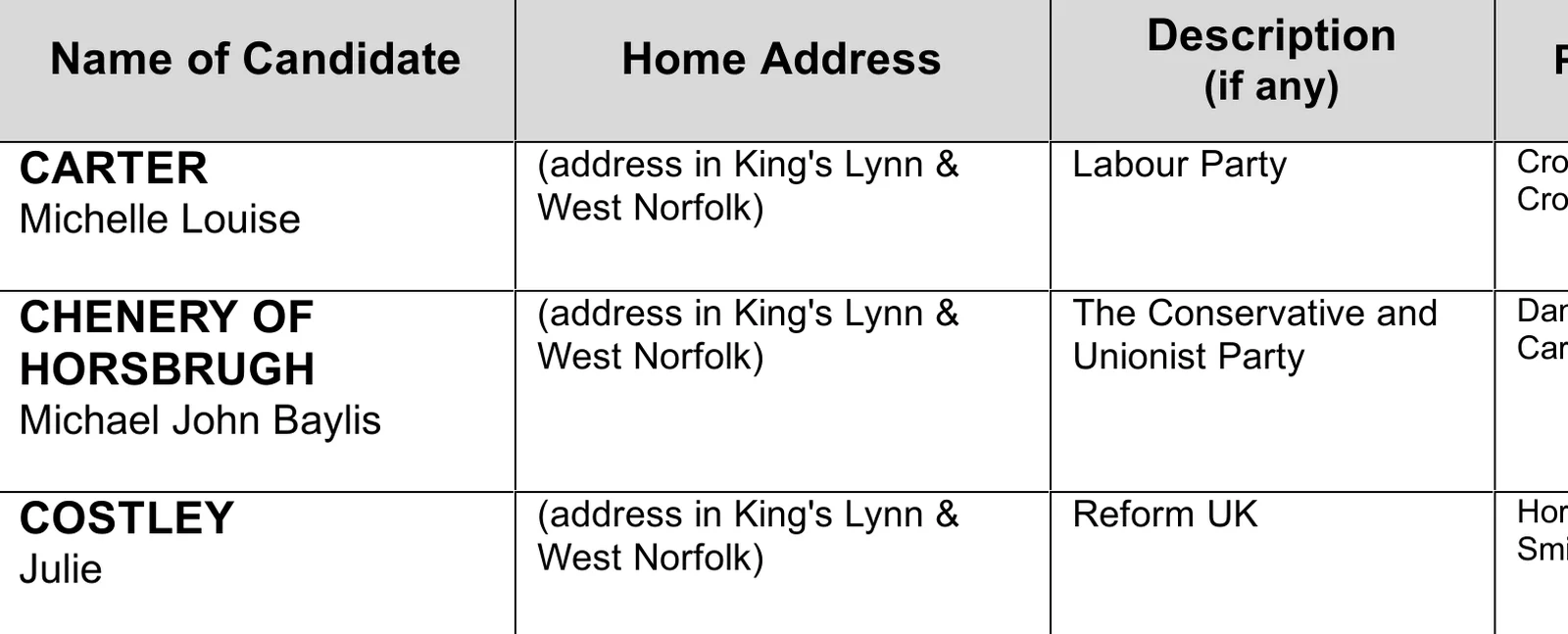
The ballot paper strips every title
A nomination paper asks for full names, and the returning officers’ forms say what that excludes: “Prefixes like Sir, or suffixes like Snr, must not be used”; “Titles will not appear on the ballot paper or other notices.”5 The rule is the same for a knight: Sir Keir Starmer, KCB since 2014, stood in July 2024 as “Starmer, Keir”.6 What survives is the name, and a baron’s name carries his designation.7
A name and a title
A title of nobility is part of its holder’s name and identity. The passport’s two fields may, at the holder’s option, take the title in the surname field, with the full name in the observations; a legal contract gives the whole, “THE MOST NOBLE TORQUHIL IAN CAMPBELL, Thirteenth Duke of Argyll, Marquess of Kintyre and Lorne etc”.8
Someone may legally own a barony, but no one, person or organisation, can be compelled to recognise it or to address the holder by it. Others, the Roll included, remain free to recognise the title or not, and to address its holder in any courteous manner they choose. A peer stands in the same place. The Crown made David Cameron “BARON CAMERON OF CHIPPING NORTON” in 2023; the Government’s own pages then called him both “Foreign Secretary Lord Cameron” and “British Foreign Secretary David Cameron”.9 Some will use a title as a courtesy, some will not know the form, and a digital system may have no way to bend.
The Lord Lyon is another matter. He is the Crown’s officer in Scotland, appointed on the First Minister’s recommendation, and his court is “Scotland’s Heraldic Authority”.10 Others take their lead from him: HM Passport Office includes a title on “evidence that the Lord Lyon has recognised their feudal barony”, the Scottish Register of Tartans keeps its Clan/Family category for clans and families “as recognised by the Court of the Lord Lyon”, and the surname he recognises is the one on the ballot paper. So his is no private courtesy. If the Lord Lyon declines to recognise a title, the others have nothing to follow, and recognition suffers everywhere.
Abroad
Each state draws its own line. Germany keeps an old title only as part of a name, Italy only the territorial predicate, and Poland’s Constitution of 1921 recognised none.11 Austria abolished its nobility in 1919, down to the “von”, and the ban covers titles from abroad. An Austrian citizen adopted in Germany carried “Fürstin von Sayn-Wittgenstein” on her German driving licence and her Austrian passport; Vienna struck out “Fürstin von”, and in 2010 the European Court of Justice held that EU law allowed it.12 A German citizen took a name with “Graf” and “Freiherr” in it by deed poll in London and carried it on his British passport; in 2016 the same Court held that Germany was “not bound to recognise” it, if refusal was needed to keep its citizens equal before the law.13
Ireland shows the two things apart. Its Constitution confers no titles of nobility, and an Irish passport carries no “Sir”, “Lord” or “Baron”; yet when the 8th Marquess Conyngham, an Anglo-Irish peer, was buried at Slane in June 2025, the President’s aide-de-camp and the Tánaiste attended.14 The law gave the title nothing; courtesy gave it the State at the graveside.
The peer’s option
Hugh Peskett’s conclusion on the Act of 2000, that it “places baronies in the same class as peerages”, has a consequence for the record.15 A peer is known by his title alone: “Councillor Lord Howard” in the borough’s list, “Argyll” at the foot of a contract. Scots conveyancing settled that long ago: “A peer subscribes simply by his title.”16 A dignity of the same class carries the same option, and a baron has the form ready: “the Baron of Inverness”, or “Inverness” alone.17
The history shows what happens when the option is withheld. The Act of 1672 allowed only peers and bishops to sign by their titles; the Commons after 1707 had only “Esquire” and “Mr.” for a baron; and the Lyon Court’s own note records that the style of “Baron” then “gradually fell into desuetude”.18 A title kept out of the record falls out of use.
Where the record has room, the title appears
The Crown has used it in the honours list: “Robert Brown Gillespie, Baron of Blackhall”, OBE, 2005.19 The Scottish Parliament has room for the designation: in May 2026 a member was sworn as “Alexander James Amherst Burnett of Leys”.20
More often the Crown’s instruments carry the name alone. The 24th Baron of Drum was commissioned a Deputy Lieutenant in 1961 as “Henry Quentin Forbes Irvine of Drum Castle”, and the Baron of Ochtercoull in 1989 as “James Malcolm Marcus Humphrey of Dinnet”. The heir’s style is printed too: in 1986 the heir of the Chief of Clan Cameron, whose family holds the barony of Lochiel, was commissioned as “Donald Cameron, Younger of Lochiel”. No Deputy Lieutenant’s commission in the Gazette since 1945 has carried “Baron of X”.21
A territorial designation is part of a name, not a dignity: about four in five of those on the Lord Lyon’s rolls belong to lairds who are not barons. Many baronial families have used the name alone since the Union and have no tradition of using the title. It is theirs nonetheless.
Where a record has no line for a dignity, the dignity drops out and the Lyon Court’s record carries it: “Sir Nicholas Fairbairn” in the Commons’ database and “Baron of Fordell” in Hansard’s; “Boot, Geoffrey George” in Tynwald’s list and “Boot, Baron of Waughton” in the Lyon’s.22 None of these records shows a refusal. They show a form with no line for a dignity, and one record, the borough’s, that was given the title and printed it.
For the Commons, see Did Scottish barons sit in the House of Commons?
The Roll and the Pledge
A family with no tradition of using its title needs two things, precedent and evidence. These papers give the precedent. The Baronage of Scotland Association keeps the Roll of Scottish Barons, which enters a holder only on evidence, and offers the Pledge: an undertaking, in honour and not in law, to preserve a barony within the family for future generations and to uphold the Baronial Code of Honour. The model is the baronets’ Roll of 1910.
Notes
- The Edinburgh Gazette, 4 April 1997, issue 24169, p. 777, Court of the Lord Lyon, roll under 15 May 1995: “†Chenery of Horsburgh”, the dagger marking arms “matriculated with chapeau in respect of being a Minor Baron”; the Gazette prints the Peeblesshire spelling, Horsburgh, where the holder and every council and election record have Horsbrugh. Borough councillor for Creake 1987–95 and Rudham 2003–19; county councillor for Docking 2009–26 and chairman of the Norfolk Records Committee 2019–26: Eastern Daily Press, 23 June 2026, “Tributes after death of Baron Chenery of Horsbrugh”. The Roll of Scottish Barons. ↩
- Borough Council of King’s Lynn & West Norfolk, councillor details, as archived on 22 September 2015 and 13 August 2016: “Councillor Baron Chenery of Horsbrugh”, Rudham Ward; meeting attendance, Council, 10 May 2018. After his term ended on 7 May 2019 the page reads “Councillor Michael Chenery of Horsbrugh … Not currently an elected councillor”. ↩
- Norfolk County Council, Norfolk Records Committee, agenda for 24 October 2025 with the minutes of 25 July 2025: “Cllr Michael Chenery of Horsbrugh (Chair)”; signed “Councillor Michael Chenery of Horsbrugh, Chair, Norfolk Records Committee” (committee papers on the council’s CMIS system). The borough’s list of county councillors: “Docking — Michael Chenery of Horsbrugh”. ↩
- Borough Council of King’s Lynn & West Norfolk: Notice of Poll, Docking Electoral Division, 25 April 2017; Statement of Persons Nominated, borough election, 4 April 2023, Bircham with Rudhams Ward; Statement of Persons Nominated, Docking County Division, 10 April 2026. ↩
- Borough Council of King’s Lynn & West Norfolk, Annotated nomination papers – Principal Areas – England, version 2 (January 2023), p. 4; the same words in North Somerset Council’s annotated district nomination paper (2022). Both follow the Electoral Commission’s guidance for candidates. ↩
- The London Gazette, supplement 60728, 31 December 2013, p. N3, Order of the Bath, K.C.B.: “Keir Starmer, Q.C., lately Director of Public Prosecutions”. London Borough of Camden, Statement of Persons Nominated and Notice of Poll, Holborn and St Pancras, poll of 4 July 2024, as archived on 8 June 2024: “Starmer, Keir — Labour Party”. ↩
- The Edinburgh Gazette, 19 August 2005, issue 25893, p. 2502, note 1 to the Lyon Court’s roll: a holder may “add the designation as the part of the name and by doing so regularly make those words their ‘ordinary surname’”. See Baron of X, or X of Y? Two styles of a Scottish baron. ↩
- The forms, and the law behind them, are in How is a Scottish baron named in a legal document?. ↩
- The London Gazette, issue 64237, 21 November 2023, p. 23554, Crown Office: Letters Patent of 17 November 2023 conferring a barony for life “upon The Right Honourable David William Donald Cameron, by the name, style and title of BARON CAMERON OF CHIPPING NORTON”. Gov.uk, “Foreign Secretary Lord Cameron visits Ashgabat”, 6 May 2024, and readout of 26 April 2024: “British Foreign Secretary David Cameron paid an official visit to Mongolia”. ↩
- Court of the Lord Lyon, About us: the Lord Lyon is “appointed by the Sovereign on the recommendation of the First Minister”, and the matriculation of arms is “a judicial function from which there is appeal directly to the Court of Session and ultimately to the Supreme Court”. HM Passport Office, Titles: caseworker guidance, version 25.0 (2026), “Scottish feudal baronies”: gov.uk. Scottish Register of Tartans, FAQs: “The Clan/Family category is reserved for historic Scottish clans and families as recognised by the Court of the Lord Lyon in Edinburgh.” ↩
- Germany: Constitution of 11 August 1919, Art. 109, in force as federal law: “Titles of nobility are valid only as part of a name and may no longer be conferred”, as quoted in Case C-438/14, paras 4–5. Italy: Constitution, Transitional and Final Provisions, XIV: “Titles of nobility shall not be acknowledged. The predicates of those existing prior to 28 October 1922 shall serve as part of the name.” Poland: Constitution of 17 March 1921, Art. 96 (Dz.U. 1921, no. 44, item 267): “Rzeczpospolita Polska nie uznaje przywilejów rodowych ani stanowych, jak również żadnych herbów, tytułów rodowych i innych, z wyjątkiem naukowych, urzędowych i zawodowych”, recognising no privileges of family or estate, nor any arms, family or other titles, save academic, official and professional ones. ↩
- Austria: Law of 3 April 1919 on the abolition of the nobility (StGBl. 211/1919), of constitutional status, and its implementing provisions of 18 April 1919 (StGBl. 237/1919), para. 1, on privileges “acquired in Austria or in a foreign country”, and para. 2, “The right to use the nobiliary particle ‘von’”, as quoted in Case C-208/09, Sayn-Wittgenstein v Landeshauptmann von Wien, judgment of 22 December 2010, paras 3 and 6–7. Licence and passport: para. 24. The Austrian authorities “do not appear to have gone further than is necessary” (para. 93); EU law does not preclude the refusal “provided that the measures adopted by those authorities in that context are justified on public policy grounds” (ruling). ↩
- Case C-438/14, Bogendorff von Wolffersdorff v Standesamt der Stadt Karlsruhe, judgment of 2 June 2016, paras 14–15 (naturalisation and deed poll), 44 (British passport and driving licence) and ruling: the authorities are “not bound to recognise” the name, provided “a refusal of recognition is, in that context, justified on public policy grounds, in that it is appropriate and necessary to ensure compliance with the principle that all citizens of that Member State are equal before the law”, which was for the German court to decide. The elements of the name “do not formally constitute titles of nobility either in Germany or in the United Kingdom” (para. 81). Both cases concern a state’s own citizens. ↩
- Constitution of Ireland, Article 40.2: “1° Titles of nobility shall not be conferred by the State. 2° No title of nobility or of honour may be accepted by any citizen except with the prior approval of the Government.” Henry Conyngham, 8th Marquess Conyngham, died 18 June 2025 and was buried from St Patrick’s Church, Slane, on 25 June 2025. ↩
- Hugh Peskett, opinion on the nobility, title and dignity of Scottish baronies (after 2013), para. 3.3, reproduced in Did Scottish barons sit in the House of Commons?: “The 2000 Act clearly identifies a barony as a dignity. This places baronies in the same class as peerages.” ↩
- Allan Menzies, Conveyancing according to the Law of Scotland (3rd ed., Edinburgh, 1863), p. 104; the rule and the forms are in How is a Scottish baron named in a legal document?. ↩
- Proper address: “John, Baron of Inverness” or “John Inverness” as a signature; “Inverness” in speech. ↩
- Lyon King of Arms Act 1672, c. 47: “it is onlie allowed for Noblemen and Bishopes to subscrive by their titles”; Court of the Lord Lyon, note in the petition of Sturzenegger of Arran, p. 7: “The style of ‘Baron’, although not incorrect, gradually fell into desuetude.” On 1707 see Did Scottish barons sit in the House of Commons?. ↩
- The London Gazette, 11 June 2005, supplement no. 1 (issue 57665), Birthday Honours, O.B.E., p. B23; The Edinburgh Gazette, 19 August 2005, issue 25893, p. 2502, under 2003: “*† Gillespie of Blackhall”. ↩
- Scottish Parliament, Official Report, 14 May 2026, Oaths and Affirmations: “I, Alexander James Amherst Burnett of Leys, do swear …”. ↩
- The London Gazette, no. 42260, 24 January 1961, p. 603, commissions signed by the Lord Lieutenant of Aberdeenshire, 14 January 1961; the Roll of Scottish Barons, Drum, 24th Baron, 1940–1975. The London Gazette, no. 51889, 2 October 1989, p. 11269; The Edinburgh Gazette, 17 January 1984, issue 21460, p. 51, under 1983: “Humphrey of Dinnet”, marked a minor baron; his barony is Ochtercoull, as Officially Recognised explains. The London Gazette, no. 50467, 21 March 1986, p. 4069, commissions for Lochaber, Inverness, Badenoch and Strathspey; the Roll of Scottish Barons enters the present chief, Lord Cameron of Lochiel, as Baron of Lochiel. A search of the Gazette’s Deputy Lieutenant commissions from 1945 to 2026 for “Baron of” finds no Scottish baron so named; the only hits are peerage styles such as “Baron Forteviot” and Lyon Court notices printed on the same pages. ↩
- UK Parliament, members’ database, “Sir Nicholas Fairbairn”; Historic Hansard: “Alternative names: Baron of Fordell 1933–1995”; The Edinburgh Gazette, 26 March 1971, issue 18975, p. 209, under 1970, “† Fairbairn of Fordell”. Tynwald, former members, “Boot, Geoffrey George”, MHK 2015–2021; The Edinburgh Gazette, 15 August 2000, issue 24861, p. 1734, “øBoot, Baron of Waughton”. ↩
This research is paid for by members and friends of the Association. Support the Baronage →