Law & Statutes
How is a Scottish baron named in a legal document? There is no “commonly called”
The Crown writes “commonly called” before a courtesy title, which the law does not confer. A Scottish barony is a dignity kept by statute, and every Lord Lyon on record has written it into the name. A deed names a baron as it names a duke
The Baron’s CoursePaper 13 of 13
13 min read · Reviewed October 2026
Baronage of Scotland Association · The Reading Room · www.baronage.com/reading-room/how-a-scottish-baron-is-named-in-a-legal-document/

Scots conveyancing has a settled form for a duke, an earl, a Master and a courtesy lord. Applied to a Scottish baron, it gives one result.
The short answer
- Name the baron as a deed names a peer. “THE MUCH HONOURED JOHN ALEXANDER SMITH, BARON OF INVERNESS, residing at … (‘the Baron’)”, on the pattern of “THE MOST NOBLE …, Duke of Argyll … (‘the Duke’)”.
- Do not write “commonly called”. The Crown Office puts that formula before a style the law does not itself confer: a courtesy title, or a foreign one. Halsbury’s example is a peer of Ireland with no seat in Parliament: he is still described “by his proper name with the addition of his title and degree, but without the expression ‘commonly called’”.
- The barony is a dignity in law. “Nothing in this Act affects the dignity of baron”, says section 63 of the Act of 2000. A courtesy title, in the Lord Chancellor’s words of 1963, gives “no legal right”.
- The Lyon Court writes the title into the name, as it always has. Lords Lyon have styled themselves “Baron of X” in their own instruments since the seventeenth century, and the Court’s Letters Patent to barons name the grantee the same way as a matter of course. “Officially Recognise the Petitioner in the name X, Baron of Y” are the Court’s standard words, under every Lord Lyon whose patents the Roll holds.
- The passport’s two fields are not the measure of the name. HM Passport Office’s own guidance says “Titles of nobility are part of a person’s name and identity”, and records a baron’s full name on the observations page: “THE HOLDER IS (FORENAMES) (SURNAME), BARON OF (territorial designation)”. The deed uses that full name.
- Signatures follow the deed. Since 1995 a granter signs “with the full name by which he is identified in the document”, or with surname and forename. The rule of 1672 that only “Noblemen” might “subscrive by their titles” is repealed.
The conveyancing form
A deed of assignation of a Scottish barony granted by the Earl of Airlie runs: “I, THE RIGHT HONOURABLE DAVID GEORGE COKE PATRICK OGILVY, EARL OF AIRLIE, K.T., G.C.V.O. (‘Lord Airlie’) residing at …”, and narrates a trust for his son, “THE HONOURABLE DAVID JOHN OGILVY, MASTER OF AIRLIE, commonly called LORD OGILVY (‘Lord Ogilvy’), residing at …”. One by the Duke of Argyll opens: “WE, (In the First Place) THE MOST NOBLE TORQUHIL IAN CAMPBELL, Thirteenth Duke of Argyll, Marquess of Kintyre and Lorne etc residing at …, (‘the Duke’)”.1
That is the ordinary form. The peer’s own dignity and its style are written bare: “THE RIGHT HONOURABLE … EARL OF AIRLIE”, “THE MOST NOBLE … Duke of Argyll”. The heir’s own title, “MASTER OF AIRLIE”, is written bare too. The one title the heir holds by custom from his father’s peerage, “Lord Ogilvy”, is introduced by “commonly called”.
The passport and the deed
A passport has two name fields, forenames and surname, and an observations page. The peers’ deeds do not copy the two fields. They design the party by the full legal name: every forename, the family surname and the title, “DAVID GEORGE COKE PATRICK OGILVY, EARL OF AIRLIE”. The passport itself treats the title as part of that name. His Majesty’s Passport Office’s guidance to its staff says: “Titles of nobility are part of a person’s name and identity. Customers who use a title of nobility as part of their name, must ask us to enter it in the ‘surname’ field of the personal details page of their passport.” For a duke the surname field reads “The Duke of [title]” and the observations page carries the whole name, “THE HOLDER IS HIS GRACE [forenames and family surname] DUKE OF [title]”; for the heir of a Scottish peer the surname field is “MASTER OF [title]”. For a Scottish baron the same guidance gives the surname field as “(surname) of (territorial designation)” and the observation as “THE HOLDER IS (FORENAMES) (SURNAME), BARON OF (territorial designation)”, on evidence of the Lord Lyon’s recognition and the entry in Burke’s Peerage and Gentry, the two conditions it lists.2 Hugh Peskett recorded the same practice: the Passport Office and the DVLA “have accepted inclusion of the title of Baron on their documents for Scottish Barons”.3
So the full legal name is what the observations page records and what the deed uses: forenames, surname and title together. The two fields are the format of the data page, not the measure of the name.
What “commonly called” means
The formula has a settled meaning. Blackstone, in 1765: the eldest sons of peers, “though generally titular lords, are only esquires in the law, and must so be named in all legal proceedings”.4 Halsbury’s Laws of England, in 1912: a peer of Ireland who is not a lord of Parliament “should be described by his proper name with the addition of his title and degree, but without the expression ‘commonly called,’ which is only used in the case of courtesy titles of sons of dukes, marquesses, viscounts, or earls”.5
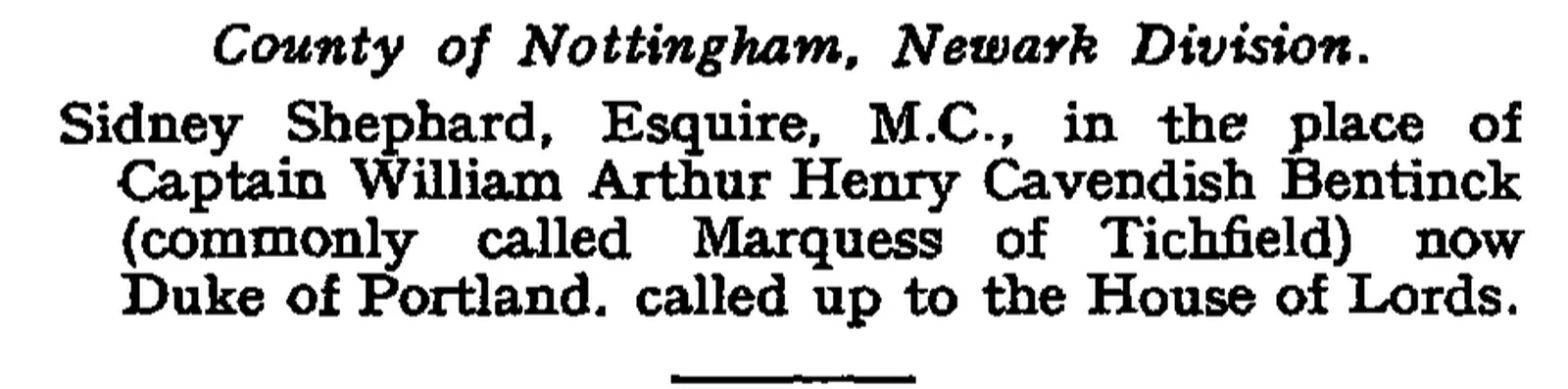
The Crown Office has kept to that use for two centuries: “commonly called Lord Viscount Althorp” in 1830, “commonly called Lord Dunglass” in 1931.6 In 1857 it returned “Lionel Nathan de Rothschild, commonly called Baron Lionel Nathan de Rothschild”: his barony was his own, but Austrian, licensed by Queen Victoria and not conferred by British law, so it took the formula too.7 In 1943 it put both kinds of title in one entry: a member returned “in the place of Captain William Arthur Henry Cavendish Bentinck (commonly called Marquess of Tichfield) now Duke of Portland, called up to the House of Lords”.8 The courtesy marquessate sits inside the brackets; the dukedom stands outside them.
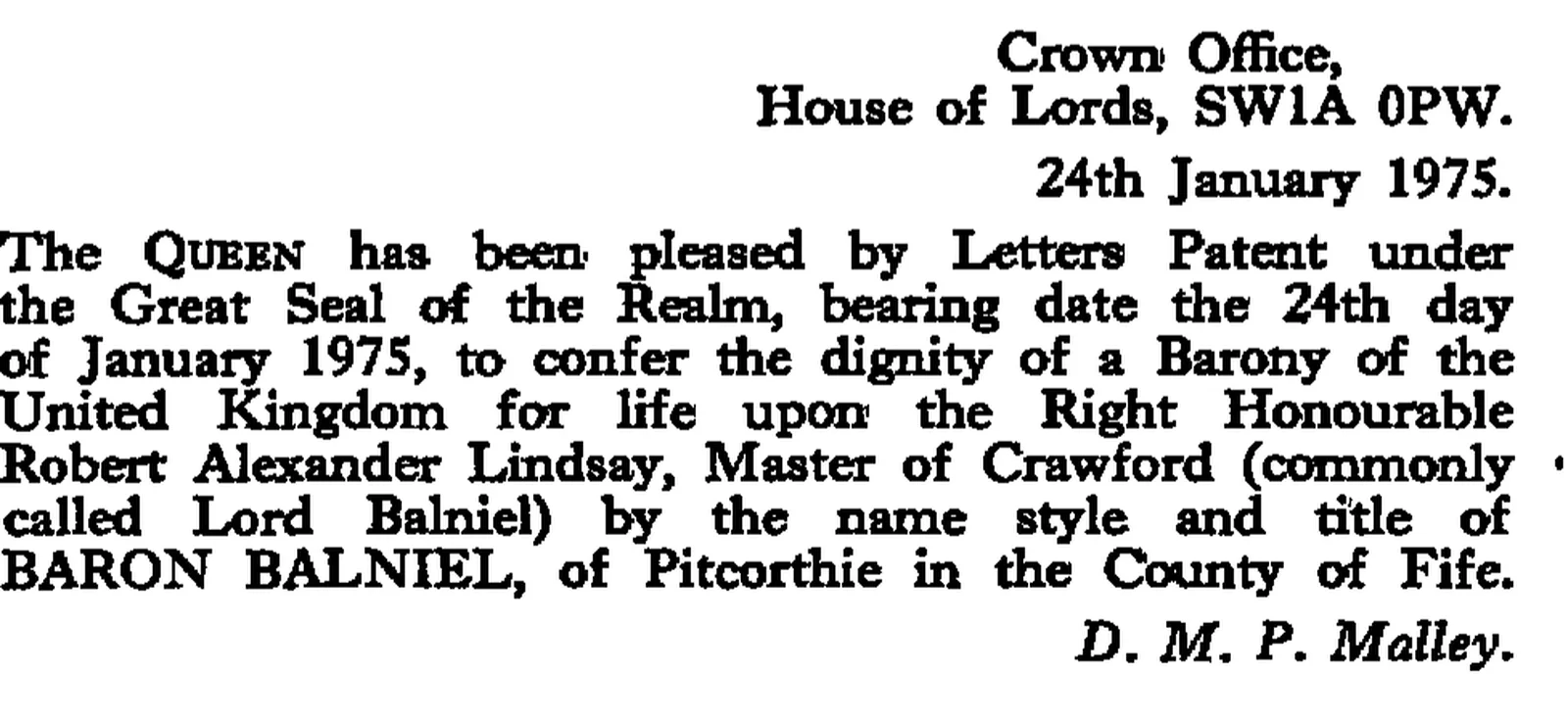
The Lord Chancellor said in 1963 what lies behind it: “there is in fact no legal right to a courtesy title”, and to a peer who spoke of an heir’s entitlement, “a courtesy title is a courtesy title and when the noble Lord talks about anyone being entitled to a courtesy title, it is a contradiction of terms”.9 The Attorney-General told the Commons that members with courtesy titles “are sworn in and entered on the rolls of this House as ‘Mr. John Smith, commonly known as Viscount …’”, with one exception: the elder sons of Scottish peers, “often known as the Master of somewhere, may have a title as of right”.10 Lord Saltoun put it shortly: “The title ‘Master’ is not a courtesy title. … It is a real title on its own.”11 The Crown Office’s practice reflects it. In 1906 it had written “Esq. (commonly called Master of Elibank)”; in 1975 it created a life peerage for “the Right Honourable Robert Alexander Lindsay, Master of Crawford (commonly called Lord Balniel)”.12 The Master’s title stands in the name; the courtesy title takes the formula. The Earl of Airlie’s deed is drawn on that pattern.
The test, then, is not whether a title is a peerage. It is whether the law confers it. “Commonly called” is for the rest.
What the law confers on a baron
A legal argument of 1382 says Baronia est nomen dignitatis: a barony is a name of dignity. The Crown charter of 1590 erecting Spynie into a free barony conferred the “Titulum, Honorem, Ordinem, et Statum liberi Baronis”, whose holders “now and for ever shall be called Barons of Spynie”.13 Section 63 of the Abolition of Feudal Tenure etc. (Scotland) Act 2000 provides that “nothing in this Act affects the dignity of baron”, that the dignity “shall not attach to the land”, and that a dignity “includes any quality or precedence associated with, and any heraldic privilege incidental to, a dignity”.14 The Scottish Law Commission, whose report the Act followed, had recommended that “barons should retain the right to call themselves baron”.15 Hugh Peskett, consulting editor of Burke’s Peerage, drew the conclusion:
“The 2000 Act clearly identifies a barony as a dignity. This places baronies in the same class as peerages. … A barony as a title shorn of its land remains a dignity just as peerages are ‘dignities’.”
Hugh Peskett, in an opinion on the dignity of baron, after 2013
The same opinion adds that “equating a Scottish Barony with an English Lordship of a Manor is quite wrong. Scottish Baronies must be founded on a Charter under the Great Seal, i.e. a charter from the Crown”.16
Where the Lord Chancellor could say of a courtesy lord that there was “no legal right” to his style, the statute says of a baron that his dignity, with its quality, precedence and heraldic privilege, is untouched.
The Lyon Court’s form
The officer of the Crown with jurisdiction over names in Scotland has written the title into the name for as long as the Court’s registers run. Sir Alexander Erskine, Lord Lyon from 1677, described himself in a birthbrief as “Baron of Cambo”; Innes of Learney’s certificate of 1946 opens “We, Thomas Innes of Learney, Baron of Learney, Kinnairdy and Yeochrie, Advocate, Lord Lyon King of Arms”; his son’s Letters Patent of 1982 open “WE, Malcolm Rognvald Innes of Edingight, Baron of Yeochrie, … Lord Lyon King of Arms”.17 The Court’s Letters Patent to barons use the same form as a matter of course. The grantee is named “X, Baron of Y” in the preamble, and the operative words recognise him “in the name X, Baron of Y”: those are the standard words of the patent, under every Lord Lyon whose patents the Roll holds, and the dated examples below are instances of it, not exceptions. Innes of Edingight, 1996: “MICHAEL WOODLEY, BARON OF MENIE in the County of Aberdeen”. Blair, 2007: “We have (Primo) OFFICIALLY RECOGNISED as We do by These Presents OFFICIALLY RECOGNISE the Petitioner in the name Graham Nassau Gordon Senior-Milne, Baron of Mordington”, who with his successors is to be “received as Nobles in the Noblesse of Scotland”. Sellar, 2009: “in the name Margaret Hamilton of Rockhall, Baroness of Lag”. Morrow, 2014: “in the name Camilo Agasim-Pereira of Fulwood, Baron of Fulwood”; and 2015: “in the name Stephan Claus Roh, baron of Inchdrewer for aught yet seen”.18 Lord Lyon Sellar’s guidance of 2010 states the rule for baronies acquired after 28 November 2004: such barons “will be granted a helm appropriate to their degree, that is, to the dignity of baron, and will be recognised in the style of baron of X”.19

“In the name”: the words are the Lyon’s, in a public register. Innes of Learney wrote that the name in which a person is granted arms is “a ‘name of dignity’ … and in the nature of a ‘title’ if it comprehends a feudal designation”, a passage the Inner House adopted in 2009.20 The Court of Session prints the title in its headings, “DAVID AYRE OF KILMARNOCK, BARON OF KILMARNOCK” and “PROFESSOR THE MUCH HONOURED STEPHEN PENDARIES KERR OF ARDGOWAN, BARON OF ARDGOWAN”, and the Lyon Court’s roll in the Edinburgh Gazette lists “Ayre, Baron of Kilmarnock”, “Parsons, Baron of Ormiston” and a dozen more.21 The Birthday Honours of 2005 appointed “Robert Brown Gillespie, Baron of Blackhall” an OBE.22
A title the law keeps, that the Crown’s officer recognises “in the name”, that the court prints in its headings and the honours list carries without a bracket: none of that is true of “Lord Ogilvy”, and all of it is true of “Baron of Mordington”.
Signing the deed
The Lyon King of Arms Act 1672 declared “that it is onlie allowed for Noblemen … to subscrive by their titles And that all others shall subscrive their Christned names or the initiall letter therof with there Sirnames and may if they please adject the designations of their Lands prefixing the word Of to the saids designations”.23 The conveyancing professors read it strictly: “A peer subscribes simply by his title” (Menzies); “Peers subscribe by their title of honour alone—a privilege extended by custom to the eldest sons of Peers enjoying titles by courtesy merely” (Bell).24 Menzies noticed how the courtesy lords had got there: they “subscribe by that title—a practice which has been made valid by invariable usage, although not expressly authorized by the Statute upon the subject”.25 The Act never annulled a deed; one signed only “Fullarton of that Ilk” was sustained in 1765.26 And the test of a designation has always been identification: the granter “must be so designated by his profession, or residence, or other certain description, as to distinguish him from all other persons”.27 The Inner House said in 2009 that barony holders “can call themselves by any name they choose”.28
Since 1 August 1995 the clause of 1672 is gone. The Requirements of Writing (Scotland) Act 1995 repealed it, saving “any right of a person to add a territorial designation to his signature or the jurisdiction of the Lord Lyon King of Arms in relation to any such designation”.29 A deed is now signed by a granter who signs “with the full name by which he is identified in the document”, or “with his surname, preceded by at least one forename”.30 The name in the deed governs the name at its foot. A baron designed “John Smith, Baron of Inverness” signs so, or “John Smith”.
The form of 1896
Green’s Encyclopaedia of the Law of Scotland said in 1896 that “the mere territorial baron has no title of dignity appropriated to him”, that in formal documents “he is described as ‘——, lord of the barony of ——’”, and that he may not sign by his surname alone or by the name of his lands.31 The passage was making one point, that a territorial barony is not a peerage, which nobody disputes. Its form described the owner of lands, because in 1896 the barony was an estate held of the Crown. Since 28 November 2004 there is no estate: a party described as “lord of the barony of X” is described as the owner of something that no longer exists, and the words invite the confusion with an English lordship of the manor that Peskett warned against. The Lyon Court’s form has been “Baron of X” in the name from Erskine of Cambo to the patents of the present Lord Lyon, and never “lord of the barony of”; a Lyon Court note observes that after the Act of 1746 cut down the baron courts “the style of ‘Baron’, although not incorrect, gradually fell into desuetude”.32 As for the rule on signatures, it was the rule of 1672, and Parliament repealed it in 1995.
A form for conveyancers
A Scottish baron is designed on the pattern of the peers’ deeds above: every forename, the surname, the title, the residence, and a defined term. The prefix of the baronage is “The Much Honoured”, the form the Court of Session used in the heading of Kerr of Ardgowan in 2008.33
THE MUCH HONOURED JOHN ALEXANDER SMITH, BARON OF INVERNESS, residing at [address] (“the Baron”)
Where the baron also bears a territorial designation, the Lyon Court keeps both, as in “Margaret Hamilton of Rockhall, Baroness of Lag” and “Camilo Agasim-Pereira of Fulwood, Baron of Fulwood”:
THE MUCH HONOURED JOHN ALEXANDER SMITH OF KILDONAN, BARON OF INVERNESS, residing at [address] (“the Baron”)
A baroness in her own right takes the same form:
THE MUCH HONOURED JANE MARY SMITH, BARONESS OF INVERNESS, residing at [address] (“the Baroness”)
A baron’s wife is designed with her forenames, her maiden and married surnames in the Scots manner, and the title. She signs as a peeress does: by her Christian name and the title, which Menzies gives as the peeresses’ form, “their Christian name prefixed to the title of nobility”, and Bell extends to a wife “whose title arises from marriage”.34
JANE MARY BROWN or SMITH, LADY INVERNESS, residing at [address] (“Lady Inverness”)
Not “Lady of Inverness”, and not “Lady Jane”, which is the style of a peer’s daughter. A widow keeps the form, “Margaret, Lady Inverness”.
The heir is designed as Scots deeds have always designed a laird’s heir. The Lyon Court’s roll of 2005 notes that “the names and designations are in Scots law and practice used by … the eldest son and his wife, with the adjective ‘younger’”, and the Parliament of 1707 listed “John Cockburn, younger, of Ormiston” among the barons’ members.35
JAMES JOHN SMITH, YOUNGER OF INVERNESS, residing at [address] (“the Younger of Inverness”)
On the social forms, and on widows and former wives, see Proper address and “Younger of” and “Master of”.
Three things do not belong in the clause. Not “commonly called”: that is the Crown’s formula for a title it does not confer, and the Crown confers this one. Not “lord of the barony of”: there is no land. And not the title on a line of its own, apart from the name: the Lyon’s patents, the court’s headings and the honours list all run name and title together, “John Smith, Baron of Inverness”.
The Roll and the Pledge
A title named in law still has to be shown. That is a matter of evidence.
The Baronage of Scotland Association keeps the Roll of Scottish Barons, which enters a holder only on evidence, and offers the Pledge: an undertaking, in honour and not in law, to preserve a barony within the family for future generations and to uphold the Baronial Code of Honour. The precedent is the baronets’ Roll of 1910.
Notes
- Deeds of assignation of Scottish baronies in the Association’s files: one granted by the Earl of Airlie, narrating a deed of gift and declaration of trust of 15 November 2018 in favour of the Master of Airlie; one granted by the Duke of Argyll and a company within the last ten years. The parties’ addresses and the purchasers’ names are omitted; the deeds are quoted only for the styles in which the parties are designed. ↩
- HM Passport Office, Titles: caseworker guidance, version 25.0, published for Home Office staff on 1 June 2026 and updated 18 June 2026, sections “Titles of nobility”, “Scottish feudal baronies”, “Titles for a Duke” and “Titles for the heir apparent to a Scottish peerage”: gov.uk. The guidance also records, for the Scottish barony, that “the retained dignity of baron is no longer attached to land” and “may be bequeathed by will”. ↩
- Peskett, opinion cited above, para. 3.5. ↩
- William Blackstone, Commentaries on the Laws of England, vol. I (Oxford, 1765), bk I, ch. 12, pp. 393–394, citing Coke, 3 Inst. 30 and 2 Inst. 667. ↩
- The Laws of England, ed. the Earl of Halsbury, vol. XXII (London, 1912), “Peerages and Dignities”, para. 594, p. 271, citing R. v. Graham (1791) 2 Leach 547. ↩
- The London Gazette, no. 18718, 16 August 1830, p. 1759, “The Right Honourable John Charles Spencer, commonly called Lord Viscount Althorp”; no. 33769, 6 November 1931, p. 7147, “Lanark Division. Captain Alexander Frederick Douglas Home (commonly called Lord Dunglass)”. The Lyon Court used the formula in the same way: no. 43156, 12 November 1963, p. 9249, Court of the Lord Lyon, 6 November 1963, “DAVID ALEXANDER COSPATRICK DOUGLAS-HOME, commonly called LORD DUNGLASS, has renounced the courtesy title of LORD DUNGLASS”. ↩
- The London Gazette, no. 22025, 28 July 1857, p. 2609, where “Alfred Spencer Churchill, commonly called Lord Alfred Spencer Churchill” stands on the same page. On the licence of 1838 see Is a Scottish baron a commoner? Not in Scots law. ↩
- The London Gazette, no. 36056, 15 June 1943, Crown Office, 11 June 1943, p. 2739. ↩
- Lord Dilhorne, Lord Chancellor, House of Lords, 11 July 1963, Peerage Bill, committee, Hansard vol. 251, cols 1488–1489; and at second reading, 4 July 1963, vol. 251, cols 1006–1007: “the fundamental rule of law is that anybody may call himself what he likes provided, of course, he does not use an assumed name for dishonest purposes.” ↩
- Sir John Hobson, Attorney-General, House of Commons, 19 June 1963, Peerage Bill, committee, Hansard vol. 679, cols 549–550. The Commons’ Official Report has the same form: “Alexander Victor Edward Paulet Montagu, esquire, commonly called Viscount Hinchingbrooke, South Dorset”, 21 October 1959, vol. 612, col. 28. ↩
- Lord Saltoun, House of Lords, 11 July 1963, vol. 251, col. 1491. Neither House took the point further in 1963. See “Younger of” and “Master of”. ↩
- The London Gazette, no. 27885, 13 February 1906, p. 1049, “Counties of Peebles and Selkirk. Alexander William Charles Oliphant Murray, Esq. (commonly called Master of Elibank)”, repeated in no. 28338, 11 February 1910, p. 1038; no. 46479, 28 January 1975, Crown Office, 24 January 1975, p. 1231: Letters Patent “to confer the dignity of a Barony of the United Kingdom for life upon the Right Honourable Robert Alexander Lindsay, Master of Crawford (commonly called Lord Balniel) by the name style and title of BARON BALNIEL, of Pitcorthie in the County of Fife.” ↩
- Registrum Episcopatus Aberdonensis, vol. i, p. 152, quoted by Innes of Learney, “The Robes of the Feudal Baronage of Scotland”, PSAS 79 (1944–45), p. 144; Registrum Magni Sigilli, vol. V, no. 1727, Holyrood, 6 May 1590, as quoted in Baron of X, or X of Y? Two styles of a Scottish baron. ↩
- Abolition of Feudal Tenure etc. (Scotland) Act 2000, s. 63(1), (2) and (4), in force 28 November 2004. ↩
- Scottish Law Commission, Report on Abolition of the Feudal System (Scot Law Com No 168, February 1999), para. 2.45, recommendation 5(c), and para. 2.38: the report (PDF). ↩
- Hugh Peskett (1945–2020), genealogist, consulting editor of Burke’s Peerage, expert witness before the Committee for Privileges of the House of Lords, in an opinion on the nobility, title and dignity of Scottish baronies written in reply to a letter of the Lyon Clerk of 28 November 2013, paras 3.3, 3.5 and 3.6; quoted with permission. ↩
- Birthbrief of Innes of that Ilk, in which “the Lord Lyon, Sir Alexander Erskine, officially describes himself as ‘Baron of Cambo’” (Innes of Learney, PSAS 79, p. 160); certificate of Lord Lyon Innes of Learney, 10 March 1946, Public Register of All Arms and Bearings in Scotland, vol. 35, fol. 6 (printed copy); Letters Patent of Lord Lyon Innes of Edingight, 30 November 1982 and 20 February 1984. All are set out, with images, in Barons in the Lyon Court’s own words. ↩
- Letters Patent of Lord Lyon Innes of Edingight, 25 June 1996 (Menie), the Roll of Scottish Barons; of Lord Lyon Blair, 30 October 2007 (Mordington), Public Register vol. 86, p. 111, signed “R. O. Blair, Lyon”, the Roll; of Lord Lyon Sellar, 26 October 2009 (Lag), “Conform to Our Warrant of date 30 July 2009 we have (Primo) OFFICIALLY RECOGNISED … the Petitioner in the name Margaret Hamilton of Rockhall, Baroness of Lag”, signed “David Sellar, Lyon”, the Roll; of Lord Lyon Morrow, 10 October 2014 (Fulwood), Public Register vol. 74, p. 108, “OFFICIALLY RECOGNISE the Petitioner in the name Camilo Agasim-Pereira of Fulwood, Baron of Fulwood”, signed “Joseph John Morrow, Lyon”; and 28 October 2015 (Inchdrewer), Public Register vol. 88, p. 126, “Officially Recognise the Petitioner in the name Stephan Claus Roh, baron of Inchdrewer for aught yet seen”, the Roll. The Fulwood and Inchdrewer patents are set out in Barons in the Lyon Court’s own words. ↩
- David Sellar, Lord Lyon King of Arms, “Guidance regarding Baronial Additaments” and “Guidance regarding Territorial Designations”, 5 January 2010, on the Lyon Court’s website as archived on 25 September 2010. ↩
- Thomas Innes of Learney, Scots Heraldry (2nd ed., Edinburgh, 1956), p. 198, as quoted by the Extra Division in Kerr v Blair [2009] CSIH 61, 2010 SC 1, para. [9] (archived opinion). The court held in the same passage that the Lord Lyon has a wide discretion whether to enter a name in the Public Register. ↩
- Kerr v Blair [2009] CSIH 61, heading and paras [2]–[3], the Lord Lyon having recognised “the dignitas of ‘Baron of Ardgowan’” and “the dignitas of ‘Baron of Kilmarnock’”; Kerr of Ardgowan, Petitioner [2008] CSOH 36 (Lord Uist, 22 February 2008), heading and para. [1], quoting the Lord Lyon’s interlocutor of 25 October 2004 in which the petitioner “was designed as ‘Stephen Pendaries Kerr, Baron of Ardgowan’” (archived opinion); Senior-Milne v Advocate General for Scotland [2020] CSIH 39, para. [1], “recognized as the Baron of Mordington by interlocutor of the Lord Lyon dated 11 November 2004”. The Edinburgh Gazette, 19 August 2005, issue 25893, Court of the Lord Lyon, p. 2502, with the heading on p. 2501: a roll “in the Styles or Ordinary Names wherein they have been Officially Recognised by the Lord Lyon King of Arms”; note 1 adds that “it is open to those concerned to add the designation as the part of the name and by doing so regularly make those words their ‘ordinary surname’”. See Barons in the Gazette. ↩
- The London Gazette, 11 June 2005, supplement no. 1 (issue 57665), Birthday Honours, Diplomatic Service and Overseas List, O.B.E., p. B23. ↩
- Lyon King of Arms Act 1672, c. 47, text as at 1 February 1991. The words “and Bishops” after “Noblemen” had been repealed by the Statute Law Revision (Scotland) Act 1906. ↩
- Allan Menzies, Conveyancing according to the Law of Scotland (3rd ed., Edinburgh, 1863), p. 104, the Act being quoted at p. 105; Alexander Montgomerie Bell, Lectures on Conveyancing (Edinburgh, 1867), vol. I, p. 36: “This Act contains the rule now in force on this subject.” ↩
- Menzies, p. 104. ↩
- Gordon v Murray, 21 June 1765, M. 16818, as stated by Menzies, p. 105: “the Act attaches no nullity to deeds not subscribed in conformity with its terms, but makes the offenders punishable by the Privy Council”. Bell, p. 36, thought the decision “not to be regarded as of authority, at least with reference to any modern deed”. ↩
- Menzies, p. 149: “This is the criterion of the sufficiency of a designation.” At p. 150 he adds that “there is no need of judicial authority to entitle a man in Scotland to change his name”. ↩
- Kerr v Blair [2009] CSIH 61, para. [11]. The court was rejecting an argument under Article 8 of the European Convention, and refused all three petitions: Official recognition of a name in the Public Register, it held, is a different matter from the name a person may use. ↩
- Requirements of Writing (Scotland) Act 1995 (c. 7), s. 14(2) and (5) and Sch. 5, repealing “the words from ‘And his Maiestie with consent’ to ‘contraveiners heirof’”; in force 1 August 1995 under s. 15(2). ↩
- Requirements of Writing (Scotland) Act 1995, s. 7(2). Paragraph (c) also admits a name, description, initial or mark that “was his usual method of signing”, except for the purposes of s. 3, the self-proving document. ↩
- J. H. Stevenson, “Baron”, in Green’s Encyclopaedia of the Law of Scotland, ed. John Chisholm, vol. II (Edinburgh, 1896), p. 33: “He may not sign himself in these by his surname alone or by the name of his lands, but with his Christian name, or the initial letter thereof with his surname; and he may, if he pleases, adject the designation of his lands, prefixing the word OF to the said designation (1672, c. 47).” The article contrasts “the holder of a barony by patent”, who is “the Right Honourable the Lord ——”. ↩
- Court of the Lord Lyon, note in the petition of Sturzenegger of Arran (undated, after 2009), p. 7. On the desuetude see Did Scottish barons sit in the House of Commons?. ↩
- Kerr of Ardgowan, Petitioner [2008] CSOH 36, heading. On the prefix see Where “The Much Honoured” comes from. ↩
- Menzies, p. 104: “their wives subscribe by their Christian name prefixed to the title of nobility”; Bell, vol. I, p. 36: “Peeresses in their own right, or whose title arises from marriage, including the wives of Peers by courtesy, subscribe their Christian name, in the same way as if they were commoners, and also their own or their husband’s title of honour, as the case may be.” On the wife’s style see Proper address. ↩
- The Edinburgh Gazette, 19 August 2005, issue 25893, p. 2502, note 3; Minutes of Parliament, 13 February 1707, RPS M1706/10/107. ↩
This research is paid for by members and friends of the Association. Support the Baronage →