Law & Statutes
Did Scottish barons sit in the House of Commons? Yes, but never as “Baron of X”
From 1707 the barons’ members sat at Westminster as “Esquire”, in a House that had no word for them. At home they were barons, and since 2004 the dignity stands on a statute
12 min read · Reviewed October 2026
Baronage of Scotland Association · The Reading Room · www.baronage.com/reading-room/barons-in-the-house-of-commons/

On 13 February 1707 the Parliament of Scotland chose its thirty shire members for the first Parliament of Great Britain under the heading “Of the barons”. At Westminster the same men were sworn as “Esquire”. This paper follows the barons into the House of Commons, shows how Parliament named them for three centuries, and asks what the right form is now that an Act of Parliament keeps the dignity.
The short answer
- Yes, from the first day. The Scottish Parliament chose the first thirty shire members “of the barons”, and the Act of 1707 says the first members were “chosen by the peers, barons and burghs respectively”.
- Never as “Baron of X”. Westminster sat them as “John Cockburne, junior, of Ormstown, Esquire” and “William Blair, of Blair, Esq.”. In the Commons’ own records a “Baron” was a member for the Cinque Ports.
- The barons kept their estate’s franchise. Until 1832 the county seats went to landowners holding of the Crown, a body that one contemporary said “may be termed indifferently Barons or Freeholders”. In 1788 the Scottish counties had 2,662 voters in all.
- A modern MP was a baron. The Lord Lyon marked “Fairbairn of Fordell” a minor baron in 1970, and Sir Nicholas Fairbairn sat for Perth until 1995. Parliament’s own records give the title only as an “alternative name”.
- Barons sit in other chambers today. Tynwald lists a Member of the House of Keys, and two councils their councillors, by name alone; the Lord Lyon’s rolls list the same men as barons.
- Section 63 changed the ground. A barony was “a name of dignity” in 1382. The Act of 2000 severed it from the land and kept it as a dignity in law, with “any quality or precedence associated with” it: no longer a title that passed with an estate, but a personal dignity, as a peerage is. The Birthday Honours of 2005 made “Robert Brown Gillespie, Baron of Blackhall” an OBE.
- A baron’s title is his own. The Crown writes “commonly called” before a style that the law of the United Kingdom does not itself confer: a courtesy title, or a foreign one. A Scottish barony is a dignity kept by that law. Baronets, courtesy lords and now hereditary peers sit in the Commons under their titles; “John Smith, Baron of Y” is the form that follows.
“Of the barons”, February 1707
The Union made one Parliament with two Houses. The Treaty gave Scotland sixteen peers in the Lords and “45 the number of the Representatives of Scotland in the House of Commons”.1 An Act of the Scottish Parliament of 5 February 1707 settled how they were to be chosen. For the first Parliament of Great Britain the forty-five were to be “chosen by the peers, barons and burghs respectively in this present session of parliament, and out of the members thereof”.2
The Estate of Barons chose its own. On 13 February 1707 the minutes record the thirty shire members under the heading “Of the barons”: William Nisbet of Dirleton, John Cockburn, younger, of Ormiston, William Morrison of Prestongrange, Alexander Grant, younger, of that ilk, Hugh Rose of Kilravock and the rest.3 Several held their lands in free barony. Morison had been served heir to his father in 1684 “in terris et baronia de Prestounegrainge”; the Cockburns held “in terris et baronia de Ormestoune”; the Grants “in terris et baronia de Frewchie”; the Roses “in terris et baronia de Kilravok”.4
The Scottish barons had sat in their own Parliament as an estate of the nobility, as Trial by barons and Is a Scottish baron a commoner? set out. From 1707 their members sat in the Commons.
“Esquire”, October 1707
The first Parliament of Great Britain met on 23 October 1707. The Lord Steward’s commission for swearing the members, printed at the head of the Commons Journal, names the Scottish members among the commissioners: “John Cockburne, junior, of Ormstown, Esquire, Wm. Morison, of Preston Grange, Esquire, Wm. Seaton, junior, of Pitmedan, Esquire, Alexander Graunt, junior, of Graunt, Esquire”.5
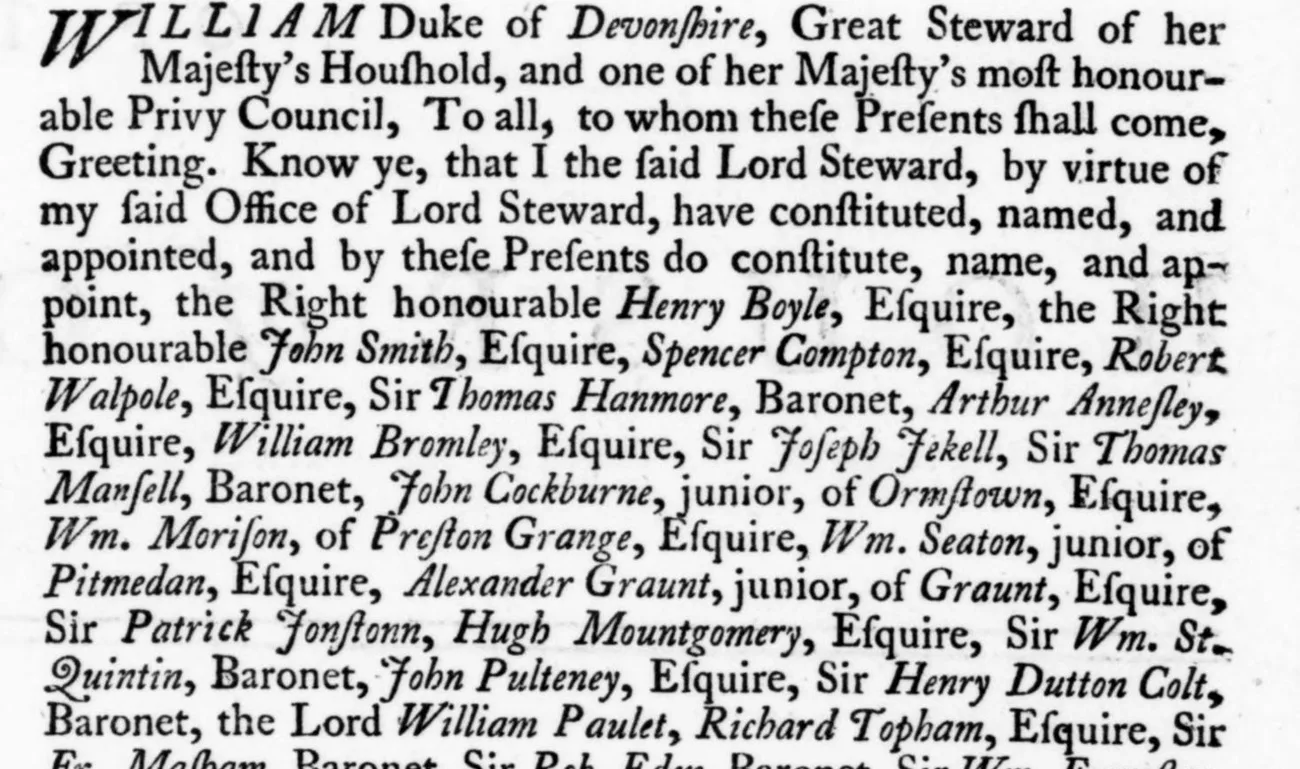
The word “baron” was in use on that page, with another meaning. The commission covers every person elected “a Knight, Citizen, Burgess, or Baron of any the five Ports”: the members for the Cinque Ports were called barons.5 Otherwise, at Westminster, a baron was a peer. The House had no word for a Scottish baron, and used the one it had for every landed man who was not a peer, baronet or knight: Esquire.
The form held for a century and a quarter.
- 1710. The Committee of Privileges resolved that “Hugh Rosse, junior, of Kilravock, Esquire, is not duly elected a Commissioner, to serve in Parliament for the Shire of Rosse”. His family had held “in terris et baronia de Kilravok” since at least 1661.6
- 1749. The Journal names the member for Nairnshire “Mr. Campbell of Calder”. His grandfather had been served heir in 1662 in “terris thanagii et baroniæ de Calder”.7
- 1813. The Crown Office returned Sir James Mackintosh for Nairn “in the room of Hugh Rose, Esq. who has accepted the Chiltern Hundreds”.8
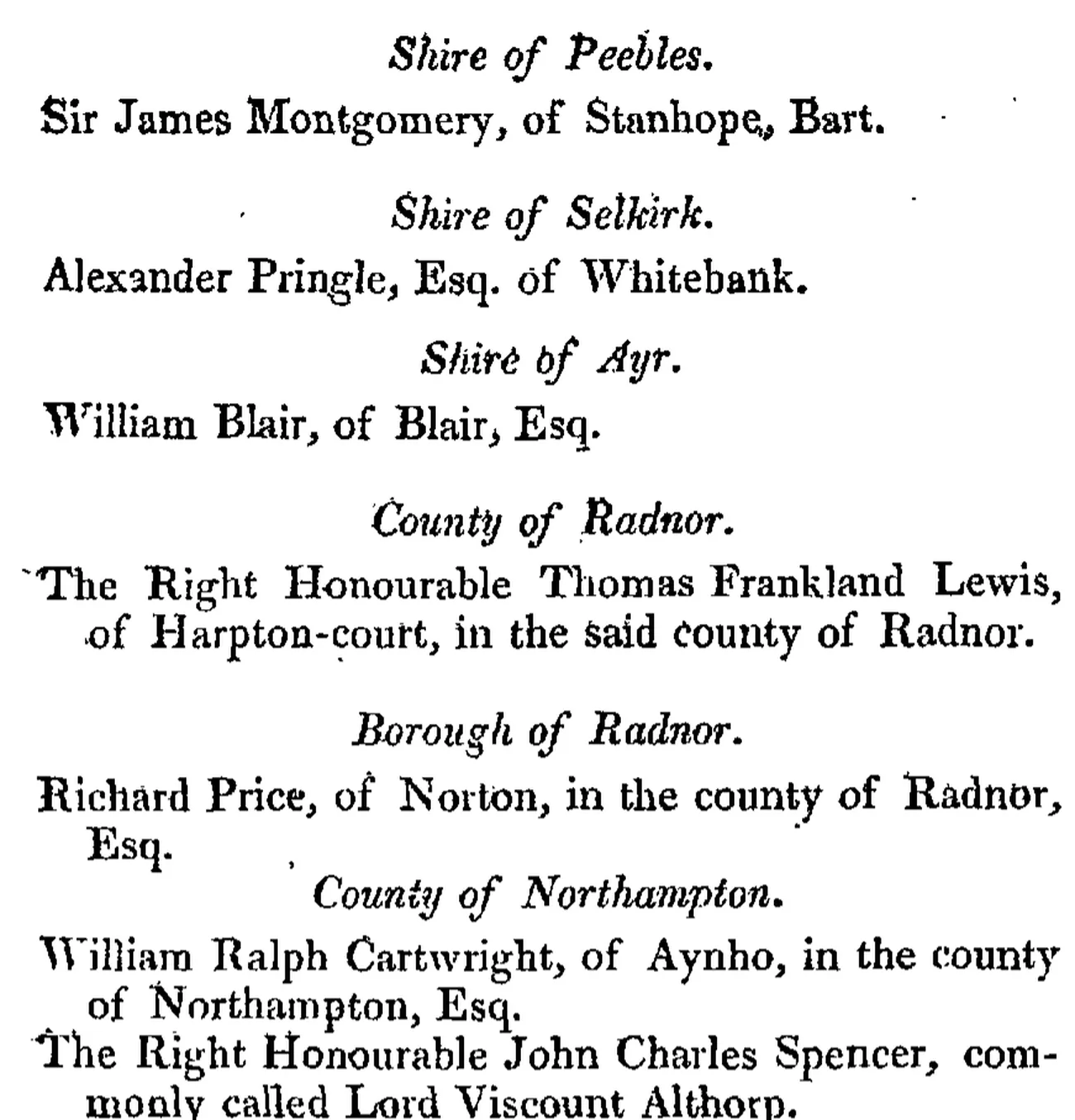
- 1830. The Crown Office’s list of members returned reads, under “Shire of Ayr”, “William Blair, of Blair, Esq.”. The Blairs had been served heirs “in terris et baronia de Blair” since 1645.9
Baron at home, Esquire at Westminster
At home the same men were barons. The Roses of Kilravock had been “the baron of Kilraok” to the Countess of Crawford in 1576 and “the richt honorable the Barrone of Kilraik” to the Marquis of Argyll in 1642. When Hugh Rose of Kilravock, chosen for the first Parliament of Great Britain, died in 1732, an Inverness baker was paid “for dressing and ordering the honored Hugh Rose baron and laird of Kilraock’s funeralls”, and Lord Lovat wrote to his son, “My dear Baron”.10 The title lived on in the families that had always carried it, and in the letters of the peers and officers of state who addressed them: see Baron of X, or X of Y? Two styles of a Scottish baron and Where “The Much Honoured” comes from.
Westminster did not recognise it. The House had one word for a landed man who was not a peer, baronet or knight, and used it. The baron of Kilravock was “Esquire” in the Commons and “my dear Baron” at home, and no English record of the period knew the difference.
Barons or freeholders
After the first Parliament the shire members were elected by “the several freeholders in the respective shires and stewartries”, each elector and member “twenty-one years of age complete and Protestant”.2 The vote went with land held of the Crown, by the Act of 1681.11 A report of 1788 called the electors the old Estate of Barons under another name: Crown vassals “may be termed indifferently Barons or Freeholders”, though in the statutes “Baron” meant the holder of an erected barony.12 Not every county voter was a baron, but every baron who held of the Crown was one, and the members were drawn from them.
It was a House of landowners, chosen by landowners, and by few of them: in 1788 the thirty-three Scottish counties had 2,662 voters in all.13 The Reform Act of 1832 ended the landed qualification for Scottish county members,14 and the vote reached all men only in 1918.15 The baron courts had already been cut down in 1748, though the Act of 1746 left the barons their lesser jurisdiction.16
Desuetude, and a revival
After the Union the title went out of public use. The barons’ members sat at Westminster as Esquires, the baron court was cut down in 1748, and the lairds of the eighteenth and nineteenth centuries signed “X of Y”, as the Act of 1672 required. The dignity was never taken away, but by 1934 a baron could tell the Lord Lyon that the right of the Scottish baronage “to be designated as ‘Baron of Bradwardine’” was being allowed “to fall into desuetude”.17
The Lyon Court answered. It had awarded a baron’s descendant the cap of maintenance in 1835, “as being indicative of his descent from the ancient barons of Dolphington”; in 1934 it awarded the chapeau to the Baron of Esslemont after proof, and recorded him by that title; in 1943 it found the minor barons “recognised as a ‘titled nobility’”; and in 1945 Lord Lyon Innes of Learney set out the record of the baronage in a paper that is still the fullest account of the order. From 1934 the chapeau was the mark of every baron who matriculated arms, and from 1968 the Court’s rolls in the Edinburgh Gazette carried that mark. The rolls were never a complete list, and they are not the Register: see Officially Recognised.18
A baron in the Commons, 1974 to 1995
The style never entered the Commons, but barons did not stop being elected. On 4 November 1970 Nicholas Hardwicke Fairbairn matriculated arms with the chapeau, and the Lord Lyon’s roll in the Edinburgh Gazette marked “† Fairbairn of Fordell” a minor baron.19 From 1974 he sat for Kinross and West Perthshire, and from 1983 for Perth and Kinross, until his death in 1995; he was Solicitor General for Scotland from 1979 to 1982.
Parliament’s records show the same two faces as in 1707. The House of Commons members’ database names him “Sir Nicholas Fairbairn”. The History of Parliament’s record carries “Baron of Fordell (Title)” with the note “Scottish title, not in the peerage”, and the Hansard index lists “Baron of Fordell” among his “Alternative names”.20 The title was recorded, and kept out of the name.
The same two faces appear in other chambers and offices today. Three holders entered on the Roll of Scottish Barons show it.
- The House of Keys. The Lord Lyon’s roll in the Edinburgh Gazette of 15 August 2000 lists “øBoot, Baron of Waughton”, Geoffrey George, matriculated with the chapeau on 18 March 1999. Tynwald’s own list of former members has “Boot, Geoffrey George”, Member of the House of Keys from 2015 to 2021, and its Hansard names him “Hon. G G Boot (Glenfaba and Peel)” and “The Minister for Environment, Food and Agriculture (Mr Boot)”. No Manx record carries the barony.21
- A Scottish council. The roll of 17 January 1984 marks “Humphrey of Dinnet”, James Malcolm Marcus, a minor baron; his barony is Ochtercoull, as Officially Recognised explains. The Crown used his designation when it made him a Deputy Lieutenant in 1989: “James Malcolm Marcus Humphrey of Dinnet, Dinnet, Aboyne, Aberdeenshire”. Aberdeenshire Council’s election notices of 1999, 2003 and 2007 return him as “HUMPHREY J M M” and “Marcus HUMPHREY”.22
- An English council. The roll of 16 July 2002 lists “†Thacker, Baron of Fetternear”, Martin Edwin, matriculated 26 January 2001. The New Year Honours of 2000 record “Martin Edwin THACKER. For services to the Chesterfield Deaf Society, Derbyshire.” North East Derbyshire District Council names him “Councillor Martin E Thacker MBE JP”, and has twice made him its Chairman.23
In each case the body with no place for the dignity left it out, and the Lyon Court’s record carried it.
The Scottish Parliament has taken a different course on names. On 14 May 2026 a member was sworn as “Alexander James Amherst Burnett of Leys”, the territorial designation forming part of the name in the Official Report.24
Section 63: the old dignity on a new footing
The dignity is old. A legal argument of 1382 says Baronia est nomen dignitatis et importat judicaturam: a barony is a name of dignity and carries jurisdiction. The Crown charter of 1590 erecting Spynie into a free barony conferred the “Titulum, Honorem, Ordinem, et Statum liberi Baronis”, the title, honour, rank and status of a free baron.25 What was new in 2004 was its footing. Until then the dignity passed with the land, and to many a “feudal title” meant a thing bought and sold with an estate: “A market in Scottish Baronies has developed in recent years”, as the Act’s own Explanatory Notes put it.26
Section 63 of the Act of 2000 cut the dignity loose and kept it. “Nothing in this Act affects the dignity of baron”, it says; the dignity “shall not attach to the land”; and a dignity “includes any quality or precedence associated with, and any heraldic privilege incidental to, a dignity”.27 The Scottish Law Commission, whose report the Act followed, had recommended that “barons should retain the right to call themselves baron and should retain any precedence and ceremonial or heraldic privileges deriving from their barony”, and that “Baronies should become non-territorial dignities”.28 The genealogist Hugh Peskett, who had been an expert witness before the Committee for Privileges of the House of Lords, drew the conclusion in an opinion written after 2013:
“The 2000 Act clearly identifies a barony as a dignity. This places baronies in the same class as peerages. … A barony as a title shorn of its land remains a dignity just as peerages are ‘dignities’.”
Hugh Peskett, in an opinion on the dignity of baron, after 2013
That is the change. A barony is no longer a “feudal title” that a buyer of land picks up with the deeds. It is a personal dignity held in law, as a peerage is a dignity held in law, and the privileges that go with it are kept by statute.29
The Lyon Court used the title in the same words. Its roll in the Edinburgh Gazette of 2005 lists “† Parsons, Baron of Ormiston”, “† Jackson, Baron of Paistoun” and “† Harden, Baron of Cowdenknowes”.30 By interlocutors of 25 October and 11 November 2004 it designed one petitioner “Stephen Pendaries Kerr, Baron of Ardgowan” and recognised another “as the Baron of Mordington”, and the Court of Session carried the first in the heading of a case.31
The Crown used it too. The Birthday Honours of June 2005 appointed “Robert Brown Gillespie, Baron of Blackhall” an Officer of the Order of the British Empire, “For services to British business interests, especially engineering, in France”. The Lyon Court’s roll of the same year lists “*† Gillespie of Blackhall”, matriculated with the chapeau on 10 January 2003.32 The title that had fallen into desuetude after 1707 now stood on a statute and in the honours list.
Whose title it is
The Crown Office has a formula for a style that the law of the United Kingdom does not itself confer: “commonly called”. The list of 1830 shown above has “The Right Honourable John Charles Spencer, commonly called Lord Viscount Althorp”, a courtesy title used by custom from his father’s peerage. In 1857 it returned “Alfred Spencer Churchill, commonly called Lord Alfred Spencer Churchill” and, on the same page, “Lionel Nathan de Rothschild, commonly called Baron Lionel Nathan de Rothschild”. Rothschild’s barony was his own, an Austrian dignity that Queen Victoria had licensed him to use in 1838; it took the formula because it was Austrian, not British. In 1975 the Crown Office named the heir of a Scottish earl “Master of Crawford (commonly called Lord Balniel)”: the Master’s own title, which the heir holds in his own right, stands bare, and the father’s subsidiary title takes the formula (see “Younger of” and “Master of”).33
A Scottish baron’s dignity is neither a courtesy nor foreign. An Act of the Scottish Parliament keeps it, with its quality and precedence, as an incorporeal hereditament of its holder; the Lord Lyon has named it, and the Crown’s honours list has carried it. The Commons of 1707 wrote “Esquire” because it had no other word, not because it had ruled that the dignity did not exist. The House has always carried the styles of its members: “Bart.” for a baronet, “commonly called Lord” for a peer’s heir, a foreign title the Crown has licensed, and since 1999 the peerage itself, for the Act of that year let a hereditary peer be elected to the Commons, and Viscount Thurso sat for Caithness, Sutherland and Easter Ross from 2001 to 2015 under his title.34 Since 2004 a Scottish baron’s title rests on the same kind of ground as theirs, a statute, and Scots law is part of the law of the United Kingdom. The form that follows is the plain one: “John Smith, Baron of Y”.
The Roll and the Pledge
A title named in law still has to be shown. That is a matter of evidence.
The Baronage of Scotland Association keeps the Roll of Scottish Barons, which enters a holder only on evidence, and offers the Pledge: an undertaking, in honour and not in law, to preserve a barony within the family for future generations and to uphold the Baronial Code of Honour. The precedent is the baronets’ Roll of 1910.
Notes
- Union with England Act 1707, Art. XXII. ↩
- Act settling the manner of electing the sixteen peers and forty-five members to represent Scotland in the parliament of Great Britain, 5 February 1707, RPS 1706/10/293. ↩
- Minutes of Parliament, 13 February 1707, “Election of the representatives for Scotland to the parliament of Great Britain”, RPS M1706/10/107; the same list in the record of warrants, RPS 1706/10/307. ↩
- Inquisitionum ad Capellam Domini Regis Retornatarum Abbreviatio, vol. I (1811): Haddington, no. 352, 31 December 1684, William Morison of Prestongrange (leaf); Haddington, no. 309, 28 December 1671, Adam Cockburn of Ormiston, “unitis in baroniam de Ormestoun” (leaf); Inverness, no. 96, 11 February 1665, Ludovick Grant of Freuchie, “unitis in baroniam de Frewquhie” (leaf); Nairn, no. 24, 17 December 1661, Hugh Rose of Kilravock, “omnibus unitis in baroniam de Kilravock” (leaf). The volume prints entry numbers, not page numbers. ↩
- Journals of the House of Commons, vol. XV, p. 392, the Lord Steward’s commission of 23 October 1707. ↩
- Journals of the House of Commons, vol. XVI, p. 287, January 1710; Retours, Nairn, no. 24 (1661) and no. 38, 24 April 1688, as in note 4. ↩
- Journals of the House of Commons, vol. XXV, p. 680, 16 January 1749; Retours, Nairn, no. 25, 6 February 1662, Sir Hugh Campbell of Calder, “unitis infra dictum thanagium et baroniam de Calder” (leaf). ↩
- The London Gazette, no. 16747, 3 July 1813, Crown Office, p. 1274; Journals of the House of Commons, vol. LXVIII, p. 516, 24 May 1813, a new writ “in the room of Hugh Rose, Esquire”. ↩
- The London Gazette, no. 18718, Crown Office, 16 August 1830, p. 1759; Retours, Ayr, no. 393, 1 May 1645, John Blair of that Ilk, “in terris et baronia de Blair … unitis cum aliis terris in Renfrew in baroniam de Blair” (leaf). ↩
- A Genealogical Deduction of the Family of Rose of Kilravock (Spalding Club, Edinburgh, 1848), p. 407 (the account of 11 February 1732, and Lord Lovat’s letter, pp. 407–408). The letters of 1576 and 1642 are quoted, with their pages, in Where “The Much Honoured” comes from. ↩
- Act concerning the election of commissioners for shires, 17 September 1681, RPS 1681/7/45. ↩
- William Adam, View of the Political State of Scotland in the Last Century (Edinburgh, 1887), Introduction, p. xii and p. xiii, note 2. The book prints a confidential report of 1788 on the county voters. ↩
- William Adam, View of the Political State of Scotland in the Last Century (Edinburgh, 1887), table of the voters enrolled in each county at Michaelmas 1788, “Total, 2662”: archive.org. ↩
- Representation of the People (Scotland) Act 1832 (2 & 3 Will. IV c. 65), s. XXXVII. ↩
- Representation of the People Act 1918 (7 & 8 Geo. V c. 64), s. 1: the franchise for men of twenty-one resident in the constituency. ↩
- Heritable Jurisdictions (Scotland) Act 1746 (20 Geo. II c. 43), ss. XVII and XXIV, in force 25 March 1748: see The Treaty of Union and the baronage. ↩
- Memorial for Gordon of Hallhead, Baron of Esslemont, 1934, printed in Innes of Learney, “The Robes of the Feudal Baronage of Scotland”, PSAS 79 (1944–45), pp. 162–163, open access PDF; the Act of 1672 on subscription, RPS 1672/6/57. See The Esslemont petition of 1934. ↩
- The Esslemont petition of 1934; Untitled or titled nobility?; The Lord Lyon’s Case for the Baronage; Officially Recognised: the Lyon Court’s Rolls in the Gazette. ↩
- The Edinburgh Gazette, 26 March 1971, issue 18975, p. 209, under 1970: “† Fairbairn of Fordell”, Nicholas Hardwicke, 4 November, LII, p. 87; key note 2, “† indicates that the Arms have been matriculated with chapeau in respect of being a Minor Baron.” See Officially Recognised: the Lyon Court’s Rolls in the Gazette. ↩
- UK Parliament, members’ database, “Sir Nicholas Fairbairn”; History of Parliament, Members after 1832, “Nicholas Fairbairn”: “FORDELL, Baron of (1933–1995)”, “Scottish title, not in the peerage”; Historic Hansard, “Sir Nicholas Fairbairn”: “Alternative names: Baron of Fordell 1933–1995”; constituencies Kinross and West Perthshire, 10 October 1974 to 9 June 1983, and Perth and Kinross, 9 June 1983 to 19 February 1995. ↩
- The Edinburgh Gazette, 15 August 2000, issue 24861, p. 1734 (heading on p. 1733), under 1999: “øBoot, Baron of Waughton”, Geoffrey George, 18th March, 82/27; key note 2, “ø indicates that the Arms have been matriculated with chapeau in respect of being a Minor Baron.” Tynwald, former members: “Boot, Geoffrey George”, Member of the House of Keys 2015–2021; Tynwald Court Hansard, 19 February 2020, pp. 2 and 20. ↩
- The Edinburgh Gazette, 17 January 1984, issue 21460, p. 51, under 1983: “Humphrey of Dinnet”, James Malcolm Marcus, 24 September, 65/68, with the mark that “indicates the Arms are matriculated with chapeau as a minor Baron”. The London Gazette, no. 51889, 2 October 1989, p. 11269, Deputy Lieutenant commissions, Grampian Region (County of Aberdeen). Aberdeenshire Council, notices of poll: 1999, p. 8, Ward 53 Upper Deeside; 2003, p. 9; 2007, p. 8, Ward 15 Aboyne, Upper Deeside and Donside. ↩
- The Edinburgh Gazette, 16 July 2002, issue 25256, p. 1782, under 2001: “†Thacker, Baron of Fetternear”, Martin Edwin, 26 January, 83/99. The London Gazette, supplement 55710, 31 December 1999, p. 32, M.B.E., Civil Division. North East Derbyshire District Council: Councillor Martin E Thacker MBE JP; “New Leader, Deputy Leader, Chair and Vice Chair announced at Annual Council”, 24 May 2023; “Council Chairman raises £55,000 for Ashgate Hospice in 12 months”, 21 May 2024, which records that he had held the chair before, in 2021–22. ↩
- Scottish Parliament, Official Report, Meeting of the Parliament, 14 May 2026, Oaths and Affirmations: “I, Alexander James Amherst Burnett of Leys, do swear …”. ↩
- The argument of 1382 is printed in the Registrum Episcopatus Aberdonensis, vol. i, p. 152, and quoted by Innes of Learney, “The Robes of the Feudal Baronage of Scotland”, PSAS 79 (1944–45), p. 144: see The baron’s court and its officers. The Spynie charter of 6 May 1590: Registrum Magni Sigilli, vol. V, no. 1727, as quoted in Baron of X, or X of Y? Two styles of a Scottish baron. ↩
- Explanatory Notes to the Abolition of Feudal Tenure etc. (Scotland) Act 2000, paras 195 and 198. ↩
- Abolition of Feudal Tenure etc. (Scotland) Act 2000, s. 63(1), (2) and (4), in force 28 November 2004. ↩
- Scottish Law Commission, Report on Abolition of the Feudal System (Scot Law Com No 168, February 1999), para. 2.45, recommendation 5(c); also para. 2.38, “the holder of land on a barony title has the right to use the title of baron”: the report (PDF). ↩
- Hugh Peskett (1945–2020), genealogist, consulting editor of Burke’s Peerage, in an opinion on the nobility, title and dignity of Scottish baronies written in reply to a letter of the Lyon Clerk of 28 November 2013, para. 3.3; quoted with permission. The same opinion records that the Passport Office and the Driver and Vehicle Licensing Agency “have accepted inclusion of the title of Baron on their documents for Scottish Barons” (para. 3.5). ↩
- The Edinburgh Gazette, 19 August 2005, issue 25893, p. 2502, with the key on p. 2501. ↩
- Kerr of Ardgowan, Petitioner [2008] CSOH 36 (Lord Uist, 22 February 2008), para. [1], quoting the Lord Lyon’s interlocutor of 25 October 2004, and the case heading (archived opinion); on later proceedings in the case see Kerr of Ardgowan v Lord Lyon 2009 SLT 759. Senior-Milne v Advocate General for Scotland [2020] CSIH 39, para. [1]: “The petitioner was recognized as the Baron of Mordington by interlocutor of the Lord Lyon dated 11 November 2004.” ↩
- The London Gazette, 11 June 2005, supplement no. 1 (issue 57665), Birthday Honours, Diplomatic Service and Overseas List, Order of the British Empire, O.B.E., p. B23. The Edinburgh Gazette, 19 August 2005, issue 25893, p. 2502, under 2003: “*† Gillespie of Blackhall”, Robert Brown, 10 January, 85/18. ↩
- The London Gazette, no. 22025, 28 July 1857, p. 2609; no. 46479, 28 January 1975, p. 1231: “the Right Honourable Robert Alexander Lindsay, Master of Crawford (commonly called Lord Balniel)”. See Is a Scottish baron a commoner? on the Rothschild case. ↩
- House of Lords Act 1999 (c. 34), s. 3(1): “The holder of a hereditary peerage shall not be disqualified by virtue of that peerage for … being, or being elected as, a member of that House.” UK Parliament, members’ database, “Viscount Thurso”, Member for Caithness, Sutherland and Easter Ross, 7 June 2001 to 30 March 2015. ↩
This research is paid for by members and friends of the Association. Support the Baronage →