
Law & Statutes
Were Scotland’s barons “noblemen”? The word in the Act of 1672, read in its own time
The Act of 1672 let “noblemen” sign by their titles, and the baronage’s critics read that as proof that a baron was not noble. Parliament used the word in two senses, and the narrow one ranked the barons within the nobility
6 min read · Reviewed November 2026
Baronage of Scotland Association · The Reading Room · www.baronage.com/reading-room/were-scotlands-barons-noblemen/

One Act is quoted against the baronage more than any other. Here it is, with the Acts around it.
The short answer
- The objection. The Lyon King of Arms Act 1672 allowed “noblemen and bishops to subscribe by their titles” and required “all others”, barons included, to sign their names. Green’s Encyclopaedia concluded in 1896 that “the mere territorial baron has no title of dignity appropriated to him”.
- The answer is in the same Act. Its recital names “noblemen, barons and gentlemen” as three classes, and its fee scale charges “every prelate and nobleman” twenty merks and “every knight and baron” ten. “Noblemen” there means the lords of Parliament; the barons stand next to them, with the knights. The Register the Act created gave the barons a section of their own, so that, as Innes of Learney put it, “every laird recorded in that section … was ipso facto a ‘baron’”.
- Parliament used the word both ways. In 1540, “every noble man, such as an earl, lord, knight and baron”; in 1567, the barons “as a part of the nobility”; in 1592, “the nobility, earls, lords and barons”; in 1592, 1662 and 1672, “noblemen” beside “barons”.
- The law’s own writer agreed. Mackenzie, the Lord Advocate, in 1680: nobility “is divided with us, as in England, into nobiles majores & minores”, the greater and the lesser, and “they are all Peers to one another”.
- The rule of 1672 is gone; the dignity is not. Parliament repealed the signing clause in 1995 and kept “the dignity of baron” in 2000. The Lyon Court had found in 1943 that the minor barons “are, and have been” recognised as a titled nobility.
The objection, stated fairly
The Act of 1672, which set up the Public Register of All Arms and Bearings, has a rule on signatures: “it is only allowed for noblemen and bishops to subscribe by their titles; and that all others shall subscribe their christened names, or the initial letter thereof with their surnames, and may, if they please, add the designations of their lands”.1 A baron signed “Rose of Kilravock”, not “Kilravock”; so, the argument runs, the law did not count him a nobleman. Stevenson put it for the lawyers in 1896: “The mere territorial baron has no title of dignity appropriated to him.”2 It was old then: in 1680 the baronets claimed precedence of the barons because “a Baron is no Name of Dignity”.3
It is a fair reading of one clause, and no reading of the Act.
The Act of 1672 names three classes
The Act opens by reciting the Lyon’s power “to visit the whole arms of noblemen, barons and gentlemen”, orders “all and sundry prelates, noblemen, barons and gentlemen” to bring in their arms, and fixes what each shall pay: “twenty merks by every prelate and nobleman, and ten merks by every knight and baron, and five merks by every other person bearing arms, and no more”.1

That is a scale within the nobility, not a line drawn round it. The Act that let “Noblemen” sign by their titles ranks the barons one step below them and one above the gentry. When it says “Noblemen”, it means the lords of Parliament, the peers, and it says so by naming the barons beside them.
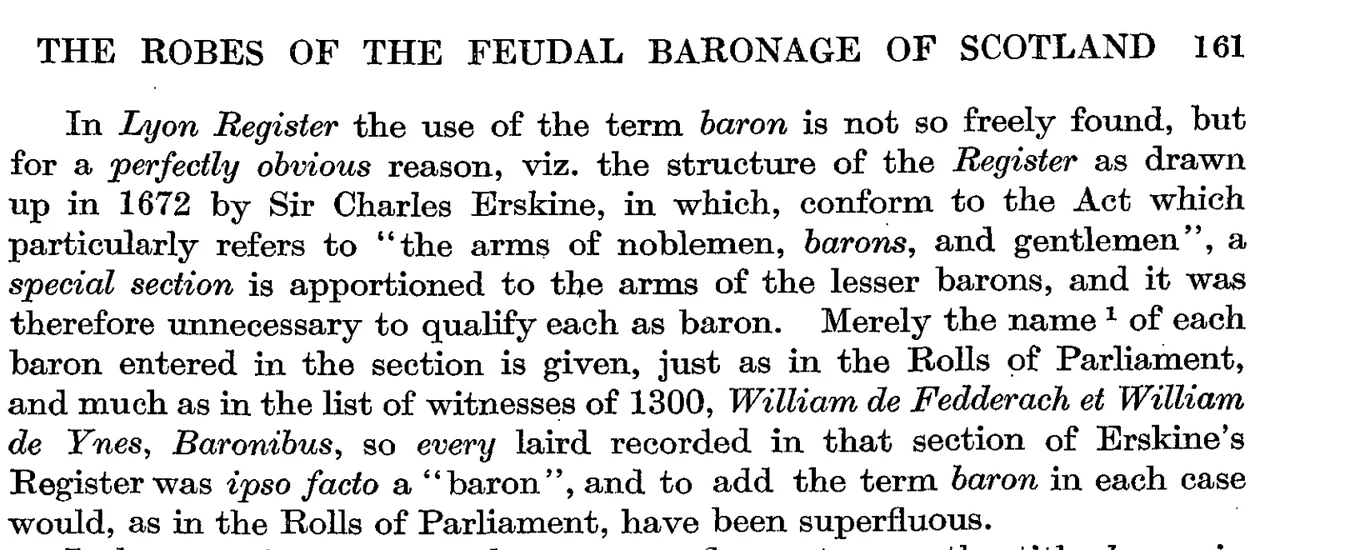
The Register the Act set up was built on the same three classes. Innes of Learney, as Lord Lyon, explained why the word “baron” is so seldom written in its first volume: “the structure of the Register as drawn up in 1672 by Sir Charles Erskine, in which, conform to the Act which particularly refers to ‘the arms of noblemen, barons, and gentlemen’, a special section is apportioned to the arms of the lesser barons, and it was therefore unnecessary to qualify each as baron … every laird recorded in that section of Erskine’s Register was ipso facto a ‘baron’”. He adds the consequence for rank: “The baron is greater than the esquire”, and the Lyon Court never joined the two words.4 The critics read one clause. The Lord Lyon who kept the Register read the Act whole.
Parliament used the word both ways
Neither sense was new in 1672. In 1540 Parliament required “every noble man, such as an earl, lord, knight and baron” to keep horse and harness.5 In 1567 it resolved that “of law and reason, the barons of this realm ought to have vote in parliament as a part of the nobility”.6 In 1592 it used both senses: one Act named “the nobility, earls, lords and barons”,7 and another empowered the Lyon over “the whole arms of noblemen, barons and gentlemen”.8 In 1662 an Act listing dukes, marquesses, earls, viscounts and “each Lord of Parliament” calls them “the said noblemen”, beside “the nobility and gentry of this kingdom”.9
Two senses, side by side for a century and more: the nobility from the earls down to the barons, and “noblemen” as the short name for the lords’ estate in a Parliament of lords, barons and burghs. The signing clause of 1672 uses the second. It no more denies the barons’ nobility than the fee scale on the same page.
The lawyers of the day
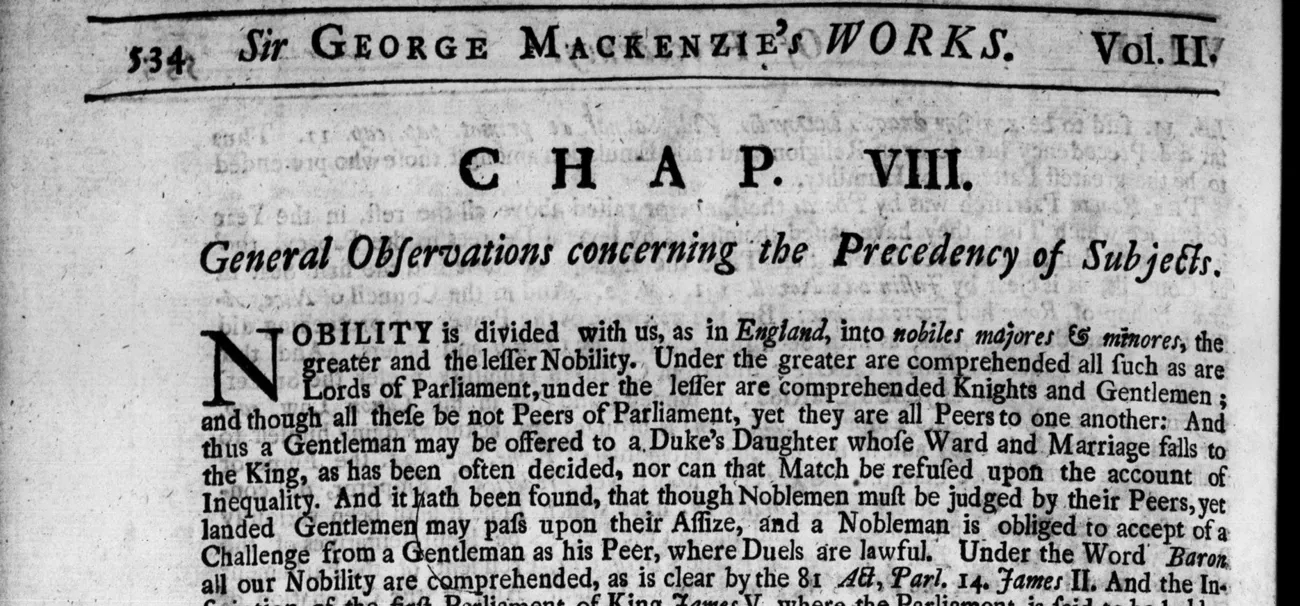
Sir George Mackenzie, the Lord Advocate, set out the rule in 1680. “Nobility is divided with us, as in England, into nobiles majores & minores, the greater and the lesser Nobility. Under the greater are comprehended all such as are Lords of Parliament, under the lesser are comprehended Knights and Gentlemen; and though all these be not Peers of Parliament, yet they are all Peers to one another.”10 On the same page he uses the narrow word himself: “Noblemen must be judged by their Peers, yet landed Gentlemen may pass upon their Assize.” One page, both senses. In the same year he wrote that “a Barony, as we call it, do ennoble”.11
England reads the word differently: there the greater nobility and the peerage are one thing.12 Read with that habit, “Noblemen” in a Scottish statute looks like the whole nobility. The statute says only who paid twenty merks and who paid ten.
Where it stands
The signing clause of 1672 was repealed in 1995.13 The dignity it ranked was kept in 2000: “nothing in this Act affects the dignity of baron”.14 Between the two, in 1943, the Lyon Court found and declared that the minor barons of Scotland “are, and have been both in this nobiliary Court and in the Court of Session recognised as a ‘titled nobility’”.15 The clause and the finding describe one order from two ends: below the peers, and noble.
The Roll and the Pledge
A title named in law still has to be shown. That is a matter of evidence.
The Baronage of Scotland Association keeps the Roll of Scottish Barons, which enters a holder only on evidence, and offers the Pledge: an undertaking, in honour and not in law, to preserve a barony within the family for future generations and to uphold the Baronial Code of Honour. The precedent is the baronets’ Roll of 1910.
Notes
- Lyon King of Arms Act 1672, c. 47, as printed in J. H. Stevenson, Heraldry in Scotland (Glasgow, 1914), vol. II, pp. 439–441: the recital and the order to bring in arms at p. 440, the fee scale at p. 440, the signing clause at p. 441. Quoted here in modern spelling. The revised text, with the words “and Bishops” repealed in 1906, is at legislation.gov.uk. ↩
- J. H. Stevenson, “Baron”, in Green’s Encyclopaedia of the Law of Scotland, ed. John Chisholm, vol. II (Edinburgh, 1896), p. 33. On the form of designation he gave, and what replaced it, see How is a Scottish baron named in a legal document?. ↩
- Sir George Mackenzie, The Science of Herauldry (1680), in Works, vol. II (Edinburgh, 1716), pp. 549–550: the old barons, “especially where they are Chiefs of Clans”, refused to yield precedence to baronets, “though the other pretend that a Baron is no Name of Dignity”. See Baron of X, or X of Y? Two styles of a Scottish baron. ↩
- Innes of Learney, “The Robes of the Feudal Baronage of Scotland”, PSAS 79 (1944–45), p. 161: the passage quoted, and “in no instances are the terms esquire and baron conjoined … the word esquire should not be applied to a baron, and accordingly was not so applied by Lyon Court where the individual was a feudal Baron”. See Baron of X, or X of Y? Two styles of a Scottish baron. ↩
- “The manner of harness, weapons and armour”, RPS 1540/12/30, modern-English text of the Records of the Parliaments of Scotland. ↩
- “Act anent the barons’ vote in parliament”, December 1567, RPS 1567/12/45, modern-English text of the Records. See The baronage in the statutes, 1428–2004. ↩
- Act regarding the age and qualities of the lords of session, 5 June 1592, RPS 1592/4/72, modern-English text of the Records. See The baronage in the statutes, 1428–2004. ↩
- Lyon King of Arms Act 1592 (c. 29), as printed in Stevenson, Heraldry in Scotland, vol. II, p. 436, in modern spelling. ↩
- Act in favours of the Lord Lyon King-at-Armes, 1662, c. 53, as printed in Stevenson, vol. II, pp. 437–438. ↩
- Sir George Mackenzie, Observations upon the Laws and Customs of Nations as to Precedency (1680), in Works, vol. II (Edinburgh, 1716), ch. VIII, p. 534. See Is a Scottish baron a commoner? Not in Scots law. ↩
- Mackenzie, The Science of Herauldry (1680), in Works, vol. II, p. 583. ↩
- Debrett’s Peerage, and Titles of Courtesy (1921), p. lxxii: in England the nobiles majores, “or high nobility”, are “co-extensive with the whole peerage”; and see Is a Scottish baron a commoner? on Blackstone. ↩
- Requirements of Writing (Scotland) Act 1995 (c. 7), s. 14(2) and (5) and Sch. 5, in force 1 August 1995. ↩
- Abolition of Feudal Tenure etc. (Scotland) Act 2000, s. 63(1). ↩
- Court of the Lord Lyon (Lord Lyon Sir Francis Grant), interlocutor of 26 February 1943, Public Register of All Genealogies and Birthbrieves, vol. iv, p. 26; printed in Innes of Learney, PSAS 79, p. 143 n. 3. See Untitled or titled nobility?. ↩
This research is paid for by members and friends of the Association. Support the Baronage →