Click for Scottish Baronies, ExplainedNew
Baronage of Scotland charter sealBaronage of ScotlandAssociationNon-profit

Print to read

Scottish Baronial Studies: the booklet

All seventeen papers in order, each starting on a new page, with their notes and sources: about 140 printed pages. The contents page lists the papers with a box to tick as you finish each one.

Or keep it as a PDF, to read on a tablet or to send by email. The PDF also prints Scottish Baronies, Explained in full, to read first, and the Proper Address guide as an appendix.

Baronage of Scotland Association · The Reading Room

Scottish Baronial Studies

Seventeen papers, read in order, give a baron or an heir the words, the rank, the recognition and the evidence behind the title.

Contents

Tick each paper as you finish it.

Read first · before Paper 1

  1. Scottish Baronies, ExplainedThe words, the rank and the questions every holder asks: the primer the papers build on. (36 min)

Part I · The words

  1. 1.Lairds, lords and barons: what the words meantWhat a laird, a lord and a baron were, and what a territorial designation is. (9 min)
  2. 2.Why is the lowest Scottish peer a Lord of Parliament, not a baron?Why the Scottish peerage has no baron, and the lords of the baronage who were never peers. (8 min)
  3. 3.Baron of X, or X of Y? Two styles of a Scottish baronThe title and the name are two different things, and “of X” needs the Lord Lyon’s recognition. (16 min)
  4. 4.“Younger of” and “Master of”: the record set straightHow an heir is styled, and why “Younger of” is the Scots form. (9 min)

Part II · The rank

  1. 5.Untitled or titled nobility?The Lyon Court’s own finding of 1943: the minor barons are a titled nobility. (4 min)
  2. 6.Is a Scottish baron a commoner? Not in Scots lawThe noblesse of Scotland, and where a baron stands in it. (14 min)
  3. 7.Were Scotland’s barons “noblemen”? The word in the Act of 1672, read in its own timeThe strongest objection to the baronage, and the Acts’ own answer to it. (6 min)
  4. 8.Were Scotland’s barons peers? The word before the Union“Peer” meant an equal before it meant a lord: tried by barons, and named with the lords in 1665. (6 min)
  5. 9.“Never ceded” to knights or baronets: the precedence of a Scottish baronAfter knights and before esquires: the baron’s place, “never ceded”. (13 min)
  6. 10.“A class of nobles”: how the baronets pleaded the barons’ nobilityThe baronets themselves pleaded the barons’ nobility to the Crown. (10 min)

Part III · Recognition

  1. 11.The baronage in the statutes, 1428–2004Twenty Acts: excused in 1428, declared a part of the nobility in 1567, kept by name in 2000. (11 min)
  2. 12.The Esslemont petition of 1934The chapeau, and what the Lyon Court meant by granting it. (7 min)
  3. 13.Barons in the Lyon Court’s own wordsLords Lyon who signed as barons, and the instruments that say “Baron of X”. (10 min)
  4. 14.The Lord Lyon and the baronage since 2004Section 63 and the appointed day: the dignity kept, the land let go. (7 min)

Part IV · In public life

  1. 15.How is a Scottish baron named in public life? By title, by name, or by designationBy title, by name, or by designation: how councils, parliaments and the ballot paper name a baron. (6 min)

Part V · The Roll

  1. 16.A dignity in disarray: the baronets’ Roll of 1910Why a dignity needs a roll, and why a roll needs a pledge. (9 min)

Part VI · In the deed

  1. 17.How is a Scottish baron named in a legal document? Like a peer: he may now sign by his titleHow to design a baron in a deed, and why it never says “commonly called”. (18 min)

Appendix

  1. The Definitive Guide to Proper Address for Scottish BaronsForms of address and precedence: on the envelope, in a letter, in person and online.

Read first · before Paper 1

Scottish Baronies, Explained

The words, the rank and the questions every holder asks: the primer the papers build on.

36 min read · www.baronage.com/scottish-baronies-explained/

Not printed in this booklet: read it at the address above before Paper 1.

Paper 1 of 17 · Part I · The words

Lairds, lords and barons: what the words meant

Laird and lord are one word; laird was never a rank; and what made a laird a baron was not the word but the Crown’s erection of his lands in free barony

9 min read · www.baronage.com/reading-room/lairds-lords-and-barons/

“Laird” is the Scottish word most often misunderstood — taken for a rank, sold with souvenir plots, confused with “lord”. The records say something simpler: laird and lord are one word, laird was never a rank, and what turned a laird into a baron was a Crown charter, not a name.

One word, two spellings

“Laird” is not a separate rank from “lord”; it is the same word. Old English hlāford — literally the “loaf-ward”, the keeper of the bread, the head of a household — became laverd in early Scots and English alike. In the south it contracted to lord; in Scotland it also contracted to lard, then laird. The Dictionary of the Older Scottish Tongue records lard from 1379 (“Schir William the Lyndesay lard of the Byres”) and gives its first sense as “one who has dominion over others; a prince, chief or lord” — it was even used of Christ (“the yhere of oure lard”, 1389).1 Sir George Mackenzie, Lord Advocate under Charles II, put it bluntly in 1680: “a Laird, in effect, is but the corrupt Word of a Lord”.2

The same thing happened in England

In medieval England every master of a household or estate was somebody’s “lord”: the lord of the manor, the landlord, the “lord” of a monastery’s tenants. Only later did “Lord” harden into a rank reserved for the peerage. The dictionaries date the sense “an owner of land, houses, etc.” (the sense in landlord) to about 1300, and the use of “Lord” as a formal address for peers below ducal rank to the 1540s.3 England kept one spelling and split the meaning. Scotland kept the meaning and split the spelling — though not cleanly into rank on one side and land on the other. “Laird” stayed with the estate and its owner, baron or not. “Lord” went two ways at once. From the mid-fifteenth century it was the style of the Lords of Parliament, the personal peerage. But it was also, and had been for longer, the style of the territorial lordship: the free lordship erected by Crown charter, dominus de X, “Lord of X / Lord X”, a lord in the baronage of Scotland ranking above a baron, but non-peerage. Many of those lordships were afterwards raised into Lords of Parliament. Others never were — most obviously where the holder already sat in Parliament under a higher dignity and had no need of the further honour — and they continued as lordships of the nobility in their own right. A “Lord of X / Lord X” in a Scottish charter is therefore not necessarily a peer, and in Scotland “lord” for titled nobility never became, as it did in England, a word the peerage owned.

Who was a laird?

A laird was a landholder known by the name of his land. The Dictionary of the Older Scottish Tongue defines the Scots sense as “a landowner who was a tenant-in-chief of the sovereign, a baron or a freeholder; after the 14th c., chiefly or only one of the smaller barons or landowners”, and adds that the word was “from an early date applied only to the ‘smaller barons’ or smaller landowners generally, as opposed to the greater or titled barons or ‘lords’”.1 The records show the distinction in use. In 1467 Parliament listed “for the barons … the lord Lindissay, the lord Lyle, the lard of Caldorwod” — two peers and a laird, all sitting as barons. In 1625 the Privy Council named “the lairds of Keir, Tracquair [etc.], for the small barronis”.1 Mackenzie again: “such as did hold their Lands of the Prince, were called Lairds, but such as held their Lands of a Subject, though they were large, and their Superior very noble, were only called Good-men”.2

So in Scots usage “laird” was a catch-all for the landed man below the peerage. A baron was a laird; so was a freeholder who held of the Crown but had no barony; and by the eighteenth century, as the Scottish National Dictionary notes, so was the owner “of an estate of land of any size from the largest to a single farm”, the equivalent of the English squire — “every one who possessed a piece of land, however small, rent free, was called a laird” (1807).4 Lord Kames observed in 1747 that “a Scotch Laird has come to be in some Measure a Term of Reproach, like a French Marquis, or a German Baron” — the word had spread far beyond the baronage.4

What made a laird a baron

Not the word, but the tenure. A baron was a laird whose lands the Crown had erected in liberam baroniam, with a baron court and jurisdiction; Mackenzie: “such Feus as had a Jurisdiction annext to them, a Barony, as we call it, do ennoble; for Baronies are establisht only by the Prince’s Erection or Confirmation”.2 The records kept the two apart even when speech did not: the Act of 1428 excuses “the small barons and freeholders” from Parliament;5 the Act of 1587 gives the vote at shire elections to freeholders of forty shillings land held of the king;6 a Banffshire sheriff in 1713 ordered production of charters “that it may be known who are barons and who have power to vote”.7 As Lord Lyon Innes of Learney wrote, “Freeholders were not Barons and everybody recognised that. Heraldically Freeholders are not allowed the insignia of Barons.”7 (See The Lord Lyon’s Case for the Baronage, section 3.)

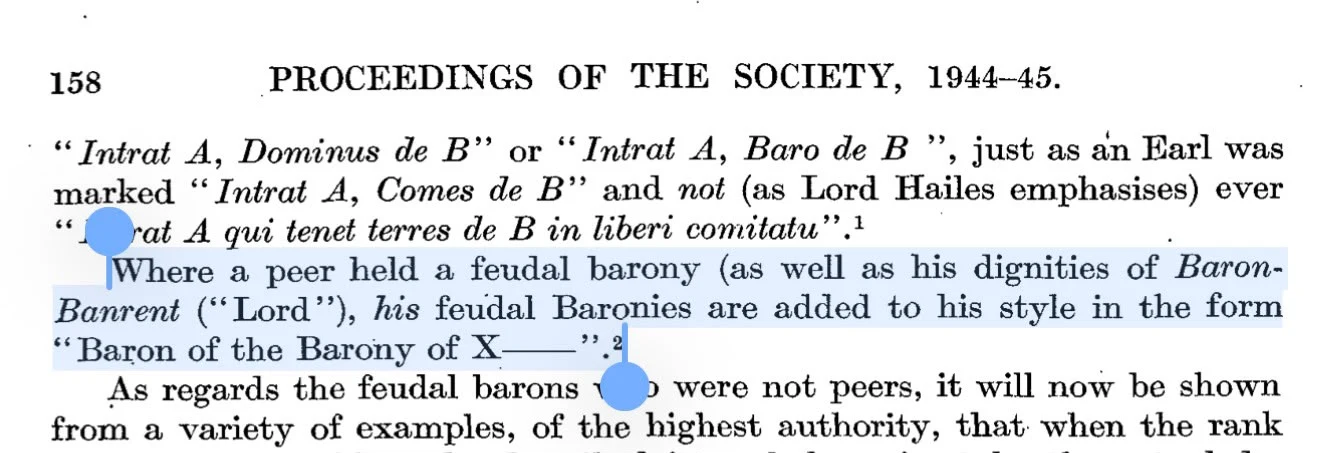
The Latin of the sheriff-court rolls is the clearest guide. Answering the head court, a Crown vassal was entered “Intrat A, Comes de B” (Earl of B), “Intrat A, Dominus de B” (Lord of B) or “Intrat A, Baro de B” (Baron of B), never “A, who holds the lands of B in free barony”.7 William Borthwick set out the same rule for Parliament in 1775: “if he held his lands in libero comitatu, he was marked down Comes; if he held his lands in libero dominio, he was marked Dominus; if he held them only in libera baronia, he was marked Baro.”8 Comes, Dominus, Baro, laird: the first three were ranks of holding, the fourth was what the neighbours called all of them.

Arms mattered apart from the barony, too. A laird who matriculated a coat of arms with the Lord Lyon, without ever holding his lands in free barony, was armigerous, and so counted among the untitled nobility of Scotland — the equivalent, in England, of the gentry: armigerous, but bearing no title.

In the Crown’s own words

Some entries in the Register of the Great Seal simply name a man as baron of his lands.9 Others say what the erection gave.10

On 20 June 1589 James VI made the abbey lands of Culross a barony for James Colville of Easter Wemyss, with “titulum, honorem et statum liberi baronis ratione dictarum terrarum”: the title, honour and status of a free baron, by reason of the lands. Colville was to bear a free baron’s badge and arms and be called baron of Culross.11

He was not then a peer. The Scots Peerage dates his lordship of Parliament to 1604.12

Spynie shows the same words read two ways. Alexander Lindsay’s charter of 6 May 1590 granted him “Titulum, Honorem, Ordinem, et Statum liberi Baronis”, the holders to be called Barons of Spynie for ever.13

In the peerage claim of 1785, notes of Lord Mansfield’s speech record that the claimant “now admitted that this charter has nothing to do with Peerage”. The words of a lordship of Parliament appear in the Act of ratification of 1592 and the charter of 1593.14

John Riddell disagreed with Mansfield in 1842. In his reading, “title, honour, and rank of a free Baron” then described a peer. He cited Sir James Balfour’s record that Lindsay was made a Lord of Parliament on 4 November 1590.15

On either reading, the words were the Crown’s own.

“Of that Ilk”: the territorial designation

The sheriff-court roll entered a Crown vassal as Baro de B; the neighbours called him the laird of B; he signed himself “A of B”, or, where surname and estate coincided, “A of that Ilk”. That signature is the territorial designation: a place-name adjoined to the surname, recognised by the Lord Lyon as part of the surname and entered in the Public Register of All Arms and Bearings in Scotland. It designates a person; it is neither a title of dignity nor a barony. A baron had both, the title and the name, and the records move freely between them, often in the same deed: the evidence is set out in Baron of X, or X of Y? Two styles of a Scottish baron. Lord Lyon Sellar’s guidance of 5 January 2010 gives the modern test, the “classic case” being “ownership of an ‘estate’, or farm or, at the very least, a house with policies extending to five acres or thereby, outwith a burgh”.16

The custom is older than the test. The Lyon King of Arms Act 1672 “declares that it is only allowed for noblemen (peers: ‘the Nobility’ in the narrow English sense, of which the barons were nonetheless ‘a part’) and bishops to subscribe by their titles, and that all others shall subscribe their christened names … with their surnames, and may, if they please, adject the designations of their lands prefixing the word ‘of’ to the said designations”. The words were repealed in 1995; the thing they describe survives.17 Sir Crispin Agnew of Lochnaw wrote that “once a territorial designation has been consistently used over a few generations (and probably recorded in the Lyon Court books), then it becomes separable from the land and continues as that family’s proper surname”. After roughly three generations the “of” has become the name.18

What it is not is plain. A souvenir plot confers nothing: the Court of the Lord Lyon calls such plots “insufficient to bring anyone within the jurisdiction of the Lord Lyon King of Arms”,19 and they cannot be entered in the Land Register.20 Nor is the designation a title. HM Passport Office records that “The Lord Lyon King of Arms has confirmed that for Scottish Lairds it is not necessary for the words ‘Laird of’ to appear on any part of the passport”; the Passport Office’s form for the surname field is “(surname) of (territorial designation)”.21

Designation and barony can coexist, but are decided separately. In Kerr of Ardgowan v Lord Lyon 2009 SLT 759 the petitioner was recognised as Baron of Ardgowan, the designation being a separate question; the Extra Division held that the Lord Lyon “does indeed enjoy a wide discretion in deciding whether or not to accept a change of name for entry in the Public Register in question”.22 A baron who owns the historic lands of his barony may be “Surname of X, Baron of X”: one is his name, the other his dignity. Three things, not one: laird is what the neighbours called a landholder; the designation is the Lyon Court’s formal recognition of that “of”; the barony is a Crown erection. See the FAQ: What is a territorial designation, and is it the same as a barony?.

Laird today

Laird remains a description, not a title. HM Passport Office records that “The Lord Lyon King of Arms has confirmed that for Scottish Lairds it is not necessary for the words ‘Laird of’ to appear on any part of the passport”,21 and the Court of the Lord Lyon said so in terms on its former website: laird “is description rather than a title” and “is not appropriate for the owner of a normal residential property, far less the owner of a small souvenir plot of land” (see Scottish Baronies, Explained).23 A souvenir plot of a few square feet does not make its buyer a laird in any sense the Lyon Court recognises: the Court’s current guidance on petitioning for arms states that such plots are “insufficient to bring anyone within the jurisdiction of the Lord Lyon King of Arms”,19 and they cannot be registered in the Land Register at all.20 A barony is different in kind — a dignity preserved by statute24 — which is why the passport guidance provides for “BARON OF (territorial designation)”, where the Passport Office’s “territorial designation” means the name of the barony, but not for “Laird of”.21

The Roll and the Pledge

What made a laird a baron was a Crown charter, and a charter can be produced. That is the proof the Roll asks for.

The Baronage of Scotland Association keeps the Roll of Scottish Barons, which enters a holder only on evidence, and offers the Pledge: an undertaking, in honour and not in law, to preserve a barony within the family for future generations and to uphold the Baronial Code of Honour. The precedent is the baronets’ Roll of 1910.

Notes

  1. DOST, Lard, Laird n., senses 1–3, quotations 1379, 1389, 1467 and 1625; DOST, Laverd n., etymology from Old English hláford, hláfweard. ↩
  2. Sir George Mackenzie, The Science of Herauldry (1680), in Works, vol. ii (1722), pp. 549–550, 583. ↩
  3. Online Etymology Dictionary, lord. ↩
  4. SND, Laird n., sense 2, quotations 1747 (Kames) and 1807. ↩
  5. RPS 1428/3/3, Act of the small barons, 5 March 1428. ↩
  6. RPS 1587/7/143, Declaration concerning the votes of small barons in parliament. ↩
  7. Thomas Innes of Learney, “The Robes of the Feudal Baronage of Scotland”, PSAS vol. 79 (1944–45), pp. 137 n. 1, 157–158, 162 — open access PDF. ↩
  8. William Borthwick, An Inquiry into the Origin and Limitations of the Feudal Dignities of Scotland (1775), p. 13. ↩
  9. For example Registrum Magni Sigilli Regum Scotorum, vol. IV (1546–1580), ed. J. M. Thomson (Edinburgh, 1886), no. 354, Edinburgh, 18 July 1549, p. 81: a grant to “ROBERTO MOWBRAY de Bernbowgall, baroni de Ovir-Berntoun”. Words of this kind designate the holder of a barony; they are not a grant of title. ↩
  10. Besides Culross and Spynie, the charter of 3 February 1588/89 to Sir William Keith of Delny erected his lands in free barony, “concedendo dictis Wil. &c. titulum et honorem baronis de Delny”: Registrum Magni Sigilli, vol. V (1580–1593), ed. J. M. Thomson (Edinburgh, 1888), no. 1625, Holyrood, p. 557, col. 1. It is a weaker example: on 10 December 1591 the same subjects were granted to George, Earl of Huntly, “concedendo dictis Georgio &c. titulum et honorem baronis de Delny”, so within three years the same words were used for a peer (ibid., no. 1975, p. 669). ↩
  11. Registrum Magni Sigilli, vol. V, no. 1675, Edinburgh, 20 June 1589, to “JACOBUM COLVILL de Eister Wemis”, pp. 575–576; the clause quoted is at p. 576, col. 1 (register reference xxxvii. 420). The lands are incorporated “in unam temporalem baroniam de Culros”, “dando dictis Jac. et heredibus titulum, honorem et statum liberi baronis ratione dictarum terrarum, et voluit quod ille honoraretur cum dictione lie badge et armis liberi baronis, baro de Culros appellandus”. Lie marks a vernacular word, here “badge”. The volume prints Latin abstracts of the register, not the full text of the charter. ↩
  12. Sir James Balfour Paul (ed.), The Scots Peerage, vol. II (Edinburgh, 1905), “Colville, Lord Colville of Culross”, p. 556: a charter of 10 March 1604 conferred “the style and title of a Lord of Parliament to be called Lords of Culross”; Calderwood records that he was made Lord Colville “in the Parliament of 26 April 1604”; and when the House of Lords restored the dormant title in 1723 it was ranked “according to the date of the patent creating Sir James Colville a Peer on 20 January 1609”. At p. 555 The Scots Peerage calls the 1589 erection a “temporal lordship”; the Register’s abstract says “temporalem baroniam”. ↩
  13. Registrum Magni Sigilli, vol. V, no. 1727, Holyrood, 6 May 1590, pp. 591–592; clause at p. 592, col. 1 (register reference xxxvii. 415), where the abstract gives only “titulum et statum liberi baronis de S.”. The fuller clause, “Titulum, Honorem, Ordinem, et Statum liberi Baronis, qui nunc et imperpetuum Barones de Spynie nuncupabuntur”, is from the charter as quoted in James Maidment, Reports of Claims Preferred to the House of Lords in the Cases of the Cassillis, Sutherland, Spynie, and Glencairn Peerages (Edinburgh, 1840), Spynie report, p. 4; the manuscript register has not been checked. ↩
  14. Maidment, Reports of Claims, Spynie report, p. 10, from “somewhat imperfect notes” of Lord Mansfield’s speech, 15 April 1785, recording that the claimant, having founded on the charter, had “now admitted” this; the resolution on the same page finds that “the original creation of the title, honour, dignity, and peerage of Spynie has not been shown”, and decides the descent from “the act of ratification 1592, the charter 1593, and the charter 1621”. Act of ratification as printed at p. 5: Lindsay to have “the Honor, Estate, Dignity, and Preeminence of ane frie Lord of Parliament”. Charter of 17 April 1593: Registrum Magni Sigilli, vol. V, no. 2280, Holyrood, pp. 781–782, at p. 782 (“concedendo dicto Alex. titulum et honorem liberi baronis et domini parliamentorum, domini de Spynie nuncupand.”). ↩
  15. John Riddell, Inquiry into the Law and Practice in Scottish Peerages (Edinburgh, 1842), vol. II, p. 655 (Mansfield’s view “untenable”; he adds that the claimant’s counsel were “rash and ill advised” to “give it up” as a grant of peerage; his n. 2 cites the Abercorn charter of 5 April 1603, where “title, honour, rank, and state of a free Baron” is used of a peerage) and p. 656, quoting Balfour: “same zeire, (1590) 4 Novembris, Alexander Lindesy … ves knighted, and immediatelie thereafter made Lord of oure Soveraigne Lords Parliament, and nam’d Lord Spynie”, with David Moysie’s Memoirs to the same effect. Balfour’s words are taken from Riddell. ↩
  16. Lord Lyon Sellar, Guidance regarding Territorial Designations, issued 5 January 2010 (formerly at lyon-court.com/lordlyon/616.html), reproduced in D. D. Campbell, Scottish Armory and Heraldry: A General Overview (rev. 12 January 2019), pp. 50 and 84. ↩
  17. RPS 1672/6/57, Act concerning the privileges of the office of Lyon King at Arms; revised text as Lyon King of Arms Act 1672, c. 47, where the subscription words are noted as repealed with effect from 1 August 1995 by the Requirements of Writing (Scotland) Act 1995 (c. 7), ss. 14(2), 15(2), Sch. 5. ↩
  18. Sir Crispin Agnew of Lochnaw, “Territorial Designations”, The Double Tressure vol. 4 (1982), pp. 11–12, as quoted in D. D. Campbell, Scottish Armory and Heraldry: A General Overview (rev. 12 January 2019), pp. 49–50; the “three generations” reading is Campbell’s, p. 50. ↩
  19. Court of the Lord Lyon, Petitioning for Arms (current website) — souvenir plots “insufficient to bring anyone within the jurisdiction of the Lord Lyon King of Arms”. ↩
  20. Land Registration etc. (Scotland) Act 2012, s. 22 (souvenir plots). ↩
  21. HM Passport Office, Titles included in passports (v25.0, 18 June 2026), sections on Scottish baronies and Scottish lairds. ↩
  22. Kerr of Ardgowan and others v Lord Lyon 2009 SLT 759 (Extra Division), per Lord Marnoch at p. 761, para. [10], as quoted by Lord Lyon Sellar in his Note in the petition of Sturzenegger of Arran, p. 14, where the case is described as one “which concerned territorial designations”. ↩
  23. Court of the Lord Lyon, Lairds (former website, archived 28 July 2012) — of laird: “It is description rather than a title, and is not appropriate for the owner of a normal residential property, far less the owner of a small souvenir plot of land”; the same page adds that “the term ‘laird’ is not synonymous with that of ‘lord’ or ‘lady’”. ↩
  24. Abolition of Feudal Tenure etc. (Scotland) Act 2000, s. 63, in force 28 November 2004. ↩
Paper 2 of 17 · Part I · The words

Why is the lowest Scottish peer a Lord of Parliament, not a baron?

England made “baron” a rank of its peerage. Scotland already had a baronage, and its peerage has no baron in it

8 min read · www.baronage.com/reading-room/why-the-lowest-scottish-peer-is-not-a-baron/

In England a baron is the lowest rank of the peerage. The Peerage of Scotland has no such rank: its lowest is the Lord of Parliament, and “baron” stayed with the baronage. This paper shows how the line was drawn, from the Great Seal, and why it matters to the standing of a Scottish baron.

The short answer

  • The Peerage of Scotland has no baron. Its ranks are duke, marquis, earl, viscount and Lord of Parliament. A woman holding the lowest rank sat in the Lords as “Lady Saltoun of Abernethy”, not “Baroness”.
  • The baronage came first. “Baron” was the name of the whole order. Sir Alexander Forbes held a free barony by 1429 and became a lord of parliament only in 1444 or 1445.
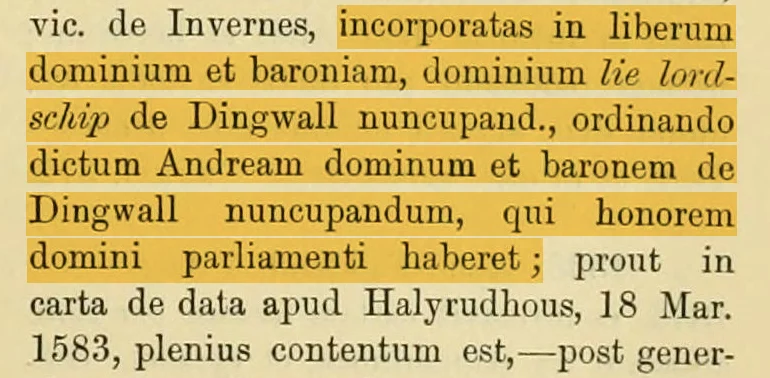
  • The honour was added. A Great Seal charter of 1583 makes Andrew Keith lord and baron of Dingwall, “who should have the honour of a lord of Parliament”.
  • Sometimes the honour was in the land. At Torphichen the title of Lord of Parliament was annexed to part of a barony granted to “heirs and assignees”: “a territorial Peerage”, the peerage lawyer Riddell called it. Its holder was Baron of Torphichen by the barony and Lord Torphichen by the honour, and a notice of 1862 used both.
  • So a Scottish baron is no lesser copy of an English peer. In England the word names a rank of the peerage. In Scotland it names a dignity of its own, which the Act of 2000 keeps by name.

“Baron” meant the whole order

Sir George Mackenzie, Lord Advocate, wrote in 1680: “Under the Word Baron all our Nobility are comprehended”.1 A Lord Lyon said the same two centuries later: “The Earls belonged to the order of Barons.”2 Parliament counted the barons in the nobility: “every noble man, such as an earl, lord, knight and baron” in 1540, “a part of the nobility” in 1567, and “the nobility, earls, lords and barons” in 1592.3 Tenure gave the name. William Borthwick wrote in 1775 that a man holding in free earldom was marked earl, in free lordship lord, and in free barony baron.4

An honour added to the lordship

The Act of 1428 excused the small barons from Parliament and kept the great men to it, the “lords of parliament” among them, summoned by the King’s “special precept”.5 The first named creations follow in the 1440s. Forbes is the clear case: a free barony in 1429, the honour of Parliament in 1444 or 1445.6

The Register of the Great Seal shows that lordship and the honour of Parliament were separate things. A charter could give the one without the other.

“in free lordship and barony … the said Andrew to be called lord and baron of Dingwall, who should have the honour of a lord of Parliament”

Charter of 18 March 1583, in modern English7

  • 1583, Dingwall. A lord and baron by charter, with the honour named as something further.
  • 1587, Paisley. A free temporal lordship and barony, with “the title and honour of a free baron and lord of parliaments”.8
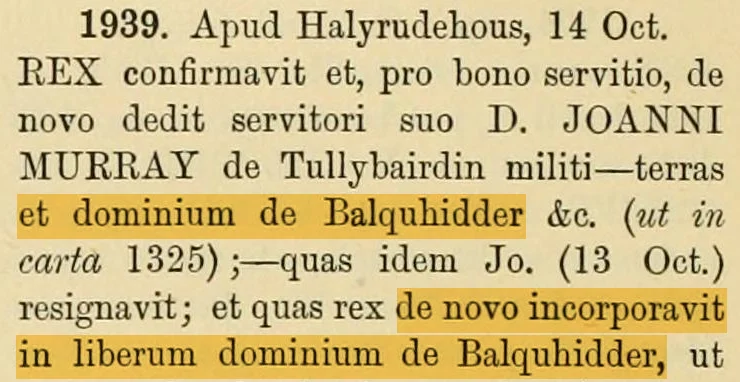
  • 1591, Balquhidder. Sir John Murray, a knight, in free lordship. No honour of Parliament.9
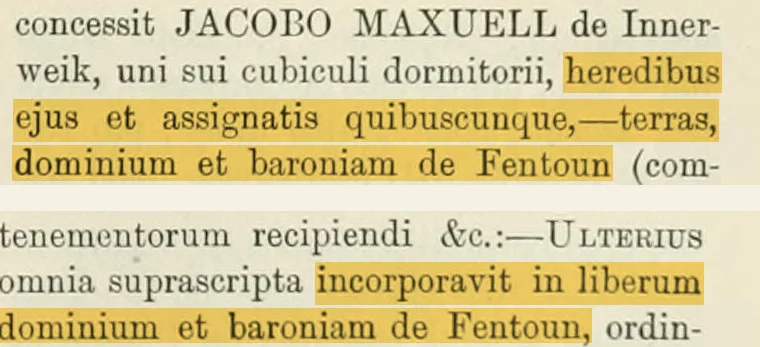
  • 1631, Fenton. James Maxwell of Innerwick, in free lordship and barony. No honour of Parliament.10

It is often said that the only lords are peers. The Register answers it. Balquhidder and Fenton were erected into free lordships with no honour of Parliament, and their holders were lords of those lands and nothing more. Dingwall’s charter adds the honour as a further clause. Torphichen shows a third kind of lord. Before his lordship became a hereditary peerage in 1564, Sir James Sandilands was Lord of St John by his office as Preceptor of the Knights, and the Preceptors held it for their lives, by election and “investiture in the fief”. The three charter entries are below.

Register of the Great Seal, vol. V, no. 1337, 3 August 1587, reciting the charter of 18 March 1583: the lands of Dingwall incorporated in liberum dominium et baroniam, the lordship called the lordschip of Dingwall, ordaining the said Andrew to be called dominum et baronem de Dingwall, qui honorem domini parliamenti haberet
Dingwall, 1583, highlighted: the lands “incorporated into free lordship and barony, to be called the lordship of Dingwall, ordaining the said Andrew to be called lord and baron of Dingwall, who should have the honour of a lord of Parliament”. The honour is the last clause. Register of the Great Seal, vol. V, no. 1337, p. 461.
Register of the Great Seal, vol. V, no. 1939, 14 October 1591: the King confirms and grants anew to Sir John Murray of Tullibardine, knight, the lands and lordship of Balquhidder, which he resigned, and which the King incorporated anew in liberum dominium de Balquhidder
Balquhidder, 1591, highlighted: Sir John Murray of Tullibardine, a knight, resigns his lands, and the King “incorporated them anew into the free lordship of Balquhidder”. No honour of Parliament. Register of the Great Seal, vol. V, no. 1939, p. 654.
Two parts of one entry in the Register of the Great Seal, vol. VIII, no. 1779, 4 June 1631: the King grants to James Maxwell of Innerwick, heredibus ejus et assignatis quibuscunque, the lands, lordship and barony of Fenton; and below, incorporates all in liberum dominium et baroniam de Fentoun, ordaining the tower and manor place of Fenton Tower to be the principal messuage
Fenton, 1631, highlighted: to James Maxwell of Innerwick, “his heirs and assignees whomsoever”, the lands, lordship and barony of Fenton, all “incorporated into the free lordship and barony of Fenton”. No honour of Parliament. Two parts of one entry. Register of the Great Seal, vol. VIII, no. 1779, p. 609.

So “lord” alone did not make a peer. The peerage rank needed its fuller name, Lord of Parliament, because lords held territorially in the baronage. It was at first an honour added to such a lordship, and only later given by patent alone: in 1627 Sir Thomas Fairfax, an Englishman, was made Lord Fairfax of Cameron with no lands.11

Torphichen: the honour in the land

At Torphichen the barony and the lordship of Parliament were one estate. In January 1564 Sir James Sandilands, Preceptor of the Knights of St John in Scotland, resigned the Order’s lands into Queen Mary’s hands. She granted them back to him “and his heirs and assignees”, for 10,000 crowns of the sun, and incorporated them “into the free barony of Torphichen”. The charter names no title. It calls the erection a free barony, not a lordship, and its grantee “James, lord of St John’s”: the Preceptor’s style, for the Preceptors, Riddell notes, had held the peerage for their lives, “after their election, but more especially investiture in the fief”.12 In 1606 the charter was accepted “as the sole evidence creating the lordship and carrying with it the dignity of Lord Torphichen”.13 Riddell, writing on peerage law in 1833, read the record so: the grant “is merely that of a common barony, but with higher rights and privileges”; the heir of 1597 “assumes the dignity, on vesting himself in the fief, by retour”; and the barony “passed like a common property, under a limitation applicable to land, carrying the Peerage along with it”.14

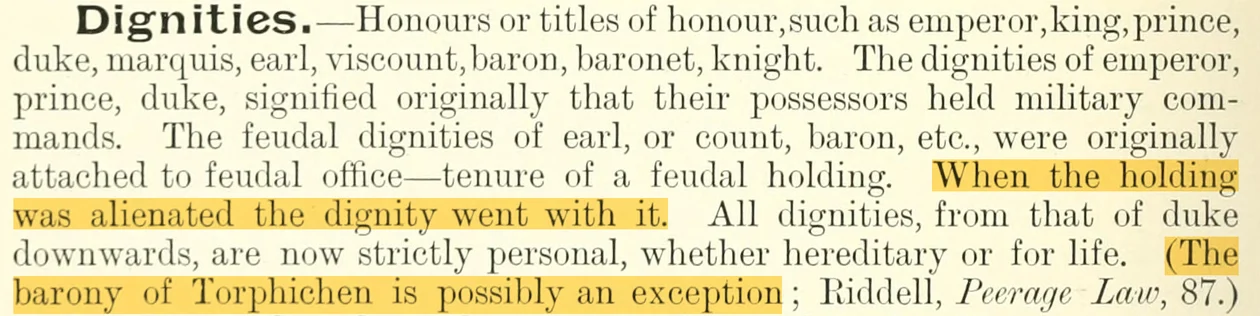
When Charles I resumed the church lands, the fourth Lord feared for the superiorities of his barony. An award of the King in 1636, with the force of an Act of Parliament, kept them “within that … portion of it in which the title and dignity of Lords of Parliament subsists, and to which the title of Lord of Parliament is annexed”.15 The peerage stood in the land: a lordship of Parliament annexed to part of a barony, held of the Crown by heirs and assignees. “Is not this a territorial Peerage?”, Riddell asked: a title that follows “the fate of the land, in which it subsists, and without which, like the head and members, it cannot subsist”. Sixty years later Stevenson’s legal encyclopaedia laid down that a dignity “is not now capable of transference”, and added: “The barony of Torphichen is possibly an exception.”16

Green’s Encyclopaedia of the Law of Scotland, vol. IV, 1897, article Dignities: the feudal dignities of earl, or count, baron, etc., were originally attached to feudal office, tenure of a feudal holding; when the holding was alienated the dignity went with it; all dignities are now strictly personal; the barony of Torphichen is possibly an exception, citing Riddell, Peerage Law, 87; a dignity is not now capable of transference
Highlighted: “When the holding was alienated the dignity went with it … The barony of Torphichen is possibly an exception.” J. H. Stevenson, “Dignities”, Green’s Encyclopaedia of the Law of Scotland, vol. IV (1897), p. 226.

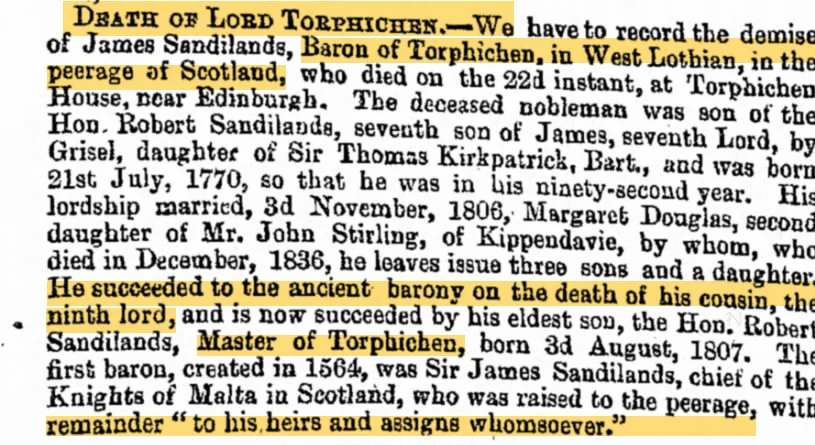
The holder carried two titles, as Forbes did: the barony made him Baron of Torphichen, the honour made him Lord Torphichen. Neither is a form of the other. When the tenth Lord died in March 1862, the London press used both. Its heading was “Death of Lord Torphichen”; its text recorded “James Sandilands, Baron of Torphichen, in West Lothian, in the peerage of Scotland”, who had “succeeded to the ancient barony on the death of his cousin, the ninth lord”, and whose heir was “Master of Torphichen”.17 The barony is named first and the peerage after it, in one sentence, for one man.

Newspaper notice, March 1862, headed Death of Lord Torphichen: We have to record the demise of James Sandilands, Baron of Torphichen, in West Lothian, in the peerage of Scotland … He succeeded to the ancient barony on the death of his cousin, the ninth lord, and is now succeeded by his eldest son, the Hon. Robert Sandilands, Master of Torphichen … The first baron, created in 1564, was Sir James Sandilands, chief of the Knights of Malta in Scotland, who was raised to the peerage, with remainder to his heirs and assigns whomsoever
The notice of March 1862, highlighted: “Death of Lord Torphichen”, “Baron of Torphichen, in West Lothian, in the peerage of Scotland”, “the ancient barony”, “Master of Torphichen”, and a remainder “to his heirs and assigns whomsoever”. The charter itself has “heirs and assignees”. The same notice ran in the Saint James’s Chronicle, 27 March 1862, p. 5.

What the Union changed

England took another road. There “baron” became the lowest rank of the peerage, and at Westminster a baron was a peer. The Peerage of Scotland closed at the Union of 1707, and no Scottish peerage has been created since. The Stair Encyclopaedia puts it in a line: the lowest rank in the peerage was “lord” in Scotland before the Union, and has been “baron” since.18

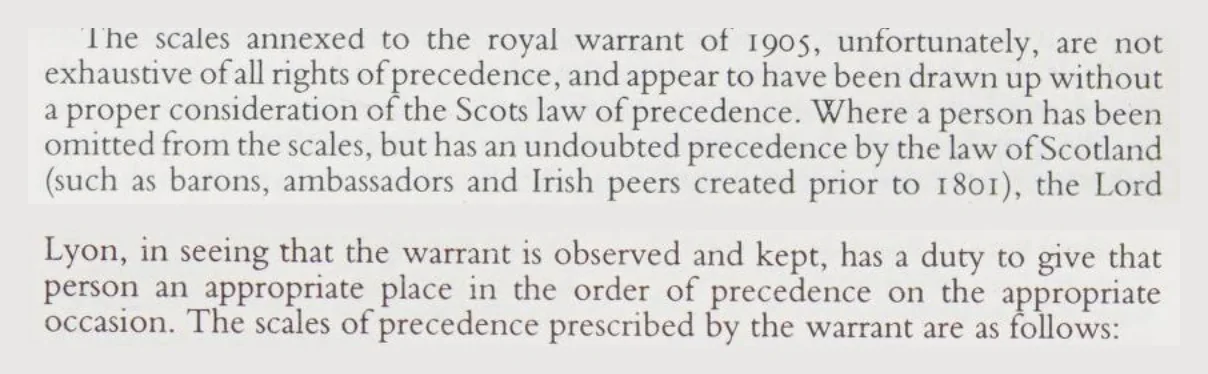
That is why the King’s Scale of 1905 lists “Barons of Scotland” among the peers: it uses the British name for the lords of parliament.19 The holders themselves stayed Lords, and the women show it best. The Peerage Act 1963 gave a woman holding a peerage in her own right a seat in the Lords.20 Within months the House had “Baroness Strange of Knokin”, in an English barony, and “The Lady Kinloss”, in a Scottish lordship. Hansard’s “Lord Saltoun” of 1955 was followed by “Lady Saltoun of Abernethy”.21 The Scottish holders were Ladies, not Baronesses: the peerage of Scotland has no such rank.

Debrett’s table for England now gives them a line of their own, “Lords of Parliament, Scotland”.22

Why it matters

The common objection runs: a baron is a peer, so a Scottish baron who is not a peer is no real baron. That is English usage. In Scotland the word never passed to the peerage, because the baronage already held it.

Stair warns that the title “should not be confused with a dignity in the peerage of Scotland”.23 That is right, and it is the point. A Scottish baron does not claim a rank of the peerage. He holds a dignity older than the peerage: the Act of 2000 preserves “the dignity of baron”, and in 1943 the Lyon Court found the minor barons “a ‘titled nobility’”.24

What the record does not say

  • No source gives the reason in terms. The charters show the separation. That the rank took its name from it is our reading.
  • The word still crosses over. Debrett’s table for Scotland reads “Barons or Lords of Parliament (Scotland)”.
  • How far the Torphichen peerage follows the land. Riddell: the barony “passed like a common property, under a limitation applicable to land, carrying the Peerage along with it”, and “a curious question might, possibly, arise, on the alienation” of the portion that carries the title. Stevenson: “When the holding was alienated the dignity went with it”, and Torphichen “is possibly an exception” to the rule that a dignity “is not now capable of transference”. Both leave the question open; the record shows the peerage passing with the barony by inheritance.
  • The phrase is older than the first named creations. The Act of 1428 has “lords of parliament”; the first named creations are of the 1440s.

The Roll and the Pledge

The Baronage of Scotland Association keeps the Roll of Scottish Barons, which enters a holder only on evidence, and offers the Pledge: an undertaking, in honour and not in law, to preserve a barony within the family for future generations and to uphold the Baronial Code of Honour.

Notes

  1. Mackenzie, Works, vol. II, p. 534: “Under the greater are comprehended all such as are Lords of Parliament, under the lesser are comprehended Knights and Gentlemen; and though all these be not Peers of Parliament, yet they are all Peers to one another”. He adds: “Under the Word Baron all our Nobility are comprehended”. ↩
  2. George Burnett, Lord Lyon, in a letter of 1889 printed in G. E. C., The Complete Peerage, vol. I (London, 1910), Preface to the First Edition, p. xxvii. He goes on: “All Barons in the old sense, i.e., landholders holding their land as a Barony, had the right, or, more properly speaking, were under the obligation, to attend the meeting of the Estates”. ↩
  3. RPS 1540/12/30; Parliament of December 1567, RPS 1567/12/45; Act regarding the age and qualities of the lords of session, 5 June 1592, RPS 1592/4/72. See The baronage in the statutes, 1428–2004. ↩
  4. William Borthwick, An Inquiry into the Origin and Limitations of the Feudal Dignities of Scotland (1775), p. 13, in modern English: “if he held his lands in free earldom, he was marked down Earl; if he held his lands in free lordship, he was marked Lord; if he held them only in free barony, he was marked Baron”. ↩
  5. The Act of 5 March 1428, in modern English: “All bishops, abbots, priors, dukes, earls, lords of parliament and bannerets whom the King wishes shall be reserved, and summoned to councils and to parliaments by his special precept”. The Acts of the Parliaments of Scotland, vol. II, p. 15, printed under 1427 in the old reckoning of the year; RPS 1428/3/3. ↩
  6. Registrum Magni Sigilli Regum Scotorum, vol. II, no. 134, p. 27: the Register’s page is headed 1429; The Scots Peerage gives 1430. The Scots Peerage, vol. IV (Edinburgh, 1907), p. 49: “Between October 1444 and July 1445 Sir Alexander Forbes, knight, was raised to the Peerage”. Mackenzie, Works, vol. II, p. 547. ↩
  7. Charter of 18 March 1583, recited on 3 August 1587, translated from the Latin. Register of the Great Seal, vol. V, no. 1337, p. 461. ↩
  8. 29 July 1587, translated from the Latin: “incorporated into the free temporal lordship and barony of Paisley, giving the said Lord Claud &c. the title and honour of a free baron and lord of parliaments”. Register of the Great Seal, vol. V, no. 1320, p. 453. ↩
  9. 14 October 1591, translated from the Latin: “into the free lordship of Balquhidder”. Register of the Great Seal, vol. V, no. 1939, p. 654. ↩
  10. 4 June 1631, translated from the Latin: “into the free lordship and barony of Fenton”. Register of the Great Seal, vol. VIII, no. 1779, p. 609. ↩
  11. 18 October 1627: Register of the Great Seal, vol. VIII, no. 1155, p. 404. ↩
  12. Register of the Great Seal, vol. IV, no. 1499, 24 January 1563-64, pp. 343–344, translated from the Latin: the lands, which “the Queen incorporated into the free barony of Torphichen”, granted to “the said James, lord of St John’s, his heirs and assignees”, for “10,000 gold crowns of the sun”, with a promise to ratify the grant in Parliament when she reached the age of twenty-five. Riddell, Remarks upon Scotch Peerage Law (1833), p. 63, on the Preceptors. ↩
  13. The Scots Peerage, vol. VIII (Edinburgh, 1911), p. 387: “Though his new title is not named in this charter, it was accepted in 1606 as the sole evidence creating the lordship and carrying with it the dignity of LORD TORPHICHEN, which designation he bore from the date of the writ.” ↩
  14. John Riddell, Remarks upon Scotch Peerage Law (Edinburgh, 1833), p. 61: “There is no mention here of any title of honor, peerage, or hereditary seat, or vote in Parliament; the grant is merely that of a common barony, but with higher rights and privileges, such as had been possessed by the Preceptors”; p. 62: the heir “assumes the dignity, on vesting himself in the fief, by retour of that date, as heir to his grand-uncle, in terms of the charter in 1563. The barony, in this manner, passed like a common property, under a limitation applicable to land, carrying the Peerage along with it”; the award “in reality in 1636, but inserted in the Acts of Parliament in 1633”; p. 63: “is not this a territorial Peerage”, and the Preceptors’ peerage held “during their lives, after their election, but more especially investiture in the fief”; p. 64; p. 65: “the title still retains its ancient character, being still an incident, and following, according to its original nature and constitution, the fate of the land, in which it subsists, and without which, like the head and members, it cannot subsist”, and “a curious question might, possibly, arise, on the alienation of that transcendant, and highly privileged mean portion”. ↩
  15. Award of Charles I, dated 15 May 1636, The Acts of the Parliaments of Scotland, vol. V, p. 162, as quoted in The Scots Peerage, vol. VIII, p. 392, in modern English. The award followed a resolution of the Privy Council and was “to have the force of an Act of Parliament”. ↩
  16. J. H. Stevenson, “Dignities”, in Green’s Encyclopaedia of the Law of Scotland, ed. John Chisholm, vol. IV (Edinburgh, 1897), p. 226: “The feudal dignities of earl, or count, baron, etc., were originally attached to feudal office, tenure of a feudal holding. When the holding was alienated the dignity went with it. All dignities, from that of duke downwards, are now strictly personal, whether hereditary or for life. (The barony of Torphichen is possibly an exception; Riddell, Peerage Law, 87.)” And: “A dignity is indivisible; is not now capable of transference, or attachable for debt.” ↩
  17. Saint James’s Chronicle, 27 March 1862, p. 5; the same notice in the Brighton Gazette, 3 April 1862, p. 2 (British Newspaper Archive). The tenth Lord died on 22 March 1862: The Scots Peerage, vol. VIII, p. 397. ↩
  18. Stair Memorial Encyclopaedia, vol. 16, “Peerages”, para. 1311, p. 136. The title “Precedence”, para. 2018 (p. 432), uses “baron” in the same way, for the lowest rank of the peerage. In copyright; summarised. ↩
  19. The London Gazette, 14 March 1905, issue 27774, p. 2013. See “Never ceded”: the precedence of a Scottish baron. ↩
  20. Peerage Act 1963, s. 6: “A woman who is the holder of a hereditary peerage in the peerage of England, Scotland, Great Britain or the United Kingdom shall … have the same right … to sit and vote in that House”. ↩
  21. House of Lords Debates, 19 November 1963, vol. 253, c. 207: “Baroness Strange of Knokin took the Oath”; 18 February 1964, vol. 255, c. 753: “The Lady Kinloss—Sat first in Parliament, pursuant to the Peerage Act, 1963”; 22 November 1955, vol. 194, cc. 687–707; 1 May 1985, vol. 463, cc. 234–6. Hansard’s record of Flora Fraser: “Titles in Lords: Lady Saltoun of Abernethy”. ↩
  22. Debrett’s, Tables of Precedence (online, read 1 November 2026). ↩
  23. Stair Memorial Encyclopaedia, vol. 16, “Peerages”, para. 1311, p. 136. ↩
  24. Abolition of Feudal Tenure etc. (Scotland) Act 2000, s. 63; Court of the Lord Lyon, interlocutor of 26 February 1943, Public Register of All Genealogies and Birthbrieves, vol. iv, p. 26. See Untitled or titled nobility? ↩

Paper 3 of 17 · Part I · The words

Baron of X, or X of Y? Two styles of a Scottish baron

A name and a title: the evidence that Scotland’s barons were called by both, often by the same writer and sometimes in the same deed

16 min read · www.baronage.com/reading-room/the-two-styles-of-a-scottish-baron/

“To our traist freynd the barroun of Kylrawak,” wrote Mary Queen of Scots from Aberdeen on 3 November 1562. Five years later a writ in her name called the same baron “Hucheoun Ros of Kilrawak”. The first gives him his title, the barony, a dignity and title of nobility; the second gives his name, with its territorial designation. A Scottish baron had both, and the records move freely between them. This paper sets out the evidence as it stands: the Kilravock papers, the Forbes, Leys and Irvine charters, and a count across four volumes of Aberdeen and Banff records.

Key findings, checked against the records

60of 150 mentions in the Kilravock papers give the title, “baron of Kilravock”The evidence
Zerotimes a Rose of Kilravock calls himself “laird” in anything he wrote or signedThe evidence
80%of territorial designations are lairds, not baronsThe evidence

“To our right traist freind the Baron of Kilrawack.”

The Privy Council of Scotland, 1 August 1632It shows the title used at the top of government.

“the honored Hugh Rose baron and laird of Kilraock”

An Inverness baker’s receipt for his funeral, 11 February 1732It shows locals and neighbours used laird.

Two parties, both with evidence

The argument is old. Sir George Mackenzie recorded in 1680 that the old barons, “especially where they are Chiefs of Clans”, refused to yield precedence to baronets, although “the other pretend that a Baron is no Name of Dignity”.1 J. H. Stevenson took the second side for modern scholarship: “the mere territorial baron has no title of dignity appropriated to him”.2 Sir Thomas Innes of Learney took the first, marshalling letters, suit-rolls and Lyon Court records in which men are called “Baron of X” outright; in 1943 the Court of the Lord Lyon found the minor barons recognised as a “titled nobility”.3

Both parties could point to genuine documents. The reason is not that one side misread its sources. It is that the sources themselves give the same man two styles.

A name and a title

The two forms are not two versions of one style. “X of Y” is a name: the surname with its territorial designation, the “of” that Scots law treats as part of the name itself.4 “Baron of X” is a title: the barony is a dignity, an honour and a title of nobility. A document of 1382 says so in terms, Baronia est nomen dignitatis et importat judicaturam, a barony is a name of dignity and imports jurisdiction;5 the Crown charter of 1590 erecting Spynie into a free barony conferred the “Titulum, Honorem, Ordinem, et Statum liberi Baronis”, the title, honour, rank and status of a free baron;6 and in 1943 the Court of the Lord Lyon found the minor barons a “titled nobility”.3 The dignity outlived feudal tenure: under the Act of 2000 an estate held in barony ceased to exist as a feudal estate, but “the dignity of baron, though retained, shall not attach to the land”.7

The name and the title need not go together. A territorial designation marks a laird, not necessarily a baron, and most lairds held no barony; the difference is set out in Lairds, lords and barons. In the older records every baron was also a laird, since he held his barony as land; that is no longer so, and a baron today need not be a laird. Cosmo Innes drew the same line when he edited the Kilravock papers in 1848: Hugh Rose of Kilravock “was not a mere rustic laird, but a baron”.8 A designation comes from land, and the Lord Lyon’s guidance of 5 January 2010 looks for property of some substance: “an ‘estate’, or farm or, at the very least, a house with policies extending to five acres or thereby, outwith a burgh”.9 A baron might take his designation from one estate and his title from a barony elsewhere. Innes cites “Gordon of Hallhead, Baron of Esslemont”, where Hallhead “is only a feu-holding in the Barony of Cushnie, whilst at Esslemont he holds a barony in his own right”;10 the Great Seal register of 1548, below, gives John Forbes of Pitsligo as baron of Kinnaldie.

A baron might also have no designation from his barony, or none at all, and neither is new. In the later twentieth century, as Lord Lyon Sellar recorded, it came to be accepted that a baron need not own all the lands of his barony, or even half of them, “so long as ownership of the caput, or chief place of the barony, could be shown”, and the caput could even be moved “to some other, less prominent, part of the barony”.11 A designation, by contrast, needs the Lord Lyon’s recognition and a named estate outwith a burgh, so a baron holding little more than the caput, or not owning the place his barony was named for, would not ordinarily be designed from it. He might carry a designation from other land, or none. The Lyon Court’s notices in the Gazette show both before 2004. Dennistoun Gordon Teall, designed “Baron of Huntly” by the Lord Lyon’s warrant of 30 June 1993, a barony that shares its name with a town, took his designation from other land and is printed “Teall of Teallach Baron of Huntly”.12 In 1988 the Gazette printed “Holman, Baron of Rickarton”, and in 2002 “Thacker, Baron of Fetternear”, each with no designation at all.13

Since 2004, when the dignity ceased to attach to land, a barony brings no land with it, and many barons now have no designation of any kind. The Lord Lyon recognises a baron who acquired his barony after that date “in the style of ‘baron of X’”, and the Letters Patent of 2010 name “Brian Lawrence Williamson, Baron of Craigmillar”, with no designation in his name.14 For the difference, see What is a territorial designation, and is it the same as a barony?

Where the designation and the barony share a place-name, as at Kilravock, a baron could be named “Hugh Rose of Kilravock” and titled “Baron of Kilravock”. The place-name is the same in both; what it does is not.

Peers were different. A peer was known, and signed, by his title, not by a surname with a territorial designation. The Lyon King of Arms Act of 1672 declared “that it is only allowed for noblemen [peers: ‘the Nobility’ in the narrow English sense, of which the barons were nonetheless ‘a part’] and bishops to subscribe by their titles”, and that all others should sign with their surnames and “may, if they please, adject the designations of their lands prefixing the word ‘of’”.15 The papers below bear it out: the Earl of Huntly signs “Huntlye”, the Regent Moray “James Regent”, and Lord Sinclair “Williame Lord Synclare”.16 The change can be watched in one man. Sir Alexander Forbes is styled “of that Ilk” in October 1444, and in a writ of 1 July 1445 he is “Lord Forbes”.17 The territorial designation was the mark of everyone below the peerage, barons included; the peer had his title in its place. In modern times a handful of peers have also carried a territorial designation in their surname. The Lyon Court’s Rolls printed in the Edinburgh Gazette include Lord Strathspey as “Grant of Grant”, the Earl of Annandale and Hartfell as “Johnstone of Annandale and of that Ilk”, and Lord Borthwick as “Borthwick of that Ilk”.18

What follows is the evidence of how the records used the baron’s name and his title.

The Kilravock papers

The Roses of Kilravock kept their papers, and the Spalding Club printed them in 1848 as A Genealogical Deduction of the Family of Rose of Kilravock.19 Across the book a baron of Kilravock is styled some 150 times. About sixty give him his title, “baron of Kilravock”; about ninety give his name, “Rose of Kilravock”, or call him “the laird of Kilravock” or simply “Kilravock”.20

The same writers use both. Mary Queen of Scots wrote in 1562 “To our traist freynd the barroun of Kylrawak”; the writ of 1567 in her name runs “oure louit Hucheoun Ros of Kilrawak”.21 Her mother, Mary of Guise, writing as Queen Regent, used his title in 1555, 1557 and 1559: “To our traist freind the barron of Kylrawok”.22 The Earl of Huntly addressed one letter “To my trast cussyng the barroun off Kylrawak” and another “To our traist cousing Huchon Ros of Kilrawok”; on 15 July 1567 he wrote “To my trest cuseing Barroun of Kilravak”, and on 27 July 1570 “To our treist cusing Hutchon Ros of Kylrawok”.23 The Regent Moray’s letter of 24 April 1569 is addressed “To our traist freind the Baron of Kilrawak”; a writ of his printed on the same page opens “Huchone Ros of Kilrawok, we undirstand …”.24

It was not only sovereigns and peers. The officers of the Crown and the organs of government used the title too. In 1484 Robert Colvil, whom the editor calls the queen’s “seneschal”, discharged a payment received “fra the baroune of Kilrawec”;25 in 1493, before the Lords Auditors of Causes and Complaints, “Hutcheon the Rose, baron of Kilravock” acknowledged a payment of 100 merks.26 The Earl of Argyll, Justice General, wrote in 1561 “To our traist freind the Barroune of Kilravok”; the Lord Treasurer, Robert Richardson, in 1565 “To his assurit gude freind the Barrone of Kilrawak”; and the Earl of Mar, Lord High Treasurer, addressed four letters of 1622 to 1629 in the same way, “To my very louing freind the Barron of Killrauok”.27 On 1 August 1632 the Privy Council itself, asking the baron’s help in settling the feuds of the Grants, addressed a letter signed by nine councillors “To our right traist freind the Baron of Kilrawack”.28 Parliament used both forms. It appointed “Hugh Rose of Kilravock” sheriff of Inverness in 1647, and in 1649 an Act, reciting the complaint of the burgh of Tain against his quartering of troops there, twice names “the baron of Kilravock”.29

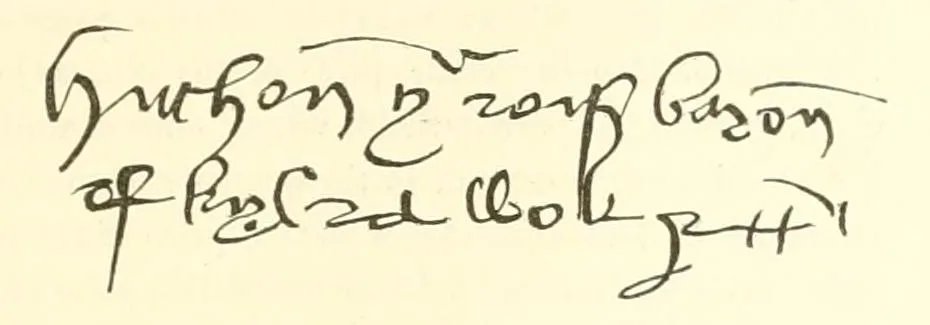
The barons used both of themselves, sometimes in one deed. A marriage contract made at Auldearn on 6 May 1515 names Hugh Rose, eighth of Kilravock, among the parties as “Huchon Ros of Kylrawok”, and later as “the sad Huchon Ros baron of Kylrawak”; he subscribed it in his own hand, with his title.30

Facsimile of the handwritten subscription of Hugh Rose of Kilravock to the Auldearn contract of 6 May 1515, signed with the word baron: Huchon Ros baron of Kylrawok.
Hugh Rose’s own subscription to the Auldearn contract, 6 May 1515, signing as “baron” of Kilravock. Facsimile in A Genealogical Deduction of the Family of Rose of Kilravock (1848), p. 187.

On 1 May 1545 Hugh Rose subscribed a bond “HUCHON Ros baroun off Kilrawok”.31 Taken prisoner at Pinkie, he bound himself for his ransom in a bond that opens “Me Huchon Ros baroun of Kilrawoch, to be bynd and oblist”, and closes, “at the Torwodlie” on 24 October 1547, “HUCHON Ros of Kylrawok, with my hand.”32 When Mary of Guise wrote to him on 10 August 1559 “To our traist freind the Barroun of Kilrawak”, his draft answer of 9 September, in his own hand, is signed “Huchone Ros off Kylrawok”: the Queen Regent used his title, and he signed with his name.33

None of them, in anything he wrote or signed, calls himself laird: that was the word of neighbours, clerks and tradesmen. The building contract of 11 January 1553 calls him “the said Lard” throughout, and he subscribes it “HUCHONE Ros off Kylrawok”;34 a later Hugh’s memorandum of 22 June 1621, in his own hand, calls his neighbour “the Lerd of Calder” and is signed “HUCHONE ROSE of Kilraok”, while the Earl of Moray’s letter printed on the same page, of 1618, is addressed “To the honorabill my luffing freind the Barrone off Kilraok”.35 Neighbours moved freely between the two words: an award on the marches of 25 June 1577, made by arbiters and not signed by him, gives certain ground “wnto the barron of Kilrawok” and, a few lines later, leave “to the laird of Kilrawok”.36

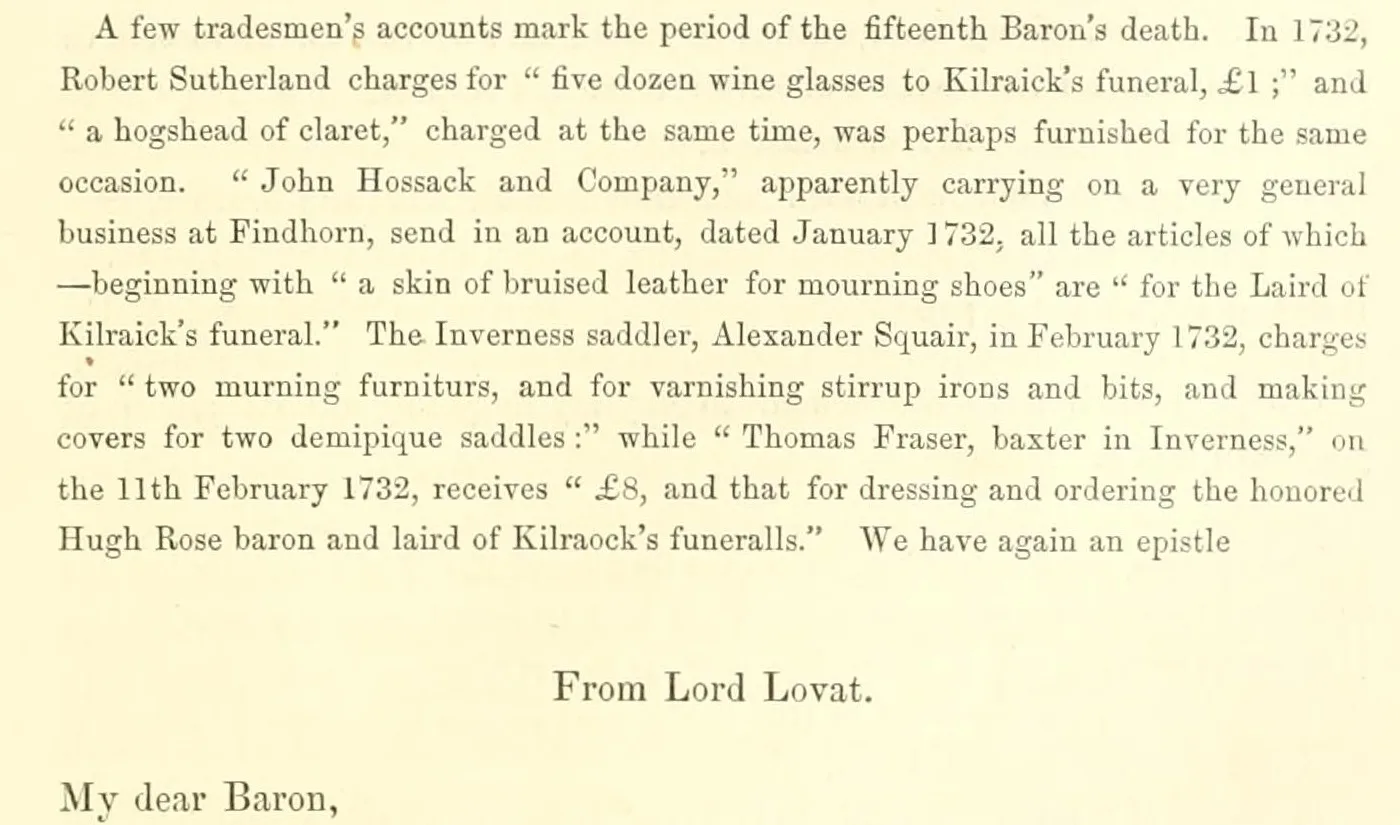
When Hugh Rose, fifteenth of Kilravock, died in January 1732, the accounts for his funeral use every form within a few weeks. One bill is for wine glasses “to Kilraick’s funeral”; a Findhorn merchant’s goods are all “for the Laird of Kilraick’s funeral”; the painter of the funeral arms charged for “the richt honble the lait deceast Laird of Kilrauack”;37 and an Inverness baker was paid “for dressing and ordering the honored Hugh Rose baron and laird of Kilraock’s funeralls”, his name, his title and his lairdship in a single line. Lord Lovat’s letter of condolence to his son opens “My dear Baron,”.38

Page 407 of the 1848 Kilravock book: tradesmen’s accounts for the funeral of 1732, including a baker’s receipt for dressing and ordering the honored Hugh Rose baron and laird of Kilraock’s funeralls, followed by Lord Lovat’s letter beginning My dear Baron.
The funeral of 1732: “Kilraick’s funeral”, “the Laird of Kilraick’s funeral”, and “the honored Hugh Rose baron and laird of Kilraock’s funeralls”, with Lord Lovat’s “My dear Baron” below. A Genealogical Deduction of the Family of Rose of Kilravock (1848), p. 407.

Where each style falls

The name and the title are not scattered at random. The name, “Rose of Kilravock”, is the working form: it carries the great majority of bonds, contracts and discharges, most of the barons’ own subscriptions, and the Crown’s writs. The title, “Baron of Kilravock”, is the marked form. It gathers in letters from sovereigns, regents and peers, in the letters of officers of state and of the Privy Council, and in documents where the barony itself was in issue. The earliest in the book is an indenture made at Elgin in January 1458 between “Huchoun of Rosse baroune of Kilravach” and William of Doles;39 two years later came a licence of 18 February 1460 from John of Isla, Earl of Ross and Lord of the Isles, to “Huchone de Roos, baron of Kylravok, to fund, big, ande vpmak a toure of fens … within the barony of Kylrawok”.40 In the correspondence of the 1550s to the 1640s the baron form is the usual address of a superior to the baron; after about 1650 it thins out, surviving mostly in the salutations of peers and kinsmen, such as Lord Lovat’s “My dear Baron”.

A third pattern puts the two together. A charter of 1474 by Alexander Sutherland of Duffus grants lands “dilecto nostro Hugoni Ros de Kyl-rawok baroni”, name and title side by side.41 The funeral bill of 1732 does the same in Scots: “Hugh Rose baron and laird of Kilraock”.

The same pattern elsewhere

Kilravock is not unusual. Alexander Forbes appears in an English safe-conduct of 1421 as “Alexandro Forbas milite domino de Forbas”.42 In a royal charter to his brother William, given at Inverness on 27 July 1429, the remainder runs to “Alexandro de Forbas militi et heredibus suis baronibus de Forbas”: Alexander and his heirs, barons of Forbes. He was not yet a peer; he became the first Lord Forbes between October 1444 and July 1445.43 A bond of manrent of 1467 names “Duncane Makyntoschy cheife and captane of Clanchattane” beside “Hutschone Ross barrone of Kilrawake”.44

The Crown’s own instruments give the title to barons with no peerage. On 24 July 1548 the Great Seal confirmed a charter of “Johannis Forbes de Petslego, baronis de Kynawde”: his name, Forbes of Pitsligo, with its territorial designation, and his title, baron of Kinnaldie, taken from a different place altogether.45 A birthbrief under Charles I, given at Edinburgh on 15 November 1642, names among the forebears of Dr Alexander Donaldson “Davidis Lambe baronis de Dunkeny”, “Patricij Mortimer barronis de Cragievar” and “Donaldi Donaldsoun baronis de Essilmond”.46 None of these men was a peer.

The Burnetts show the same division between record and speech. Their Latin records call the baron “Alexander Burnet de Leyis”; their historian of 1901 calls Alexander Burnard, who held Leys from 1454 to 1505, “the first ‘Baron of Leys’”, and Brodie of Brodie’s diary speaks of “the lord of Leyis Burnet”.47 Their neighbour Alexander Irvine opens his own charter of 1458–9 as “Alexander Irwyne dominus de Drwm”.48

Counting the record

Style can be counted. Across the four printed volumes of the Spalding Club’s Aberdeen and Banff records, the word is used far more often of land than of men: “barony” as a unit of tenure outnumbers “baron” as a person’s style by at least five to one in the second volume and by more than twelve to one in the third and fourth. The personal style occurs some seventy times. It is used of barons with no peerage, some of them knights, a knighthood being a personal honour and the barony a separate dignity; and of peers, for baronies they held beside their peerages, as when John of Isla, Earl of Ross, wrote in 1470 as “Johannes de Ylle comes Rossie et baro de Kynedward”.49 Most of its dated uses gather between 1467 and 1548; the earliest is the Forbes charter of 1429.50

The figures bear out both parties. Baronia was above all a tenure, and most documents name a man by his lands. But the personal style was a real and repeated usage: among barons with no peerage as well as peers, in the Crown’s own letters, and in the barons’ own deeds.

In the Lyon Register

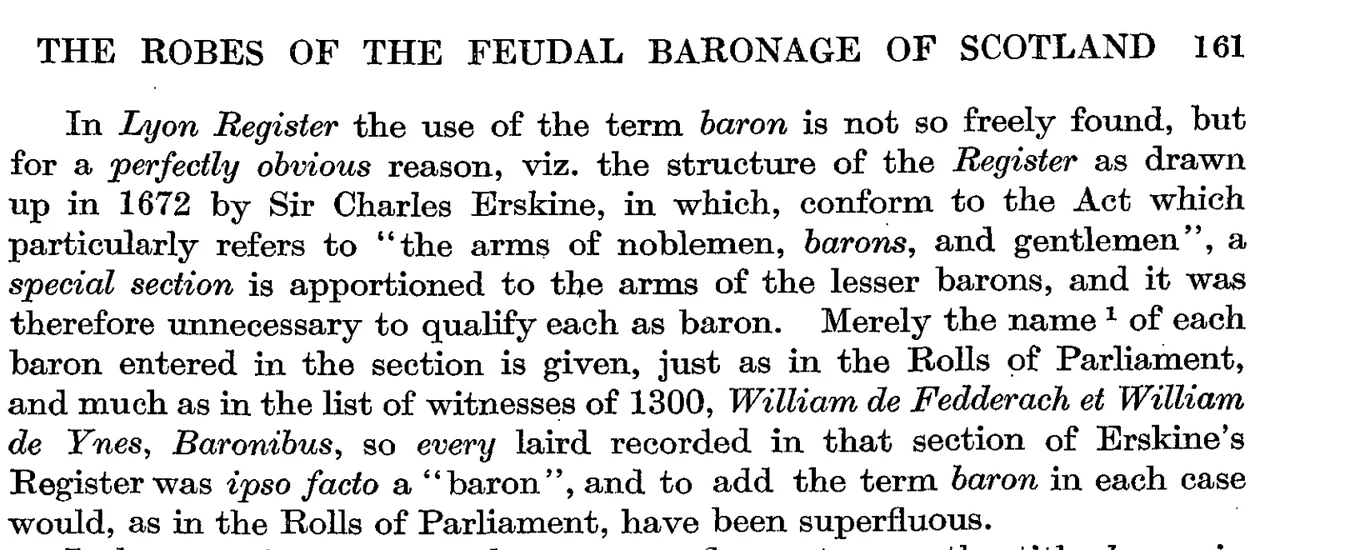
The Lyon Court’s own records show the same two forms, and explain why the title can seem to be missing from them. When Sir Charles Erskine drew up the Public Register of All Arms and Bearings in 1672, the lesser barons were given a section of their own. Innes explains the consequence: “it was therefore unnecessary to qualify each as baron”, and “every laird recorded in that section of Erskine’s Register was ipso facto a ‘baron’”.51 Sir James Balfour Paul, himself Lord Lyon, describes the same arrangement: the first part of the volume held “the arms of the King and the Duke of Albany and York, the prelates, peers, and lesser barons of Scotland”.52

Innes of Learney, PSAS 79 (1944–45), p. 161: in the Lyon Register as drawn up in 1672 a special section was apportioned to the arms of the lesser barons, so every laird recorded there was ipso facto a baron and the title was not written on each entry.
Innes of Learney, “The Robes of the Feudal Baronage of Scotland”, PSAS 79 (1944–45), p. 161: the lesser barons had a section of their own in the Lyon Register of 1672, so the title was not repeated on each entry. Reproduced from the Society’s open-access PDF.

Once entries were made in date order, a change Innes dates to a recommendation of Lord Coulston in 1764, a baron’s status had to be written into the entry itself. Innes cites examples from the Register: “Sir Alexander Colquhoun, Baron of Colquhoun”, Sir George Brisbane, Baron of Brisbane, and “Aylmer Hunter, Baron of Hunterston”.53 The Lyon Court’s second register, of genealogies and birthbriefs, used the title freely. The Innes birthbrief, recorded in an earlier volume that no longer survives, is subscribed by the Lord Lyon, Sir Alexander Erskine, “Ego Alexander Areskinus Baro de Cambo”, and names ancestors’ wives as daughters of the “Baronis de Fyvie” and the “Baronis de Gight”.54 In the surviving volumes of that register Innes found Lord Lyon Brodie styling himself Baron of Brodie, and in almost every birthbrief with baronial ancestors found them described as “A.B. Baro de C.”, a usage he follows into the nineteenth century.55 By his account the Lyon Court’s documents used “simply ‘Baron of X’ down to late in the nineteenth century”; the longer “Baron of the Barony of X” appeared in a matriculation of 1932, and the plain form was “since resumed”, as in the Esslemont matriculation of 1934.56

The same records show that barons were a small minority of those the Lyon Court recorded, and that most lairds with a territorial designation were not barons. In Gordon of Hallhead’s case it was calculated that baronial registrations made up “about 7½ per cent” of the Register.57 The Rolls of the Chiefs and Heads of Territorial Houses that the Court printed in the Edinburgh Gazette from 1951 to 2005 point the same way. Not every recognition was gazetted, and until 1967 the Rolls had no mark for a baron at all, so a minor baron recognised as such before then appears only by his name and designation. Once the mark was introduced, about 80 per cent of the entries printed to 1979 are lairds’ designations without it.58

What the record shows

A Scottish baron had a name and a title. “Rose of Kilravock” was his name, the surname with its territorial designation, and the everyday form: the Lyon King of Arms Act of 1672 afterwards set it for subscription, allowing all but peers and bishops to sign with their surnames and to “adject the designations of their lands prefixing the word ‘of’”.59 “Baron of Kilravock” was his title, the dignity, used in address by sovereigns, regents and peers, by officers of state and the Privy Council, and by the barons themselves when the barony was in point. To be named by the one was not to lose the other: Hugh Rose used both in the same bond. A territorial designation made a man a laird; only a barony made him a baron. The two need not share a place-name, as Hallhead and Esslemont, or Teallach and Huntly, show; and a baron might hold the title with no territorial designation from it, as some always did and many have since 2004.

That is why the question could be argued for centuries from genuine records on both sides. A charter or a bond will usually show the name; a royal letter will often show the title. The Lyon Court’s own registers recorded barons as barons: in a section of their own from 1672, by title in the entries from the later eighteenth century, and as Baro de in the birthbriefs. The style the Court confirmed in 1934 and 1943 was not new; it is the style the sovereigns themselves used. For the words themselves, see Lairds, lords and barons; for how the Lyon Court settled the description, Untitled or titled nobility?; for the form recorded in 1934, The Esslemont petition of 1934.

The Roll and the Pledge

Charters, royal letters and the Lyon Court’s registers are the records counted in this paper. They are the records the Roll cites for each holder.

The Baronage of Scotland Association keeps the Roll of Scottish Barons, which enters a holder only on evidence, and offers the Pledge: an undertaking, in honour and not in law, to preserve a barony within the family for future generations and to uphold the Baronial Code of Honour. The precedent is the baronets’ Roll of 1910.

Notes

  1. Sir George Mackenzie, The Science of Herauldry (1680), in Works, vol. ii (1722), pp. 549–550. ↩
  2. J. H. Stevenson, quoted in Lord Lyon Sellar’s Note in Sturzenegger of Arran, p. 8. ↩
  3. Innes of Learney, PSAS vol. 79, pp. 157–161; the interlocutor of 26 February 1943 (Lord Lyon Sir Francis Grant) is printed at p. 143 n. 3. ↩
  4. Innes of Learney, PSAS vol. 79, p. 161 n. 1: “The ‘Name’ including territorial designation in accordance with Scots Law.” On the territorial designation, see Lairds, lords and barons. ↩
  5. Innes of Learney, PSAS vol. 79, p. 144. ↩
  6. Registrum Magni Sigilli, vol. V, no. 1727, Holyrood, 6 May 1590, pp. 591–592; clause at p. 592, where the abstract gives only “titulum et statum liberi baronis de S.”. The fuller clause is from the charter as quoted in James Maidment, Reports of Claims Preferred to the House of Lords in the Cases of the Cassillis, Sutherland, Spynie, and Glencairn Peerages (Edinburgh, 1840), Spynie report, p. 4. ↩
  7. Abolition of Feudal Tenure etc. (Scotland) Act 2000, s. 63(2), in force 28 November 2004. ↩
  8. A Genealogical Deduction of the Family of Rose of Kilravock, p. 209, of Hugh Rose, tenth of Kilravock. The editor, Cosmo Innes, is not to be confused with Innes of Learney. ↩
  9. Lord Lyon Sellar, Guidance regarding Territorial Designations, 5 January 2010, reproduced in D. D. Campbell, Scottish Armory and Heraldry: A General Overview (rev. 12 January 2019), pp. 50 and 84. ↩
  10. Innes of Learney, PSAS vol. 79, p. 159. On the petition that recorded him as Baron of Esslemont, see The Esslemont petition of 1934. ↩
  11. Lord Lyon Sellar, Note in Sturzenegger of Arran, p. 9. ↩
  12. Lord Lyon Sellar, Note in Sturzenegger of Arran, p. 4 (petition of 27 May 1992 by “Dennistoun Gordon Teall of Teallach”; Warrant of 30 June 1993); The Edinburgh Gazette, 4 April 1997, issue 24169, p. 777 (matriculated 13 April 1994). Sir Crispin Agnew of Lochnaw, Rothesay Herald, described a designation as taken from “a named piece of land, usually an estate, farm, house and policies, outwith a burgh” (Campbell (2019), p. 49); the guidance of 2010, quoted above, likewise asks for land “outwith a burgh” (p. 84). See also Officially Recognised: the Lyon Court’s Rolls in the Gazette. ↩
  13. The Edinburgh Gazette, 17 May 1988, issue 22351, p. 733 (“øHolman, Baron of Rickarton”, matriculated 29 January 1987), and 16 July 2002, issue 25256, p. 1782 (“†Thacker, Baron of Fetternear”, matriculated 26 January 2001); see Officially Recognised: the Lyon Court’s Rolls in the Gazette. ↩
  14. Lord Lyon’s general guidance on baronial additaments, 5 January 2010, reproduced in Campbell (2019), p. 83; Letters Patent of 15 December 2010, Public Register of All Arms and Bearings, vol. 89, p. 78, on an assignation recorded in the Scottish Barony Register on 10 March 2009. The patent is reproduced in Barons in the Lyon Court’s own words. ↩
  15. Lyon King of Arms Act 1672, RPS 1672/6/57. ↩
  16. A Genealogical Deduction of the Family of Rose of Kilravock (1848): Huntly, 27 July 1570, p. 253; the Regent Moray, 24 April 1569, p. 250; Antiquities of the Shires of Aberdeen and Banff, vol. III, p. 102 (1487). ↩
  17. The Scots Peerage, ed. Sir James Balfour Paul, vol. iv (1907), “Forbes, Lord Forbes”, p. 49: “Between October 1444 and July 1445 Sir Alexander Forbes, knight, was raised to the Peerage, as he is at the first date styled ‘of that Ilk,’ and in a writ of 1 July 1445 he is styled LORD FORBES.” ↩
  18. Rolls of the Chiefs and Heads of Territorial Houses, Court of the Lord Lyon, as printed in the Edinburgh Gazette: “Grant of Grant”, Lord Strathspey, dated 6 March 1950 (16 January 1951, p. 28); “Johnstone of Annandale and of that Ilk”, the Earl of Annandale and Hartfell, dated 29 January 1986, and “Borthwick of that Ilk”, Lord Borthwick, dated 20 June 1986 (5 September 1986, p. 1338). The Gazette did not print every recognition, and its tables are not free of error, so these are examples, not a complete list, and the dates are as printed. ↩
  19. A Genealogical Deduction of the Family of Rose of Kilravock (Spalding Club, 1848), archive.org. In the scan, the leaf is the printed page plus 27. ↩
  20. Counted by hand from the text of the 1848 edition, excluding uses of “barony” for the estate. The figures are close approximations; a handful of cases could be classed either way. ↩
  21. Mary Queen of Scots, Aberdeen, 3 November 1562, p. 239; writ of 24 April 1567, p. 248. Innes of Learney (PSAS vol. 79, p. 158) prints Mary’s address as “Our traist friend the barroun of Kylrawak”, citing p. 220 of the 1848 edition; the letter on that page, of 27 June 1555, is signed “Marie R.” at Edinburgh while Mary was in France, and is her mother’s, as Queen Regent. Mary’s own letter of 1562 bears the same address. ↩
  22. Mary of Guise, Queen Regent: 27 June 1555, p. 220, “To our traist ffrend the Barroun of Kylrawach”; 12 May 1557, p. 223, the words quoted; 10 August 1559, p. 228, “To our traist freind the Barroun of Kilrawak”. ↩
  23. Huntly’s undated letters, p. 217 and p. 234; 15 July 1567, p. 249; 27 July 1570, p. 253. ↩
  24. p. 250. The letter is dated at Edinburgh, 24 April 1569, and subscribed “Youre gude freind James Regent”; the writ that follows it is undated. ↩
  25. Discharge given at Stirling, 6 February 1484, p. 151; the editor identifies Robert Colvil, “afterwards of Ochiltree”, as the queen’s “seneschal”. ↩
  26. RPS 1493/5/68, a record of the Lords Auditors of Causes and Complaints, in the Records’ modern English. ↩
  27. The Earl of Argyll, hereditary Justice General: 19 December 1560, p. 232; 30 September 1561, p. 235, the words quoted; 14 October 1562, p. 237. Robert Richardson, 27 October 1565, p. 246, headed by the editor “From the Lord Treasurer” and signed “Thesar”. The Earl of Mar, Lord High Treasurer until 1630: 29 July 1622 and 26 February 1623, p. 312; 28 July 1625, p. 314; 8 July 1629, p. 317, the words quoted. ↩
  28. p. 318: Holyroodhouse, 1 August 1632, headed “From the Lords of Secret Council” and signed “Hadinton”, “J. Mar”, “J. Arskyne”, “Wintoun”, “Adam B. of Dunblane”, “Jo. Isles”, “Naper”, “Scottistarvatt” and “Arch. Acheson”. Haddington was then Lord Privy Seal and Acheson a Secretary of State. ↩
  29. RPS 1646/11/364 and RPS 1649/1/363, in the Records’ modern English. The 1663 Act naming justices of the peace lists him plainly as “Hugh Ross of Kilravock” (RPS 1663/6/144). ↩
  30. Contract made at Auldearn, 6 May 1515, between Hugh Rose of Kilravock and Master John Calder, chanter of Ross, for the marriage of Rose’s daughter Elizabeth to Alexander Calder: p. 185 (parties), p. 186 (“the sad Huchon Ros baron of Kylrawak”) and p. 187 (the sealing clause, “the sad baron has affixt to his propir seill, with his subscriptioun manuall”, and the facsimile). ↩
  31. Bond with James Ogilvy of Cardell and others, at Spynie, 1 May 1545, p. 213. ↩
  32. The ransom bond, p. 214 (opening) and p. 215 (subscription, “at the Torwodlie”, 24 October 1547). ↩
  33. Mary of Guise, 10 August 1559, p. 228; the answer, dated “Of Kylrawok, the ix of September”, p. 228–229. ↩
  34. Contract with John Anderson, mason, at Kilravock, 11 January 1553, pp. 218–219. Across the 1848 edition “laird” is used of the barons of Kilravock by correspondents, clerks drafting deeds, tradesmen, the family historians and the editor, but not in their own letters, memoranda or subscriptions. ↩
  35. p. 308: memorandum of 22 June 1621 and the Earl of Moray’s letter of 22 June 1618. ↩
  36. Agreement of 25 June 1577, p. 269. ↩
  37. p. 383, printed after the account of his death on 23 January 1732. ↩
  38. Funeral accounts and Lord Lovat’s letter, January–February 1732, p. 407. ↩
  39. Indenture made at Elgin, “the xvi day of the moneth of Januar, the yeir of our Lorde a thousand four hundreth fyffty and acht yeris”, pp. 133–134. ↩
  40. Licence by John of Isla, Earl of Ross and Lord of the Isles, 18 February 1460, p. 135. ↩
  41. Charter by Alexander Sutherland of Duffus, p. 136, dated “Apud Kylrawok nono die mensis Maij” 1474, p. 137. By contrast the Great Seal confirmation of 11 March 1475, p. 138, names “Hugoni le Ross de Kylrawak” and confirms to him “terras baronie de Kilrawak”, the barony there being the land. ↩
  42. Antiquities of the Shires of Aberdeen and Banff, vol. IV, p. 386, A.D. 1421. ↩
  43. Ibid., vol. IV, p. 390, “Carta Willelmi de Forbes militis super terris de Kynnaldy”, abridged by the editor from the Register of the Great Seal (lib. iii, no. 39); date clause at p. 391, “apud Inuernys xxvijo die mensis Julij … millesimo quadringentesimo xxix”. On Alexander’s peerage and his brother William of Kynnaldy, The Scots Peerage, ed. Sir James Balfour Paul, vol. iv (1907), pp. 49 and 69. ↩
  44. Ibid., vol. IV, p. 402, bond of manrent, 1467. ↩
  45. Registrum Magni Sigilli, vol. iv, no. 234, p. 57: confirmation “Apud Monast. de Hadingtoun, 24 Jul.” 1548 of a charter given at Clune on 15 June 1548. The Antiquities of the Shires of Aberdeen and Banff, vol. IV, p. 657, summarises it as by “John Forbes of Petslego, baron of the barony of Kynawde” and dates the confirmation 4 July; the Register reads “baronis de Kynawde” and 24 July. ↩
  46. Antiquities of the Shires of Aberdeen and Banff, vol. IV, p. 370, “Litera prosapiae Alexandri Donaldsoun medicine doctoris”, dated at Edinburgh, 15 November 1642. A diploma of Charles II of 17 June 1669 similarly names “Domini Joannis Vrrie comarchi seu baronis de Pitfichie”: vol. III, p. 501. ↩
  47. The Family of Burnett of Leys: “Alexander Burnet de Leyis”, p. 183; p. 11; p. 72. ↩
  48. Ibid., charter X, 2 March 1458–9, p. 163. ↩
  49. Antiquities of the Shires of Aberdeen and Banff, vol. II, p. 360, A.D. 1470. ↩
  50. Counted in the archive.org text of all four volumes, vol. I included, excluding uses of “barony” for land. The text is nineteenth-century OCR; two independent scans of the same volumes differ by up to about a tenth, and two counting methods gave different ratios for the second and fourth volumes, so the lower figures are given and all are indicative. ↩
  51. Innes of Learney, PSAS vol. 79, p. 161. ↩
  52. Sir James Balfour Paul, An Ordinary of Arms contained in the Public Register of All Arms and Bearings in Scotland (2nd ed., 1903), Introduction, p. xv. ↩
  53. Innes of Learney, PSAS vol. 79, p. 161 and nn. 2–5: Lyon Register, vol. i, pp. 528, 529 and 507, in the part of the volume filled after the change to chronological entries. The manuscript Register is not published, and Balfour Paul’s Ordinary, an index of blazons, does not print the style, so these entries rest on Innes’s reading. ↩
  54. Ane Account of the Familie of Innes (Spalding Club, 1864), p. 45 and p. 47; Innes of Learney, PSAS vol. 79, p. 160 and n. 2. ↩
  55. Innes of Learney, PSAS vol. 79, p. 160 and nn. 3–5, citing the Register of Genealogies, vol. i, p. 1 (Brodie) and vol. iii, pp. 20, 24 and 44 (Leslie of Balquhain, 18 January 1861; “Joannes MacDonell, Baro de Lochgarry”). ↩
  56. Innes of Learney, PSAS vol. 79, p. 158 n. 2 (Fraser of Reelig, 10 February 1932, “Baron of the Barony of Moniack”); see The Esslemont petition of 1934. ↩
  57. Innes of Learney, PSAS vol. 79, p. 155 n. 4. ↩
  58. Counted from the thirteen notices of 24 January 1967 to 16 November 1979: about 141 of some 180 entries carry no mark (two notices are poorly scanned and counted approximately); the notice of 15 March 1968, the first to use the mark, marks four of sixteen. The mark was given where arms were matriculated with a chapeau as a minor baron. A baron who did not matriculate a chapeau also appears unmarked, and not every recognition was printed, so the figure is a guide rather than a count of barons. The marked share rose in later notices: 18 of 34 entries in 2002 and 38 of 57 in 2005. See Officially Recognised: the Lyon Court’s Rolls in the Gazette. ↩
  59. Lyon King of Arms Act 1672, RPS 1672/6/57; see Lairds, lords and barons. ↩

Paper 4 of 17 · Part I · The words

“Younger of” and “Master of”: the record set straight

For five centuries the records of Crown and Parliament have styled a baron’s heir “younger of”, beside “Master of” for the heir of a peer

9 min read · www.baronage.com/reading-room/younger-of-and-master-of/

The heir to a Scottish title is “Younger of”, unless the title is a peerage, when the heir is “Master of”. The two styles have stood side by side in the records since the 1500s. Where a baron, baronet, chief or laird has a territorial designation, the heir adds “younger” to it, after it or before it. The heir of a baron with none is “Younger of [the barony]”. Some say he may not be. This paper sets out the record.

The short answer

  • The style is old and official. From 1584 to 2005, Parliament, the Great Seal, the Gazette and the Lyon Court’s own rolls write the heir “younger of”.
  • It is the counterpart of “Master”. A survey of Scots law of 1936 puts the two in one sentence: the heir of a peer is “Master”, the heir of a baron is “younger of”.
  • Barons share it with baronets, chiefs and lairds. Each adds “younger” to the family’s territorial designation. Only the heir to a peerage is “Master”.
  • It follows the father’s rank. One man was “younger of Stair” in 1689 and “master of Stair” in 1690, when his father had become a peer.
  • No rule requires a territorial designation. It is part of a surname and needs the Lord Lyon’s recognition, and many barons have none. No statute, court ruling or Lyon Court text has been found that says a baron’s heir needs one.
  • A baron with no territorial designation uses the barony. His heir is “Younger of [Barony]”, as a peer’s heir is “Master of [Peerage]”. The “of” is the barony’s own, as in “Baron of X”. “The” may go before either.

In the record

“Robert Dowglas, younger of Lochlevin, Laurence, maister of Oliephant, Johne, maister of Forbes”

Summons of treason, Parliament of Scotland, 1584

In 1584 Parliament summoned a list of men for treason. The clerk put the heirs of lairds and the heirs of peers in one line. “Robert Dowglas, younger of Lochlevin” is followed at once by “Laurence, maister of Oliephant” and “Johne, maister of Forbes”, and, one name later, by “Johne Levingsstoun, younger of Dynnypace, Johne Carmichaell, younger of that Ilk”. “Maister” is Master. Lord Oliphant and Lord Forbes were lords of Parliament, so their heirs are Masters. The other fathers were not, so their heirs are “younger”.1

The Crown’s Latin says the same. In a Great Seal charter of 1600 the heir is “juniori de Bathgait”, younger of Bathgate, “filio et heredi apparenti”, son and heir apparent, of his father the elder.2 And the heir acted under the style: in 1693 “The laird of Calder, younger” was admitted to Parliament for Nairnshire “in place of Sir Hugh Campbell of Calder, his father”.3

The form lasted. In 1986 the London Gazette printed a commission to “Donald Cameron, Younger of Lochiel”.4 The Lyon Court’s rolls in the Edinburgh Gazette, down to 2005, carried a note signed by the Lyon Clerk: a family’s name and territorial designation are used by “The eldest son and his wife, with the adjective “younger””.5

Beside the Master

“Whilst the heir-apparent of a feudal baron is invariably styled ‘younger of,’ the heir, whether apparent or presumptive, of an earl or peerage-lord is ‘Master’.”

The Stair Society’s survey of Scots law, 1936, as quoted in the Scottish National Dictionary

The national dictionary quotes that sentence twice, once to explain “Master” and once to explain “younger”. Of “Master of” it says: “The designation is that of the title to be inherited.”6

The Lord Lyon’s own certificate does the same for a baron’s heir. In 1930 he certified the birth of “Thomas Innes of Learney, younger”, son of the “Baron of the Baronies of Learney and Kinnairdy”. The pedigree on the certificate names the child “younger, apparent heir to the Barony of Learney”.7

Sir John Dalrymple shows both on one man. In June 1689 Parliament recorded “Sir John Dalrymple, younger, of Stairs”. By 1690 his father was “the viscount of Stair”, and the next name on the roll is “the master of Stair”.8 The father’s rank changed, and the son’s style changed with it.

A Master is named from his father’s dignity, not from the surname or an estate. Debrett’s of 1921 lists the heir of Lord Saltoun, whose surname is Fraser, as “Master of Saltoun”.9

Who is “Younger”

The style is not the barons’ alone. The national dictionary gives it to “the eldest son and heir of a landed proprietor below peerage rank”.6 A guide to forms of address of 1955 gives the heirs of chiefs and lairds as “John Mackvicular, younger of Mackvicular”, and says of a baronet’s eldest son: “In Scotland he is styled “younger” of the family description.”10

So the heir of a chief, a laird, a baronet or a baron with a territorial designation is “younger” of it. Only the heir to a peerage is Master.

The word goes after the territorial designation or before it. The Lyon Court’s rolls print “FORBES OF ROTHIEMAY, younger”;5 the Gazette prints “Donald Cameron, Younger of Lochiel”.4

A baron with no territorial designation has no “of X” in his surname to add the word to. His heir takes the style from the barony itself: “Younger of [Barony]”. Whether he may is the question that follows.

Does it need a territorial designation?

A territorial designation is the “of X” in a surname. It is not the barony. It comes from land, and it needs the Lord Lyon’s recognition: his guidance of 2010 says it “proclaims a relationship with a particular area of land”.11

A baron may have none, and that is not new. The Lyon Court’s own rolls print “HOLMAN, BARON OF RICKARTON” in 1988 and “THACKER, BARON OF FETTERNEAR” in 2002, each with no territorial designation.12 Since 2004 “the dignity of baron, though retained, shall not attach to the land”, and many barons have no territorial designation at all.13

One baronial society says on its website that the son of such a baron may not use the style: a baron must first have a territorial designation recognised by the Lord Lyon. It cites no authority.14 Another, in a paper of 2024, accepts “Younger” for him but not yet “Younger of”. It says “the use of ‘Younger’ without territorial reference is acceptable”, while “Younger of Exton” for the heir of a baron with no estate “has not yet gained wide acceptance”.15

That view treats the “of” as belonging to a surname territorial designation (TD). But a barony has an “of” of its own. “HOLMAN, BARON OF RICKARTON” has no TD, and the “of” is in his barony title.12 And the heir’s “of” does not depend on an “of” in the father’s style at all. Lord Oliphant, Lord Forbes and Lord Saltoun have none, yet their heirs are “Master of Oliphant”, “Master of Forbes” and “Master of Saltoun”.19 That is the precedent for “Younger of [Barony]”: an heir named from the title itself, not from a territorial designation.

The Lyon Court has published no rule on the style of a baron’s heir. Its Gazette note speaks only of a family’s “names and designations”.5

What do the records show?

Named from the barony. In 1649 Parliament put two heirs on a commission “in place of their said fathers”. One is the “laird of Duncrub, younger”. The other is the “baron of Auchyle, younger”.16 In the Lyon Court’s own rolls, “McCUNE OF COLL-EARN, BARON OF ELPHINSTONE” in 1989 is followed by “McCUNE OF ELPHINSTONE, younger” in 1992: on its face, a younger named from the barony.17

Named from the territorial designation. A territorial designation and a barony can have different names. Where they did, the old registers name the heir from the surname’s “of X”, not from the barony. In a Great Seal charter of 1631 a father and son are “seniori de Bischoptoun” and “juniori de Bischoptoun”, elder and younger of Bishopton, though their barony is Gogoside. In 1681 “James Gordon, younger of Lesmore” was “infeft in the lands and barony of Newtongarry”.18

Each of those fathers had a territorial designation in his surname: he was “Surname of X”. None of these records shows the heir of a baron who had none.

The peerage does show an heir named from the title alone: a Master is named from the dignity, whatever the surname.

No court has ruled on the point for barons. But no statute, court ruling or Lyon Court text has been found that says a baron’s heir needs a territorial designation, and the society that says so cites none.

With or without “the”

The style is “Younger of X”, after the name or alone, as a peer’s heir is “Master of X”. For both, “the” is optional.

The Master shows it. The passport rules have both in a single entry. The surname field reads “MASTER OF [title]”. The observation reads “THE HOLDER IS [forenames and surname] THE MASTER OF [title]”.19 An account of a reception for chiefs’ heirs in 2014 has “John, Master of Lauderdale” and “Alexander, the Master of Cranstoun” in one list.20

“The Younger” has long been written: “Donald Cameron the Younger, of Lochiel” in the London Gazette of 1746, and “Pirie Gordon the Younger of Buthlaw” in a book on titles of 1991. An Act of 1778 names “Alexander Thomson Keith Urquhart of Meldrum” and, next, “James Urquhart the younger thereof”. The forenames differ, so “the younger” is not there to tell two men of one name apart.21

The top of page 486 of the Act 18 George III chapter 23, 1778, a list of commissioners that names Archibald Grant the younger of Monymusk, Robert Horn the younger of Westhall and James Urquhart the younger thereof.
“the younger of” in an Act of Parliament, 1778. 18 Geo. III c. 23, p. 486.

It is written without “the” as well: the Crown’s “Donald Cameron, Younger of Lochiel” of 1986.4

There is a practical reason to add “the”. A standard work on the clans, revised by Innes of Learney as Lord Lyon, warns that officials “might otherwise suppose “younger” to be a surname”.22 “The” before the word removes the doubt, as it marks the Master.

A woman as heir

In some families a daughter who is heir is “the Maid of”. Sir Iain Moncreiffe of that Ilk, a herald of the Lyon Court, wrote in 1967: “It is the old Scots custom to call an heiress the Maid of her inheritance.”23 No statute, court or Lyon Court rule sets the form.

A woman may also be “Younger”. In 2014 the Standing Council of Scottish Chiefs gave a reception for heirs at the Palace of Holyroodhouse, with the Lord Lyon and the Lyon Clerk among the guests. Among the heirs its account names are “Catriona, the Maid of Bachuil” and “Claire Henderson younger of Fordell”, daughter of the chief of the Hendersons.20 It is the earliest record found of a woman so styled: a recent precedent, from the chiefs’ own council. The clan’s own society, in its journal for 2015, gives the style to her brother, as Tanist.24 One baronial society’s paper of 2024 says the use “is not a style that is generally accepted”.15

The Lord Lyon has taken a modern view of equality between men and women. In recent years he has granted women their arms on a shield, where an oval or a lozenge was once usual: see the arms of the Baroness of Redcastle in the Armorial.

The Roll and the Pledge

A Younger takes his style from a barony. The Roll shows, on evidence, who holds it.

The Baronage of Scotland Association keeps the Roll of Scottish Barons, which enters a holder only on evidence, and offers the Pledge: an undertaking, in honour and not in law, to preserve a barony within the family for future generations and to uphold the Baronial Code of Honour. The precedent is the baronets’ Roll of 1910.

Notes

  1. Summons of treason, RPS 1584/5/60, in the original Scots. The name between is “Patrik Drumond, apperand of Carnok”, the heir apparent of Carnock. “Of that Ilk” means of the place that bears the family’s own name. ↩
  2. Registrum Magni Sigilli, vol. vi, no. 1020 (18 February 1600), p. 338: “ROBERTO HAMMILTOUN juniori de Bathgait, filio et heredi apparenti Roberti H. senioris de B.” The printed Register gives the editor’s Latin abstract of each charter. ↩
  3. RPS M1693/4/21. ↩
  4. The London Gazette, 21 March 1986, p. 4069, Deputy Lieutenant commissions for Lochaber, Inverness, Badenoch and Strathspey. ↩
  5. The Edinburgh Gazette, 16 July 2002, “Court of the Lord Lyon”, note 3 — notice: “the names and designations are in Scots law and practice used by: a) The head of the family and his wife. b) The eldest son and his wife, with the adjective “younger”, and their eldest son.” Signed “Mrs. C. G. W. Roads, Lyon Clerk and Keeper of the Records”. The same note stands in the roll of 19 August 2005. ↩
  6. An Introductory Survey of the Sources and Literature of Scots Law (Stair Society, vol. 1, 1936), p. 433, as quoted in the Scottish National Dictionary under “Young”, sense 2, and “Maister”, sense 3. The Society’s list of the volume’s contents gives the chapters “Peerage Law” and “Heraldic Law” to Thomas Innes, afterwards Sir Thomas Innes of Learney, Lord Lyon. ↩
  7. Birthbrief by Sir Francis Grant, Lord Lyon, 27 March 1930, Public Register of Genealogies, vol. iv, p. 9, reproduced as Plate XLIII in Sir Thomas Innes of Learney, Scots Heraldry, 2nd edn (Edinburgh, 1956). It certifies that the child “is the son and apparent heir of Thomas Innes of Learney, Carrick Pursuivant of Arms, Baron of the Baronies of Learney and Kinnairdy”. The father was the book’s author. ↩
  8. RPS M1689/6/4 (June 1689); RPS 1690/4/44, commissioners for the sheriffdom of Wigtown: “the viscount of Stair, president of the sessione, the master of Stair”. ↩
  9. Debrett’s Peerage and Titles of Courtesy (London, 1921), p. 803: “SALTOUN, BARON. (Fraser.)”, with “Hon. ALEXANDER ARTHUR (Master of Saltoun)”. ↩
  10. Titles and Forms of Address, 9th edn (London: A. & C. Black, 1955), p. 94, of chiefs and lairds: “Their heirs are addressed in writing as: John Mackvicular, younger of Mackvicular”; and p. 84, “Children of Baronets”. ↩
  11. Lord Lyon Sellar, guidance on baronial additaments and territorial designations, 5 January 2010, from the Lyon Court’s website as archived on 5 June 2011. On territorial designation and title, see The two styles of a Scottish baron. ↩
  12. The Edinburgh Gazette, 17 May 1988, p. 733, and 16 July 2002, p. 1782, in the Lyon Court’s rolls. On barons with and without a territorial designation, see Baron of X, or X of Y? Two styles of a Scottish baron ↩
  13. Abolition of Feudal Tenure etc. (Scotland) Act 2000, s. 63(2), in force 28 November 2004. ↩
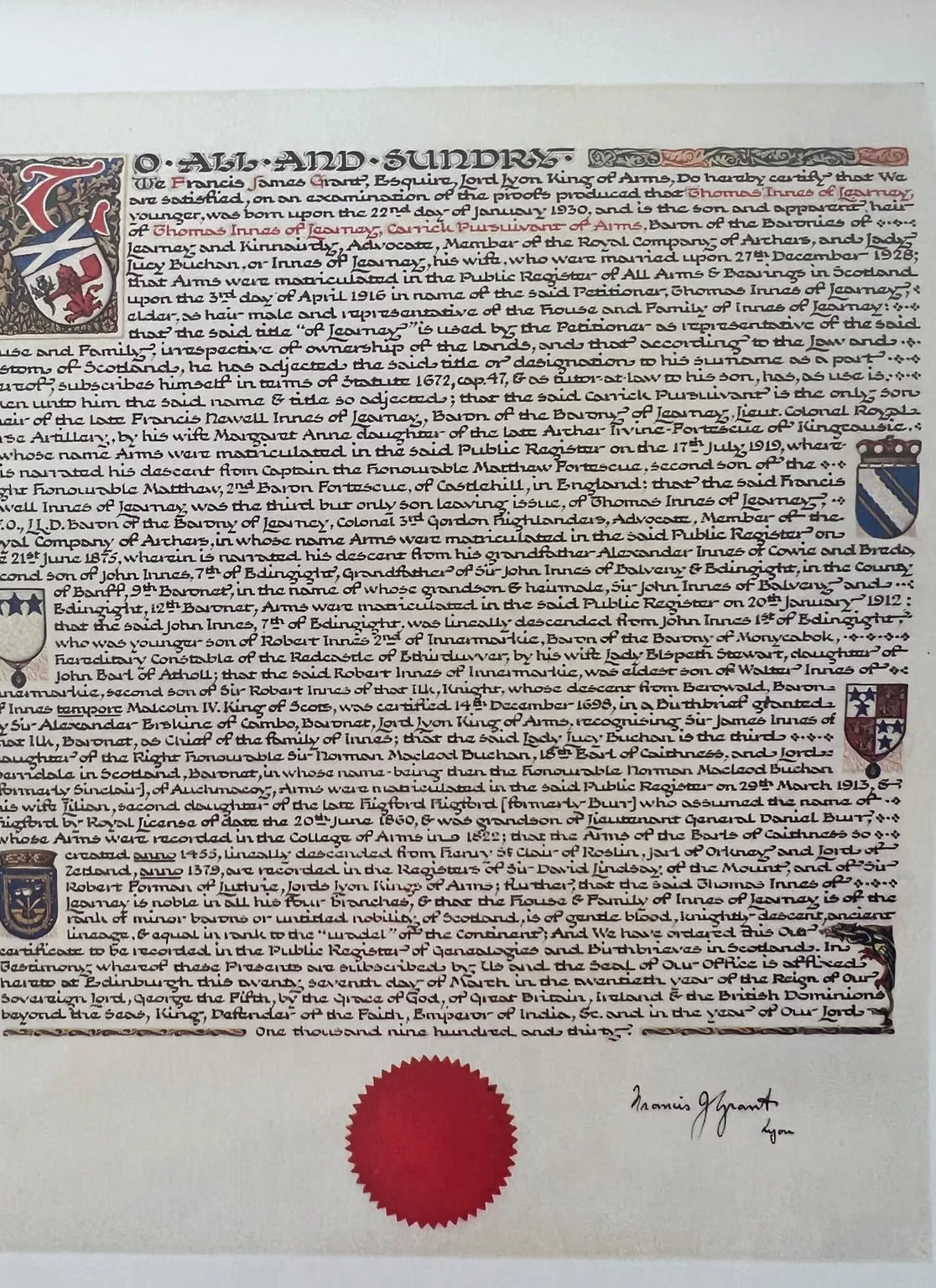
  14. The Convention of the Baronage of Scotland, web page “Male Heir”, read 13 October 2026. The archived copy of 26 December 2004 limits these usages to a baron who has taken the territorial name, but does not have the sentence that the style is otherwise wrong. The copy of 9 May 2006 does. ↩
  15. Forum for the Scottish Baronage, Forms of Address & Related Matters (August 2024), endnote 18. The society’s web page on forms of address, read 13 October 2026, says the eldest son of a baron “may be known by his father’s territorial designation with the addition of “younger””, and gives “James McDonald, Younger of X”. On a woman as heir, the same endnote: “Some have suggested the use of ‘Younger’ for a female heir presumptive, as well as for an eldest son, but this is not a style that is generally accepted.” ↩
  16. Act of addition to the revaluers of Perthshire, RPS 1649/5/132, in the modern-English text of the Records, leaving out the names its editors supply in brackets. The original reads “the laird of Duncrub, youngar, and baroun of Auchyll, youngar, may be put in place of thair saidis fathers”. ↩
  17. The Edinburgh Gazette, 5 December 1989, p. 2064, and 7 April 1992, p. 1040, in the Lyon Court’s rolls of names officially recognised. Each entry carries the mark that, by the rolls’ own note, “indicates that the Arms have been matriculated with chapeau in respect of being a Minor Baron”. ↩
  18. Registrum Magni Sigilli, vol. viii, no. 1846 (9 August 1631), p. 630, a grant of lands “omnes in baroniam de Gogoside erectas”, all erected into the barony of Gogoside; RPS 1681/7/191, in the modern-English text of the Records. So too Sir Patrick Home, “juniori de Aytoun”, in the charter of 1605 that erects his own lands into the barony of Duns (vol. vi, no. 1628, p. 591), and “John Livingstone, younger, of Dunipace”, whose infeftment “of the lands and barony of Craigs” is named in an Act of 1593 (RPS 1593/4/38). ↩
  19. HM Passport Office, Titles (guidance for passport staff), version 25.0, “Titles for the heir apparent to a Scottish peerage” — GOV.UK, read 13 October 2026. ↩
  20. “Heirs reception given by the Standing Council of Scottish Chiefs”, posted 15 December 2014 on the Standing Council’s website; the link is to the Internet Archive’s copy of 31 December 2014. The reception was on 28 November 2014; those attending included “Lord Lyon King of Arms, Dr. Joseph Morrow, and, Lyon Clerk, Elizabeth Roads”. Burke’s Peerage, 107th edn (2003), vol. 2, p. 1864, as reported at thepeerage.com, gives her as the daughter of Alistair Donald Henderson of Fordell, then “younger”; the Clan Henderson Society’s website says he “was recognized as Chief of the Name and Arms of the Baronial House of Henderson by the Lord Lyon in 2005”. ↩
  21. 18 Geo. III c. 23 (1778), p. 486. The London Gazette, 3–7 June 1746, no. 8542, front page. L. G. Pine, Titles: How the King Became His Majesty (New York, 1991), p. 163. ↩
  22. Adam, Clans, Septs and Regiments, 6th edn (1960), p. 408. ↩
  23. Sir Iain Moncreiffe of that Ilk and David Hicks, The Highland Clans (New York, 1967), p. 119, of the chief of the MacDougalls, “known, not as the Maid of Dunollie, but as the Maid of Lorn”. The Scottish National Dictionary, “Maid”, sense 2, has “the Maid of Lorn(e), the eldest daughter of MacDougall of Lorne”. ↩
  24. An Canach (the journal of the Clan Henderson Society), vol. 27, Fall 2015, p. 25: “Tanist / Iain M. Henderson / Younger of Fordell”. A tanist is a chief’s named heir. ↩

Paper 5 of 17 · Part II · The rank

Untitled or titled nobility?

The Lyon Court’s own words on the minor barons, from the Innes of Learney birthbrief to the finding of 1943

4 min read · www.baronage.com/reading-room/untitled-in-1930-titled-in-1943/

In March 1930 Lord Lyon Sir Francis Grant certified that the House of Innes of Learney was “of the rank of minor barons or untitled nobility of Scotland”. In February 1943 the same Lord Lyon found that the minor barons “are, and have been … recognised as a ‘titled nobility’”. Between the two came the Esslemont petition of 1934. This paper sets the documents side by side.

The birthbrief of 1930

On 27 March 1930 Sir Francis Grant, Lord Lyon King of Arms, certified the birth and descent of Thomas Innes of Learney, younger, born two months earlier, “son and apparent heir of Thomas Innes of Learney, Carrick Pursuivant of Arms, Baron of the Baronies of Learney and Kinnairdy, Advocate, Member of the Royal Company of Archers”. The certificate is a birthbrief in the old Scottish form, recorded in the Public Register of Genealogies and Birthbrieves, and its colour facsimile was printed in 1933 in The Deeside Field, with the Carrick Pursuivant’s own article on the barony of Learney.1

The achievement and sixteen quarterings on the birthbrief of Thomas Innes of Learney, younger, 1930
The achievement and sixteen quarterings on the birthbrief of Thomas Innes of Learney, younger, 27 March 1930. Facsimile printed in The Deeside Field, Sixth Number (1933).

The birthbrief traces the family through Innes of Edingight and Innes of Innermarkie, “Baron of the Barony of Monycabok”, to “Berowald, Baron of Innes tempore Malcolm IV, King of Scots”, a descent “certified 14th December 1698, in a Birthbrief granted by Sir Alexander Erskine of Cambo, Baronet, Lord Lyon King of Arms”, the document in which Erskine styled himself Baron of Cambo.2 It records that the title “of Learney” is used by the petitioner “as representative of the said House and Family, irrespective of ownership of the lands”, adjected to his surname “in terms of Statute 1672, cap. 47”. And it closes with a nobility clause:1

“further, that the said Thomas Innes of Learney is noble in all his four branches, & that the House & Family of Innes of Learney is of the rank of minor barons or untitled nobility of Scotland, is of gentle blood, knightly descent, ancient lineage, & equal in rank to the ‘uradel’ of the Continent”.

Text of the birthbrief of Thomas Innes of Learney, younger, signed by Lord Lyon Sir Francis Grant, 27 March 1930
The text of the birthbrief, signed “Francis J. Grant, Lyon”, 27 March 1930.

Two things in this document are worth holding on to. The minor barons are described as untitled nobility. And the baron is styled in the conveyancer’s form, “Baron of the Baronies of Learney and Kinnairdy”, his father “Baron of the Barony of Learney”.

1934: the form is challenged

Four years later Gordon of Hallhead, Baron of Esslemont, petitioned the same Lord Lyon for the baronial chapeau, and led a proof on the use of the baronial title. His Memorial objected to precisely the form used in 1930: that the baron’s title, “Baron of Bradwardine”, was being allowed “to fall into desuetude or — as it now transpires — ‘peerage-conveyancing description’ Baron of the Barony of B—— substituted, thereby conveying to the public and to foreigners that the feudal Baronage of Scotland are not truly constitutional barons, whereas they are”. On 4 September 1934 Grant found the claim established, awarded the chapeau, and recorded the petitioner as “Baron of Esslemont”.3 The proof and the Memorial are set out in The Esslemont petition of 1934.

1943: titled

On 26 February 1943, in a petition for a birthbrief, the Lyon Court under Grant “Finds and Declares that the Minor Barons of Scotland are, and have been both in this nobiliary Court and in the Court of Session recognised as a ‘titled nobility’ and that the estait of the Baronage (i.e. Barones Minores) are of the ancient Feudal Nobility of Scotland”.4 The words are the Court’s own, in the same register as the 1930 birthbrief, and they are retrospective: “are, and have been”. Innes of Learney, by then Albany Herald, drew the conclusion in his paper of 1945: whatever the date of a barony’s erection, “all are equally, and in the European sense, ‘Barons’ in a ‘Feudal Baronage’, and constitute a ‘titled nobility’ in the feudal sense”.5

The Continental comparison moved with it. In 1930 the family was “equal in rank to the ‘uradel’ of the Continent”, the ancient nobility. On 19 April 1945 the Court declared Wauchope of Niddrie, “as feudal Baron of Niddrie-Merschell and Lochtoure”, to be “of Baronial Race, and of rank equivalent to that denominated Hoch Adel”, the high nobility, “and equivalent to the Chiefs of Baronial Houses, upon the Continent of Europe”.6 And when Innes became Lord Lyon, his own certificates opened “We, Thomas Innes of Learney, Baron of Learney, Kinnairdy and Yeochrie”, the form the 1934 Memorial had asked for, not the form of 1930.7

What the two documents show

Read together, 1930 and 1943 are not the Lyon Court changing its mind about the barons. They are the Court settling a description that had been loosely used. Innes himself records the ambiguity: an impression had formed that the title of baron “was not used at all and contrariwise that it was applied to any large landowner”, and “both these views are wrong”; his own tentative suggestion of 1934, that chapeaux might be graded by the date of erection, gave way on “subsequent consideration” to the position that all barons are equally “a ‘titled nobility’ in the feudal sense”.5 The 1930 birthbrief, with its “untitled nobility” and its “Baron of the Barony of”, belongs to that loose usage. The proof of 1934 put the evidence on the record, and the finding of 1943 is declaratory, not a new rule: the minor barons “are, and have been” recognised as a titled nobility. From 1943 the position stands settled in the Court’s own register. The minor barons of Scotland are a titled nobility, and always were. The documents of 1930 and 1943 are the record of the last time the Court examined the question with evidence, and of the answer it gave.

The Roll and the Pledge

In 1934 the Court took proof before it settled the form, and in 1943 it made its finding. The Roll takes the same course with each holder: evidence first.

The Baronage of Scotland Association keeps the Roll of Scottish Barons, which enters a holder only on evidence, and offers the Pledge: an undertaking, in honour and not in law, to preserve a barony within the family for future generations and to uphold the Baronial Code of Honour. The precedent is the baronets’ Roll of 1910.

Notes

  1. Birthbrief of Thomas Innes of Learney, younger, 27 March 1930, subscribed by Francis James Grant, Lord Lyon King of Arms, and ordered to be recorded in the Public Register of Genealogies and Birthbrieves in Scotland; colour facsimile in Thomas Innes of Learney, “The Barony of Learney”, The Deeside Field, Sixth Number (1933). The quotations are from the facsimile. ↩
  2. Birthbrief of 1930, as above; Innes of Learney, PSAS 79, pp. 126–127 and 160 (the Innes of that Ilk birthbrief and Erskine of Cambo’s style). ↩
  3. Innes of Learney, PSAS 79, pp. 154, 160 and 162–163; Lyon Register vol. xxxi, p. 20. ↩
  4. Court of the Lord Lyon (Lord Lyon Sir Francis Grant), interlocutor of 26 February 1943, Public Register of All Genealogies and Birthbrieves, vol. iv, p. 26; printed in Innes of Learney, PSAS 79, p. 143 n. 3. ↩
  5. Innes of Learney, PSAS 79, pp. 154 and 157. ↩
  6. Wauchope of Niddrie, 19 April 1945, Lyon Register vol. xxxv, p. 31; printed in Innes of Learney, PSAS 79, p. 160. ↩
  7. Certificate of Lord Lyon Innes of Learney, 10 March 1946 — scan of the original. ↩

Paper 6 of 17 · Part II · The rank

Is a Scottish baron a commoner? Not in Scots law

Why “anyone who is not a peer is a commoner” is English law, and what Scots law says about the baron before and after the Union

14 min read · www.baronage.com/reading-room/is-a-scottish-baron-a-commoner/

In English law everyone below a peer is a commoner, however grand. Scots law drew the line lower: its nobility took in the barons, the knights and the gentlemen. The Union of 1707 sent the barons’ members to the House of Commons, but it did not change the law of rank. This paper sets out both meanings of “commoner” and the record for each.

The short answer

  • “Commoner”, in the sense of anyone who is not a peer, is English law. Blackstone wrote in 1765 that all below the peers are “in law peers, in respect of their want of nobility”.
  • Scots law drew the line lower. Sir George Mackenzie, Lord Advocate, wrote in 1680 that the nobility is “greater” and “lesser”, and that “Under the Word Baron all our Nobility are comprehended”. An Act of 1540 names “every noble man, such as an earl, lord, knight and baron”. Parliament called the barons “a part of the nobility” in 1567, and named “the nobility, earls, lords and barons” in 1592.
  • Noble, though not peers of Parliament. Mackenzie: “though all these be not Peers of Parliament, yet they are all Peers to one another”. A nobleman had to accept a gentleman’s challenge to a duel as his peer. See Were Scotland’s barons peers?.
  • A barony ennobles. Mackenzie: “a Barony, as we call it, do ennoble; for Baronies are establisht only by the Prince’s Erection or Confirmation.”
  • Before the Union, Scots did not use the word for rank. A “commoner” was an arbitrator. The common people were, in Mackenzie’s word, “Plebeians”.
  • “Commoner” measures the peerage, not nobility. A foreign baron in London is not called a commoner. A British one was: Lionel de Rothschild, a baron of the Austrian empire, sat in the House of Commons from 1858.
  • The Union changed Parliament, not Scots law. Scotland’s forty-five members went to the House of Commons, and the printed Act of 1707 that settled their election calls them “commoners”. The Treaty kept Scots law.
  • The Lyon Court said so in 1943. It found that the minor barons are “recognised as a ‘titled nobility’”.

Two meanings of “commoner”

England divides its people in two. Blackstone, the great writer on English law, put it like this in 1765:

“The commonalty, like the nobility, are divided into several degrees; and, as the lords, though different in rank, yet all of them are peers in respect of their nobility, so the commoners, though some are greatly superior to others, yet all are in law peers, in respect of their want of nobility.”

William Blackstone, Commentaries on the Laws of England, 1765

In English law, then, the nobility is the peerage. “The first dignity after the nobility”, Blackstone goes on, is a knight of the Garter. Baronets, knights, esquires and gentlemen are all commoners, and that is how the word is used today: a commoner is anyone who is not a peer. Even so, a page later Blackstone still calls the baronets and knights an “inferior nobility”.1

Older Scots had no such word. The Dictionary of the Older Scottish Tongue, which covers Scots up to 1700, gives “commoner” only as an arbitrator. In 1591 Edinburgh named two of its assessors as arbitrators (“commoneris”) for the town in a dispute with the Kirk of Leith.2 The common people were “the commoun”, and one of them was “a commoun”.3

“The greater and the lesser Nobility”

Scotland’s rule was set down by Sir George Mackenzie of Rosehaugh, Lord Advocate, in his treatise on precedence of 1680.

Page 534 of Sir George Mackenzie's Works, volume II, chapter VIII, General Observations concerning the Precedency of Subjects: Nobility is divided with us, as in England, into nobiles majores and minores, the greater and the lesser Nobility. Under the greater are comprehended all such as are Lords of Parliament, under the lesser are comprehended Knights and Gentlemen; and though all these be not Peers of Parliament, yet they are all Peers to one another. Under the Word Baron all our Nobility are comprehended.
“The greater and the lesser Nobility”: Mackenzie, 1680. Mackenzie, Works, vol. II, p. 534.

The lords of parliament are the greater nobility. Knights and gentlemen are the lesser. All of them are “Peers to one another”, though not all are “Peers of Parliament”.4 Mackenzie says England divided its nobility the same way, and an English writer had said so a century earlier: Sir Thomas Smith, in 1583, called England’s knights, esquires and gentlemen “the second sort of gentlemen which may be called Nobilitas minor”.5 English law later drew the line at the peerage. Scots law did not.

Then Mackenzie gives the word that covers them all: “Under the Word Baron all our Nobility are comprehended”. “Baron” was once the common name of the whole nobility, as “peer” is now, because the greater nobles held baronies too. In Lord Clyde’s words, Scotland distinguished “the greater barons and the lesser barons, the former acquiring such titles as Duke or Earl”.6 The dukes, earls and lords were the great barons, and the small barons had no greater title: “Now the Lords are called the great Barons, and the rest are called small Barons”.7

His proof is the wording of the old Parliaments: James V’s first Parliament sat with “the prelates, the barons and the commissioners of the burghs”, and Robert I’s with earls, barons “and other great men”, so that there were great men below the barons.4

The statute book agrees. An Act of 1540 on arms and armour begins with “every noble man, such as an earl, lord, knight and baron”. In 1567 Parliament resolved that the barons “ought to have vote in parliament as a part of the nobility”, and an Act of 1592 names “the nobility, earls, lords and barons”.8

What made a baron noble was the Crown’s grant, not his acres. Owning land, Mackenzie writes in his Science of Heraldry, “doth not nobilitate in all Cases … for else a rich Man might ennoble himself”. But “such Feus as had a Jurisdiction annext to them, a Barony, as we call it, do ennoble; for Baronies are establisht only by the Prince’s Erection or Confirmation.” Those who held their lands of the Crown “were called Lairds”; those who held of a subject, “though they were large, and their Superior very noble, were only called Good-men”.9 See Lairds, lords and barons.

Below the gentlemen came everyone else. Mackenzie’s word for them is “Plebeian”. He asks, for instance, whether “a Knight Baronet’s Lady marrying a Plebeian, could thereafter recover her Dignity if she marry a Gentleman”.10

A baron by barons

Nobles were judged by their equals. Quoniam Attachiamenta, one of the old books of Scots law, says that no man should be judged by a man of lower rank than his own peer: an earl by earls, a baron by barons.11 “Peer” here means an equal in rank, and a baron’s peers were barons.

David Hume, professor of Scots law at Edinburgh, put it plainly in 1800: “the order of noblemen and other barons, or immediate vassals of the Crown, were truly one and the same, and therefore peers to each other in the strict sense of law”.12 The baron’s right to be tried by men of his own rank outlived the Union: see Trial by barons.

A duel at Carberry Hill

Rank decided who could fight whom, as well as who could judge whom.

On 15 June 1567 the Queen’s army faced the lords who had taken up arms against Bothwell, at Carberry Hill near Musselburgh. Bothwell, the Queen’s husband, rode out “with a defie to any that would fight with him”. James Murray took it up, and Bothwell refused him, “alleadging he was not his equall”. Murray’s elder brother then offered himself.13

“William Murray, Laird of Tullibardin, answered, That he would fight with him, as being his better in estate, and in antiquitie of house many degrees above him; yet Bothwell refused him, saying, That he was not a Peer of the Kingdom, as he was”

The History of the Reformation in Scotland, Book V, printed in 1644

Lord Lindsay offered next. Bothwell, “seeing that there was no more subterfuge nor excuse”, had the Queen forbid the fight, and she surrendered to the lords the same day.13

Bothwell drew the line at the peerage, and it kept him out of the fight. A century later Mackenzie set down the rule the other way: “a Nobleman is obliged to accept of a Challenge from a Gentleman as his Peer, where Duels are lawful”.4 That did not make a baron a peer of the realm; it meant a nobleman could not refuse a gentleman’s challenge (a gentleman being untitled nobility, if armigerous) as beneath him.

A Parliament without commons

Scotland’s Parliament sat as one house. Its estates were the clergy, the barons and the burgesses. There was no estate of commons.

The small barons owed attendance in person, and in 1428 each absent baron or freeholder was “adjudged in an amercement of £10 for their contumacy”.14 For a small baron with a small estate, far from Edinburgh or Perth, the seat was a burden: the journey was long, and the fine for missing it, the “old unlaw”, could be levied at will. An Act of 1428 let each shire send two or more commissioners instead, but it “remained practically inoperative”;15 an Act of 1504 spared the smaller men, those within 100 merks of land, from being “compelled to appear in person”.16 The historian R. S. Rait read these Acts less as taking the barons’ seats away than as “a protection from the occasional arbitrary employment of a partially obsolete penalty”.17 In 1587 James VI revived the shire commissioners, whose attendance would “relieve the whole remaining small barons and freeholders of the shires of their suits and presence owing”.18

Whether that ended the barons’ own right to sit was argued for the rest of the century. In 1673 the barons pleaded that the Act did not bar them, but only excused their absence.19 Mackenzie called them “originally heritable Counsellers to the King, as Members of Parliament, and not debarred”.20 In his Science of Heraldry he put it more plainly: the barons “were Members of Parliament with us, as such, and never lost that Priviledge, though for their convenience, they were allowed to be represented by two of their number”.21 The claim was made to the end. On 7 January 1707, as the Union was voted, George Lockhart of Carnwath protested that nothing in the treaty “shall prejudice the barons of this kingdom from their full representation in parliament as now by law established, nor in any of their privileges”.22

What the Union changed

The Union of 1707 made one Parliament, with a House of Lords and a House of Commons. Article XXII fixed Scotland’s share: sixteen peers in the Lords, and “45 the number of the Representatives of Scotland in the House of Commons”.23 The printed Act of 5 February 1707 that settled how they were to be chosen calls the forty-five “commoners”. For the first Parliament of Great Britain, they were to be “chosen by the peers, barons and burghs respectively”.24

From then on a baron who sat in Parliament sat in the Commons, as baronets and knights did. The Scottish Parliament chose its thirty shire members on 13 February 1707 under the heading “Of the barons”, among them “Hugh Rose of Kilravock”;25 at home he was “baron and laird of Kilraock”, and Lord Lovat wrote to his son, “My dear Baron”.26 In Parliament’s sense the barons became commoners in 1707, in a House of landowners chosen by landowners: see Did Scottish barons sit in the House of Commons?. Nothing else in the Treaty made them so.

  • Article XXIII protected the peers. They became peers of Great Britain, with “Rank and Precedency next and immediately after the Peers of the like orders and degrees in England”, and were to be tried as peers.27 No article spoke of the barons.
  • Article XVIII kept Scots law. No alteration was to be made “in Laws which concern private Right except for evident utility of the subjects within Scotland”.28 The law of barony, and the Lyon Court’s law of rank, went on as before.
  • Article XX kept the barons’ courts, with the other heritable jurisdictions, “as Rights of Property”.29 See The Treaty of Union and the baronage.

A foreign baron in London

A Spanish or German baron in London is not called a commoner: the English rule of two classes applies only to the Crown’s own subjects. A British subject with a Continental title was a commoner like anyone else.

Lionel de Rothschild inherited from his father the title of a baron of the Austrian empire, granted at Vienna on 29 September 1822. In 1838 Queen Victoria gave him licence to “assume and use the title thereof in this country”.30 He was elected for the City of London, and on 26 July 1858 “Baron Lionel Nathan de Rothschild” was sworn and took his seat in the House of Commons.31 The Crown Office called him “Lionel Nathan de Rothschild, commonly called Baron Lionel Nathan de Rothschild”. In the same notice it used the same form for a duke’s son, “Alfred Spencer Churchill, commonly called Lord Alfred Spencer Churchill”.32 Courtesy lords sat in the Commons, and so did the Austrian baron. The family left it for the Lords only when his son was made a peer in 1885, as Baron Rothschild of Tring.33

So in English usage “commoner” measures the peerage, not nobility. Debrett’s said as much in 1921. Foreign titles, it noted, “afford their holders no precedence whatever in this country”, and the English tables are silent on Scottish barons too. But it placed the Continent’s barons, the German freiherrs, “with the families in England who are also of the nobiles minores (knights, esquires, and gentlemen)”.34

Noble after 1707

Scots writers after the Union kept Mackenzie’s line.

  • 1742. Alexander Nisbet’s System of Heraldry repeats Mackenzie’s division of the nobility into greater and lesser word for word, though not his sentence that “Under the Word Baron all our Nobility are comprehended”.35
  • 1800. Hume writes of the barons as peers of the noblemen, and of the privilege at trial: “To this extent the privilege still maintains itself”.36
  • 1835. The Lyon Court grants George Robert Ainslie of Pilton, “heir and representative of the Feudal Barons of Dolphinton”, a cap of maintenance in his crest, “the cap as being indicative of his descent from the ancient barons of Dolphington”.37
  • 1930. A Lyon Court birthbrief describes the House of Innes of Learney as “of the rank of minor barons or untitled nobility of Scotland”.38
  • 1943. The Lyon Court corrects the description. “With regard to the words ‘untitled nobility’ employed in certain recent birthbrieves in relation to the Minor Baronage of Scotland”, it “Finds and Declares that the Minor Barons of Scotland are, and have been both in this nobiliary Court and in the Court of Session recognised as a ‘titled nobility’”.39 Before 1943 the barons were sometimes incorrectly called untitled nobility; the Lyon Court found them a titled nobility. See Untitled or titled nobility?
  • 1949. What was left of the privilege, a jury with a majority of landed men, is abolished, a year after the peers’ privilege.40
  • 1945 to 2007. From Innes of Learney’s time, Lyon Court grants of arms close by receiving the grantee and his successors “amongst all Nobles and in all Places of Honour … as Nobles in the Noblesse of Scotland”. A grant of 1952 made a corporate body “an incorporation noble in the noblesse of Scotland”; the clause is in a grant of 1984, in Lord Lyon Blair’s patent of 27 July 2007 to the Baron of Ballencrieff, and in a corporate grant of October 2007. It was left out of all grants made after 2007, to barons and peers alike.41
  • 2000. The Act of 2000 keeps the dignity: “nothing in this Act affects the dignity of baron”, and a dignity includes “any quality or precedence associated with” it.42

Why people get it wrong

  • English usage. Parliament and the press use “commoner” for anyone who is not a peer. In that sense a baronet, a knight and a Scottish baron are all commoners, and for England the usage is right. The same press calls a baronet an aristocrat, and a Scottish barony an “ancient noble title” or an “ancient aristocratic title”.43
  • The House of Commons. After 1707 the barons’ members sat in the Commons. By 1739 the Lords of Session themselves spoke of the old Scottish Parliament’s “peers and commons, who sat together in one house”.44
  • The books. Burke’s Landed Gentry and its kind listed Scottish barons among the landed gentry, an English category, until Burke’s Peerage set them beside the peers, baronets and chiefs in its 107th edition (2003).45

Rank in Scotland

The Noblesse of Scotland, in order of precedence

#RankScots lawEnglish / UK usage
1Peers (dukes, marquis, earls, viscounts, lords of parliament in the peerage of Scotland)Titled nobility; noblemen; peers (“greater barons” also holding baronies)Nobility; peers
2Baronets (baronets of Nova Scotia, the baronetage of Scotland)Baronetcy (hereditary knighthood); noblemenCommoners in law; gentry, often counted among the aristocracy
3Knights (knights of the Thistle and knights bachelor)Knighthood (for life); noblemenCommoners, gentry
4Barons (barons and barons of higher dignities in the baronage of Scotland)Titled nobility; noblemen; “minor barons”; before 1943 sometimes incorrectly untitled nobility, and before 2004 feudal barons (both terms are now defunct)Commoners, gentry
5Esquires/Chiefs/LairdsUntitled nobility if armigerousCommoners, gentry
6GentlemenUntitled nobility if armigerousCommoners, gentry
7Everyone else (not of the Noblesse)The commons (Mackenzie: “Plebeians”)Commoners

English usage counts everyone below a peer a commoner;1 but UK law includes Scots law.28

In 1945 the Lyon Court declared a Scottish baron “of rank equivalent to that denominated Hoch Adel”, the Continent’s high nobility.46

In Scotland, greater or lesser, all are noble: “though all these be not Peers of Parliament, yet they are all Peers to one another” (Mackenzie, 1680). Rank decided who could fight or marry whom, yet a baron, even a gentleman as untitled nobility, counted as a duke’s peer: he could challenge him to a duel and marry his daughter.4

The table is the one on Scottish Baronies, Explained, where each row carries its sources. The order is the one Lord Lyon Innes of Learney drew from the record in 1945: “Their precedence was thus after Knights and before Esquires.”47 See “Never ceded”: the precedence of a Scottish baron.

The Roll and the Pledge

Nobility in Scots law goes with the dignity, and the dignity has to be shown, not assumed.

The Baronage of Scotland Association keeps the Roll of Scottish Barons, which enters a holder only on evidence, and offers the Pledge: an undertaking, in honour and not in law, to preserve a barony within the family for future generations and to uphold the Baronial Code of Honour. The precedent is the baronets’ Roll of 1910.

Continued in Did Scottish barons sit in the House of Commons?

Notes

  1. William Blackstone, Commentaries on the Laws of England, vol. I (Oxford, 1765), book I, ch. 12, “Of the Civil State”, p. 391; p. 392: “The last of these inferior nobility are knights bachelors”. ↩
  2. Dictionary of the Older Scottish Tongue, “Commoner n.”: “An arbitrator”, quoting the Edinburgh burgh records of 1591 (“Mr Jhonn Prestoun and Mr Henry Balfour, assessouris, be commoneris for the toun anent the difference betuix the town and the Kirk of Leyth”) and 1600. “Commonar n.” is “A sharer, partaker”. ↩
  3. Dictionary of the Older Scottish Tongue, “Commoun n.”, sense 2, “The common people”, and 2 b, “One of the common people”; compare “Commounis n. pl.” ↩
  4. Sir George Mackenzie, Observations upon the Laws and Customs of Nations as to Precedency (1680), in Works, vol. II (Edinburgh, 1716), ch. VIII, p. 534. Mackenzie writes that “Noblemen must be judged by their Peers, yet landed Gentlemen may pass upon their Assize” (same page), and the Lyon King of Arms Act 1672 (RPS 1672/6/57) names “noblemen barons and gentlemen”. In such places “noblemen” is the narrow word for the peers; the barons stayed a part of the nobility. Mackenzie records that in the old records “the Barons and Noblemen” were “represented promiscuously”, that is, together (p. 545). Translated from the Latin, James V’s Parliament was held “by the guardian of the king and kingdom, together with the prelates, barons and commissioners of the burghs”, and Robert I’s “with the bishops, abbots, priors, earls, barons and other magnates”. ↩
  5. Sir Thomas Smith, De Republica Anglorum (London, 1583), book I, ch. 16–18, in the edition of L. Alston (Cambridge, 1906), p. 31 (“Of gentlemen the first and chiefe are the king, the prince, dukes, marquises, earles, vicountes, barrons, and these are called κατ’ ἐξοχὴν the nobility … next to these be knightes, esquiers and simple gentlemen”; ch. 17, “Of the first part of gentlemen of englande called Nobilitas maior”) and p. 32 (ch. 18). ↩
  6. Spencer-Thomas of Buquhollie v Newell 1992 SLT 973, per Lord Clyde: archive.org. Mackenzie, Works, vol. II, p. 545: “With us all are called Barons who hold their Lands of the King in libera baronia [in free barony]”. ↩
  7. Mackenzie, Works, vol. II, p. 534 and p. 550: “Now the Lords are called the great Barons, and the rest are called small Barons in the 101 Act, 7 Parl. James I. and ever since.” On p. 549 he adds that “of old I conceive that Lords and Barons were the same”. ↩
  8. Act of 10 December 1540, “The manner of harness, weapons and armour”, RPS 1540/12/30, modern-English text of the Records; the original reads “every nobill man, sic as erle, lord, knycht and baroune”. Parliament of December 1567, RPS 1567/12/45; Act regarding the age and qualities of the lords of session, 5 June 1592, RPS 1592/4/72. See The baronage in the statutes, 1428–2004. ↩
  9. Mackenzie, The Science of Heraldry (1680), in Works, vol. II, p. 583. A feu is land held of a superior. ↩
  10. Mackenzie, Works, vol. II, p. 552. He quotes a French writer on the restoring of a noblewoman who has married a plebeian, “ut interveniat principis restitutio quæ plebeitatis maculam abstergat”: so that the prince’s restoring may wipe away the stain of plebeian status. ↩
  11. Quoniam Attachiamenta, cap. 67, in Sir John Skene, Regiam Majestatem: The Auld Lawes and Constitutions of Scotland (Edinburgh, 1609), the Scots text. The Scots reads: “na man sould thoill judgement, or be judged, be ane man of inferiour estate then his awin peir; that is, ane Earle, be Earles; ane Baron, be Barons”. The chapter is headed “Ilk man sould be judged be his peirs”. ↩
  12. David Hume, Commentaries on the Law of Scotland, respecting Trial for Crimes, vol. II (Edinburgh, 1800), p. 99. ↩
  13. The History of the Reformation in Scotland, Book V, in David Laing (ed.), The Works of John Knox, vol. II (Edinburgh, 1848), p. 560 and p. 561, where Laing’s note dates the Queen’s surrender at Carberry Hill to “Sunday the 15th June”. Book V was first printed in London in 1644. Laing thought it was compiled from Knox’s papers by an unknown hand. The Dictionary of the Older Scottish Tongue cites the passage under “Pere n.1”, sense 5: “in Scotland, a member of the titled nobility”. ↩
  14. RPS 1428/3/1, the general council at Perth, March 1428; the same formula in RPS 1428/7/1, July 1428. ↩
  15. RPS 1428/3/3: “the small barons and freeholders need not come to parliaments or general councils, so that two or more wise men, according to the size of the sheriffdom, be sent from each sheriffdom”. C. S. Terry, The Scottish Parliament: its Constitution and Procedure, 1603–1707 (Glasgow, 1905), p. 22. An Act of 1458 had spared freeholders below £20 “except if he be a baron”: RPS 1458/3/22. ↩
  16. RPS 1504/3/44, 15 March 1504; those above 100 merks were “to come to the parliament, under the pain of the old penalty”. Mackenzie cites it as “the 78 Act, Parl. 6. James IV.” (Works, vol. II, p. 545). ↩
  17. R. S. Rait, The Scottish Parliament before the Union of the Crowns (London, 1901), p. 23: the Acts “are generally regarded as freeing the lesser barons from the burden of attending Parliament … it seems much more likely that the real burden from which it freed them was that of ‘the old unlaw’”. C. S. Terry, The Scottish Parliament: its Constitution and Procedure, 1603–1707 (Glasgow, 1905), p. 23, agrees: the Acts were framed “less with the object of disfranchising the freeholders whose status they touched than of protecting them from the occasional and arbitrary exaction of penalties for absence”. ↩
  18. RPS 1587/7/143, Declaration concerning the votes of small barons in parliament, 1587, “providing always that the said small barons observe their promise and condition made to his majesty”. ↩
  19. Fountainhall, “Sundry Barons, &c. against The Lord Lyon”, June 1673, in Brown’s Supplement to the Dictionary of Decisions, vol. iii (1826), pp. 6–7: the Act “nowise debars them; but allenarly dispenses with their absence”. See Robes, chapeau and insignia of the baronage. ↩
  20. Mackenzie, Works, vol. II, p. 545. On the same page: “With us all are called Barons who hold their Lands of the King in libera baronia [in free barony], and who have Power of Pit and Gallows”. ↩
  21. Mackenzie, The Science of Herauldry (Edinburgh, 1680), ch. XXXI, p. 94, on why the old barons may use supporters. See The arms and flags of a baron. ↩
  22. RPS 1706/10/214, “Protest for the privileges of the barons by George Lockhart”, 7 January 1707; the protest goes on, “and particularly their judicative and legislative capacity, of which they are deprived by the terms of this treaty of union”. An earlier protest of his, of 27 December 1706, is RPS 1706/10/172. ↩
  23. Union with England Act 1707, Art. XXII. ↩
  24. Act settling the manner of electing the sixteen peers and forty-five members to represent Scotland in the parliament of Great Britain, 5 February 1707, RPS 1706/10/293. The Records follow the manuscript, which has “members”, and note “‘commoners’ in printed acts”. In general the shire members were to be elected by “the several freeholders in the respective shires and stewartries”. ↩
  25. Minutes of Parliament, 13 February 1707, “Election of the representatives for Scotland to the parliament of Great Britain”, RPS M1706/10/107; the same list in the record of warrants, RPS 1706/10/307. ↩
  26. A Genealogical Deduction of the Family of Rose of Kilravock (Spalding Club, Edinburgh, 1848), p. 407 (11 February 1732, and Lord Lovat’s letter, dated at Edinburgh, 11 February 1732, pp. 407–408). The same page records an account “for the Laird of Kilraick’s funeral”. ↩
  27. Union with England Act 1707, Art. XXIII; Hume, Commentaries, vol. II, p. 100: Scottish peers “shall be tried as peers of Great Britain”. ↩
  28. Union with England Act 1707, Art. XVIII. ↩
  29. Union with England Act 1707, Art. XX; the Heritable Jurisdictions (Scotland) Act 1746 later abolished the greater jurisdictions with compensation. ↩
  30. The London Gazette, no. 19628, 22 June 1838, “Whitehall, June 16, 1838”, p. 1413 and p. 1414: the licence runs to “the said Lionel Rothschild, and the heirs male of the body of his aforesaid late father (being respectively natural born subjects of this realm), upon whom the dignity of a Baron of the Austrian empire shall devolve, in virtue of the limitations of the letters patent or diploma granted by the said late Emperor unto the said late Nathan-Meyer Rothschild, and bearing date at Vienna the 29th day of September 1822”. ↩
  31. Journals of the House of Commons, vol. 113 (1857–58), 26 July 1858, p. 345: “Baron Lionel Nathan de Rothschild was sworn accordingly, and subscribed the Oath at the Table.” See also Hansard, House of Commons, 26 July 1858, vol. 151, cols 2105–2115. ↩
  32. The London Gazette, no. 22025, 28 July 1857, p. 2609, Members returned to serve in the present Parliament. ↩
  33. The London Gazette, no. 25486, 3 July 1885, p. 3060: “Sir Nathaniel Mayer Rothschild, Bart., by the name, style, and title of Baron Rothschild, of Tring, in the county of Hertford.” ↩
  34. Debrett’s Peerage, and Titles of Courtesy (London, 1921), “Foreign Titles”, p. lxxii: “the nobiles minores of Germany and France, varying between in France the rank of comte to that of baron or plain ecuyer gentilhomme, and in Germany the grafs of the new Empire down to, and including, the freiherrs (by courtesy) and herr vons, rank according to the antiquity of their families with the families in England who are also of the nobiles minores (knights, esquires, and gentlemen).” The same page counts the whole peerage as England’s “nobiles majores (or high nobility)”. ↩
  35. Alexander Nisbet, A System of Heraldry, vol. II (Edinburgh, 1742), part IV, ch. XVII, “Of Precedency”, p. 175; in the edition of 1804, p. 190. Nisbet does not repeat Mackenzie’s next sentences on the word “Baron” and the old Parliaments. ↩
  36. Hume, Commentaries, vol. II, pp. 97–98. ↩
  37. Petition of George Robert Ainslie of Pilton, and the matriculation pursuant to the Lyon Court’s interlocutor of 28 November 1835, Lyon Register vol. iv, p. 2, as printed in Innes of Learney, “The Robes of the Feudal Baronage of Scotland”, PSAS 79 (1944–45), p. 153. The cap of maintenance is the baron’s chapeau. ↩
  38. Birthbrief of Thomas Innes of Learney, younger, 27 March 1930, subscribed by Francis James Grant, Lord Lyon King of Arms; colour facsimile in Thomas Innes of Learney, “The Barony of Learney”, The Deeside Field, Sixth Number (1933). ↩
  39. Court of the Lord Lyon (Lord Lyon Sir Francis Grant), interlocutor of 26 February 1943, Public Register of All Genealogies and Birthbrieves, vol. iv, p. 26; printed in Innes of Learney, PSAS 79, p. 143 n. 3. ↩
  40. Criminal Justice Act 1948 (11 & 12 Geo. VI c. 58), s. 30(1); Juries Act 1949 (12, 13 & 14 Geo. VI c. 27), ss. 28(2) and 30: “The privilege to which a landed person is entitled of being tried by a jury comprising a majority of landed persons is hereby abolished.” ↩
  41. The Wauchope of Niddrie declaration of 19 April 1945 (Lyon Register vol. xxxv, p. 31) receives the baron “amongst all Nobles and in all places of Honour”: Innes of Learney, PSAS 79 (1944–45), p. 160. The 1952 grant to the Law Society of Scotland: Juridical Review, vol. 67 (1955), p. 105. The grant of 20 February 1984 is reproduced in D. D. Campbell, Scottish Armory and Heraldry: A General Overview (rev. 2019), p. 77: “amongst all Nobles and in all Places of Honour, to be taken, numbered, accounted and received as Nobles in the Noblesse of Scotland”. The Ballencrieff patent of 27 July 2007, “with a nobility clause at the end”, and the omission of the clause from grants made after 2007: Hamilton of Rockhall v Lord Lyon [2019] CSOH 85, paras [21]–[22]; see Barons in the Lyon Court’s own words. Letters Patent of 29 October 2007 to Scottish House, “as an Association Noble in the Noblesse of Scotland”: Matthew Glozier, Journal of the Sydney Society for Scottish History 21 (2023), fig. 7, p. 30. A grant of 21 April 2009 has no such clause: Strachan, Heraldry for Beginners (2024), fig. 1, p. 5. ↩
  42. Abolition of Feudal Tenure etc. (Scotland) Act 2000, s. 63(1) and (4), in force 28 November 2004. ↩
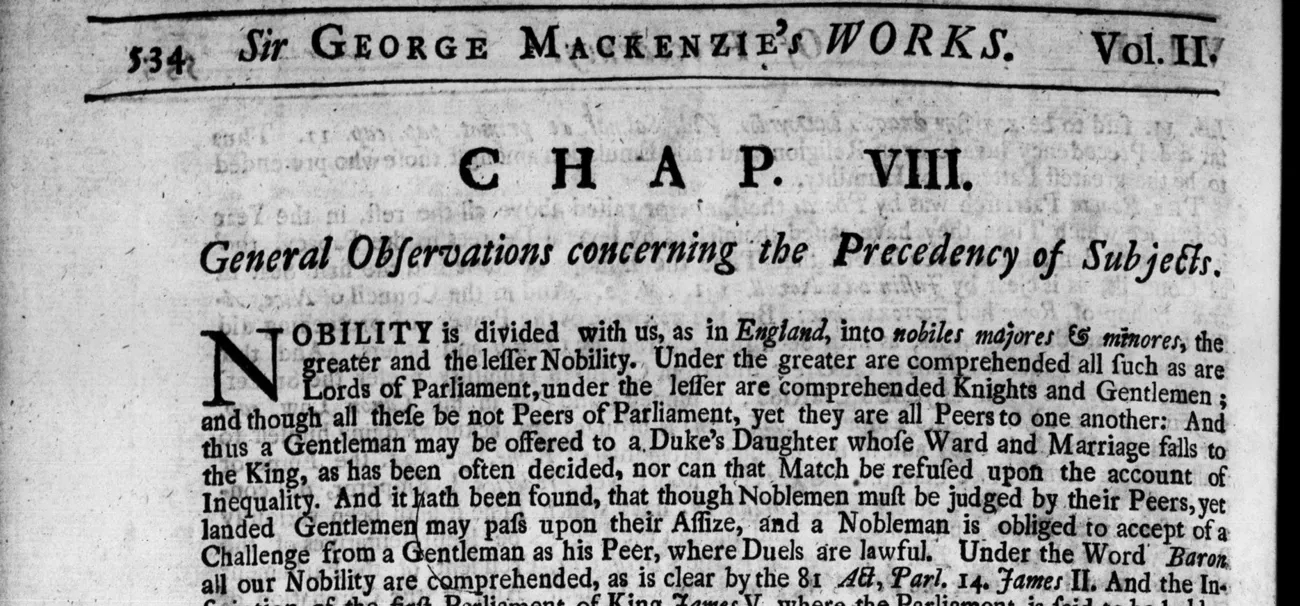
  43. The Guardian, 2 February 2023, “Landowner blocks plans for green walkway through Sussex estate”: “An aristocrat is at odds with his local council …”, the estate being “owned by a baronet”, Sir Richard Kleinwort. BBC News, 1 June 2007, “Rock star could be baronet’s heir”: “A Somerset aristocrat … Baronet Sir Benjamin Slade”. BBC News, 22 July 2004, “US buyer found for Scots castle”: “The new owner will assume an ancient noble title and become 35th Baron of Lee, following a proclamation by the Lord Lyon King of Arms in Edinburgh.” The Scotsman, 11 May 2023, “Prestige property: What £10m will buy you nowadays”, on the Logan estate: “Ownership also comes with an ancient aristocratic title. … The barony title that comes with the estate was granted in 1594”. The Times, 6 November 2019, “Baroness of Lag counts cost of legal battle over aristocratic titles”: “A trader in aristocratic titles has failed to overturn a ruling that bans people who purchase baronies from calling themselves barons.” ↩
  44. Return of the Lords of Session to the House of Lords, 1739, printed in Nisbet, A System of Heraldry, vol. II, p. 193. ↩
  45. Charles Mosley, editorial introduction to Burke’s Peerage, Baronetage & Knightage, 107th edition (2003), which “now contains knights, dames, Scottish and Irish chiefs and Scottish feudal barons”: archived copy. ↩
  46. Lyon Court declaration in the matriculation of Wauchope of Niddrie, 19 April 1945: “of rank equivalent to that denominated Hoch Adel, and equivalent to the Chiefs of Baronial Houses, upon the Continent of Europe”; printed in Innes of Learney, PSAS 79, p. 160. Innes, p. 146: in Scotland the baronage “is officially recognised as Hoch-adel”. ↩
  47. Innes of Learney, “The Robes of the Feudal Baronage of Scotland”, PSAS 79 (1944–45), p. 113: open access PDF. ↩

Paper 7 of 17 · Part II · The rank

Were Scotland’s barons “noblemen”? The word in the Act of 1672, read in its own time

The Act of 1672 let “noblemen” sign by their titles, and the baronage’s critics read that as proof that a baron was not noble. Parliament used the word in two senses, and the narrow one ranked the barons within the nobility

6 min read · www.baronage.com/reading-room/were-scotlands-barons-noblemen/

One Act is quoted against the baronage more than any other. Here it is, with the Acts around it.

The short answer

  • The objection. The Lyon King of Arms Act 1672 allowed “noblemen and bishops to subscribe by their titles” and required “all others”, barons included, to sign their names. Green’s Encyclopaedia concluded in 1896 that “the mere territorial baron has no title of dignity appropriated to him”.
  • The answer is in the same Act. Its recital names “noblemen, barons and gentlemen” as three classes, and its fee scale charges “every prelate and nobleman” twenty merks and “every knight and baron” ten. “Noblemen” there means the lords of Parliament; the barons stand next to them, with the knights. The Register the Act created gave the barons a section of their own, so that, as Innes of Learney put it, “every laird recorded in that section … was ipso facto a ‘baron’”.
  • Parliament used the word both ways. In 1540, “every noble man, such as an earl, lord, knight and baron”; in 1567, the barons “as a part of the nobility”; in 1592, “the nobility, earls, lords and barons”; in 1592, 1662 and 1672, “noblemen” beside “barons”.
  • The law’s own writer agreed. Mackenzie, the Lord Advocate, in 1680: nobility “is divided with us, as in England, into nobiles majores & minores”, the greater and the lesser, and “they are all Peers to one another”.
  • The rule of 1672 is gone; the dignity is not. Parliament repealed the signing clause in 1995 and kept “the dignity of baron” in 2000. The Lyon Court had found in 1943 that the minor barons “are, and have been” recognised as a titled nobility.

The objection, stated fairly

The Act of 1672, which set up the Public Register of All Arms and Bearings, has a rule on signatures: “it is only allowed for noblemen and bishops to subscribe by their titles; and that all others shall subscribe their christened names, or the initial letter thereof with their surnames, and may, if they please, add the designations of their lands”.1 A baron signed “Rose of Kilravock”, not “Kilravock”; so, the argument runs, the law did not count him a nobleman. Stevenson put it for the lawyers in 1896: “The mere territorial baron has no title of dignity appropriated to him.”2 It was old then: in 1680 the baronets claimed precedence of the barons because “a Baron is no Name of Dignity”.3

It is a fair reading of one clause, and no reading of the Act.

The Act of 1672 names three classes

The Act opens by reciting the Lyon’s power “to visit the whole arms of noblemen, barons and gentlemen”, orders “all and sundry prelates, noblemen, barons and gentlemen” to bring in their arms, and fixes what each shall pay: “twenty merks by every prelate and nobleman, and ten merks by every knight and baron, and five merks by every other person bearing arms, and no more”.1

The Act of 1672 as printed by Stevenson: For which shall be payed to the Lyon the soume of Tuentie merkes by every Prelat and Nobleman, and Ten merks be every Knight and Baron, and Five merkes by every other persone bearing Armes, and noe more
The fee scale of the Act of 1672: prelates and noblemen, then knights and barons, then every other person bearing arms. Printed in J. H. Stevenson, Heraldry in Scotland (1914), vol. II, p. 440.

That is a scale within the nobility, not a line drawn round it. The Act that let “Noblemen” sign by their titles ranks the barons one step below them and one above the gentry. When it says “Noblemen”, it means the lords of Parliament, the peers, and it says so by naming the barons beside them.

The Register the Act set up was built on the same three classes. Innes of Learney, as Lord Lyon, explained why the word “baron” is so seldom written in its first volume: “the structure of the Register as drawn up in 1672 by Sir Charles Erskine, in which, conform to the Act which particularly refers to ‘the arms of noblemen, barons, and gentlemen’, a special section is apportioned to the arms of the lesser barons, and it was therefore unnecessary to qualify each as baron … every laird recorded in that section of Erskine’s Register was ipso facto a ‘baron’”. He adds the consequence for rank: “The baron is greater than the esquire”, and the Lyon Court never joined the two words.4 The critics read one clause. The Lord Lyon who kept the Register read the Act whole.

Innes of Learney, PSAS 79 (1944–45), p. 161: the Register as drawn up in 1672 apportioned a special section to the arms of the lesser barons, so every laird recorded in that section was ipso facto a baron
Innes of Learney, “The Robes of the Feudal Baronage of Scotland”, PSAS 79 (1944–45), p. 161: the Register of 1672 was drawn up “conform to the Act which particularly refers to ‘the arms of noblemen, barons, and gentlemen’”, with a section of its own for the lesser barons. Reproduced from the Society’s open-access PDF.

Parliament used the word both ways

Neither sense was new in 1672. In 1540 Parliament required “every noble man, such as an earl, lord, knight and baron” to keep horse and harness.5 In 1567 it resolved that “of law and reason, the barons of this realm ought to have vote in parliament as a part of the nobility”.6 In 1592 it used both senses: one Act named “the nobility, earls, lords and barons”,7 and another empowered the Lyon over “the whole arms of noblemen, barons and gentlemen”.8 In 1662 an Act listing dukes, marquesses, earls, viscounts and “each Lord of Parliament” calls them “the said noblemen”, beside “the nobility and gentry of this kingdom”.9

Two senses, side by side for a century and more: the nobility from the earls down to the barons, and “noblemen” as the short name for the lords’ estate in a Parliament of lords, barons and burghs. The signing clause of 1672 uses the second. It no more denies the barons’ nobility than the fee scale on the same page.

The lawyers of the day

Sir George Mackenzie, the Lord Advocate, set out the rule in 1680. “Nobility is divided with us, as in England, into nobiles majores & minores, the greater and the lesser Nobility. Under the greater are comprehended all such as are Lords of Parliament, under the lesser are comprehended Knights and Gentlemen; and though all these be not Peers of Parliament, yet they are all Peers to one another.”10 On the same page he uses the narrow word himself: “Noblemen must be judged by their Peers, yet landed Gentlemen may pass upon their Assize.” One page, both senses. In the same year he wrote that “a Barony, as we call it, do ennoble”.11

Sir George Mackenzie, Works, vol. II, p. 534: Nobility is divided with us, as in England, into nobiles majores and minores, the greater and the lesser Nobility
“The greater and the lesser Nobility”: Mackenzie, 1680. Mackenzie, Works, vol. II, p. 534.

England reads the word differently: there the greater nobility and the peerage are one thing.12 Read with that habit, “Noblemen” in a Scottish statute looks like the whole nobility. The statute says only who paid twenty merks and who paid ten.

Where it stands

The signing clause of 1672 was repealed in 1995.13 The dignity it ranked was kept in 2000: “nothing in this Act affects the dignity of baron”.14 Between the two, in 1943, the Lyon Court found and declared that the minor barons of Scotland “are, and have been both in this nobiliary Court and in the Court of Session recognised as a ‘titled nobility’”.15 The clause and the finding describe one order from two ends: below the peers, and noble.

The Roll and the Pledge

A title named in law still has to be shown. That is a matter of evidence.

The Baronage of Scotland Association keeps the Roll of Scottish Barons, which enters a holder only on evidence, and offers the Pledge: an undertaking, in honour and not in law, to preserve a barony within the family for future generations and to uphold the Baronial Code of Honour. The precedent is the baronets’ Roll of 1910.

Notes

  1. Lyon King of Arms Act 1672, c. 47, as printed in J. H. Stevenson, Heraldry in Scotland (Glasgow, 1914), vol. II, pp. 439–441: the recital and the order to bring in arms at p. 440, the fee scale at p. 440, the signing clause at p. 441. Quoted here in modern spelling. The revised text, with the words “and Bishops” repealed in 1906, is at legislation.gov.uk. ↩
  2. J. H. Stevenson, “Baron”, in Green’s Encyclopaedia of the Law of Scotland, ed. John Chisholm, vol. II (Edinburgh, 1896), p. 33. On the form of designation he gave, and what replaced it, see How is a Scottish baron named in a legal document?. ↩
  3. Sir George Mackenzie, The Science of Herauldry (1680), in Works, vol. II (Edinburgh, 1716), pp. 549–550: the old barons, “especially where they are Chiefs of Clans”, refused to yield precedence to baronets, “though the other pretend that a Baron is no Name of Dignity”. See Baron of X, or X of Y? Two styles of a Scottish baron. ↩
  4. Innes of Learney, “The Robes of the Feudal Baronage of Scotland”, PSAS 79 (1944–45), p. 161: the passage quoted, and “in no instances are the terms esquire and baron conjoined … the word esquire should not be applied to a baron, and accordingly was not so applied by Lyon Court where the individual was a feudal Baron”. See Baron of X, or X of Y? Two styles of a Scottish baron. ↩
  5. “The manner of harness, weapons and armour”, RPS 1540/12/30, modern-English text of the Records of the Parliaments of Scotland. ↩
  6. “Act anent the barons’ vote in parliament”, December 1567, RPS 1567/12/45, modern-English text of the Records. See The baronage in the statutes, 1428–2004. ↩
  7. Act regarding the age and qualities of the lords of session, 5 June 1592, RPS 1592/4/72, modern-English text of the Records. See The baronage in the statutes, 1428–2004. ↩
  8. Lyon King of Arms Act 1592 (c. 29), as printed in Stevenson, Heraldry in Scotland, vol. II, p. 436, in modern spelling. ↩
  9. Act in favours of the Lord Lyon King-at-Armes, 1662, c. 53, as printed in Stevenson, vol. II, pp. 437–438. ↩
  10. Sir George Mackenzie, Observations upon the Laws and Customs of Nations as to Precedency (1680), in Works, vol. II (Edinburgh, 1716), ch. VIII, p. 534. See Is a Scottish baron a commoner? Not in Scots law. ↩
  11. Mackenzie, The Science of Herauldry (1680), in Works, vol. II, p. 583. ↩
  12. Debrett’s Peerage, and Titles of Courtesy (1921), p. lxxii: in England the nobiles majores, “or high nobility”, are “co-extensive with the whole peerage”; and see Is a Scottish baron a commoner? on Blackstone. ↩
  13. Requirements of Writing (Scotland) Act 1995 (c. 7), s. 14(2) and (5) and Sch. 5, in force 1 August 1995. ↩
  14. Abolition of Feudal Tenure etc. (Scotland) Act 2000, s. 63(1). ↩
  15. Court of the Lord Lyon (Lord Lyon Sir Francis Grant), interlocutor of 26 February 1943, Public Register of All Genealogies and Birthbrieves, vol. iv, p. 26; printed in Innes of Learney, PSAS 79, p. 143 n. 3. See Untitled or titled nobility?. ↩

Paper 8 of 17 · Part II · The rank

Were Scotland’s barons peers? The word before the Union

“Peer” meant an equal in law before it meant a lord. A baron was tried by barons, called with the lords to an assize, and named with them in the coronet warrant of 1665

6 min read · www.baronage.com/reading-room/were-scotlands-barons-peers/

Today “peer” means a member of the peerage, and a Scottish baron is not one. Before the Union the word had an older sense, and in that sense the barons were peers. This paper sets out both senses from the record, and where the limit lies.

The short answer

  • “Peer” meant an equal in law. The Dictionary of the Older Scottish Tongue gives that as the word’s first sense, with a court record of 1564 that called “barons and peers” to an assize.
  • A baron’s peers were barons. The old law held that no man should be judged by anyone below his own peer: “an earl by earls, a baron by barons”. In 1667 the Court of Justiciary upheld a baron’s objection to jurors who were not barons, and ordered a new jury, most of it “of the Laird of Spott’s own quality, namely barons holding of the King”.
  • The lords and the barons were one order. Mackenzie, 1680: “Under the Word Baron all our Nobility are comprehended”; the greater and the lesser nobility “are all Peers to one another”. Hume, 1800: “peers to each other in the strict sense of law”.
  • The Crown used both senses in one warrant. Charles II gave a coronet in 1665 to “the barons and lords of Parliament”, calling them “those of the degree of peers”.
  • The limit. A baron was never a peer of Parliament. The narrower sense, the titled nobility, is as old as the wider one, and since 1707 it is the only one in use.

Two senses of one word

The Dictionary of the Older Scottish Tongue records the word from the 1400s in two senses. The first is “one’s equal in rank or before the law”. A criminal record of 1564 uses it so: the trial of the lairds of Gight, elder and younger, was put off because “a sufficient number of barons and peers” did not appear to sit on the assize. In 1600 a court held that “a burgess may be a peer to a landed man not being a baron”. The second sense is “a member of the nobility of a country; in Scotland, a member of the titled nobility”. Wyntoun, about 1420, has the “peers of the parliaments”, and Knox has Bothwell at Carberry Hill in 1567 refusing the Laird of Tullibardine’s challenge, “saying that he was not a peer of the kingdom as he was”.1

Both senses were in use through the whole period. The narrow one is not a product of the Union.

Judged by his peers

Quoniam Attachiamenta, one of the old books of Scots law, lays down that no man should be judged by one of lower estate than his own peer: “an earl by earls, a baron by barons”.2 The rule was still pleaded in the 1600s. In 1613 Hew Somervell of Drum, “within the degree of a baron”, asked to be “tried by his peers, that is, by barons”; that time the jurors were allowed to sit.3 In 1667 the plea was upheld. Archibald Douglas of Spott, a baron accused of killing a man in a duel, objected to the jurors who were not barons. His counsel, Sir George Mackenzie, told the Court of Justiciary that “by our law a baron is interpreted to be of parity with a lord”: lords were judged only by their peers, and it was against reason that the same should be denied to barons.4 The court agreed. On 9 May 1667 the Justices found “the objection against the present jurors relevant”, and ordered a new jury, “the most part of which assize they ordain to be of the Laird of Spott’s own quality, namely barons holding of the King”.5 The privilege is set out in Trial by barons.

One order, greater and lesser

Mackenzie, by then Lord Advocate, gave the rule in 1680. “Nobility is divided with us, as in England, into nobiles majores & minores, the greater and the lesser Nobility. Under the greater are comprehended all such as are Lords of Parliament, under the lesser are comprehended Knights and Gentlemen; and though all these be not Peers of Parliament, yet they are all Peers to one another.” And: “Under the Word Baron all our Nobility are comprehended”.6 David Hume, professor of Scots law at Edinburgh, wrote in 1800 that “for long, and until the full establishment of parliamentary representation, the order of noblemen and other barons, or immediate vassals of the Crown, were truly one and the same, and therefore peers to each other in the strict sense of law”.7

Parliament had said as much. In 1567 the barons “ought to have vote in parliament as a part of the nobility”; in 1592 an Act names “the nobility, earls, lords and barons”.8

The coronet warrant of 1665

The Crown used both senses in one document. In 1665 Charles II gave the lowest rank of the peerage a coronet: a crimson cap with a gold circle and six pearls. His warrant gives it to “the barons and lords of Parliament of this ancient kingdom”, “who had place and vote in Parliament, and all other public conventions, by heritable right”, and calls them “those of the degree of peers”.9

The right it describes was the barons’. They owed attendance in person, on pain of a fine. The Act of 1428 excused the small barons from coming and did not bar them; Parliament declared them a part of the nobility in 1567; and from 1587 two commissioners from each shire relieved the rest of their attendance. Mackenzie: the barons “were Members of Parliament with us, as such, and never lost that privilege, though for their convenience they were allowed to be represented by two of their number”.10 At the Union the Estate of Barons chose thirty of the forty-five Scottish members, under the heading “Of the barons”. On the words, the cap was given to barons and lords alike. Mackenzie, fifteen years on, writes of it as the lords’: “the Lords, who had no Coronet till the Year 1665”. The case is set out in the precedence paper. The Association claims no coronet: a baron’s mark is the chapeau.

The limit

A baron was a peer of the lords. He was not a peer of Parliament. The lords sat by the King’s summons; the barons, after 1587, by their commissioners, though their own right to come stood until the Union. Mackenzie draws the line in the sentence that joins them: “though all these be not Peers of Parliament, yet they are all Peers to one another”. By 1707 Parliament itself used the narrow word, “the peers, barons and burghs”, and at the Union the peerage of Scotland closed. Since then “peer” in Britain has meant one thing, and a Scottish baron does not claim it. What he holds is older: a dignity that Parliament called a part of the nobility and the Act of 2000 kept by name.11

England drew the line the other way. Blackstone wrote in 1765 that all below the peers are “in law peers, in respect of their want of nobility”.12 Read by that rule a Scottish baron is a commoner; read by his own country’s law he never was. See Is a Scottish baron a commoner?

What the record does not say

  • No statute calls the barons “peers”. The wide sense is in the court records and the lawyers. The Act of 1707 has “the peers, barons and burghs”: three words for three bodies.
  • The warrant does not say which reading it meant. It names the barons and lords together and the degree once. Both readings are stated in the precedence paper.
  • The lawyers describe the old law. Mackenzie in 1667 was arguing for a client, and Hume in 1800 wrote of a time “until the full establishment of parliamentary representation”.

The Roll and the Pledge

The Baronage of Scotland Association keeps the Roll of Scottish Barons, which enters a holder only on evidence, and offers the Pledge: an undertaking, in honour and not in law, to preserve a barony within the family for future generations and to uphold the Baronial Code of Honour.

Notes

  1. A Dictionary of the Older Scottish Tongue, “Pere n.1”, senses 1 and 5. The quotations in their Scots: 1564, “becaus sufficient nowmer of barronys and pearis compeirit nocht to pas vpoun the assyise of the saidis lairdis of Geycht, elder and ȝounger” (cited there as Criminal Trials I. i. 454); 1600, “ane burges may be a peir to ane landit man nocht being ane barroune” (Criminal Trials II. 145); Wyntoun, c. 1420, “peris of the parliamentis”; Knox, “he was not a peer of the kingdom as he was”, in David Laing (ed.), The Works of John Knox, vol. II (Edinburgh, 1848), p. 561. ↩
  2. Quoniam Attachiamenta, cap. 67, in Sir John Skene, Regiam Majestatem: The Auld Lawes and Constitutions of Scotland (Edinburgh, 1609), the Scots text: “na man sould thoill judgement, or be judged, be ane man of inferiour estate then his awin peir; that is, ane Earle, be Earles; ane Baron, be Barons”. ↩
  3. Robert Pitcairn, Criminal Trials in Scotland, vol. III (Edinburgh, 1833), p. 260: “within the degrie of ane Barroune”; “tryit be his peiris, viz. be Barrones”. The Justice found the jurors “honest, substantious men” and let them sit. ↩
  4. Records of the Proceedings of the Justiciary Court, Edinburgh, 1661–1678, ed. W. G. Scott-Moncrieff, vol. I (Scottish History Society, 1905), pp. 206–207: “by our Law a Barron is interpret to be of parity with a Lord”. Mackenzie was counsel for the accused; this is his argument, not the court’s finding. ↩
  5. Records of the Proceedings of the Justiciary Court, Edinburgh, 1661–1678, ed. W. G. Scott-Moncrieff, vol. I (Scottish History Society, 1905), p. 211, in modern English; the charge, pp. 200–201. The order gave him barons in the majority, not a jury of barons only. The Crown had argued that “it cannot be instanced that the said objection was ever proponed and sustained” (p. 202). Spott escaped from Edinburgh Castle and was never tried (p. 214). ↩
  6. Sir George Mackenzie, Observations upon the Laws and Customs of Nations as to Precedency (1680), in Works, vol. II (Edinburgh, 1716), ch. VIII, p. 534. ↩
  7. David Hume, Commentaries on the Law of Scotland, respecting Trial for Crimes, vol. II (Edinburgh, 1800), p. 99. ↩
  8. Parliament of December 1567, RPS 1567/12/45; Act regarding the age and qualities of the lords of session, 5 June 1592, RPS 1592/4/72, modern-English text of the Records. See The baronage in the statutes, 1428–2004. ↩
  9. Warrant of Charles II, Whitehall, 2 June 1665, recorded by the Privy Council at Edinburgh on 29 June 1665: Alexander Nisbet, A System of Heraldry, vol. II, part IV, pp. 51–52: “the Barons and Lords of Parliament of this ancient Kingdom … who had Place and Vote in Parliament, and all other publick Conventions by heritable Right”; “these of the Degree of Peers”. ↩
  10. General council at Perth, March 1428, RPS 1428/3/1: each absent baron or freeholder “adjudged in an amercement of £10 for their contumacy”. Act of 5 March 1428, RPS 1428/3/3: the small barons “need not come to parliaments or general councils”. RPS 1587/7/143. Mackenzie, The Science of Herauldry (1680), ch. XXXI, p. 94, in modern spelling; and Observations upon the Laws and Customs of Nations as to Precedency (Edinburgh, 1680), p. 49: the old barons were “not Debarred”, and “the Lords, who had no Coronet till the year 1665”. The election of 13 February 1707, RPS M1706/10/107. See Did Scottish barons sit in the House of Commons?. ↩
  11. Act of the Parliament of Scotland of 5 February 1707 on the first members, “chosen by the peers, barons and burghs respectively”, quoted in Did Scottish barons sit in the House of Commons?. On the peerage of Scotland after 1707 see Why is the lowest Scottish peer a Lord of Parliament, not a baron?. Abolition of Feudal Tenure etc. (Scotland) Act 2000, s. 63. ↩
  12. William Blackstone, Commentaries on the Laws of England, vol. I (Oxford, 1765), book I, ch. 12, p. 391. ↩

Paper 9 of 17 · Part II · The rank

“Never ceded” to knights or baronets: the precedence of a Scottish baron

The King set his baronets before the barons in 1625, and the barons fought it. They shared a name and a red robe with the lords of parliament, and in 1665 Charles II gave a coronet to “the barons and lords of Parliament”

13 min read · www.baronage.com/reading-room/the-precedence-of-a-scottish-baron/

Where does a Scottish baron rank? The Crown gave an answer in 1625, when it set its new baronets before the barons. The barons took the matter to the Estates. This paper sets out what the record fixes, what it leaves open, and what the law keeps today.

The short answer

  • A baron ranks before esquires. The Stair Memorial Encyclopaedia, the standard work on Scots law, says so in a paragraph headed “The baronage”.
  • The place rests on an Act of Parliament. In 1633 Parliament gave the baronets’ patents the force of statute. Those patents name the barons.
  • The Crown named the rank in 1625. Each baronet’s patent sets him before all knights, and before all barons, esquires and gentlemen.
  • The barons fought it, and “never ceded” it. The Estates voted to back their petition, and the King overruled them. Sir George Mackenzie records the claim still alive in 1680.
  • “Lords and Barons were the same”, and were robed alike. “Of old”, Mackenzie says. “Baron” was then the common name of the whole nobility, as “peer” is now. The Act of 1455 gave the lords of parliament one red mantle, which Lord Lyon Innes of Learney read as the barons’, great and small.
  • Charles II gave a coronet to “the barons and lords of Parliament”. His warrant of 1665 names both, and describes a right the barons held. The Baronage of Scotland Association does not claim the coronet today: a baron’s own mark is the chapeau.
  • The Lord Lyon has a duty to give barons their place. The King’s Scale of 1905 left the baronage out. The standard work on Scots law says barons have “an undoubted precedence by the law of Scotland”, and that the Lord Lyon “has a duty to give that person an appropriate place in the order of precedence on the appropriate occasion”.
  • The law keeps the precedence. The Act of 2000 saves “any quality or precedence associated with” the dignity of baron.

Named by the King, 1625

Charles I created the first baronets of Scotland in 1625. The patent of the first, Sir Robert Gordon, gives him place

“before all knights … and before all barons, called lairds, esquires, and gentlemen whatsoever”

Patent of Sir Robert Gordon, baronet, 28 May 1625, translated from the Latin

The patent is in Latin, with the Scots word set beside it: “baronibus, lie Lairdis”.1 Sir George Mackenzie, the King’s Advocate, put the clause into English in 1680: “before all Knights, called equites aurati, all lesser Barons, commonly called Lairds, and before all other Gentlemen”.2

So the Crown’s own instrument names the barons as a rank, and sets the baronet above them. It does not rank the barons against the knights or the esquires. A charter of the same year lists the esquires first.3

The barons object

The barons did not accept it.

  • 1625: the barons petitioned. The “small Barronis”, the barons who were not lords of parliament, told the Convention of Estates that the baronets’ precedence over every small baron and freeholder prejudiced their “priviledgeis and dignityis”, held in all ages past.4
  • 1625: the Estates took their side. Having heard both parties, they voted by a majority to join the barons in asking the King to suspend it.4
  • 1626: the King overruled them. He called the petition derogatory to his royal prerogative, and told the Laird of Traquair to take a baronetcy himself or “complain no more”.5
  • 1630: the Estates ratified the baronets’ “dignity, place and precedence”.6
  • 1633: Parliament ratified it again, this time by Act.7

So the baronets kept their place, and keep it. The record also shows how the barons saw their own: as privileges and dignities, held time out of mind.

“Never ceded”

“The old Barons (or Lairds) amongst us, especially where they are Chiefs of Clans, or the Representatives of old Families that were Earldoms … have never ceded the Precedency to Knights Baronets, much less to ordinary Knights”

Sir George Mackenzie, 1680

Mackenzie gives both sides in the one sentence. The other side said “that a Baron is no Name of Dignity”, and “generally it is believed, that next to Knights Baronets succeed Knights Batchellors, and next to them our Lairds or landed Gentlemen”.8 Elsewhere he says the old barons yield to the baronets “with some Reluctancy”, and gives their reason: they were “originally heritable Counsellers to the King, as Members of Parliament”.9

So in 1680 the old claim was still alive, and the common view put the barons next after the knights.

The Lyon Register, begun in 1672, groups them the same way. After the prelates and the nobility come “the bearings of the Knights Baronet, Knights Bachelor, and Barons”, in one alphabet, and after them the “Gentlemen”.10 Lord Lyon Innes of Learney drew the conclusion in 1945: “Their precedence was thus after Knights and before Esquires.”11

The place in the law books

The Act of 1633 is the root of it. These are not our words but Parliament’s:

“… the said dignitie, title, and order of Baronets, and all letters patents and infeftments of Lands, and dignities granted therewith, to any person whatsoever, shall stand and continue in full force; with all liberties, priviledges and precedencies thereof, according to the tenour of the same.”

Act of Parliament, 1633

The patents are to stand as fully as if their words were written into the Act itself.7 Their words are part of the statute, and their words name the barons.

Two legal encyclopaedias read the baron’s place from it.

The Encyclopaedia of the Laws of Scotland of 1931 says the old Scots order of precedence below the baronet was given the effect of an Act of Parliament in 1633, and that the warrant of 1905 does not override it. It then takes the barons by name. They once ranked next to the knights. Under the Scale of 1905, with its newer degrees, “they can only rank before esquires”. The writer was Thomas Innes, Carrick Pursuivant, the later Lord Lyon.12

Section 28 of the article Precedence in the Encyclopaedia of the Laws of Scotland, 1931, headed Landowners: the barones lie lairds hold land in liberam baroniam of the Crown, formerly had precedence next to knights, and under the present warrant can only rank before esquires; by a decision of the Lyon Depute in 1811 they rank before doctors of divinity, law and physic.
“They can only rank before esquires”: the Encyclopaedia of the Laws of Scotland, 1931. The page.

The Stair Memorial Encyclopaedia is the standard modern work. Its volume of 1995 has a paragraph headed “The baronage”. The baronage, it says, has a precedency established by Act of Parliament. Barons rank before esquires, and before doctors of divinity, law and physic. Among themselves they rank by the date on which their lands were erected into a barony. The writer was Sir Crispin Agnew of Lochnaw, Rothesay Herald of Arms.13

Paragraph 2021 of the Stair Memorial Encyclopaedia, headed The baronage: the baronage has a precedency established by Act of Parliament; they rank before esquires and before doctors of divinity, law and physics; inter se they rank by the date of the erection of their lands into a barony.
“The baronage”: The Laws of Scotland: Stair Memorial Encyclopaedia, 1995. The page.

Stair adds that a right of precedence which comes from an Act of Parliament may well be one a court of law would enforce.14

“Lords and Barons were the same”

“Baron” was once the common name of the whole nobility, as “peer” is now. Mackenzie says so in terms: “Under the Word Baron all our Nobility are comprehended”.15 A Lord Lyon said the same two centuries later: “The Earls belonged to the order of Barons.”16 Dukes, earls and lords were the great barons, and held baronies of their own. The small barons had no greater title.

“With us here in Scotland there was no distinction of greater or lesser barons”, Nisbet wrote, “but all were admitted to come to Parliament who had a free barony”. An Act of James I then excused the small barons from coming: “Here we have the first distinction of small barons, and barons lords of Parliament”.17 Mackenzie: “of old I conceive that Lords and Barons were the same”. The old Acts put them “in one Column undistinguished, and under the common Name Barons”. “Now the Lords are called the great Barons, and the rest are called small Barons”.18 David Hume, professor of Scots law, wrote in 1800 of “the order of noblemen and other barons”, who were for long “truly one and the same”.19

Lord Forbes shows it. In 1429 the King erected Sir Alexander Forbes’s lands “in unam liberam baroniam de Forbes”, into one free barony of Forbes. He was a lord of parliament only from 1444 or 1445: a baron first, and a great baron after. Mackenzie’s roll of the lords begins with “Forbes Lord Forbes”.20 The Roll enters the present Lord Forbes as Baron of Forbes.

The King’s Scale of 1905 uses the word more narrowly. It lists “Barons of Scotland” among the peers, and the words “Lords of Parliament” are not in it.21

Lines from the Scale of General Precedence in Scotland as printed in the London Gazette in 1905: Barons of England, Barons of Scotland, Barons of Great Britain, Barons of the United Kingdom and Barons of Ireland, then Eldest Sons of Viscounts, Younger Sons of Earls, Eldest Sons of Barons.
“Barons of Scotland”: the King’s Scale of 1905. London Gazette, 14 March 1905.

The Stair Encyclopaedia explains the name. The lowest rank in the peerage was “lord” in Scotland before the Union, and has been “baron” in the peerage since.22 The peerage of Scotland closed at the Union, and its lowest rank is still the Lord of Parliament, styled Lord. So the Scale’s “Barons of Scotland” are the lords of parliament, under the British name for their rank. Usage has since moved on: Debrett’s table for England now gives them a line of their own, “Lords of Parliament, Scotland”, and the Act of 2000 uses the word for the baronage, “the dignity of baron”. The baronage itself is not in the Scale. See Why is the lowest Scottish peer a Lord of Parliament, not a baron?

Robed alike

Their dress shows the same. The Act of 1455, the first on robes, gave the earls “mantles of ‘grained’ brown”. “The other lords of parliament” were to have “a mantle likewise of red, open at the front”. The burgh commissioners had blue cloaks, “open on the right shoulder”.23

Lord Lyon Innes of Learney read “the other lords of parliament” as the barons, great and small: under the Act they “were robed alike”. The freeholders had no robe in the Act. Their cloak, he says, fastened with three buttons; the baron’s mantle had five.24 In 1606 a proclamation ordered “Dukes, Marquesses, Earls, Lordis, and Barronis” to have “robes to be made in red, lined white”.25 The pictures are in Robes & Chapeau.

The robe says what the name says. Great barons and small wore one mantle. The earls’ differed, and the freeholders had none.

The coronet of 1665

The lords of parliament had no coronet until 1665. In that year Charles II gave one, and his warrant has been read as giving it to every baron. The case is worth stating.

The warrant’s words are “the barons and lords of Parliament of this ancient kingdom”. It describes them as those “who had place and vote in Parliament, and all other public conventions, by heritable right”. That was the barons’ own right. They owed attendance in person, and an absent baron was fined. The Act of 1428 excused the small barons from coming; it did not bar them. Parliament declared in 1567 that they “ought to have vote in parliament as a part of the nobility”, and named “the nobility, earls, lords and barons” in 1592. From 1587 two commissioners from each shire relieved the rest of their attendance, and the barons pleaded in 1673 that the Act “in no way bars them, but only dispenses with their absence”. Mackenzie put it plainly: the barons “were Members of Parliament with us, as such, and never lost that privilege, though for their convenience they were allowed to be represented by two of their number”.26 At the Union the Estate of Barons chose thirty of the forty-five Scottish members of the first Parliament of Great Britain, under the heading “Of the barons”, as the statutes and the Commons paper show. On that reading the cap “with a golden circle decorated with six pearls” was given to barons and lords alike. Nor did “peers” then mean the lords only. Mackenzie wrote in 1680 that the lesser nobility “be not Peers of Parliament, yet they are all Peers to one another”.15 See Were Scotland’s barons peers?

The other reading is that the words name one body twice. The warrant goes on to speak of “those of the degree of peers”, who are to bear the cap as “the viscounts of this kingdom, and other peers of higher degree” bear their coronets. Mackenzie, fifteen years later, writes “the Barons or Lords of Parliament”.27

On the words, the wider reading is the stronger: the right the warrant describes was the barons’ right, and the name it uses was Parliament’s name for them. The Association does not press the point, and claims no coronet today. A baron’s own mark is the chapeau, the red cap turned up with ermine, and the record of it is older than the warrant. When the vault at Roslin was opened in 1650, the Baron of Roslin lay “in his armour with a red velvet cap on his head”. In 1835 the Lyon Court allowed Ainslie of Pilton a cap of maintenance “as being indicative of his descent from the ancient barons of Dolphington”.28

What the Scale of 1905 leaves out

The Scale of 1905 was the first laid down by authority. Until then, the warrant says, “a Scale of Precedence in Scotland has not been defined with due authority”. It runs from the peers through “Baronets” and the knights to “Esquires” and “Gentlemen”. It has no line for the baronage.21

Nothing in it says why. When the scale was questioned in the Commons two days later, question and answer were about the peers: the Lord Advocate pointed to article 23 of the Union.29

The dates are worth setting side by side. In 1843 the baronets’ own book called the baron’s “an hereditary dignity which has long been considered obsolete, although, in fact, it is only merged in the higher degrees”.30 Seven years before the King’s Scale, a legal encyclopaedia printed the order of precedence then in use in Scotland, the one “recognised by the Lyon King of Arms”. It ran from baronets and knights to esquires and gentlemen, and did not mention barons.31 The King’s Scale followed in 1905.

The Lord Lyon’s duty

The warrant of 1905 gave its keeping to one officer. The Lyon King of Arms, “to whom the cognizance of matters of this nature in Scotland doth properly belong”, is to “see this Order observed and kept”.21

The encyclopaedia of 1931 says what that charge is. The Lord Lyon’s duty “is ministerial to see that the order is observed and kept”, and among his duties is “to rank and order all degrees of subjects in proper and convenient places at coronations, Parliaments … and other public solemnities”. It adds that he “daily determines … who are, or are not, barones lie lairds”, the barons, “and entitled to the privileges—armorial and otherwise—of such”.32

Sections 37 and 38 of the article Precedence in the Encyclopaedia of the Laws of Scotland, 1931: the Lord Lyon daily determines who are, or are not, barones lie lairds and entitled to the privileges of such; then, under the heading Execution of Precedence, the recording and execution of the Warrant of 1905 are committed to the Lyon King of Arms; his duty is ministerial to see that the order is observed and kept; amongst his duties is to rank and order all degrees of subjects in proper and convenient places at coronations, Parliaments and other public solemnities.
“Who are, or are not, barones lie lairds” and “to rank and order all degrees of subjects”: the Encyclopaedia of the Laws of Scotland, 1931. The page.

The Stair Encyclopaedia of 1995 applies the duty to the barons by name. Its writer, Sir Crispin Agnew of Lochnaw, was himself a herald of the Lyon Court.33

Paragraph 2013 of the Stair Memorial Encyclopaedia: the scales annexed to the royal warrant of 1905 are not exhaustive of all rights of precedence; where a person has been omitted from the scales but has an undoubted precedence by the law of Scotland, such as barons, the Lord Lyon, in seeing that the warrant is observed and kept, has a duty to give that person an appropriate place in the order of precedence on the appropriate occasion.
The Lord Lyon’s duty: The Laws of Scotland: Stair Memorial Encyclopaedia, 1995. The page.

So a baron left out of a list of precedence is not left without a place in law. The law names the officer whose duty it is to give him one: the Lord Lyon.

The Lyon Court has upheld the barons before. It awarded the chapeau to a baron, as a baron, in 1934, and found in 1943 that the minor barons are recognised as a “titled nobility”: see The Esslemont petition and Untitled or titled nobility?.

What the law keeps

The Abolition of Feudal Tenure etc. (Scotland) Act 2000 ended a barony’s jurisdiction and kept the dignity: “nothing in this Act affects the dignity of baron”. It also says what the word covers: “‘dignity’ includes any quality or precedence associated with, and any heraldic privilege incidental to, a dignity”.34

Two things follow. The old answer to the barons, “that a Baron is no Name of Dignity”, is not the law: the statute’s words are “the dignity of baron”. And whatever precedence went with that dignity before the Act goes with it still. Both encyclopaedias were written when a barony went with land. The Act cut that tie in 2004, and kept the dignity with its precedence.

What is not shown

  • No line in the King’s Scale. The warrant of 1905 does not name the baronage. Their place comes from the patents and the Act of 1633, as the two encyclopaedias read them.
  • Not from the patents’ words alone. The patents set the baronet above the barons. They do not rank barons against knights or esquires. That barons come before esquires is the reading of the encyclopaedias and of Innes of Learney.
  • The robe of 1455. The Act says “lords of parliament”, not barons. That the words then covered the barons is Innes’s reading.
  • No Act of 1592. The Convention of the Baronage of Scotland gives the same order, baronets, knights, barons, esquires, gentlemen, and cites “Statutes of 1592” for it, along with the baronets’ patents. The order is right, and so are the patents. The statute is not: the Act of 1592 on the Lyon King of Arms speaks of the arms of “noblemen, barons and gentlemen” and ranks no one, and Scotland had no baronets until 1625. The order comes from the patents and the Act of 1633.35
  • No place among the peers. The Scale of 1905 gives the baronage none, and this paper does not say it does. Stair says the baron’s title is not to be confused with a dignity in the peerage of Scotland.22

The Roll and the Pledge

Precedence goes with the dignity, so the first question is always who holds the barony. That is a matter of evidence.

The Baronage of Scotland Association keeps the Roll of Scottish Barons, which enters a holder only on evidence, and offers the Pledge: an undertaking, in honour and not in law, to preserve a barony within the family for future generations and to uphold the Baronial Code of Honour. The precedent is the baronets’ Roll of 1910.

Notes

  1. F. W. Pixley, A History of the Baronetage (London, 1900), p. 83, where the patent of Sir Robert Gordon of Gordonstoun, the first baronet created, is printed in full from p. 59. The Latin: “ante omnes milites auratos hactenus factos et creatos, aut quocunque tempore a futuro faciendos et creandos, et prae omnibus baronibus, lie Lairdis, armigeris lie Esquyris, et generosis quibuscunque, lie Gentilmen”. “Lie” introduces the Scots word. The English is ours. ↩
  2. Sir George Mackenzie, “Of Precedency” (1680), in his Works, vol. II (Edinburgh, 1716), p. 547. ↩
  3. Charter to Sir William Alexander, 1625, in David Laing (ed.), Royal Letters, Charters, and Tracts relating to the Colonization of New Scotland (Bannatyne Club, 1867), Charters, p. 44, translated from the Latin: he is to have place “both before all esquires, minor barons and gentlemen, commonly called squires, lairds and gentlemen, of our said kingdom of Scotland, and before all the aforesaid knights baronet”. ↩
  4. The Records of the Parliaments of Scotland, A1625/10/48, “Regarding baronets”, 2 November 1625, in modern English; the Scots of the record is in Laing, Royal Letters, Preface, pp. 29–30. The vote: “It was found by a majority of votes that the Estates should join with them in their petition”. ↩
  5. The King to the Privy Council, Whitehall, 12 February 1626 (“so much derogatory to our royal prerogative”), and to the Laird of Traquair, 24 March 1626 (“that you complain no more hereafter of others being preferred to you”): Laing, Royal Letters, Preface, pp. 31–32, in modern English. ↩
  6. The Records of the Parliaments of Scotland, A1630/7/28, “Ratification of the order of knight baronets”. ↩
  7. Act of 1633, c. 28, “Ratification in favour of the Viscount of Sterling … and of the dignity and order of Knight Baronets”, as first printed in 1633: Laing, Royal Letters, Preface, pp. 81–82; Acts of the Parliaments of Scotland, vol. V, p. 43. Modern text: RPS 1633/6/43. ↩
  8. Mackenzie, Works, vol. II, p. 550. The sentence in full: the old barons “have never ceded the Precedency to Knights Baronets, much less to ordinary Knights, tho’ the other pretend that a Baron is no Name of Dignity, and that Knights Baronets have a special Privilege, that there shall be no Degree betwixt them and Lords, except the Bannerets: And tho’ militia non est per se dignitas … yet generally it is believed, that next to Knights Baronets succeed Knights Batchellors, and next to them our Lairds or landed Gentlemen”. ↩
  9. Mackenzie, Works, vol. II, p. 545. ↩
  10. George Seton, The Law and Practice of Heraldry in Scotland (Edinburgh, 1863), p. 76, describing the first volume of the Register: “all sett downe as their sur-names agree with the order of the alphabet”. The Register does not rank the three among themselves. ↩
  11. Sir Thomas Innes of Learney, “The Robes of the Feudal Baronage of Scotland”, Proceedings of the Society of Antiquaries of Scotland, vol. 79 (1944–45), p. 113: open access PDF. See Innes of Learney, 1945. ↩
  12. Encyclopaedia of the Laws of Scotland, vol. XII (Edinburgh, 1931), “Precedence”, by Thomas Innes, Advocate, Carrick Pursuivant: section 13, “Exceptions to and Cases not covered by the Warrant”, ss. 25 (p. 15) and 28, “Landowners” (p. 16). For the barons’ place before doctors of divinity, law and physic he cites a decision of the Lyon Depute of 1811, whose terms, he notes, read “gentlemen of landed property”. In copyright; summarised. ↩
  13. The Laws of Scotland: Stair Memorial Encyclopaedia, vol. 16 (Edinburgh, 1995), “Precedence”, by Sir Crispin Agnew of Lochnaw, Bt, para. 2021, “The baronage”, pp. 433–434. Para. 2019 (p. 432) says the place of the baronets of Nova Scotia “was fixed by their charters of creation and by Act of Parliament”. In copyright; summarised. ↩
  14. Stair Memorial Encyclopaedia, vol. 16, “Precedence”, para. 2005, pp. 422–423, citing the Act of 1633, c. 28. ↩
  15. Mackenzie, Works, vol. II, p. 534: “Under the greater are comprehended all such as are Lords of Parliament, under the lesser are comprehended Knights and Gentlemen; and though all these be not Peers of Parliament, yet they are all Peers to one another”. He adds: “Under the Word Baron all our Nobility are comprehended”. ↩
  16. George Burnett, Lord Lyon, in a letter of 1889 printed in G. E. C., The Complete Peerage, vol. I (London, 1910), Preface to the First Edition, p. xxvii. He goes on: “All Barons in the old sense, i.e., landholders holding their land as a Barony, had the right, or, more properly speaking, were under the obligation, to attend the meeting of the Estates”. ↩
  17. Alexander Nisbet, A System of Heraldry, vol. II (Edinburgh, 1804), part IV, p. 51. For the Act see The baronage in the statutes. ↩
  18. Mackenzie, Works, vol. II, pp. 549–550. ↩
  19. David Hume, Commentaries on the Law of Scotland, respecting Trial for Crimes, vol. II (Edinburgh, 1800), p. 99. See Trial by barons. ↩
  20. Registrum Magni Sigilli Regum Scotorum, vol. II, no. 134, p. 27: the Register’s page is headed 1429; The Scots Peerage gives 1430. The Scots Peerage, vol. IV (Edinburgh, 1907), p. 49: “Between October 1444 and July 1445 Sir Alexander Forbes, knight, was raised to the Peerage”. Mackenzie, Works, vol. II, p. 547. ↩
  21. Royal Warrant of 9 March 1905, London Gazette, 14 March 1905, pp. 2012–2013. ↩
  22. Stair Memorial Encyclopaedia, vol. 16, “Peerages”, para. 1311, p. 136. The title “Precedence”, para. 2018 (p. 432), uses “baron” in the same way, for the lowest rank of the peerage. In copyright; summarised. Debrett’s, Tables of Precedence (online, read 1 November 2026); its table for Scotland reads “Barons or Lords of Parliament (Scotland)”. Abolition of Feudal Tenure etc. (Scotland) Act 2000, s. 63. ↩
  23. Act of 4 August 1455, RPS 1455/8/12, quoted from the modern-English text of the Records. ↩
  24. Innes of Learney, PSAS 79, p. 130, note 2 (the earls and the barons were the lords of parliament of the Act, the burgh commissioners having a different robe); p. 139; p. 146 (the freeholders’ cloak); p. 127 (five buttons). ↩
  25. Birrell’s Diary, 22 June 1606, as printed by Innes of Learney, PSAS 79, p. 139. The proclamation itself is not in the official record. ↩
  26. Warrant of Charles II, Whitehall, 2 June 1665, recorded by the Privy Council at Edinburgh on 29 June: Nisbet, System of Heraldry, vol. II, part IV, pp. 51–52. The fine: general council at Perth, March 1428, RPS 1428/3/1, each absent baron or freeholder “adjudged in an amercement of £10 for their contumacy”. Act of 5 March 1428, RPS 1428/3/3: the small barons “need not come to parliaments or general councils”; RPS 1567/12/45; RPS 1592/4/72; Declaration concerning the votes of small barons, RPS 1587/7/143. Fountainhall, “Sundry Barons, &c. against The Lord Lyon”, June 1673, in Brown’s Supplement to the Dictionary of Decisions, vol. iii (1826), pp. 6–7, in modern English. Mackenzie, The Science of Herauldry (1680), ch. XXXI, p. 94, in modern spelling; and Observations upon the Laws and Customs of Nations as to Precedency (Edinburgh, 1680), p. 49: “of old they were all heritable Members of Parliament”, the old barons “who are not Lords” were “Originally heritable Counsellours to the King as Members of Parliament, and not Debarred”, and “the Lords, who had no Coronet till the year 1665”; the same passage in Works, vol. II (1716), p. 545. The election of 13 February 1707, RPS M1706/10/107, “Of the barons”; the Act of 5 February 1707 on the first members, “chosen by the peers, barons and burghs”. ↩
  27. The warrant: “because it is just and reasonable that those of the degree of peers carry a mark of honour suitable to that of the peers of a higher degree”. Mackenzie, Works, vol. II, p. 545; Nisbet too has “barons or lords of Parliament” (p. 51). ↩
  28. Father Hay’s account of the Roslin vault, and the Lyon Court’s interlocutor of 28 November 1835, as given by Innes of Learney, PSAS 79, pp. 152 and 153–154. See Robes & Chapeau and The Esslemont petition. ↩
  29. House of Commons, 16 March 1905, cols 200–201. Article 23 gives the peers of Scotland rank “next and immediately after the Peers of the like orders and degrees in England”: see The Treaty of Union. ↩
  30. Sir Richard Broun, The Baronetage for 1843, dedication, pp. v–vi: see How the baronets pleaded the barons’ nobility. ↩
  31. J. H. Stevenson, “Precedence”, in Green’s Encyclopaedia of the Law of Scotland, vol. IX (Edinburgh, 1898), pp. 386–387: baronets, knights, “Heralds and other Esquires”, gentlemen. ↩
  32. Encyclopaedia of the Laws of Scotland, vol. XII (Edinburgh, 1931), “Precedence”, by Thomas Innes, ss. 37–38, pp. 21–22, citing Royal College of Surgeons v. Royal College of Physicians, 1911 S.C. 1058, and Balfour, Heraldic Tracts, p. 17. Section 39 adds that the Lord Lyon is responsible for all royal and public ceremonial in Scotland, “including the coronation itself”. In copyright; the passage is quoted. ↩
  33. The Laws of Scotland: Stair Memorial Encyclopaedia, vol. 16 (Edinburgh, 1995), “Precedence”, by Sir Crispin Agnew of Lochnaw, Bt, Rothesay Herald of Arms, para. 2013, pp. 426–427. In copyright; the passage is quoted. ↩
  34. Abolition of Feudal Tenure etc. (Scotland) Act 2000, s. 63(1) and (4). ↩
  35. The Convention of the Baronage of Scotland, “Table of Precedence”, on its website, read 14 October 2026: “Statutes of 1592 and the Baronetcy Warrants of Charles I show the non-peerage Table of Precedence as: 1. Baronets, 2. Knights, 3. Barons/Lairds, 4. Esquires, 5. Gentlemen.” The Act: RPS 1592/4/47. ↩

Paper 10 of 17 · Part II · The rank

“A class of nobles”: how the baronets pleaded the barons’ nobility

In 1843 a committee of baronets, claiming to be noble, built its case on the barons of Scotland, “called ‘Noblemen’ in Acts of Parliament”

10 min read · www.baronage.com/reading-room/how-the-baronets-pleaded-the-barons-nobility/

In 1843 a committee of baronets wanted the world to accept that baronets were noble. To prove it they pointed to the barons of Scotland, whose nobility they took as settled, and said that a baronet ranked above them. Their book survives and anyone can read it. This paper sets out what it says about the barons, and what that shows.

The short answer

  • The baronets’ own book called the barons of Scotland “a class of nobles”. Before James VI, the nobility of Scotland, it said, had three grades: “Earls, Lords, and Barons”.
  • It rested the baronets’ claim on them. A Scottish baronet was noble, it argued, because he ranked above the barons and was nearly always a baron himself.
  • It listed what a baron had: a seat in Parliament, the name “Noblemen” in Acts of Parliament, the style “Right Honourable”, pit and gallows, robes by statute and supporters to his arms. On the seat in Parliament it quoted Mackenzie: the barons “never lost that privilege”.
  • It said the dignity of baron was alive. The book calls it “an hereditary dignity”, thought obsolete by many but “in fact” still held: by the heir to the throne, as Baron of Renfrew, and by a score of the baronets in its own pages.
  • Most of it checks out. Of his seven points about the barons, six hold against the records and the seventh holds in part.
  • The law keeps the dignity. The Act of 2000 says that nothing in it “affects the dignity of baron”, and that a dignity includes “any quality or precedence associated with” it.

Who was arguing, and why

By its own account the Committee of the Baronetage for Privileges was founded on 15 July 1840. Richard Broun was its honorary secretary. It claimed for baronets a coronet, robes, a collar of SS, a badge, supporters and the style “the Honourable”. Ministers refused, and the Committee took them on its own authority. That story is told in A dignity in disarray. The Committee’s case is set out in Broun’s Baronetage for 1843.1

Every claim depended on baronets being noble, and Broun knew the point was contested: “It appears to be doubted whether a Baronet may be considered a nobleman”.2

The answer they gave

“the hereditary nobility of Scotland consisted only of three grades—EARLS, LORDS, and BARONS”

Sir Richard Broun, The Baronetage for 1843

The answer was the barons. “Nearly all the Baronets of Scotland and Nova Scotia are Barons, and as such formed a constituent portion of the second estate of the realm of Scotland”. Before the reign of James VI, “the hereditary nobility of Scotland consisted only of three grades—EARLS, LORDS, and BARONS.” Broun cites the records of the Scots Parliament for it, and Sir George Mackenzie: “under the word Baron all our nobility are comprehended.”3

With that laid down, the doubt about baronets, he says, “is clearly resolved”. Scottish baronets “have hereditary state and place above a class of nobles who ever ranked INTER MAGNATES, and formed a portion of the PROCERES REGNI”.2

The Latin is the Latin of the old records. Inter magnates means “among the great men”; proceres regni means “the nobles of the realm”. In plain words: the barons were a class of nobles who had always ranked among the great men of the kingdom, and a baronet’s place was above theirs.

The argument runs from the barons to the baronets, not the other way. The barons’ nobility is the fixed point. The baronets’ is what had to be proved.

What they said a baron had

Page 239 of Broun’s Baronetage for 1843. It begins: the nobility of Scotland consisted of three grades, Earls, Lords, and Barons. It goes on to quote Sir George Mackenzie: of old Barons might use Supporters de jure, for they were Members of Parliament with us as such, and never lost that privilege. It ends by calling the baronets of Scotland Hereditary Chiefs, Hereditary Knights, Hereditary Barons, and Hereditary Baronets.
The whole page. “Earls, Lords, and Barons” is at the top; Mackenzie’s sentence that the barons “were Members of Parliament with us as such, and never lost that privilege” is a third of the way down; “Hereditary Barons” is near the foot. Sir Richard Broun, The Baronetage for 1843, p. 239.

The English heralds had questioned the Lord Lyon’s practice of assigning supporters to Scottish baronets. Broun answered them before the Committee on 18 September 1841, with a description of the barons, whom he called “the most numerous and not least powerful section of the PROCERES REGNI SCOTIÆ”, the nobles of the kingdom of Scotland:

“As such, they had personal right to seat and voice in Parliament, INTER MAGNATES [among the great men]; they were styled ‘Lovit Cousin’ [beloved cousin] by the King; were called ‘Noblemen’ in Acts of Parliament; had ascribed to them the style ‘Right Honourable;’ exercised the power of pit and gallows within their respective Baronies; enjoyed, by statute, robes and apparel, of a kind similar to those worn by the ranks above them; and carried by prescription Supported Arms.”4

For the last point he calls Sir George Mackenzie, “the best heraldic and legal authority of his age”:

“they were Members of Parliament with us as such, and never lost that privilege”

Sir George Mackenzie on the barons, as Broun quoted him in 1843

The sentence in full reads: “And that of old Barons might use Supporters de jure, seems most certain, for they were Members of Parliament with us as such, and never lost that privilege.”4 Mackenzie’s own text, of 1680, is quoted in The arms and flags of a baron.

The other points are tested against the records in papers here: the seat in Parliament and the Acts in The baronage in the statutes, the court and its power of pit and gallows, the power of life and death, in The baron’s court and its officers, the robes in Robes, chapeau and insignia, and “Right Honourable” in Where “The Much Honoured” comes from.

Barons in the baronets’ own book

Engraving from Broun’s Baronetage for 1843: a shield with three fleurs-de-lis within a collar of SS, a badge hanging below, an open helm, a coronet above the lion crest, a mantle and two knights as supporters. The caption names Sir James Broun, Knight, Baron of Colstoun, Baronet of Scotland and Nova Scotia.
The Committee’s specimen for Scotland, with the coronet, mantle, collar, badge and supporters it had adopted. The baronet shown is the secretary’s father, whom the caption styles “Baron of Colstoun”. The Baronetage for 1843, plate facing p. 61.

The book practises what it argues. Its specimen engraving for Scotland is captioned “Arms of the HON. SIR JAMES BROUN, Knight, Baron of Colstoun, Baronet of Scotland and Nova Scotia, and Chief of his Name.” In the entries some twenty-two living Scottish baronets are given a baron’s style beside the baronetcy: “feudal baron of Innerquharity”, “free baron of Colquhoun”, “Baron of Lochnaw”.5 Of the Scottish baronets as a body Broun told the Committee: “They are Hereditary Chiefs, Hereditary Knights, Hereditary Barons, and Hereditary Baronets.”4

Broun also says where a baron’s title came from: “The title of Baron in Scotland was anciently conferred by erecting lands into a free barony”. He prints the Crown charter of 20 June 1589 that gave James Colville of Culross the “Titulum, Honorem et Statum LIBERI BARONIS”: in English, the title, honour and status of a free baron. It is the charter cited from the Register of the Great Seal in Lairds, lords and barons.6

Not obsolete: the Baron of Renfrew

The book is dedicated to the infant Prince of Wales as “Knight and Baron of Renfrew”, and the first reason given is this:

“Because, his birth has, in the person of the most exalted subject in the British nation, revived the title, honour, and state in Scotland of BARON,—an hereditary dignity which has long been considered obsolete, although, in fact, it is only merged in the higher degrees of Baronet, Lord, Viscount, Earl, Marquess, and Duke.”7

Two things stand out. Broun knew the dignity was alive: on his own showing it was held by the heir to the throne and by a score of the baronets in his book. And by 1843 many people had already come to think of it as a thing of the past. The law had not changed. The public had forgotten.

Was Broun right about the barons?

Broun was a partisan, and his campaign failed. The Spectator judged the Committee’s proceedings “for ignorant folly and self-sufficient audacity” to be “almost unequalled in the annals of impudence and humbug”.8 His book is no authority for what a baronet may wear.

What it says of the barons is another matter, because it can be checked. Here are his seven points from p. 239, each set against the records.

Broun said the barons…What the records showWas he right?
had a seat and voice in Parliament1428: the small barons “need not come” in person; each shire sends commissioners. 1567: “the barons of this realm ought to have vote in parliament as a part of the nobility”. Mackenzie, 1680: they “never lost that Priviledge”.9Yes
were called “Noblemen” in Acts of ParliamentAct of 1540: “every noble man, such as an earl, lord, knight and baron”. Article of 1567: “a part of the nobility”. Act of 1592: “the nobility, earls, lords and barons”.10Yes
were styled “Lovit Cousin” by the KingThe King’s word for a baron was “our lovit” (our beloved) or “traist freind”; “cousin” was for earls and lords. A few lairds were called cousin: James VI in 1571 wrote of “oure weilbelovit cousing, Mathew Campbell of Lowdoun, knycht”.11In part
had the style “Right Honourable”Peers used it to barons from the 1570s to 1715: “the rycht honorabill the Barrone of Kylraok” (the Earl of Crawford, 1579).12Yes, as a courtesy
had the power of pit and gallowsOnly where the charter gave it (Stair, 1681). The Act of 1746 ended it.13Yes, where the charter said so
had robes by statuteThe Act of 1455 gave “the other lords of parliament”, who then included the barons, a red mantle.14Yes, on Innes’s reading
carried supporters by prescriptionMackenzie, 1680: “old Barons in Scotland, may use Supporters”. The Lyon Court allows them “as of right” to the heirs of barons liable to be called to Parliament before 1587.15Yes, for the old baronial houses

Six of the seven hold, and the seventh in part. Broun had every reason to set baronets high, and he ranked them “superior to Baron”. Yet for a nobility to build on he reached for the barons, and the Committee, having heard him, passed its resolutions unanimously.4

Never taken away

Two things in the table have gone: the old Scots Parliament, in 1707, and the baron’s jurisdiction, in 2004. The Act that ended the jurisdiction saved everything else:

“… nothing in this Act affects the dignity of baron or any other dignity or office (whether or not of feudal origin).”

A dignity, the Act says, includes “any quality or precedence associated with, and any heraldic privilege incidental to, a dignity”.16 What belonged to the dignity of baron before the Act belongs to it still.

The Crown still uses it. In 1469 Parliament annexed “the barony of Renfrew, with the lands and tenandries of the same” to the King’s eldest son “in perpetuity”. The notice of the letters patent of 2023 that made Prince William Prince of Wales names him “Baron of Renfrew”.17

Revived, not invented

By 1843 the public had forgotten the dignity. The law had not. Its standing was recovered in the twentieth century, in the Lyon Court, and the man who did most to make the case was Sir Thomas Innes of Learney, Lord Lyon from 1945 to 1969.

In 1934 the Court recorded Gordon of Hallhead as “Baron of Esslemont” and awarded him the baron’s chapeau. In 1943 it found that the minor barons are “recognised as a ‘titled nobility’”. In October 1945 Innes, by then Lord Lyon, set out the evidence in a paper read to the Society of Antiquaries of Scotland.18

None of it was his invention. The Acts of 1455 and 1567, the charters of the Great Seal and Mackenzie were there before him, and the Court’s findings of 1934 and 1943 were made under his predecessor. He went back to the precedents and applied them.

The Roll and the Pledge

The Baronage of Scotland Association works in the same way. It claims nothing new for barons. It asks two things of those who hold the dignity.

Proof. A barony cannot be entered in the Land Register or the Register of Sasines, and no public authority keeps a record of who holds one.19 The Roll of Scottish Barons is that record: public, free, and entered only on evidence. Its precedent is the baronets’ own official Roll of 1910, which ended their disarray by the same means.

Honour. In 2019 a judge of the Court of Session took it that barony titles are conferred on “persons deserving of being raised to the nobility”, and thought “the de facto promotion of a secondary market in barony titles” to be “out of step” with that.20 The Pledge is the answer of those who hold the dignity. It is open to every holder, inherited or not. Those who sign it undertake, in honour and not in law, to preserve their barony within the family for future generations and to uphold the Baronial Code of Honour. The Roll treats pledged baronies as hereditary and not in commercio.

The baronets of 1843 knew what a baron was, and built their case on him. Parliament, in 2000, left the dignity as it found it. The Roll and the Pledge are there so that the public can know it again.

Notes

  1. Broun, The Baronetage for 1843, p. 222 (“Founded 15th July, 1840”) and p. 16 for the insignia. The title page names Broun as “Hon. Secretary of the Committee of the Baronetage for Privileges”. For the claims and their refusal by “every Minister”, The Spectator, 15 April 1843, p. 352. ↩
  2. Broun, The Baronetage for 1843, pp. 14–15. ↩
  3. Ibid., pp. 13–14. For the Acts themselves see The baronage in the statutes. ↩
  4. Ibid., p. 239, in the “exposition” Broun made to the Committee on 18 September 1841 (pp. 225–226), which the contents page calls the “Address on Exterior Heraldic Ornaments”; the heralds’ remark is at p. 238. The Committee, “having heard the Exposition made by the Hon. Secretary”, then “unanimously passed a series of Resolutions” (p. 273). The italics are in the original. ↩
  5. Ibid., plate facing p. 61; the entries are at pp. 64 (Ogilvie), 62 (Colquhoun) and 67 (Agnew). The count is from a search of the book’s text and is approximate. “Baron of Colstoun” is the book’s own style for Sir James: its entry for the family gives his residence as Lochmaben, Dumfriesshire, and lists “Colstoun, near Haddington” among its “Ancient Seats” (p. 82). ↩
  6. Ibid., p. 14. ↩
  7. Ibid., dedication, pp. v–vi. ↩
  8. The Spectator, 15 April 1843, “Broun’s Baronetage”, p. 352. ↩
  9. Act of 5 March 1428, RPS 1428/3/3; Parliament of December 1567, RPS 1567/12/45; Sir George Mackenzie, The Science of Herauldry (1680), ch. XXXI, p. 94. Mackenzie in full: they “were Members of Parliament with us, as such, and never lost that Priviledge, though for their convenience, they were allowed to be represented by two of their number”. The Acts are set out in The baronage in the statutes. ↩
  10. Act of 10 December 1540, “The manner of harness, weapons and armour”, RPS 1540/12/30, quoted from the modern-English text of the Records; the original reads “every nobill man, sic as erle, lord, knycht and baroune”; RPS 1567/12/45; Act of 5 June 1592 on the lords of session, RPS 1592/4/72, which Broun cites at p. 14 as “the 134 Act” (the old printed editions number it 132). Where later Acts say “noblemen barons and gentlemen”, as the Lyon King of Arms Act 1672 does, “noblemen” is the narrow word for the peers; the barons stayed “a part of the nobility”, and the Lyon Court found them a “titled nobility” in 1943. See The baronage in the statutes. ↩
  11. A Genealogical Deduction of the Family of Rose of Kilravock (Spalding Club, 1848): the Queen Regent’s letter of 27 June 1555, which speaks of “oure rycht traist cousing the erle of Athole” and is addressed “To our traist ffrend the Barroun of Kylrawach”, p. 220, and a summons of James IV, executed in July 1511, “at the instance of oure louit Huchoun Ross of Kilrawok”, p. 181. James VI’s letter of 22 January 1571 is printed in The Exchequer Rolls of Scotland, vol. XX, p. 61, note; Campbell of Loudoun was hereditary sheriff of Ayr. Mackenzie says that the style “familiar Counseller” is given to “all Officers of State who are not Earls, because they cannot be called Cousins”: Works, vol. ii (1722), p. 540. Broun gives no source for the phrase. ↩
  12. Family of Rose of Kilravock, 25 September 1579, p. 270; Lord Lovat “To the Right Honorable the Laird of Grant”, 1714–15, in Sir William Fraser, The Chiefs of Grant, vol. 2, p. 287. More examples, and the limits of the usage, are in Where “The Much Honoured” comes from. ↩
  13. Stair, The Institutions of the Law of Scotland (1681), Title 13, § 62, p. 276: a barony’s jurisdiction “will not reach to Capital Punishment, unless the same be exprest, as it uses to be when the Priviledge of Pit and Gallows are exprest”. Heritable Jurisdictions (Scotland) Act 1746, s. 17. See The baron’s court and its officers. ↩
  14. RPS 1455/8/12; Sir Thomas Innes of Learney, “The Robes of the Feudal Baronage of Scotland”, Proceedings of the Society of Antiquaries of Scotland, vol. 79 (1944–45), p. 130 — open access PDF. See Robes, chapeau and insignia. ↩
  15. Mackenzie, The Science of Herauldry (1680), ch. XXXI, p. 94; Innes of Learney, Scots Heraldry (1978 ed.), p. 71: they “are entitled as of right to obtain grants of supporters from the Lord Lyon”. See The arms and flags of a baron. ↩
  16. Abolition of Feudal Tenure etc. (Scotland) Act 2000, s. 63(1) and (4). The appointed day was 28 November 2004. ↩
  17. Act of 27 November 1469, RPS A1469/2; The London Gazette, issue 63979, 24 February 2023, p. 3638 — notice. ↩
  18. Lyon Register, vol. xxxi, p. 20 (4 September 1934, under Lord Lyon Sir Francis Grant), as cited by Innes; interlocutor of 26 February 1943 (Lord Lyon Sir Francis Grant), Public Register of All Genealogies and Birthbrieves, vol. iv, p. 26, printed by Innes at p. 143 n. 3; Innes of Learney, PSAS 79 (1944–45), pp. 111–163, read 27 October 1945. See The Esslemont petition of 1934, Untitled or titled nobility? and The Lord Lyon’s Case for the Baronage. ↩
  19. Abolition of Feudal Tenure etc. (Scotland) Act 2000, s. 63(2): the dignity “shall not be a right as respects which a deed can be registered in the Land Register of Scotland or recorded in the Register of Sasines”. How the Roll tests an entry is set out in its verification rules. ↩
  20. Hamilton of Rockhall v Lord Lyon King of Arms [2019] CSOH 85, para [101] (Lady Wolffe) — the opinion. The words about nobility are Innes of Learney’s, from Scots Heraldry, p. 85, which she quotes. The remark was made in passing: “it is not necessary to decide this question”, and “I reserve my opinion on this issue.” ↩

Paper 11 of 17 · Part III · Recognition

The baronage in the statutes, 1428–2004

From the Act of the small barons to section 63 of the 2000 Act: what each statute did for the baronage, with a link to the record

11 min read · www.baronage.com/reading-room/baronage-in-the-statutes/

Twenty Acts, from James I at Perth to the Scottish Parliament at Holyrood, made the baronage what it is: an order excused from Parliament in 1428, declared “a part of the nobility” in 1567, brought under the Lyon Court’s registers in 1672 and barred from signing by its title, stripped of its greater jurisdiction in 1746, given back its signature in 1995, and in 2004 left with its dignity on a new footing. This table sets them out in order, with a link to the record of each.

How to read the table

Quotations from the Acts of the old Scottish Parliament are taken from the modern translations on the Records of the Parliaments of Scotland site, which also gives the original Scots; its URLs are the permanent citation form, and each opens the record in a frameset.1 Quotations from Acts still on the statute book are from legislation.gov.uk, which shows the revised text as in force with its repeal notes. The “Record” column links to the text. Three threads run through the table — representation (1428, 1567, 1587, 1597, 1661, 1681, 1707), heraldry (1592, 1672) and jurisdiction and tenure (1707, 1746, 1874, 1964, 2000) — and they are drawn together below it. A last section follows the title itself, from 1672 to 2004.

The statutes

YearActWhat it did for the baronageRecord
1428Act of the small barons (James I, Perth, 5 March 1428)“the small barons and freeholders need not come to parliaments or general councils, so that two or more wise men … be sent from each sheriffdom … who shall be called commissioners of the shire”. Assumes the distinction between great and small barons already existed.RPS 1428/3/3
1455Act anent the habits of earls, lords of parliament, burgh commissioners and advocatesFirst statute to prescribe parliamentary robes: earls in mantles of “grained brown … furred with white”; “the other lords of parliament” — which then included the barons — a red mantle open at the front, “lined with silk or furred with grey ‘gris’ fur or ‘pured’ fur”; burgh commissioners blue cloaks open on the right shoulder.RPS 1455/8/12
1540The manner of harness, weapons and armour (James V, 10 December 1540)An Act on armour that names the baron among the nobles: “every noble man, such as an earl, lord, knight and baron”.RPS 1540/12/30
1567Article 33 of the Parliament of December 1567“of law and reason, the barons of this realm ought to have vote in parliament as a part of the nobility” — with a scheme for sheriffs to convene the barons of each shire to choose “one or two of the most qualified and wise barons within the shire to be commissioners”.RPS 1567/12/45
1567Ratification of the privilege of the barons (Parliament of December 1567)Parliament “has ratified and approved all privileges and liberties granted and given to the nobility and barons of this realm, and acts of parliament made in their favour”.RPS A1567/12/31
1587Act concerning the parliament (James VI)Restores the “form, honour and majesty” of Parliament: fines for “any earl, lord or baron of parliament, prelate or burgh” absent without excuse; members to ride to Parliament “with foot mantles”; “every estate shall have their several apparel in seemly fashion”.RPS 1587/7/26
1587Declaration concerning the votes of small barons in parliament (James VI)Revives and enforces the 1428 Act: two commissioners per shire elected yearly by “the king’s freeholders … of good rent”, and “none to have vote in their election but such as have forty shillings land in free tenantry, held of the king”.RPS 1587/7/143
1592Lyon King of Arms Act 1592 (c. 29)Lyon and his heralds to “visite the haill armes of noblemen baronis and gentlemen” and to “distinguische and discerne thame with congruent differences”; penalties for usurped arms. Still in force in part.legislation.gov.uk
1592Act regarding the age and qualities of the lords of session (James VI, 5 June 1592)Names the barons among the nobility: “the nobility, earls, lords and barons”.RPS 1592/4/72
1597Barons should send to the parliament commissioners with sufficient commissions“no barons be received as commissioners for any sheriffdom … unless the said barons bring and produce with them sufficient commissions granted to them in a full convention of the whole barons of the said sheriffdom”.RPS 1597/11/50
1661Act concerning the election and charges of the commissioners from the shires“£5 Scots of daily allowance to every commissioner from any shire”, paid by the shire’s “freeholders, heritors and liferenters holding of the king and prince”, “excepting noblemen and their vassals”.RPS 1661/1/316
1663Act concerning the riding of the parliamentAt the riding of Parliament “all noblemen, and commissioners from shires and burghs to be ready with their horses and foot-mantles, and the nobility with their robes”; absent commissioners “forfeit and lose the allowances due to them”.RPS 1663/6/52
1672Lyon King of Arms Act 1672 (c. 47)Ratifies 1592; all “noblemen barons and gentlemen” using arms to register them; the Register to be “the true and unrepeallable rule of all Armes and Bearings in Scotland”; arms may be given “to vertuous and well deserving Persones”. The original text also provided that “it is only allowed for noblemen and bishops to subscribe by their titles, and that all others shall subscribe their christened names … with their surnames, and may, if they please, adject the designations of their lands prefixing the word ‘of’” (words repealed 1995).2legislation.gov.uk · RPS 1672/6/57
1681Act concerning the election of commissioners for shiresThe test for the county vote, which stood until the Reform Act of 1832: none to vote but those “publicly infeft in property or superiority and in possession of a forty shilling land of old extent, held of the king or prince”, or in lands of “£400 of valued rent”.RPS 1681/7/45
1707Union with England Act 1707 (Scottish Parliament) / Union with Scotland Act 1706 (English Parliament)Art. XVIII: Scots private-right law to remain, alterable only “for evident utility of the subjects within Scotland”. Art. XX: “all heritable Offices, Superiorities, heritable Jurisdictions … be reserved to the Owners thereof as Rights of Property”. Art. XXII (16 peers, 45 commoners) repealed 1964 (Scotland) / 1993 (England). See The Treaty of Union and the baronage.legislation.gov.uk (Scots Act) · (English Act)
1746Heritable Jurisdictions (Scotland) Act 1746 (20 Geo. II c. 43), in force 25 March 1748“An Act for taking away and abolishing the Heretable Jurisdictions in Scotland; and for making Satisfaction to the Proprietors thereof”. Regalities, heritable sheriffships etc. abolished with compensation; baron courts kept but cut to petty civil and criminal matters; s. 25 makes any later erection of lands “into a barony, lordship, or earldom” incapable of carrying jurisdiction beyond recovery of rents. Lord Lyon Morrow (2015): after this Act “Lords of Regality became Barons”.legislation.gov.uk · Menking, paras 14–19
1874Conveyancing (Scotland) Act 1874Entry with the superior implied (s. 4): no charter from the superior needed to complete a title, whether the right was “acquired by succession, bequest, gift, or conveyance”. “Superior” includes the Crown (s. 3), so Crown charters of confirmation and resignation on transfer of a barony were no longer needed. A purchaser had entered by such a charter; an heir whose ancestor died infeft and left no warrant, by service and a precept from Chancery, which the Act kept; and a family might take one to change the destination or set up an entail.3 Transfer thereafter by disposition recorded in the Register of Sasines. Section 4 was repealed on 28 November 2004.legislation.gov.uk
1964Succession (Scotland) Act 1964, s. 37(1)(a)Excludes from the Act “any title, coat of arms, honour or dignity transmissible on the death of the holder thereof” — so an intestate barony still descends by the old rules of heritable succession.legislation.gov.uk
1995Requirements of Writing (Scotland) Act 1995 (in force 1 August 1995)Repeals the rule of 1672 on subscription (Sch. 5). A deed is signed with a name, description or mark that was the signer’s usual method or was “intended by him as his signature” (s. 7(2)(c)), so a baron may sign by his title; a self-proving deed needs his name, which may carry the title (s. 7(2)(a) and (b)). Saves “any right of a person to add a territorial designation to his signature”, and the Lord Lyon’s jurisdiction over it (s. 14(5)).legislation.gov.uk
2000Abolition of Feudal Tenure etc. (Scotland) Act 2000, s. 63 (in force 28 November 2004)Jurisdiction and conveyancing privileges of barony cease; “nothing in this Act affects the dignity of baron or any other dignity or office (whether or not of feudal origin)”; the dignity “shall not attach to the land” and becomes an incorporeal hereditament; “dignity” includes “any quality or precedence associated with, and any heraldic privilege incidental to, a dignity”.legislation.gov.uk · Explanatory Notes 195–199

Three threads

Representation. The Act of 1428 does not create the distinction between great barons and small; it assumes it, excusing the small barons and freeholders from attendance and asking each sheriffdom to send commissioners instead. The Parliament of 1567 states the principle — the barons “ought to have vote in parliament as a part of the nobility” — and the Declaration of 1587 makes shire representation effective, with two commissioners a shire elected by the freeholders of forty shillings land held of the king. Later Acts kept the machinery working: written commissions from the barons of each shire (1597), a daily allowance of £5 Scots for the commissioners (1661) and the forty-shilling test for the vote (1681). Article XXII of the Treaty of Union carried that electoral law over into the Parliament of Great Britain, though the Article itself never mentions barons: see The Treaty of Union and the baronage. The robes Act of 1455 belongs to the same thread, because it shows barons and Lords of Parliament in the same red mantle: see Robes, chapeau and insignia of the baronage.

Heraldry. The Acts of 1592 and 1672 put “noblemen barons and gentlemen” (“noblemen” meaning peers: ‘the Nobility’ in the narrow English sense, of which the barons were nonetheless ‘a part’) under the Lyon Court’s visitation and registers, and the Register of 1672 is still “the true and unrepeallable rule of all Armes and Bearings in Scotland”. This is the setting for the Lyon Court’s findings of 1943–45 on the rank of the minor barons — see The Lord Lyon’s Case for the Baronage — and for its practice today: see The Lord Lyon and the baronage since 2004.

Jurisdiction and tenure. Article XX of the Union reserved the heritable jurisdictions “as Rights of Property”. The Act of 1746 abolished the greater ones with compensation and left the baron court its petty matters; the Act of 1874 simplified the transfer of a barony; the Act of 1964 kept dignities out of the new code of succession. Section 63 of the 2000 Act ended what remained of jurisdiction and conveyancing privilege and preserved the dignity, defining it to include “any quality or precedence associated with, and any heraldic privilege incidental to, a dignity”.4 Until 28 November 2004 the barony was a feudal estate in land; since then it has been a dignity held as an incorporeal hereditament.

How the title was lost and returned

Parliament had counted the barons in the nobility: “every noble man, such as an earl, lord, knight and baron” in 1540, “a part of the nobility” in 1567, and “the nobility, earls, lords and barons” in 1592. The turn came in 1672. Landowners had signed by the names of their estates,5 and a baron might sign with his title: “Huchon Ros baron of Kylrawok”, in 1515.6 The Lyon Act now said “it is only allowed for noblemen [peers] and bishops to subscribe by their titles, and that all others shall subscribe their christened names … with their surnames”, adding “of” their lands if they wished. It listed “noblemen barons and gentlemen” as three classes, as the Act of 1592 had done, and the rule stood for 323 years. The barons remained a part of the nobility: Mackenzie wrote in 1680 that “a Barony, as we call it, do ennoble”.7 See Were Scotland’s barons “noblemen”?

  • 1707. The Union ended the Parliament of Scotland. Westminster did not recognise the title: the barons’ members sat there as “Esquire” and “Mr.”. At home they remained lairds and barons. See Did Scottish barons sit in the House of Commons?
  • 1748. The Heritable Jurisdictions (Scotland) Act 1746 came into force. It abolished the greater private jurisdictions and cut the baron court down to petty matters. A Lyon Court note says “the style of ‘Baron’, although not incorrect, gradually fell into desuetude”.8 When Scott’s Waverley appeared in 1814, the Edinburgh Review called his Baron of Bradwardine a caricature, and the British Critic called him “a specimen of the ancient gentlemen of Scotland, a race of men who are now rapidly fading even from the remembrance of their posterity”.9 By 1843 the dignity had “long been considered obsolete”.10 It was never taken away.
  • 1835. The Lyon Court allowed George Robert Ainslie of Pilton, “as heir and representative of the Feudal Barons of Dolphinton”, a Cap of Maintenance “as being indicative of his descent from the ancient barons of Dolphington”. The precedent then lay unnoticed.11
  • 1934. The Lyon Court awarded the Baron of Esslemont the chapeau after proof, and recorded him by that title. The revival of the style dates from here. See The Esslemont petition of 1934.
  • 1943. The Lyon Court found that the minor barons “are, and have been … recognised as a ‘titled nobility’”. See Untitled or titled nobility?
  • 1995. On 1 August the Requirements of Writing (Scotland) Act repealed the rule of 1672. A baron may again sign by his title, and in a self-proving deed he adds it to his name. See How is a Scottish baron named in a legal document?
  • 2004. On 28 November section 63 of the 2000 Act came into force. The barony left the land and became an incorporeal hereditament: a dignity on a new footing in Scots law.

The Roll and the Pledge

Parliament has twice put the barons’ standing on the record: “a part of the nobility” in 1567, and in 2000 a dignity that “nothing in this Act affects”. What no Act provides is a public record of who holds a barony: under section 63(2) it cannot be entered in the Land Register or the Register of Sasines.

The Baronage of Scotland Association keeps the Roll of Scottish Barons, which enters a holder only on evidence, and offers the Pledge: an undertaking, in honour and not in law, to preserve a barony within the family for future generations and to uphold the Baronial Code of Honour. The precedent is the baronets’ Roll of 1910.

Notes

  1. The Records of the Parliaments of Scotland to 1707 (University of St Andrews). The “trans” URLs cited here are the site’s permanent citation form for the modern translation of each record; the original text is reached from the same page. ↩
  2. Requirements of Writing (Scotland) Act 1995, Sch. 5, which repealed the words of the 1672 Act from “And his Maiestie with consent” to “contraveiners heirof”. See the row for 1995. ↩
  3. Allan Menzies, Conveyancing according to the Law of Scotland (Edinburgh, 1856), p. 780: “If the applicant has a personal title with a procuratory from the last entered vassal, he obtains a charter of resignation; if he be infeft upon that vassal’s warrant, a charter of confirmation”; a vassal might also take one “to change the disposal and destination after his death”, “a common mode of procedure to create a new investiture in terms of an entail”. P. 783: the precept from Chancery. Conveyancing (Scotland) Act 1874, s. 3 as enacted. ↩
  4. Abolition of Feudal Tenure etc. (Scotland) Act 2000, s. 63(4), in force 28 November 2004. ↩

  5. George Seton, The Law and Practice of Heraldry in Scotland (Edinburgh, 1863), pp. 457–458: “landowners signing by the names of their estates”. Allan Menzies, Conveyancing according to the Law of Scotland (Edinburgh, 1856), p. 101: “others subscribed deeds by the name of their lands”, and the Act of 1672 “was passed with the view partly of correcting these uncertainties”. Menzies adds that the Act “attaches no nullity” to a deed signed otherwise: Gordon v Murray, 21 June 1765. ↩
  6. Hugh Rose’s own subscription to the Auldearn contract, 6 May 1515, in facsimile: A Genealogical Deduction of the Family of Rose of Kilravock (Spalding Club, 1848), p. 187. Most of the barons’ subscriptions there read “Ros of Kilravock”: see Baron of X, or X of Y? ↩
  7. Mackenzie, The Science of Heraldry (1680), in Works, vol. II, p. 583. ↩
  8. Court of the Lord Lyon, note in the petition of Sturzenegger of Arran (undated, after 2009), p. 7. ↩
  9. Edinburgh Review, vol. 24 (November 1814), p. 210: “The Baron of Bradwardine, and Baillie Macwheeble, are caricatures no doubt”; on p. 211 the same review calls the Baron “a most honourable, valiant, and friendly person”. The British Critic (August 1814), p. 191. Innes notes that Scott “was quite correct” to style him baron: see The Esslemont petition of 1934. ↩
  10. Sir Richard Broun, The Baronetage for 1843, dedication, pp. v–vi: see How the baronets pleaded the barons’ nobility. ↩
  11. The Lyon Court’s interlocutor of 28 November 1835, as given by Innes of Learney, PSAS 79, pp. 153–154; Lyon Register, vol. iv, p. 2. See The Esslemont petition of 1934. ↩

Paper 12 of 17 · Part III · Recognition

The Esslemont petition of 1934

How the baronial chapeau came back, and the Lyon Court recorded a baron as “Baron of Esslemont” rather than “Baron of the Barony of”

7 min read · www.baronage.com/reading-room/esslemont-petition-1934/

On 4 September 1934 Lord Lyon Sir Francis Grant, after a proof on the use of the baronial title, awarded Gordon of Hallhead, Baron of Esslemont, the baronial chapeau and recorded him as “Baron of Esslemont”. The Memorial that won the case objected to a “peerage-conveyancing description”, Baron of the Barony of B——, being substituted for the baron’s title. That is the objection of 2006 and 2015, made seventy years early. The text is printed here in full.

Before 1934

The chapeau, the red cap turned up with ermine, had lost its meaning in the Lyon Register by the early twentieth century. Innes of Learney lists grants of it to Fortune in 1910, to Brock twice in 1913 and to Playfair in 1917, and calls them “both meaningless and indefensible”: chapeaux and crest-coronets had been “granted more freely than Fox-Davies supposed, and with no definite meaning”.1 The one precedent that did fix its meaning lay unnoticed. In 1835 George Robert Ainslie of Pilton had petitioned, “as heir and representative of the Feudal Barons of Dolphinton”, for his crest to issue “out of a Cap of Maintainance … as being indicative of his descent from the ancient barons of Dolphington”; the Lyon Court ordained it by interlocutor of 28 November 1835, and the matriculation was recorded on 26 January 1836.2

The petition

The question was put formally in the Petition of Gordon of Hallhead, Baron of Esslemont. Hallhead was Gordon’s ordinary designation, a feu-holding in the barony of Cushnie; at Esslemont he held a barony in his own right.3 He petitioned as tutor, on behalf of his eldest son, Hallhead younger, so that the case would settle the heir-apparent’s right as well as his own.4 Innes records that “the Laird of Hallhead led a lengthy proof upon the use of the baronial title”.5

The evidence ran from the structure of the Lyon Register itself to the records of daily life. Sir Charles Erskine’s Register of 1672 was drawn up in sections, following the Act’s reference to “the arms of noblemen [peers: ‘the Nobility’ in the narrow English sense, of which the barons were nonetheless ‘a part’], barons, and gentlemen”, so that every laird entered in the barons’ section “was ipso facto a ‘baron’” and the word did not need adding; once entries became chronological the description was inserted where it applied: “Sir Alexander Colquhoun, Baron of Colquhoun”, “Sir George Brisbane, Baron of Brisbane”, “Aylmer Hunter, Baron of Hunterston”, “John Erskine, Baron of Balhaggarty”.6 The Lord Lyon’s own form, in the Register of Birthbrieves, was “Alexander Areskinus, Baro de Cambo”.6 The Memorial marshalled the records of the Scots College at Douai (“Sir Thomas Nicolson, Baron of Kemnay”; “Margaret Abernethy, daughter of the Baron of Barry”), the Skene papers (“the Baron of Auldie”), the Banffshire roll of freeholders of 1 June 1672 (James Gordon, “Baron of Zeochrie”), the Sheriff Depute of Banffshire’s order of 1713 for production of charters “That it may be known who are barons and who have power to vote”, and a “meeting of barons and freeholders” of 1720 that listed the “names of barons”.7 On the 1713 order Innes adds the point that matters: the sheriff had to determine “not only who are barons, but also who ‘have power to vote’, meaning who are qualified, viz. other voters as freeholders, who are not barons”.7

The Memorial

Innes prints the Memorial’s conclusion in full:8

“It is therefore respectfully submitted that it has been satisfactorily shown that the Baronage of Scotland is a subsisting baronage by tenure, whose privileges, though now negligible, do not interfere with its constitutional existence, and amongst the few privileges left is that of being known upon the most formal occasions by the style and title of baron, so that they may on matrimonial and other occasions not be prejudiced in their relations with the much inferior ‘baronages’ of the Continent. Their right to be known and described, where requisite, upon fully formal occasions, as, e.g., ‘Baron of Bradwardine’, has been recognised by the highest authorities, namely by the Crown and Parliament, and by the Lord Lyon King of Arms as recorded in the Registers of the Lyon Court, and it is respectfully submitted that it would be most unfortunate if, merely because it happens that the title of baron is preferred for formal purposes by English and British lords, that the right of the Scottish Baronage to be designated as ‘Baron of Bradwardine’ should be allowed to fall into desuetude or — as it now transpires — ‘peerage-conveyancing description’ Baron of the Barony of B—— substituted, thereby conveying to the public and to foreigners that the feudal Baronage of Scotland are not truly constitutional barons, whereas they are, being indeed the only remaining example of the original feudal and territorial baronage by tenure, and the fact that their ancient title may be a source of annoyance to mushroom political ‘barons’ under the English peerage system is no reason why the rights of the Order of Baronage in Scotland, guaranteed by Art. 22 of the Treaty of Union, should be one atom abrogated, and it is therefore respectfully submitted that in formal documents such as Letters Patent, matriculations and birth-brieves, where a petitioner establishes as required by the Sheriff Depute in 1713 (if need be by production of charters) that he is in fact a ‘baron’, then he ought, in accordance with all the solemn documents, certificates, and others before recited and in particular the certificates of the Lord Lyon King of Arms himself, to be duly qualified ‘baron of’, e.g. ‘Baron of Bradwardine’, according to the custom of the Kingdom of Scotland.”

“Baron of Bradwardine” is Scott’s laird of Tully-Veolan in Waverley; Innes notes that Scott “was quite correct” to style him so, the title having been “very widely used in daily life” in a broad belt round the Highland line.9 Article XXII of the Treaty of Union is the Memorial’s claim, not a finding; what the Treaty did and did not do for the baronage is examined in The Treaty of Union and the baronage.

Innes of Learney, PSAS 79 (1944–45), p. 158: where a peer held a feudal barony it was added to his style in the form ‘Baron of the Barony of X’; the sheriff-court rolls entered ‘Intrat A, Dominus de B’ or ‘Intrat A, Baro de B’.
Innes of Learney, “The Robes of the Feudal Baronage of Scotland”, PSAS 79 (1944–45), p. 158: the “peerage-conveyancing description” the Memorial objected to, “Baron of the Barony of X”, was the form in which a peer’s feudal baronies were added to his style. Reproduced from the Society’s open-access PDF.

The decision

“After consideration of the evidence then adduced, the Lord Lyon, on 4th September 1934, found the claim established, and awarded the chapeau.”4 In upholding the Memorial the Court accepted its description of the baronage as “truly constitutional barons”, and Innes printed it as Lord Lyon eleven years later.8 The matriculation is at Lyon Register vol. xxxi, p. 20, and in it Gordon of Hallhead was “duly described as Baron of Esslemont”.5 Innes sums up: “The Baron of Hallhead-Esslemont duly received both chapeau and designation, consistently with the statute and the ancient precedents of Lyon Court.”8 Because the petition had been brought for the son, the decision “also decided the right in this insignia, of the heir-apparent of the reigning Baron”, and became the precedent for Raemoir in volume xxxv.4 Only afterwards was it found that the 1934 decision “agreed with the (then unnoticed) precedent decided by Lyon Court 28th November 1835” in Ainslie of Pilton.4

The decision set the practice of Grant’s court. Innes states it as a rule: “a Petitioner who establishes his baronial status is, whether in the Register of Arms … or the Register of Genealogies, duly recorded as ‘Baron of X———’ and Baronial ancestors duly numbered in the usual manner.”3 Carnegy of Lour’s matriculation of 28 February 1945 shows it applied, its subsidiary shields “ensigned with coronets in the case of peers, and the baronial chapeau in the case of feudal barons”.3 On 26 February 1943 the same court found the minor barons recognised “as a ‘titled nobility’”; on 19 April 1945 it declared Wauchope of Niddrie, “as feudal Baron of Niddrie-Merschell and Lochtoure”, to be “of Baronial Race” and of rank equivalent to the Continental Hoch Adel.10 Innes drew the conclusion in 1945: whatever the date of a barony’s erection, “all are equally, and in the European sense, ‘Barons’ in a ‘Feudal Baronage’, and constitute a ‘titled nobility’ in the feudal sense”.11

One further point from the proof has outlived it. The Lyon Register never conjoined “esquire” and “baron”: “The baron is greater than the esquire, and the fact that a man is qualified baron necessarily infers that he is in a higher degree than esquire, and consequently the word esquire should not be applied to a baron, and accordingly was not so applied by Lyon Court where the individual was a feudal Baron.”6

Then and now

Read the Memorial’s complaint again. What Hallhead objected to in 1934 was a conveyancer’s phrase, Baron of the Barony of B——, replacing the baron’s title, Baron of B, and so “conveying to the public and to foreigners that the feudal Baronage of Scotland are not truly constitutional barons”. The wording the Lyon Court was asked to reject in 1934, it rejected: Grant recorded “Baron of Esslemont”. The dignity itself is held under s. 63 of the 2000 Act whatever a patent says;12 the 1934 decision is the Lyon Court’s own answer to how that dignity is written.

The one document this paper does not reproduce is the matriculation itself, Lyon Register vol. xxxi, p. 20. An extract from the Lyon Office would complete the record.

The Roll and the Pledge

The Court of 1934 recorded the baron only after proof. The Memorial put the test in a line: a petitioner must establish, “if need be by production of charters”, that “he is in fact a ‘baron’”. The Roll asks the same of every holder.

The Baronage of Scotland Association keeps the Roll of Scottish Barons, which enters a holder only on evidence, and offers the Pledge: an undertaking, in honour and not in law, to preserve a barony within the family for future generations and to uphold the Baronial Code of Honour. The precedent is the baronets’ Roll of 1910.

Notes

  1. Innes of Learney, PSAS 79, pp. 153–154 (Fortune, 30 August 1910, Lyon Reg. vol. xx p. 74; Brock, 17 and 19 July 1913, vol. xxii pp. 13–14; Playfair, 4 June 1917, vol. xxiii p. 28). ↩
  2. Innes of Learney, PSAS 79, pp. 153–154 and n. 1; Lyon Reg. vol. iv, p. 2. ↩
  3. Innes of Learney, PSAS 79, p. 159 and n. 4 (Carnegy of Lour, 28 February 1945, Lyon Reg. vol. xxxv p. 24). ↩
  4. Innes of Learney, PSAS 79, p. 154 and n. 6: Lyon Reg. vol. xxxi, p. 20; “The Petition was by Hallhead as Tutor, and on behalf of Hallhead younger, his eldest son, so that the judgment also decided the right in this insignia, of the heir-apparent of the reigning Baron, and that formed precedent for Raemoir’s in xxxv.” ↩
  5. Innes of Learney, PSAS 79, p. 160 and n. 1. ↩
  6. Innes of Learney, PSAS 79, p. 161 (Lyon Reg. vol. i pp. 339, 507, 528, 529; vol. vii p. 90). ↩
  7. Innes of Learney, PSAS 79, p. 162, citing the Records of the Scots College at Douai, the Skene papers (New Spalding Club) and J. Grant Smith, Records of Banffshire, pp. 16, 131, 140. The Sheriff Depute’s order of 1713 is discussed in Lairds, lords and barons. ↩
  8. Innes of Learney, PSAS 79, pp. 162–163. ↩
  9. Innes of Learney, PSAS 79, p. 157. ↩
  10. Court of the Lord Lyon (Lord Lyon Sir Francis Grant), interlocutor of 26 February 1943, Public Register of All Genealogies and Birthbrieves, vol. iv, p. 26, printed in PSAS 79, p. 143 n. 3; Wauchope of Niddrie, 19 April 1945, Lyon Reg. vol. xxxv, p. 31, printed at p. 160. ↩
  11. Innes of Learney, PSAS 79, p. 154. ↩
  12. Abolition of Feudal Tenure etc. (Scotland) Act 2000, s. 63. ↩

Paper 13 of 17 · Part III · Recognition

Barons in the Lyon Court’s own words

From Erskine of Cambo to the Letters Patent of Fulwood, Inchdrewer and Stobo: how Lords Lyon have named barons, and what their Letters Patent show

10 min read · www.baronage.com/reading-room/barons-in-the-lyon-courts-own-words/

The baronage is older than any record the Lyon Court keeps: barons sealed the Declaration of Arbroath in 1320, and Innes of Learney traced the title to before the Norman Conquest. From its earliest surviving registers the Court called barons barons, and Lords Lyon signed as barons themselves. Five Letters Patent and a matriculation, from 1992 to 2018, are set out in the Court’s own words.

Lords Lyon who were barons

The baronage is far older than the Court’s registers. Barons sealed the Declaration of Arbroath in 1320, and Innes of Learney, following Craig, held that the title of baron in Scotland was first borne by the chiefs of the tribes, and that feudal organisation “existed in Scotland prior to the Norman Conquest in England”.1 The Court of the Lord Lyon did not merely tolerate the baronial style; its own heads used it. The birthbrief of Innes of that Ilk, which predates the surviving Register of Genealogies, describes the petitioner and his ancestors as barons and their wives as daughters of “the Baron of Fyvie” and “the Baron of Gight”, and in it “the Lord Lyon, Sir Alexander Erskine, officially describes himself as ‘Baron of Cambo’”. When Sir Thomas Innes of Learney examined the next volume, which begins in 1727, he found “the same practice and that Lord Lyon Brodie styled himself Baron of Brodie”.2 Birthbrief after birthbrief entered a baron as “A.B. Baro de C.”, and the Court was still doing so in 1861, when the pedigree of Leslie of Balquhain named him “twenty-sixth Baron of Balquhain”.2

Innes kept the custom as Lord Lyon. His certificate of 10 March 1946 on the genealogy of Wilfrid James Plowden-Wardlaw opens “We, Thomas Innes of Learney, Baron of Learney, Kinnairdy and Yeochrie, Advocate, Lord Lyon King of Arms”, and in the same document styles Brodie of Brodie “Baron and Thane of Brodie”.3 His predecessor, Sir Francis Grant, had found in 1943 that the minor barons were recognised in the Lyon Court and the Court of Session “as a ‘titled nobility’”, and in 1945 declared a baron to be “received amongst all Nobles and in all places of Honour” (see The Lord Lyon’s Case for the Baronage). Grant had already settled the form in 1934: after proof in the Esslemont petition he awarded the chapeau and recorded the petitioner as “Baron of Esslemont”, not “Baron of the Barony of” (see The Esslemont petition of 1934).4

The office itself ran in families of the baronage. Sir Charles Erskine of Cambo held it from 1663 and was succeeded in 1677 by his son Sir Alexander, who is recorded as obtaining a patent making it hereditary in the family; the Lindsays held it for most of the years between 1542 and 1630; and in the twentieth century Sir Thomas Innes of Learney was followed in it, after one intervening Lyon, by his son Sir Malcolm Innes of Edingight, Lord Lyon from 1981 to 2001 — himself a baron: as Lyon Clerk in 1965 he matriculated his arms with the chapeau of a minor baron, and the Edinburgh Gazette listed “Innes of Edingight, Malcolm Rognvald” among the Heads of Territorial Houses officially recognised by the Lord Lyon.5 The office ran in families, and the families were baronial.6

As Lord Lyon he signed as a baron, as his father had. His Letters Patent open in his own style: “WE, Malcolm Rognvald Innes of Edingight, Baron of Yeochrie, Commander of the Royal Victorian Order, Writer to Her Majesty’s Signet, Lord Lyon King of Arms, Send Greeting”. Those are the opening words of a grant of 20 February 1984, and of one of 30 November 1982, shown below.7 Yeochrie was a barony, and the one his father had named in 1946, so father and son each styled himself Baron of Yeochrie as Lord Lyon. Edingight, the family’s territorial designation, was not the barony. In 1576 its lands lay within the abbot of Kinloss’s barony of Strathisla, and no barony of Edingight has been found in the records.8

The opening of Letters Patent of 30 November 1982, in the Lord Lyon's own style: WE, Malcolm Rognvald Innes of Edingight, Baron of Yeochrie, Commander of the Royal Victorian Order, Writer to Her Majesty's Signet, Lord Lyon King of Arms send Greeting
“WE, Malcolm Rognvald Innes of Edingight, Baron of Yeochrie, Commander of the Royal Victorian Order, Writer to Her Majesty’s Signet, Lord Lyon King of Arms send Greeting”: the opening of Letters Patent of 30 November 1982, enlarged from the scan. Image: Society of Scottish Armigers, scotarmigers.org.
The dating clause and signature of the same Letters Patent: Edinburgh, 30 November 1982, with the red seal of office and the signature Malcolm R. Innes of Edingight, Lyon
The same Letters Patent, dated at Edinburgh on 30 November 1982 and signed “Malcolm R. Innes of Edingight, Lyon”, with the seal of office. Image: Society of Scottish Armigers, scotarmigers.org.

Under Innes of Edingight the practice stood as it had under Grant. On 25 November 1992 David Charles Irvine of Drum, “Baron of Drum in the County of Aberdeen, Chief of the Name of Irvine of Drum”, matriculated his arms with the full baronial achievement: “his feudo-baronial Mantle Gules doubled of silk Argent, fur-edged of miniver and collar Ermine, and fastened on the right shoulder by five spherical buttons Or”, “a chapeau Gules furred Ermine (for his feudal Barony of Drum)”, a helmet befitting his degree, and two savages as supporters. The line is the one Innes traced in 1945 from a certificate of 1757, “Alexander Irvine, baro de Drum”.9

Extract of Matriculation of the Arms of David Charles Irvine of Drum, Baron of Drum, 25 November 1992, with feudo-baronial mantle, chapeau, helm and supporters
Extract of Matriculation of the Arms of David Charles Irvine of Drum, Baron of Drum, 25 November 1992 (Lord Lyon Innes of Edingight).

It was still the ordinary practice at the end of the feudal era. When the Court of Session needed an example of the Lyon Court’s practice before the appointed day, it took Letters Patent subscribed by Lord Lyon Blair on 27 July 2007 naming the grantee “Baron of Ballencrieff”, with a nobility clause at the end.10

The Roll and the Pledge

The Lyon Court’s own instruments named barons as barons for as long as its records run. The Roll publishes such instruments beside each holder’s entry.

The Baronage of Scotland Association keeps the Roll of Scottish Barons, which enters a holder only on evidence, and offers the Pledge: an undertaking, in honour and not in law, to preserve a barony within the family for future generations and to uphold the Baronial Code of Honour. The precedent is the baronets’ Roll of 1910.

Notes

  1. Innes of Learney, “The Robes of the Feudal Baronage of Scotland”, PSAS 79 (1944–45), p. 116, adopting Craig, Jus Feudale, I.8.2. ↩
  2. Innes of Learney, PSAS 79, p. 160 (the Innes of that Ilk birthbrief; Lord Lyon Brodie; Leslie of Balquhain, 18 January 1861) and p. 126 (the Register of Genealogies begins with Lord Lyon Brodie’s appointment, 1727). ↩
  3. Certificate of Lord Lyon Innes of Learney, 10 March 1946, recorded against the matriculation of the arms of Wilfrid James Plowden-Wardlaw, Public Register of All Arms and Bearings in Scotland, vol. 35, fol. 6 — printed copy. ↩
  4. Lord Lyon Sir Francis Grant, interlocutor of 26 February 1943, Public Register of All Genealogies and Birthbrieves, vol. iv, p. 26 (printed in PSAS 79, p. 143 n. 3); Wauchope of Niddrie, 19 April 1945, Lyon Register vol. xxxv, p. 31 (printed at p. 160). ↩
  5. Edinburgh Gazette, 15 March 1968, p. 213, Rolls of the Chiefs and Heads of Territorial Houses: “Innes of Edingight, Malcolm Rognvald”, matriculated 13 August 1965, Public Register of All Arms and Bearings vol. XLVIII, p. 103, marked † “matriculated with chapeau in respect of being a Minor Baron”; notice signed by him as Lyon Clerk — Gazette page; copy on the Roll. ↩
  6. “Lord Lyon King of Arms”, Wikipedia, list of holders. ↩
  7. Letters Patent to the Rev. Thomas Freeman Hudson, Edinburgh, 30 November 1982: scan in the gallery of the Society of Scottish Armigers. The combined grant and matriculation of 20 February 1984, recorded on the 88th and 89th pages of the 65th volume of the Public Register of All Arms and Bearings in Scotland, is transcribed in D. D. Campbell, Scottish Armory and Heraldry: A General Overview (rev. 2 March 2021), Appendix 2, pp. 76–77. ↩
  8. Yeochrie: Inquisitionum ad Capellam Domini Regis Retornatarum Abbreviatio, vol. I (1811), Banff, no. 158, 21 February 1694, “in terris et baronia de Zeochrie … et unitas in baroniam de Zeochrie” (archive.org); James Grant (ed.), Records of the County of Banff, 1660–1760 (1922), p. 16, “the barony of Zeochrie”. Edingight: Registrum Magni Sigilli Regum Scotorum, vol. IV, no. 2612, 22 December 1576, pp. 707–708: “terras de Edingeith … in baronia sua de Strathilay, regalitate de Kinlos, vic. Banf”, the abbot’s barony of Strathisla, in the regality of Kinloss. ↩
  9. Extract of Matriculation of the Arms of David Charles Irvine of Drum, Baron of Drum, interlocutor of 2 September 1992, matriculated 25 November 1992, Public Register of All Arms and Bearings in Scotland, vol. 72, p. 83; Innes of Learney, PSAS 79, p. 161 (the certificate of 2 June 1757 granted by “Alexander Irvine, baro de Drum”). ↩
  10. Hamilton of Rockhall [2019] CSOH 85, para [21]. ↩

Paper 14 of 17 · Part III · Recognition

The Lord Lyon and the baronage since 2004

How the Lyon Court’s practice on recognising barons has moved since the appointed day — and what has not changed

7 min read · www.baronage.com/reading-room/lord-lyon-since-2004/

Paper 15 of 17 · Part IV · In public life

How is a Scottish baron named in public life? By title, by name, or by designation

A borough council wrote “Councillor Baron Chenery of Horsbrugh”, a county council “Cllr Michael Chenery of Horsbrugh”, and the ballot paper “CHENERY OF HORSBRUGH”. One man, three records

6 min read · www.baronage.com/reading-room/how-a-scottish-baron-is-named-in-public-life/

Which form appears depends on the record in front of the clerk, and on what it was given. The title is the same in all three.

The short answer

  • By title, where the record has room for it. A Norfolk borough council listed a member from 2015 as “Councillor Baron Chenery of Horsbrugh”, one line from “Councillor Lord Howard”, a peer. The Queen’s Birthday Honours of 2005 made “Robert Brown Gillespie, Baron of Blackhall” an OBE.
  • By name, where it has none. The county council’s papers call the same man “Cllr Michael Chenery of Horsbrugh”.
  • By designation on the ballot paper, which strips every title. Sir Keir Starmer stood in 2024 as “Starmer, Keir”. The baron stood as “CHENERY OF HORSBRUGH, Michael John Baylis”: the designation the Lord Lyon recognised is his surname.
  • A title and its use are two things. The title is the holder’s in law. No one can be compelled to use it, at home or abroad, and the holder chooses the form he gives. The Lord Lyon stands apart: he is the Crown’s officer, and others follow him.

One man, three records

Michael Chenery of Horsbrugh, Baron of Horsbrugh, recognised by the Lord Lyon in 1995, sat on a Norfolk borough council and on Norfolk County Council for most of forty years, and died in June 2026.1 The borough’s record carried the title: “Councillor Baron Chenery of Horsbrugh” on its councillor page in 2015 and 2016, and in its attendance record of 10 May 2018, beside “Councillor Lord Howard”.2 The county’s did not: the Norfolk Records Committee, which he chaired, has “Cllr Michael Chenery of Horsbrugh (Chair)”.3 The ballot paper used neither: the nomination papers of 2017, 2023 and 2026 print “CHENERY OF HORSBRUGH, Michael John Baylis”.4

Statement of Persons Nominated, Docking County Division, Norfolk County Council election, 10 April 2026: CHENERY OF HORSBRUGH, Michael John Baylis, The Conservative and Unionist Party
The Statement of Persons Nominated for Docking, 10 April 2026: “CHENERY OF HORSBRUGH, Michael John Baylis”. The territorial designation is the surname; no candidate’s title appears. Published by the Deputy Returning Officer, Borough Council of King’s Lynn & West Norfolk.

The ballot paper strips every title

A nomination paper asks for full names, and the returning officers’ forms say what that excludes: “Prefixes like Sir, or suffixes like Snr, must not be used”; “Titles will not appear on the ballot paper or other notices.”5 The rule is the same for a knight: Sir Keir Starmer, KCB since 2014, stood in July 2024 as “Starmer, Keir”.6 What survives is the name, and a baron’s name carries his designation.7

A name and a title

A title of nobility is part of its holder’s name and identity. The passport’s two fields may, at the holder’s option, take the title in the surname field, with the full name in the observations; a legal contract gives the whole, “THE MOST NOBLE TORQUHIL IAN CAMPBELL, Thirteenth Duke of Argyll, Marquess of Kintyre and Lorne etc”.8

Someone may legally own a barony, but no one, person or organisation, can be compelled to recognise it or to address the holder by it. Others, the Roll included, remain free to recognise the title or not, and to address its holder in any courteous manner they choose. A peer stands in the same place. The Crown made David Cameron “BARON CAMERON OF CHIPPING NORTON” in 2023; the Government’s own pages then called him both “Foreign Secretary Lord Cameron” and “British Foreign Secretary David Cameron”.9 Some will use a title as a courtesy, some will not know the form, and a digital system may have no way to bend.

The Lord Lyon is another matter. He is the Crown’s officer in Scotland, appointed on the First Minister’s recommendation, and his court is “Scotland’s Heraldic Authority”.10 Others take their lead from him: HM Passport Office includes a title on “evidence that the Lord Lyon has recognised their feudal barony”, the Scottish Register of Tartans keeps its Clan/Family category for clans and families “as recognised by the Court of the Lord Lyon”, and the surname he recognises is the one on the ballot paper. So his is no private courtesy. If the Lord Lyon declines to recognise a title, the others have nothing to follow, and recognition suffers everywhere.

Abroad

Each state draws its own line. Germany keeps an old title only as part of a name, Italy only the territorial predicate, and Poland’s Constitution of 1921 recognised none.11 Austria abolished its nobility in 1919, down to the “von”, and the ban covers titles from abroad. An Austrian citizen adopted in Germany carried “Fürstin von Sayn-Wittgenstein” on her German driving licence and her Austrian passport; Vienna struck out “Fürstin von”, and in 2010 the European Court of Justice held that EU law allowed it.12 A German citizen took a name with “Graf” and “Freiherr” in it by deed poll in London and carried it on his British passport; in 2016 the same Court held that Germany was “not bound to recognise” it, if refusal was needed to keep its citizens equal before the law.13

Ireland shows the two things apart. Its Constitution confers no titles of nobility, and an Irish passport carries no “Sir”, “Lord” or “Baron”; yet when the 8th Marquess Conyngham, an Anglo-Irish peer, was buried at Slane in June 2025, the President’s aide-de-camp and the Tánaiste attended.14 The law gave the title nothing; courtesy gave it the State at the graveside.

The peer’s option

Hugh Peskett’s conclusion on the Act of 2000, that it “places baronies in the same class as peerages”, has a consequence for the record.15 A peer is known by his title alone: “Councillor Lord Howard” in the borough’s list, “Argyll” at the foot of a contract. Scots conveyancing settled that long ago: “A peer subscribes simply by his title.”16 A dignity of the same class carries the same option, and a baron has the form ready: “the Baron of Inverness”, or “Inverness” alone.17

The history shows what happens when the option is withheld. The Act of 1672 allowed only peers and bishops to sign by their titles; the Commons after 1707 had only “Esquire” and “Mr.” for a baron; and the Lyon Court’s own note records that the style of “Baron” then “gradually fell into desuetude”.18 A title kept out of the record falls out of use.

Where the record has room, the title appears

The Crown has used it in the honours list: “Robert Brown Gillespie, Baron of Blackhall”, OBE, 2005.19 The Scottish Parliament has room for the designation: in May 2026 a member was sworn as “Alexander James Amherst Burnett of Leys”.20

More often the Crown’s instruments carry the name alone. The 24th Baron of Drum was commissioned a Deputy Lieutenant in 1961 as “Henry Quentin Forbes Irvine of Drum Castle”, and the Baron of Ochtercoull in 1989 as “James Malcolm Marcus Humphrey of Dinnet”. The heir’s style is printed too: in 1986 the heir of the Chief of Clan Cameron, whose family holds the barony of Lochiel, was commissioned as “Donald Cameron, Younger of Lochiel”. No Deputy Lieutenant’s commission in the Gazette since 1945 has carried “Baron of X”.21

A territorial designation is part of a name, not a dignity: about four in five of those on the Lord Lyon’s rolls belong to lairds who are not barons. Many baronial families have used the name alone since the Union and have no tradition of using the title. It is theirs nonetheless.

Where a record has no line for a dignity, the dignity drops out and the Lyon Court’s record carries it: “Sir Nicholas Fairbairn” in the Commons’ database and “Baron of Fordell” in Hansard’s; “Boot, Geoffrey George” in Tynwald’s list and “Boot, Baron of Waughton” in the Lyon’s.22 None of these records shows a refusal. They show a form with no line for a dignity, and one record, the borough’s, that was given the title and printed it.

For the Commons, see Did Scottish barons sit in the House of Commons?

The Roll and the Pledge

A family with no tradition of using its title needs two things, precedent and evidence. These papers give the precedent. The Baronage of Scotland Association keeps the Roll of Scottish Barons, which enters a holder only on evidence, and offers the Pledge: an undertaking, in honour and not in law, to preserve a barony within the family for future generations and to uphold the Baronial Code of Honour. The model is the baronets’ Roll of 1910.

Notes

  1. The Edinburgh Gazette, 4 April 1997, issue 24169, p. 777, Court of the Lord Lyon, roll under 15 May 1995: “†Chenery of Horsburgh”, the dagger marking arms “matriculated with chapeau in respect of being a Minor Baron”; the Gazette prints the Peeblesshire spelling, Horsburgh, where the holder and every council and election record have Horsbrugh. Borough councillor for Creake 1987–95 and Rudham 2003–19; county councillor for Docking 2009–26 and chairman of the Norfolk Records Committee 2019–26: Eastern Daily Press, 23 June 2026, “Tributes after death of Baron Chenery of Horsbrugh”. The Roll of Scottish Barons. ↩
  2. Borough Council of King’s Lynn & West Norfolk, councillor details, as archived on 22 September 2015 and 13 August 2016: “Councillor Baron Chenery of Horsbrugh”, Rudham Ward; meeting attendance, Council, 10 May 2018. After his term ended on 7 May 2019 the page reads “Councillor Michael Chenery of Horsbrugh … Not currently an elected councillor”. ↩
  3. Norfolk County Council, Norfolk Records Committee, agenda for 24 October 2025 with the minutes of 25 July 2025: “Cllr Michael Chenery of Horsbrugh (Chair)”; signed “Councillor Michael Chenery of Horsbrugh, Chair, Norfolk Records Committee” (committee papers on the council’s CMIS system). The borough’s list of county councillors: “Docking — Michael Chenery of Horsbrugh”. ↩
  4. Borough Council of King’s Lynn & West Norfolk: Notice of Poll, Docking Electoral Division, 25 April 2017; Statement of Persons Nominated, borough election, 4 April 2023, Bircham with Rudhams Ward; Statement of Persons Nominated, Docking County Division, 10 April 2026. ↩
  5. Borough Council of King’s Lynn & West Norfolk, Annotated nomination papers – Principal Areas – England, version 2 (January 2023), p. 4; the same words in North Somerset Council’s annotated district nomination paper (2022). Both follow the Electoral Commission’s guidance for candidates. ↩
  6. The London Gazette, supplement 60728, 31 December 2013, p. N3, Order of the Bath, K.C.B.: “Keir Starmer, Q.C., lately Director of Public Prosecutions”. London Borough of Camden, Statement of Persons Nominated and Notice of Poll, Holborn and St Pancras, poll of 4 July 2024, as archived on 8 June 2024: “Starmer, Keir — Labour Party”. ↩
  7. The Edinburgh Gazette, 19 August 2005, issue 25893, p. 2502, note 1 to the Lyon Court’s roll: a holder may “add the designation as the part of the name and by doing so regularly make those words their ‘ordinary surname’”. See Baron of X, or X of Y? Two styles of a Scottish baron. ↩
  8. The forms, and the law behind them, are in How is a Scottish baron named in a legal document?. ↩
  9. The London Gazette, issue 64237, 21 November 2023, p. 23554, Crown Office: Letters Patent of 17 November 2023 conferring a barony for life “upon The Right Honourable David William Donald Cameron, by the name, style and title of BARON CAMERON OF CHIPPING NORTON”. Gov.uk, “Foreign Secretary Lord Cameron visits Ashgabat”, 6 May 2024, and readout of 26 April 2024: “British Foreign Secretary David Cameron paid an official visit to Mongolia”. ↩
  10. Court of the Lord Lyon, About us: the Lord Lyon is “appointed by the Sovereign on the recommendation of the First Minister”, and the matriculation of arms is “a judicial function from which there is appeal directly to the Court of Session and ultimately to the Supreme Court”. HM Passport Office, Titles: caseworker guidance, version 25.0 (2026), “Scottish feudal baronies”: gov.uk. Scottish Register of Tartans, FAQs: “The Clan/Family category is reserved for historic Scottish clans and families as recognised by the Court of the Lord Lyon in Edinburgh.” ↩
  11. Germany: Constitution of 11 August 1919, Art. 109, in force as federal law: “Titles of nobility are valid only as part of a name and may no longer be conferred”, as quoted in Case C-438/14, paras 4–5. Italy: Constitution, Transitional and Final Provisions, XIV: “Titles of nobility shall not be acknowledged. The predicates of those existing prior to 28 October 1922 shall serve as part of the name.” Poland: Constitution of 17 March 1921, Art. 96 (Dz.U. 1921, no. 44, item 267): “Rzeczpospolita Polska nie uznaje przywilejów rodowych ani stanowych, jak również żadnych herbów, tytułów rodowych i innych, z wyjątkiem naukowych, urzędowych i zawodowych”, recognising no privileges of family or estate, nor any arms, family or other titles, save academic, official and professional ones. ↩
  12. Austria: Law of 3 April 1919 on the abolition of the nobility (StGBl. 211/1919), of constitutional status, and its implementing provisions of 18 April 1919 (StGBl. 237/1919), para. 1, on privileges “acquired in Austria or in a foreign country”, and para. 2, “The right to use the nobiliary particle ‘von’”, as quoted in Case C-208/09, Sayn-Wittgenstein v Landeshauptmann von Wien, judgment of 22 December 2010, paras 3 and 6–7. Licence and passport: para. 24. The Austrian authorities “do not appear to have gone further than is necessary” (para. 93); EU law does not preclude the refusal “provided that the measures adopted by those authorities in that context are justified on public policy grounds” (ruling). ↩
  13. Case C-438/14, Bogendorff von Wolffersdorff v Standesamt der Stadt Karlsruhe, judgment of 2 June 2016, paras 14–15 (naturalisation and deed poll), 44 (British passport and driving licence) and ruling: the authorities are “not bound to recognise” the name, provided “a refusal of recognition is, in that context, justified on public policy grounds, in that it is appropriate and necessary to ensure compliance with the principle that all citizens of that Member State are equal before the law”, which was for the German court to decide. The elements of the name “do not formally constitute titles of nobility either in Germany or in the United Kingdom” (para. 81). Both cases concern a state’s own citizens. ↩
  14. Constitution of Ireland, Article 40.2: “1° Titles of nobility shall not be conferred by the State. 2° No title of nobility or of honour may be accepted by any citizen except with the prior approval of the Government.” Henry Conyngham, 8th Marquess Conyngham, died 18 June 2025 and was buried from St Patrick’s Church, Slane, on 25 June 2025. ↩
  15. Hugh Peskett, opinion on the nobility, title and dignity of Scottish baronies (after 2013), para. 3.3, reproduced in Did Scottish barons sit in the House of Commons?: “The 2000 Act clearly identifies a barony as a dignity. This places baronies in the same class as peerages.” ↩
  16. Allan Menzies, Conveyancing according to the Law of Scotland (3rd ed., Edinburgh, 1863), p. 104; the rule and the forms are in How is a Scottish baron named in a legal document?. ↩
  17. Proper address: “John, Baron of Inverness” or “John Inverness” as a signature; “Inverness” in speech. ↩
  18. Lyon King of Arms Act 1672, c. 47: “it is onlie allowed for Noblemen and Bishopes to subscrive by their titles”; Court of the Lord Lyon, note in the petition of Sturzenegger of Arran, p. 7: “The style of ‘Baron’, although not incorrect, gradually fell into desuetude.” On 1707 see Did Scottish barons sit in the House of Commons?. ↩
  19. The London Gazette, 11 June 2005, supplement no. 1 (issue 57665), Birthday Honours, O.B.E., p. B23; The Edinburgh Gazette, 19 August 2005, issue 25893, p. 2502, under 2003: “*† Gillespie of Blackhall”. ↩
  20. Scottish Parliament, Official Report, 14 May 2026, Oaths and Affirmations: “I, Alexander James Amherst Burnett of Leys, do swear …”. ↩
  21. The London Gazette, no. 42260, 24 January 1961, p. 603, commissions signed by the Lord Lieutenant of Aberdeenshire, 14 January 1961; the Roll of Scottish Barons, Drum, 24th Baron, 1940–1975. The London Gazette, no. 51889, 2 October 1989, p. 11269; The Edinburgh Gazette, 17 January 1984, issue 21460, p. 51, under 1983: “Humphrey of Dinnet”, marked a minor baron; his barony is Ochtercoull, as Officially Recognised explains. The London Gazette, no. 50467, 21 March 1986, p. 4069, commissions for Lochaber, Inverness, Badenoch and Strathspey; the Roll of Scottish Barons enters the present chief, Lord Cameron of Lochiel, as Baron of Lochiel. A search of the Gazette’s Deputy Lieutenant commissions from 1945 to 2026 for “Baron of” finds no Scottish baron so named; the only hits are peerage styles such as “Baron Forteviot” and Lyon Court notices printed on the same pages. ↩
  22. UK Parliament, members’ database, “Sir Nicholas Fairbairn”; Historic Hansard: “Alternative names: Baron of Fordell 1933–1995”; The Edinburgh Gazette, 26 March 1971, issue 18975, p. 209, under 1970, “† Fairbairn of Fordell”. Tynwald, former members, “Boot, Geoffrey George”, MHK 2015–2021; The Edinburgh Gazette, 15 August 2000, issue 24861, p. 1734, “øBoot, Baron of Waughton”. ↩

Paper 16 of 17 · Part V · The Roll

A dignity in disarray: the baronets’ Roll of 1910

The Crown sold the dignity, men assumed it, and the Crown’s own rule was rescinded at the holders’ objection. The baronets formed a body, and twelve years later a Royal Warrant gave them a Roll that restored its credibility.

9 min read · www.baronage.com/reading-room/official-roll-of-the-baronetage-1910/

The baronetage was in a state of disarray. Titles were bought from the Crown, and other abuses followed, above all the title assumed by men with no right to it; a Crown rule against the practice was rescinded at the baronets’ own objection. A body was formed in 1898, which became the Standing Council of the Baronetage, and in 1910 an official Roll was approved by Royal Warrant, admitting a name only on proof. It restored the order’s credibility. This is the precedent for the Roll of Scottish Barons and the Pledge of the Baronage of Scotland Association.

A state of disarray: titles bought

The baronetage was instituted to raise money. J. H. Round’s article in the 1911 Encyclopaedia Britannica opens with the purpose: “The object of its institution was to raise money for the crown, as was also done by the sale of peerage dignities under this sovereign.” Each grantee paid for thirty soldiers in Ulster at 8d. a day for three years: “This amounted to £1095, which was the sum paid for the honour.” James promised to hold the order to two hundred men of £1,000 a year and armigerous descent. “But these qualifications were before long abandoned.”1

His son sold harder. “Creations became one of his devices for raising money; blank patents were hawked about, and in 1641 Nicholas wrote that baronetcies were to be had for £400 or even for £350; a patent was offered about this time to Mr Wrottesley of Wrottesley for £300.” At the Restoration the honour was “bestowed so lavishly” that a letter of 3 June 1660 called it “too common,” and offered to procure it for £300 or £400; Sir William Wiseman is said to have given £500.1

The order would not own it. As late as 1900 Francis Pixley, Registrar of the baronets’ own society, wrote that there was “no foundation for the assertion” that the dignity went to “any who cared to purchase a title”, and that it does not appear “to have been sold”. His own book gives the price: “there was paid by each Baronet into the Exchequer the sum of one thousand and ninety-five pounds”.2 A dignity whose own Registrar denied its history could not ask to be believed on its word. What made it credible in the end was a Roll that rested on proof.

And other abuses: the title assumed without right

Bought dignities bred assumed ones. In 1783, “in consequence of the wrongful assumption of baronetcies, an old and then increasing evil, a royal warrant was issued” requiring proof before any man was recognised as a baronet in official documents. The baronets objected, and the rule fell: “In consequence of the opposition of the baronets themselves, the first of these two regulations was rescinded and the evil remained unabated.”1 George III’s three Warrants, of 1783, 1785 and 1789, were meant “for the prevention of abuses touching the status of Baronets.” None ended them.3

Assumption went on openly. In 1834 Richard Broun, whose father had assumed a Nova Scotia baronetcy, sought privileges for the order and was refused; a petition for a badge “met with the same fate in 1836.” Refused a knighthood as a baronet’s heir apparent, Broun “publicly assumed the honour in 1842, a foolish and futile act.”1

The abuses went beyond the title. A Committee of the Baronetage for Privileges, with Broun as its secretary, claimed for baronets the style “the Honourable” and “a Collar of S. S., a Badge, Robes, a Coronet, and Supporters to their arms.” Every Minister consulted, The Spectator reported, gave “an absolute negative”. “Incredible as it may seem, the Committee solemnly resolved upon the latter course”: to take the honours anyway.4

Engraving from Broun’s Baronetage for 1843: a shield within a collar of SS with a badge hanging below, an open helm, a coronet above the crest, a mantle, and two crowned figures as supporters. The caption reads: Arms of the Hon. Sir Henry Boynton, Baronet of England, given as exemplifying the mode of charging the arms of the baronets of England, as regulated by the Committee of the Order for Privileges.
What the Committee took: coronet, mantle, collar of SS, badge and supporters, “as regulated by the Committee of the Order for Privileges”. Sir Richard Broun, The Baronetage for 1843, plate at p. 24.

Broun’s own Baronetage for 1843 sets out what was taken: a coronet, “adopted in 1841” and “distinguished from the coronets of the other degrees of dignity hereditary by four balls”; a badge “worn with a sanguine riband”; and “supporters, an open helmet, with two bars on either side, the collar of S.S., a mantle gules, doubled ermine”. Every baronet in the book is “The Honourable”. The Committee resolved that “the Arms of the applying Baronets should be registered in the books of the Order” with these ornaments, and its secretary was also its “Registrar”.5

The Spectator called it “illegal proceedings” by “one hundred and ten gentlemen of rank, property, and education” who had formed “an association for the purpose of establishing those pretensions”.4 The Committee won nothing and “was consequently dissolved”; the baronets’ own historian later regretted its “pugnacious attitude” and its “proposals for a fancy dress”.6 The case it pleaded rested on the barons of Scotland: see “A class of nobles”.

The evil outlasted the Committee. Joseph Foster’s Baronetage of the 1880s set apart, under the heading “Chaos”, the families “of persons claiming the dignity of Baronet, but regarding whose claims there does not appear to be accessible the primâ facie evidence which would justify their inclusion among those whose title is unquestioned”; G. E. Cokayne counted “no less than sixty-five Baronets (then living)” there. “No check, however, exists to anyone assuming a Baronetcy”, Cokayne wrote in 1900. In the same year Francis Pixley, Registrar of the baronets’ new society, named the cause: “there is not in existence a single tribunal which even claims for itself the right to deal with doubts and questions relating to the sixth hereditary degree”.7

A body is formed, 1898

Their body was born of a grievance about precedence, not proof. “A fresh agitation was aroused in 1897 by an order giving the sons of life peers precedence over baronets, some of whom formed themselves, in 1898, into ‘the Honourable Society of the Baronetage’ for the maintenance of its privileges. But a royal warrant was issued on the 15th of August 1898, confirming the precedence complained of as an infringement of their rights.”1 The Crown ruled against them on the very point that had brought them together, and the body did not dissolve.

It was “reconstituted in July 1903 as the Standing Council of the Baronetage as a permanent organisation to deal with all affairs of the Degree.”8 It won invitations for representatives of the order to the coronation of Edward VII, and it turned to the graver matter: it sought “to purge the order of wrongful assumptions, an evil to which the baronetage of Nova Scotia is peculiarly exposed, owing to the dignity being descendible to collateral heirs male of the grantee as well as to those of his body.”9

An official Roll is approved, 1910

The Home Office took the question up. A committee appointed on 3 November 1905 was “to consider and report what steps should be taken to safeguard the status of holders of Baronetcies, and to prevent the assumption of the title of Baronet by persons who have no right thereto.” It reported on 12 December 1906.10 The Commons was told in March 1907 that the committee “have presented their Report, and it will shortly be laid before Parliament.”11 The committee had found, The Times later reported, “that a certain number of persons had assumed the title of baronet, either wrongfully, or on a very doubtful basis”, and had recommended “the preparation by the Home Office of a Roll of Baronets to include all persons who should for the future be officially recognized and entitled to the dignity.”12

On 8 February 1910 King Edward VII signed the Royal Warrant. Its preamble states the case: “that divers abuses have crept into the said Order, and that persons have assumed the title of Baronet without any just right.”13 Clause I created “an official Roll of Baronets”, to be “prepared and kept in the Office of Our Principal Secretary of State for the Home Department.”14 Clause II made the Roll the test: “That no person whose name is not entered on the official Roll of Baronets shall be received as a Baronet, or shall be addressed or mentioned by that title in any civil or military Commission, Letters Patent or other official document.”15 A claimant had to “exhibit his claim to such succession, with the proofs thereof, to one of Our Kings of Arms”, who reported to the Secretary of State; a doubtful case went to a Law Officer and, if need be, the Privy Council.16 A Registrar of the Baronetage was made “responsible for its contents.”17 Clause XII declared the three Warrants of George III “cancelled and made void and of no effect.”18

The baronets’ body had a hand in the instrument. When the Roll was prepared, the Registrar “has received much valuable assistance from Dr. Horace Round in connexion with difficult genealogical points, and from Mr. P. W. Pixley, Registrar of the Standing Committee of the Baronetage, who made suggestions as to the form and contents of the Roll.”12

Credibility restored

The Roll settled the question by proof, not argument. The first Roll carried “the names of 1,309 baronets”. Rules for petitioners were drawn up by the Privy Council, and between December 1911 and 1913 “formal hearings of four disputed cases have been held”: two claimants were placed on the Roll, and “in the other two cases the advice of the Committee was that the names of the claimants should not be placed on the Roll.” Entry proved nothing for ever: each name “can and will be cancelled at any time on the production of evidence, or on an adjudication by a competent legal tribunal, against the validity of the claim.”12 Government guidance on the Warrant still states its purpose as being “to safeguard the status of holders of baronetcies and to prevent abuse.”19

The rule still holds. The Standing Council’s Roll for 2026 says that “only those named below are entitled to be addressed officially as Baronets”. Of 1,226 baronetcies, “Approximately 230 currently have no holder entered on the Official Roll”: where no one has proved the succession, no one is named.20

That is the measure of what the Roll did. In 1883 a genealogist set sixty-five living baronets apart under “Chaos”, and in 1900 the order’s own Registrar could name no tribunal to test a claim. After 1910 a name meant nothing on its own, only proof put it on the Roll, and only the Roll was recognised. The Roll restored the credibility of the order.

The precedent

The sequence is the precedent. A dignity in disarray, its titles bought and other abuses tolerated; a body formed in 1898 that became the Standing Council; an official Roll approved in 1910 that restored the order’s credibility. The Scottish baronage stands where the baronetage stood: baronies are bought and sold, titles are assumed without right, and no public authority keeps a register of them.21 The Association’s Roll of Scottish Barons, at roll.baronage.com, is the baronets’ answer applied to it: a public register that admits on proof, leaves the unverified off, and asks no payment for a place on it. The Pledge goes one step further than 1910: those who sign it undertake, in honour and not in law, to preserve their barony within the family for future generations and to uphold the Baronial Code of Honour.22

There is a lesson in what failed, too. Broun’s Committee took honours the Crown had refused, registered them for any baronet who applied, and was ridiculed and dissolved. The body of 1898 chose the other course: it pressed for proof, and the Crown gave the order a Roll. The Association follows the second. It claims nothing new for barons, and its Roll asks only for proof.

Notes

  1. Encyclopaedia Britannica, 11th edn (1911), vol. 3, “Baronet”, by J. H. Round, p. 440 — Wikisource. Round dates the 1783 warrant 6 December; the 1910 Warrant recites 3 December. ↩
  2. Francis W. Pixley, A History of the Baronetage (London, 1900), p. 23 (the denial: the title does not appear “to have been sold, like certain Peerages, in order to provide for the private pecuniary necessities of Kings”) and p. 101 (the sum paid). ↩
  3. London Gazette, No. 28339, 15 February 1910, preamble, p. 1123; the dates of the three Warrants are given in cl. XII, p. 1124. ↩
  4. The Spectator, 15 April 1843, “Broun’s Baronetage”, pp. 352–353 — archive.spectator.co.uk. The claims, the refusal by “every Minister” and the resolution are on p. 352; the closing judgment is on p. 353. Broun was Honorary Secretary of the Committee. ↩
  5. Sir Richard Broun, The Baronetage for 1843 (London, 1843), p. 16 (coronet, badge, supporters, collar and mantle; “The honorary style of Baronets and Baronetesses is ‘The Honourable’”) and p. 224 (“Hon. Secretary and Registrar—Sir Richard Broun”). The resolution on registration is quoted from the book by The Spectator, p. 352. ↩
  6. Francis W. Pixley, A History of the Baronetage (London, 1900), p. 314. ↩
  7. Joseph Foster, The Peerage, Baronetage, and Knightage of the British Empire for 1882, vol. 2, “Chaos”; G. E. C[okayne], Complete Baronetage, vol. I (Exeter, 1900), Preface, p. xi and note (a), counting the baronets in “Foster’s Baronetage for 1883”; Pixley, A History of the Baronetage, p. 240. Pixley became Registrar of the Honourable Society of the Baronetage on its formation on 26 January 1898 (p. 316). ↩
  8. The Standing Council of the Baronetage, “Standing Council” (“established in January 1898 and was reconstituted in July 1903”). ↩
  9. Encyclopaedia Britannica (1911), “Baronet”, p. 441 — Wikisource. ↩
  10. London Gazette, No. 28339, preamble, p. 1123. ↩
  11. HC Deb 27 March 1907, vol. 171, col. 1786 — Hansard. ↩
  12. The Times, 24 February 1914, as transcribed at heraldica.org. ↩
  13. London Gazette, No. 28339, preamble, p. 1123. ↩
  14. Ibid., cl. I, p. 1123. ↩
  15. Ibid., cl. II, p. 1123. ↩
  16. Ibid., cll. III–IV, pp. 1123–1124. ↩
  17. Ibid., cll. VII–VIII, p. 1124. ↩
  18. Ibid., cl. XII, p. 1124. ↩
  19. Ministry of Justice, “Guidance Notes on Succession to a Baronetcy other than of Nova Scotia” (rev. January 2023), para. 4 — archived copy. ↩
  20. The Standing Council of the Baronetage, “Official Roll” (as at 28 September 2026) and “History” (the position at 1 January 2026), both read on 10 October 2026. The Roll shows a baronetcy as dormant or vacant where “no person has proved their succession”. ↩
  21. Abolition of Feudal Tenure etc. (Scotland) Act 2000, s. 63(2): the dignity becomes an incorporeal hereditament and “shall not be a right as respects which a deed can be registered in the Land Register of Scotland or recorded in the Register of Sasines”. ↩
  22. The Roll of Scottish Barons, this site; the Roll’s verification rules. ↩

Then: the Roll and the Pledge

The Roll of Scottish Barons: www.baronage.com/the-roll/
The Pledge: www.baronage.com/pledge/

Text size